- 著者
- Bashford Dean
- 初版
- 1929年
- 引用サイト
- Google Books
The Metropolitan Museum of Art
CATALOGUE OF EUROPEAN DAGGERS THE METROPOLITAN MUSEUM OF ART CATALOGUE OF EUROPEAN DAGGERS lnc1uding the ELLIS, DE DINO, RIGGS, AND REUBELL · COLLECTIONS BY BASHFORD DEAN NEW YORK MCMXXIX • PRINTED IN FRANCE
PREFACE
The present volume describes and illustrates the group of daggers forming part of
the collection of arms exhibited by The Metropolitan Museum of Art. It appears in
connection with a catalogue commemorating the gift to the Museum in I 926 of a
collection of court swords and daggers. These, representing in no little part the life
work of the donor, Jean Jacques Reubell, a distinguished amateur of Paris, come to us
in memory of the mother of Mr. Reubell, who was Julia C. Coster, born and married in
the city of New York, and of his wife, Adeline E. Post, also originally of this city. The
objects of the present benefaction represent a large part of the Museum's exhibition in
this field.
Earlier in its possession, however, were important specimens from the John
Stoneacre Ellis Collection (I 896), the de Dino purchase (1904), and the William
H. Riggs Donation (I 9 I 3 ), together with several borrowed daggers and court swords,
which it is believed will come to us later by gift. It seemed, therefore, desirable that
when the Reubell memorial catalogue was published there should appear at the same
time a combined catalogue including the Museum's earlier specimens. This would
entail additional labor, but it would make unnecessary the republishing of the Reubell
objects in the event that a general catalogue of the court swords and daggers were later
authorized, bearing in mind always that publications of this nature are a matter which the
administration of the Museum will ultimately and carefully consider. Certain it is that
the Museum's collection is now the only great public one in the field of European armor
and arms which remains unpublished, and therefore inaccessible to an increasing number
of students and art lovers generally who have not the opportunity of visiting New York.
It is generally known that the national collections of Europe are, with scarcely an
exception, of ancient origin; many of them represent in no small part the treasures of
princely houses - Hapsburg, Tudor, Bourbon and Orleans, Savoy, Romanoff. Of
these collections the greater part was on public exhibition before the year I 700, and the
publications which concern them were largely prepared generations or even centuries
ago.
In the case of the armor and arms of the present Museum the condition has been
erversed; all objects have come to the Museum within a relatively short time-within,
indeed, the writer's memory-and many of them have been neither described for pu bli
cation nor illustrated. In fact, an especial merit of the present collection is this: that it
comes to us not as representing the work of a single country, century, or family, but as
illustrating the broad history ot the subject, typified by the best European specimens
which could be secured, dating from the Middle Ages and the Renaissance, fitly to repre
sent the art of each period. It was to bring together such a collection that our patron,
William H. Riggs, labored assiduously-from the time he laid down the broad lines of
his life-work fourscore years ago. To such a plan Jean Jacques Reub ell devoted himself
always.
And a similar plan was adopted by Baron C. A. de Cosson when he acted in
behalf of the Due de Dino, forming the cabinet d'annes which the Museum acquired in
I 904.
It may also be noted that the example of his predecessors has been consistently
followed by the writer.
The present introduction would be seriously incomplete if the writer failed to
acknowledge the efficient help which he received during the preparation of this volume.
Many important notes come to him from his long-time preceptor, William H. Riggs,
during the years I 9 I 2-I 9 I 3, when the outline of the catalogue of the Riggs Collection
was prepared in Paris. In similar manner he is greatly indebted to Jean Jacques Reubel.l
for notes, comments, and criticism furnished him in I 926 when a provisional catalogue
of the Reubell Collection was written. He should also express his deep obligation to
his colleagues in the Metropolitan Museum, who aided him devotedly throughout the
preparation of the present manuscript: to Assistant Curator Stephen V. Grancsay, now 1n
charge ot the Armor Department, the writer is much indebted for constant collaboration,
notably for the first draft of the descriptive catalogue, and for much time spent in arran
ging the photographs of the various daggers. To Miss Anita Reinhard, also Assistant
Curator in the Armor Department, the writer wishes to record his great indebtedness for
help in numberless directions~ notably in the analysis of references and of contemporary
documents. The photographs reproduced herewith, it should finally be recorded, were
prepared with great care by Messrs. Milla and Dickhuth of the photographic staff of
the Museum; the text figures are largely from the hand of Randolph Bullock.
BASHFORD DEAN
Chairman, Committee on Armor
The Metropolitan Museum of Art.
New York, August, 1928.
TABLE OF CONTENTS
Introduction. . . . . . . . . Scramasaxes, VI-IX Century . Basilards and Swiss Daggers, XIV-XVI Century . . . . . . . . . . . . . . . . . . Roundel Daggers, XIV-XVI Century. . . . . . . . Kidney Daggers, XIV-XVII Century. Eared Daggers, XIV-XVII Century. . . . . Cinquedeas, Ox-tongues, or Anelaces, XIV-XVI Century Quillon Daggers, Early, including their derivatives, Late XIV to Early XVI Century . . . . . . . . . . . . . . . . . . . . Landsknecht Daggers, XV-XVI Century . . . . . . . Poignards and Left-Hand Daggers, XV-XVI Century. Stylets, XVI-XVIII Century . . . . . . . . . . . Dirks, Clasp Knives, Sheath Knives ( Bastardeaux), XVI-XIX Century . Hunting Knives, XVI-XVIII Century . . . . . . . . . . . Plug Bayonets, XVII Century. . . . . . . . . . . . . . Combination Arms (Dagger or hunting knife with pistol). . . Bibliography . . Marks . . Plates . . . . . . . . . . . 3 17 23 37 49 65 79 . 93 IOI III 141 I 57 183 189 126, 184 193 197 201 DAGGERS
INTRODUCTION
The daggers of the present collection represent numerous examples dating from the fourteenth to the eighteenth century. Earlier than I 300 they are few but fairly representa tive, going back probably as far as the sixth century. Of later time (fifteenth, sixteenth, and seventeenth centuries) our series is so complete that it may be used as a means of illustrating the lines of divergence of these forms, both in time and in place. For these materials we are indebted especially to the collection presented to the Museum in I 926. Its generous donor, Jean Jacques Reubell, purchased his first specimens about I869 and during his stay at Cambridge University (r869-1873) began a careful study of this arm; from that time onward his keen interest in it has never faltered. As a collector of Euro pean daggers he is unquestionably the most experi1nente. In order to bring together materials in this field he has always been in close touch with antiquaries great and small throughout Europe. In Paris especially he lost no opportunity to secure important pieces, during many decades attending practically every sale in the Hotel Drouot at which a good object " came up. " In the earlier days of his collecting he shared with all early collectors the privilege of being the first on the spot, obtaining almost en gros objects \vhich later rarely appeared in the market. It was thus his good fortune to obtain from Baron Henri de Lannoy an extraordinary series of fourteenth- and fifteenth-century daggers which turned up in a peat-bed in the neighborhood of Saint-Omer (northernmost France). Indeed, what he failed to secure from this locality from Baron de Lannoy he obtained from Mr. Bach, a delightful old gentleman (a descendant, by the way, of Johann Sebastian Bach) whose love of ancient arms was only exceeded by his flair to discover them and his inability to keep them. Mr. Reub ell's only serious rival in the purchase of daggers was William H. Riggs, whose home was also in Paris, and to whom antiquaries \vould be apt to bring specimens of especial importance. Singularly enough, it has so happened that those daggers which Mr. Reubell lost to Mr. Riggs or vice versa have rejoined one another in the present collection. Mr. Riggs, one may note, was never a persistent amateur in the field of daggers, if one may judge from the small number of attributions in the present catalogue. More keenly interested in this field 4 EUROPEAN DAGGERS was the Baron de Casson at the time he was forming the collection of the Due de Dino purchased by the Metropolitan Museum in I 904. In a word, thanks to the skill and acumen of Jean Jacques Reubell, of William H. Riggs, and of Baron de Casson, there have now come together in our collection a series of ancient daggers which in variety and in artistic merit will, perhaps, give the student his widest knovvledge of this theme at first hand. The only great gap in our series concerns the earliest forms in which, for the rest, other great collections are scarcely less defective. It is earnestly hoped that with the extension of archaeological studies, based upon the materials gathered from river beds, from ancient moats, from wells and cisterns, e. g., in northern Italy, Pales tine, and Spain, additional specimens may some day enrich our series. The history of the dagger has never been adequately expounded. The bibliography in this field either touches special forms, or considers this arm in a purely objective fashion. The early history of the dagger has never been worked out, nor the interrela tionships of the various forms of daggers. The earliest attempt to trace the develop ment of daggers is, so far as we know, outlined in the chart or illustrated label published in I 9 I 4 by The Metropolitan Museum of Art (similar to our present fig. I). The most complete description of daggers was given by Sir Guy Francis Laking in his Record of European Armour and Arms (London, I92o, III, pp. I-8o). Daggers in earliest times and in all places can hardly be distinguished from primitive swords. From them the latter gradually arose as a longer and a heavier arm, affording a better reach and a harder thrust or cut. At this stage of development the dagger pro ceeded to evolve a series of forms in one direction, the sword in another. Sometimes, in fulfilling a similar functional need, various daggers similar in form arose in times and places widely separate, forms so special that one can at first hardly believe that they were not frank copies one of the other, instead of independent variations born of the same effort on the part of intelligent workers to produce a definite and useful result. Thus it is fair to assume that the swords and daggers in classical times may have produced " types " vvhich are not the direct " ancestors " of similar forms dating from the Middle Ages. In fact, a continuity between specialized daggers of the Romans and similar forms in the Middle Ages cannot at present .be demonstrated. In this introduction, therefore, INTRODUCTION 5 we consider only the daggers arising roundly from the time of the Crusades 1 (say, the thirteenth century) until the eighteenth century. During these epochs the dagger, partly because it could be used as a knife, was \Vorn oftener than any other arm, and as it increased in usefulness, its forms multiplied. In a general way, it played a role which the swords in their own lines of specialization could not fill. It was par excellence an instrument of convenience and precision. It could be used under conditions of time and place in which a sword could not function. It could be drawn from its sheath and struck in the press of battle or in street fighting where a sword was well-nigh useless. It should be used to dispatch mercifully (miseri corde) a wounded enemy. It might be carried where no sword would be permitted. Its blow could be delivered at close range with appalling precision. It was to be thrown into the face of an enemy before a sword could be used.2 Its blade, when specially shaped and short, could be thrust into a link of mail with great force and open it more successfully than would a sword. In its various types it could be carried lightly and conveniently, tucked vertically within a belt, or lying transversely behind the hip, instantly to be seized and drawn sometimes even too quickly, for " boaster and bragger wore new fashioned dagger " (Skelton, about 1 5 oo ). Then, too, it could be worn concealed. On the other hand, as an arm designed for adornment, the dagger could readily be brought into the scheme of the costume of all classes, military or civil. It thus became, as Chaucer says (c. I 3 90), "gaie" and "harneysed well." There also grew up around it codes prescribing its mode of use. From the " generalized " condition in the Middle Ages, when the same arm was used for many purposes, finding its place in the hand in various positions, it gave rise to numerous forms, each to be employed only in one way. Thus in later daggers a hilt is apt to be so designed that the hand seizes it in a definite manner. Finally, in certain highly " specialized " forms of daggers it may even be said that its function of thrusting was largely discarded; it had become a weapon mainly of defense. For many centuries the dagger found wide favor among wealthy civilians and sol diers as an object of luxury. The greatest artists were employed to design and to decorate it, whose drawings and engravings in numerous cases still exist, e.g., of Durer, Leonardo, Aldegrever, Holbein; these concern not the hilt of the dagger only, but its ' ' A few specimens of the Germanic scramasax (sixth to ninth century) have been included. In Europe in 1386 the English threw their daggers in their first encounter with the French (Vie de Duguesclin, Chapter 87) - a use of the dagger in which japanese were trained as late as 1840 (throwing the kozuka). 6 EUROPEAN DAGGERS blade and sheath. All structures of the dagger will be found to repay careful study. Unhappily, however, the sheath, which was apt to be an especially ornamental part of the dagger, is rarely preserved; so rare is this, in fact, that scarcely one per cent of these arms preserved in collections is provided with an original sheath; to obtain a knowledge of this, one must examine carefully numerous contemporary documents, notably portraits. In the present catalogue an effort \ivill be made to include an outline of our know ledge not of the daggers only, as they occur in our collection, but of their development, mode of use, scabbards, and attaches: also to indicate the countries to which they belong, in some cases even special districts, for in the development of these arms, as in all others, local forms have appeared.
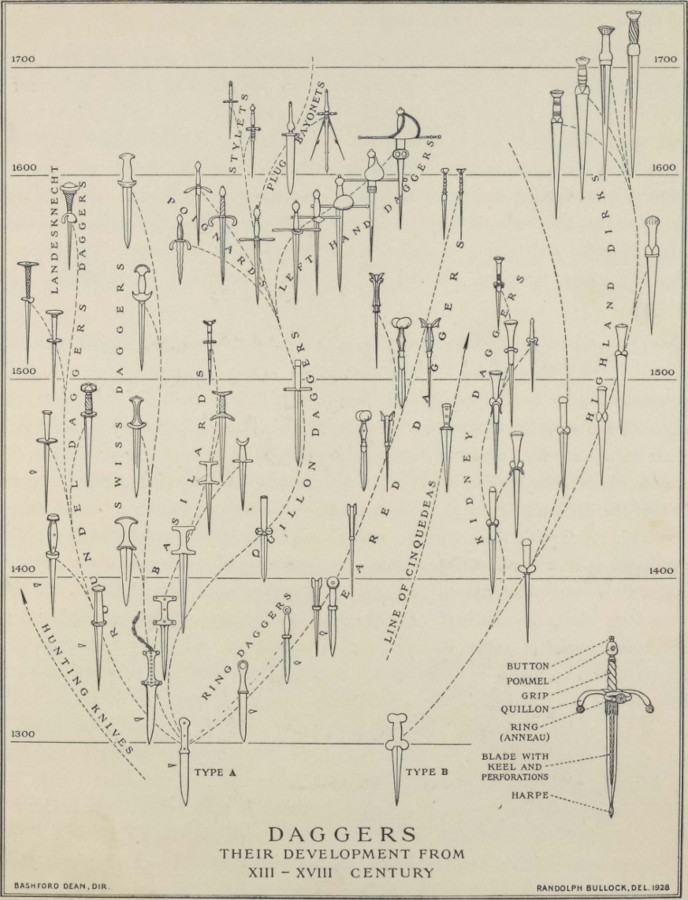
FIG. I
In the accompanying chart (fig. I) the changes are indicated which have taken
place in certain characteristic forms of daggers during six centuries, and a brief review of
this diagram may help to orient us in the arms described in the present catalogue. In
broad lines, our conception of the development of these forms is as follows.
In the thirteenth century the dagger had already assumed two characteristic forms.
The first (A), with wide blade and single cutting edge, was like a knife; its flattened tang
shaped as the handle, whose contours were rounded out by means of separate plates
riveted in place through the tang, very much as the hunting knife or pocket-knife of
today.
In this type of primitive dagger, the handle was ivory, bone, wood, horn, as
fashion or quality suggested. The second type (B) was provided with a double-edged
blade whose tang, shaped like a nail, formed the slender core of the handle, and was
held in place by a rivet head surmounting the pommel. Such a handle became more or
less spindle-shaped for convenience in usc and developed during the centuries great
diversity of form.
There can be no doubt that the two types A and B came from a common form in
earlier times, perhaps in the Hallstadt period. Certain it is that in the thirteenth century
daggers of both types, A and B, had already attained a high degree of specialization;
structurally they were even borrowing details one from the other. Thus the single
edged type sometimes, even frequently, " crossed over " and developed a double-edged
form.
The development ot type A may be traced in a series of early forms known as (I)
quillon daggers, these giving rise to (2) poignards and left-hand daggers, (3) stylets,
and (4) plug bayonets, as suggested in the chart; on the other side arose (5) basilards,
(6) roundel daggers, and (7) eared daggers.
The first line of development from the earliest type A was possibly the form noted
as quillon dagger, which suggests the sword of the period. This dagger underwent a
development in the form of the hilt which in many cases paralleled the hilt of the sword
with which this dagger was worn and used. In fact, during the fourteenth and fifteenth
centuries such a dagger became little less than a miniature sword. In the early sixteenth
century, when fencing underwent numerous innovations, the hilt of the dagger devel
oped pari passu: for one thing, in these newer schools of fence the buckler was more
often discarded and foining effected either by sword blade or dagger. The latter, in
acquiring special functions, changed notably both in blade and hilt throughout this
century.
The present chart shows several lines of development of quillon daggers beginning
with the simple form of the late fifteenth century. One of these lines leads directly to
poignards and the more specialized left-hand daggers, used widely in fencing during the
sixteenth and seventeenth centuries. Poignards are quillon daggers which from the early
sixteenth century were used more and more in the left hand as an aid to parrying. In
their northern forms they are apt to show down-turned quillons, which during the second
halt of the sixteenth century become successively shorter, wider, and more deeply
decurved. And with these changes serrated edges or wavy borders are sometimes
developed as an aid in catching a blade. In developing the main gauche the guard of
poignards developed successively an anneau, an anneau with short shell, and a handle
with large shell. In the next stage the large shell became greatly strengthened by
developing a point of contact with the base of the pommel, and finally there appeared a
complete shell triangular~ in outline (often ajoure), characteristic of Spain and southern
Italy during the first half of the seventeenth century. During this development the
quillons increased in length. Also the blade became notably specialized for seizing or
deflecting a sword blade. Thus, while the earlier blades were apt to be heavy and ribbed
or delicately perforated at various points as a device designed to render a blade less
brittle, later blades are known to develop serrations at some point of the border as a
means of gripping a sword blade. At the base of such a dagger blade one may find two
large perforations which, possibly through the adjustment of their outer borders, render
the blade less apt to break.
The dilating of the blade at this point was of further
service as a false guard, for here was formed a depression which fitted the ball of the
thumb.
INTRODUCTION
9
It is from the group of quillon daggers that stylets, used commonly during the
·seventeenth century, had their origin-delicate forms, often reduced in size, with short,
stout blades, and provided with very short hilts and quillons. Formidable weapons they
were in spite of their small size; their blade, triangular or quadrangular in section, served
as an excellent means of penetrating a ring of the chain mail defense worn at the armpit,
groin, or neck. And they could be drawn and delivered with great rapidity.
A final line of development of the quillon dagger is the plug bayonet, a specialized
arm which, as an accessory organ of the commonest firearm in military service, has
survived to the present day, outliving all other members of the ancient family of daggers.
The development of the basilard from the primitive dagger A is clearly followed.
In the fourteenth century, while single-edged blades are common, double-edged ones
appear; and the shape of the handle is already foreshadowed in the tang, which in guard
and pommel develops processes right and left on which, as well as on the grip, front and
back, plates of bone, horn, ivory, or wood may be riveted. In certain cases such a
dagger was attached to a chain made fast to a loop on the breastplate (" chain " dagger,
fig. 2), so that if dropped it could be retrieved quickly. In some daggers of this type the
lateral lobes of the hilt are notably exaggerated. In its various forms and in many
countries the basilard became the common dagger of the late fourteenth and the early
fifteenth century. Thus in England, as Laking records from a Sloane manuscript (2 59 3 ),
a satirical song of the reign of Henry V notes that:
" There is no man worth a leke,
Be he sturdy, be he meke,
But he bear a basilard. "
There can be no doubt that it was this form which gave rise to the dagger " in the
Swiss style " which was widely in evidence during the sixteenth century, when the
wealthy mercenaries of the Cantons patronized the best makers and best designers of
their day to produce their arms.
Holbein, for example, and Aldegrever designed Swiss
daggers of luxurious type, helping to give vogue to an arm which, with variations,
appears in princely portraits from England to Poland. Here the scabbard became encased
in metal which, treated ajoure, pictured personages, anitnals, arabesques ( cf. pp. 3 o-3 3 ).
An important group derived from our type A is represented by the roundel dagger
(dague a rouelle), which was in common use during the fifteenth century. The earlier
roundel daggers had grips sheathed on either side with plates, and with small roundels at
pommel and guard. About r 400 the roundel in the guard region was sometimes deep,
IO
EUROPEAN DAGGERS
shaped like a pill-box, a shape reproduced also in the pommel, although the latter might
be conical or spherical. By the middle of the fifteenth century the blade of the rouelle
dagger had become slender and had notably increased in length; its roundels had here
become thinner, larger in some cases-even three inches or more in diameter. Coinci
dent with these changes the grip became narrow, even tubular, in later specimens made
of metal.
In fact, in such cases the dagger is slender to an extraordinary degree, the
pommel alone developing a large disk-shaped roundel. On the other hand, in certain
South German daggers curious forms appear whose grip, while slender below, is in the
pommel region heavy, greatly dilated, and whose guard, no longer a roundel, breaks into
lobes which droop forward and enclose the base of the scabbard. Daggers of this type,
like certain kidney daggers, became specialized for penetrating chain mail.
Another line of descent from type A is seen in the eared dagger, or stradiote, which
arose in the fourteenth century, reached its apogee about I 500, and by I 5 50 well-nigh
disappeared, although a degenerate survivor occurred in Spain until, roundly, I 700.
The development of this dagger can probably be traced to a knife-like form in the
fourteenth century which bore a circular hole passing through the pommel from side to
side.
The eared dagger, we may note, developed a tang which was extraordinarily thick,
not wide; the whole grip, in fact, was developed not flattened in the plane of ·the blade, but
at right angles to it-the only variety of a dagger grip thus to be developed, in which the
plates of each side of the grip became narrow and high. Hindward, however, these
plates dilated and protruded beyond the pommel. And here it was that " ears " devel
oped.
In the early stage a deep slot had already appeared between the plates of the
pommel, a slot which served as a rest for finger or thumb. In later stages
the slot widened, and with this change the sheathing of the grip flared out as
" ears. "
These ears were next strengthened by a stouter rivet which fastened them to
the tang, or, structurally, to a metal washer, which (in daggers generally) frequently
intervened between the tang and the plates of the grip. This greater rivet soon became
a central ornament. In fact, in a late stage of development, the plate sheathing of the
ear (e. g., of ivory) may disappear entirely, and the great rivet head, having lost its
function, may become modified into an eminence of purely decorative value (e. g., a head
of carved ivory). In decadent stages of development, say during the latter part of the
sixteenth century, the ears became of extraordinary size, diverging one from another at
an angle of nearly I 8o0 •
A final stage of the degeneration of this line appears in the
dwarfed forms of Plate XXV, in which the entire handle including the ears is forged
from the steel of the tang.
INTRODUCTION
I I
We should further note that this curious dagger reduces its guard progressively:
this in earliest forms was a small roundel, then it became spool-shaped, then narrower
and narrower until in its latest forms it well-nigh disappears. The blade in eared daggers
undergoes noteworthy changes during three centuries: the earliest is knite-like, type A; then
the region of the point becomes sharp on either side; and shortly by the extension of this
sharp point the blade becomes double-edged, type B.
In broad lines it is reasonably clear that the dagger of type B was the progenitor of
the " kidney " daggers on the one hand, and of the Scottish dirks on the other, for if we
examine the forms of daggers shown in dated tomb figures and pictures generally,
especially manuscripts, vve are able to arrange in a row, from ancient to modern, the
forms shown in the present chart. The typical kidney dagger of the early fourteenth
century developed a dilated pommel, a spool-shaped grip, and at the guard kidney-shaped
lobes, these strengthened belovv by a metal washer the shape of which, conforming to
the mouth of the dagger sheath, was usually crescentic. From such a type the line of
northern daggers may have originated, typified today by the Scottish dirk, a form which
is
thus extremely conservative-as in similar manner are the daggers of Scandinavia.
Comparing next the early kidney dagger with the dirks, one finds but a series of minor
changes during the fourteenth, fifteenth, and sixteenth centuries. The blade becomes
longer, usually single-edged, although retaining the tapering shape of the double-edged
form. The lateral kidney-shaped eminences of the hilt are reduced in size or flattened,
merging into a wide chape-like socket for the blade. The grip, spindle-shaped, suggests
remarkable parallelism to grips of certain Hallstadt knives and swords, a resemblance
all the more striking by reason of a strap-shaped ornament in parallel lines.
The kidney dagger, in general, undergoes the development indicated in the chart.
About 1400 the kidney eminences were apt to enlarge in a transverse direction, and the
iron ferrule at the base of the blade to decrease in size. On the other hand, in many of
the kidney daggers of the fifteenth century the ferrule increases in size as the bulbous
eminences dwindle away. In this way the metal ferrule becomes the more important
element of the guard, its crescentic points now drooping over the edge ot the scabbard,
strengthening the mouth of the latter and becoming even an ornamental organ: here
they may develop terminals shaped like head of bird or beast. In later stages, about I soo,
the ferrule sometimes becomes the entire guard, the bulbous eminences persisting only as
lobate ornaments. In the course of this evolution the grip becomes conical, dilating at
the pommel, where, truncated, it is covered and strengthened by a disk-shaped washer of
metal, which sometimes, for greater security, may overlap the wooden handle in lobes or
12 EUROPEAN DAGGERS
points. During the sixteenth century this form of dagger dies out in a variety of
eccentric forms 1-in some cases the ornaments retained near the guard hardly even
suggesting the earlier kidney-shaped eminences.
1 Only in conservative England, apparently, does this type of dagger survive, and in a fairly primitive form, into the seventeenth century. Cf. e. g., the note by Charles ffoulkes on English kidney daggers dated 1616 and 1620 (The Antiquaries Journal, vol. VII, pp. 2, 139-140).
In these late forms the grip also degen
erates; it may become a mere tubular, slender sheath for the shank of the blade.
As a final line of development from type B in our series we may now consider the
group of broad-bladed daggers-and swords-known generally as anelaces, ox-tongues,
or cinquedeas (cinque dita-five-finger width).
A review of the material dealing with the early cinquedea convinces the writer
that we are in this form dealing with several lines of development (see fig. 3 8), each
culminating in a broad-bladed dagger, usually of considerable size and generally with
heavy hilt. In this region it is often subject to enrichment to such a degree that one is
apt to infer that the greater width of this type of dagger and of its handle was developed
partly as a medium for the display of rich ornamentation, recalling always that the
highest development of this arm was early in the fifteen hundreds when, under the
fostering care of the lords of North Italian cities, luxury in arms reached a height
probably unsurpassed.
There are three types of cinquedeas well known in collections, all having blades
approximately of the same proportions and length, usually furnished with parallel grooves
arranged in three transverse series-one groove near the point of the blade, two grooves
in the middle, and three at the base. In the form which we distinguish as Milanese the
hilt was that of the sword of the period, with great wheel-shaped pommel, short quillons
slightly decurved, flattened, dilated terminally in the plane of the blade; the grip is
fusiform, as in many swords, and usually developed so as to correspond with pommel
and guard.
The second type, which we term Veronese, is furnished with short quillons, with
a grip like a knife, flattened, tapering toward the guard and encased in two plates (e. g.,
of bone, wood, ivory, or horn), which may be fastened to the tang either by plain rivets,
or by metal tubes filled in with rosettes ajoure. The handle in the pommel region is
constricted in such a way as to form on either side notches for bracing the fingers. The
pommel in most cases is not pointed, and is not of great size, enabling the user to grasp
it securely.
The third type in this series, Venetian, is similar to the last, but bears a pommel of
exaggerated size enclosed in a heavy crescentic chape. In this form the quillons are
longer, the grip region narrower, and the rosaces of greater size.
A fourth type, which is especially rare, distinguished provisionally as Ferrarese,
differs from the Venetian only in having the handle (grip and pommel) encased in metal
and somewhat different in form: thus the section of the grip is roughly hexagonal or
octagonal, and the quillons at their tip are slender, drooping downward, crescentic. In
this type the pommel may be shaped as a medallion.
From the foregoing it will be seen that in the Veronese and Venetian forms we are
dealing with a plate-enclosed hilt, and that in the Milanese type we find a spindle-shaped
grip and distinctly sword-like pommel; while in the type of Ferrara we have a combination of both.
There can be little doubt that the Venetian form is highly specialized; that
the Ferrarese is closely related to the Venetian, but borrowing certain characters from
Milan.
The Veronese form was probably developed from the knives of northern Italy
of the first half of the fifteenth century, in which a similar pommel is observed, with an
occasional ajoure ornamental fastener and with a slight quillon apparent on the side of
the cutting edge. It does not, unhappily, aid a clearer understanding of the origin of
these forms when we admit that the only knives known to us of this type have but a
single cutting edge. Is it possible that such a knife may be a doubled form, right and
left?
In this connection we recall that doubled arms were well known at this period,
notably halberds where blade or beak is repeated on right and left sides-but this is an
hypothesis which may be disputed.
There is, finally, a form suggesting the cinquedea type which is sometimes described
as a " fish-tail ,, dagger (1 5 IO-I 540).
This hilt shows quillons and pommel not unlike
those of certain cinquedeas, and the blade is wide, divided into transverse areas, again in
the cinquedea manner. This rare form is probably to be interpreted as a quillon dagger
simulating a state sword of the period.
EXPLANATORY NOTE
Arrangement: ror conventence in cbronological treatment the daggers
bavc been grouped by types, ~uitboul strict reference to their early relationships.
Dimensions and weights: The length (over all) is given in ce11tinuters,
the tueigbt in granznzes (abbreviated as L. and Wt.); 11umerals in parentbesis
denote tbat scabbard of object is included.
The Afusezun inventory nu1nber
is indicated at the left.
SCRAMASAXES
The following specimens illustrate the early dagger, knife, or sword of the Germanic (" Frankish") invaders and settlers of central and western Europe. These arms vary little in shape but considerably in length (blades from four to twenty inches). It is not known for how long a time their various types persisted. They appear about the fourth century and continue, in form if not in name, to the eleventh century. A-D. SCRAMASAXES Frankish, VI-IX Century Four specimens, lacking hilts but preserving scabbards with their metal mounts. Hilts evidently wooden, for remains of them appear in semi-fossil condition. Scabbards, rusted to blade, show the broad form of the scramasax, and the seam of the scabbard covering the cutting edge of blade; this seam is in two instances (C, D) held together by bronze rivets forming a close-set row from hilt to point; here between small rivets appear single large rivets reinforcing the scabbard and producing a decorative effect. In one instance a sheath has parallel sides from hilt to near point; here an abrupt indentation, or shoulder, occurs, after which the line of rivets follows closely the apex of the blade. No chapes or ferrules are retained save in specimen A. In this instance the rim of the scabbard is reinforced by a narrow band of bronze; this extends further on the side of edge of blade, suggest ing condition in C and D - here the side of the scabbard seam was probably closed with rivets of iron which are rusted away: of iron also were probably the mountings of the mouth and tip of the scabbard. The knife B may well be the prototype of the Scottish garter-knife. This small knife retains four ornamental fasteners in bronze decorated with lines and punched circles, these fasteners corresponding obviously to the larger rivets of sheaths C and D. In general, the earliest sheaths were sewed; in a following stage sewing was reinforced by several large rivets. In a third stage sewing was replaced by small rivets, the few larger rivets remaining as reinforcing and ornamental "organs," the latter decreasing in number in course of time. In a late stage of development marginal rivets set closely together would naturally give place to a metal band, and finally to a creased band, as in fact we find it in the long apical chape of A. 17 .193·353-355,357 L. (blade, and over all) A) 35 .s (52) B) 19 C) 47 (63) D) 43 (27) (61) 18 EUROPEAN DAGGERS II. ~. c. Bibliography: Max Dreger, Das sogenannte Jagdmesser Karls des Grossen zu Aachen (Zeitsch. hist. Waffenkunde, 1924, n.s. I, no. 4, pp. 81-88. 6 figs. Bibliography). A. von Essenwein, Der Uebergang vmn Scramasax zum Dolche des I4. Jahrhunderls, in Mitt. a. d. Germanischen Museum, 1886, I, pp. I 17-120. Seymour de Ricci, Catalogue of a collection of Gennanic antiquities belonging to J. Pierpont 1\tJor gan. Paris, 1910, pl. XXX. Provenance: From burials in northern France. Stanislas Baron Collection. Gift of j. Pierpont Morgan, Sr., 1917 SCRAMASAXES E. SMALL SCRAMASAX German, IX Century (?) Hilt sheathed on each side with a bone plaque ornamented with sets of transverse lines and rows of circles. Blade single-edged, slightly deflected below the axis of the hilt. L. 133 r.s6 L. 34 Bibliography: B. Dean, Catalogue of a Loan Exhibition of Arms and Armor, 191 I, no. 142, pl. LXI. Provenance: Dug up in Bamberg. Lent by Bashford Dean BASILARDS AND SWISS DAGGERS BASILARDS Basilards 1 and their derivatives, Swiss daggers ( cf. p. 9 ), are well represented in the present collection. They date from the fourteenth to the sixteenth century. Numer ous divergent forms occur in German documents, notably in the Triumph of Maxi milian) IS I 7. The longer basilard, which in Switzerland attained a length of thirty inches, became a veritable sword. This arm was used in a downward blow. The grip was so seized by the hand that the little finger lay nearest the guard, and the thrust proceeded at right angles to the forearm. The scabbard of a basilard of the better type· was apt to be divided into transverse zones encased in bands or ferrules of metal richly ornamented, a condition which is developed to such a degree in the sheath of the Swiss dagger that it becomes, by the encroaching size of these metal bands, a quasi-metallic sheath. See also Landsknecht daggers (fig. 44). The earlier basilard was worn either thrust through the belt (fig. 3 ), or fastened to the belt (fig. 4) or guige by simple loops (fig. 5), or hanger (fig. 6). In other cases it ' Numerous references to the basilard, characteristic dagger during the fourteenth century, and fashionable (could not be worn by servants or laborers in England), indicate that it was the type figured by Laking (European Armour, vol. III, p. 9), whose ,identification is here followed- rather to fill a technical need for naming a definite kind of dagger than finally to solve the problem of the basilard. In point of fact, in our oldest reference to this dagger, Du Cange (1678) describes it as a short sword, genus pugionis vil sicae, called in France a bazelaire, but now a coutelas. Should this author be followed we may be sure that the bazelaire was the badelaire (Gay, Glossaire Archeologique) - a short sword with a bolo-shaped blade, or a wide cutlass, with disk-pommel and cross-guard. However, it is known (1) that the basilard was then the dagger universally carried; (z) that the dagger which is most often pictured (monuments, illuminated manuscripts, paintings) agrees with the type identified by Laking, which also is a type not uncommon in dug-up specimens; (3) that, on the other hand, the chopping bolo-like arm ( badelaire) appears rarely in contemporary documents or in actual specimens; (4) that contemporary nomenclature is notoriously hazy: hence we accept Laking's findings. EUROPEAN DAGGERS FIG. 3 FIG. 6 FIG. 2 FIG. 5 BASI LARDS FIG. 4 FIG. 7 Fig. 2. Wooden statuette, XIV century, from St. Lorenz Church, Vienna. Dean Collection. Fig. 3· From Crucifixion, by Giovanni da Milano, c. 1360. New York Historical Society. Fig. 4. Brass of a Franklin, c. 1370. Shottesbrooke Church, Berks (Laking, III, fig. 745). Fig. s. Brass of john Corp, 1391. Stoke Fleming Church, Devonshire (Laking, III, fig. 744). Figs. 6-7. From painting by Giovanni dal Ponte. Yale University Museum. BASI LARDS 2 5 became the " chain " dagger (fig. 2) from whose pommel extended a slender chain attaching it to the breastplate; if dropped the dagger could thus be at once recovered. Later basilards, notably German, were attached to the girdle by an ornamental leather hanger of great breadth, and sometimes richly decorated. This hanger (some times comprising purse as vvell, fig. 7) could be slipped along the belt on strap loops. The Swiss dagger, vvhich appears in numberless stained glass panels, engrav ings by Aldegrever, and portraits of the period, is sometimes shown (curiously FIG. 8 METAL CARRIER ON SCABBARD OF SWISS DAGGER enough) close to the sword on the left-hand side of the wearer, its metal carrier attached to the scabbard at the FIG. 9· DAGGER OF SWISS TYPE, I 537 FROM PORTRAIT OF HENRY THE PIOUS appropriate point enabling the dagger tO be balanced at • OF SAXONY, BY LUCAS CRANACH THE an angle of about 4 5° from the belt (fig. 8). A dagger of ELDER, DRESDEN GALLERY similar type (Saxon) is shown hanging from the belt attached by an ornamental chain (fig. 9); or then again suspension occurs by means ot a cord with heavy tassel, as may be noted in portraits by Holbein the Younger. EUROPEAN DAGGERS I. BASILARD Hispano-Arab, XIV-XV Century Grip with two plates of bone riveted to tang; the latter terminates in antenniform prong. Each plate of grip incised on one border with double lines forming stagger pattern, on the other border an incised cross-hatched pattern; central band with punched ornament of small dotted circles. Blade, double-edged, of flattened diamond section, bears armorer's mark (Arabic characters) stamped on flat ricasso. 26.145.2 L. 33·5 Wt. 213 Provenance: Spain. Plate I Reubell Benefaction 2. BASILARD North French (?), XIV Century Pommel and guard of two straight transverse plaques of bone, held together by hollow bronze rivets; at summit of pommel a rosette-shaped washer. Grip of three faceted pieces of bone hollowed to fit over tang. Pommel, grip, and guard, separated from one another by thin plates of tin (lead ?), have rich brown patine with rows of small circles with dotted centers. Blade tapering, of flattened diamond section. 26.145·3 L. 38.5 Wt. 277 Documents : Giovanni da Milano's Crucifixion (about 1360) in The New York Historical Society. Illuminated miniature (Tuscan) dating about I 335-40 (British Museum, Royal Mss., E IX, fol. 21; Laking, A Record of European Armour and Arms, 1920, II, fig. 414). Provenance: Bach Collection. Plate I Reubell Benefaction 3. BASI LARD Italian, XIV Century Pommel antenniform with molded terminals. Guard straight, delicate, molded. Grip of two faceted plates of copper (?) expanding towards mid-region and here held together by band; ornamented with herring-bone punching. Blade double-edged, of diamond section, double-grooved on either side in basal region. 26.145.4 L. 38.5 Wt. 270 Note: This type of pommel probably arose from crescentic pommels in the thirteenth century (cf. Cockerell, A Book of Old Testament Illustrations); also bas-relief on sarcophagus of Aimery di Narbona (1289), Annunziata Convent, Florence (Lensi, Jl Museo Bardini, in Dedalo, 1924-25, IV, pp. 486-srr; VI, pp. 164-183) Plate I Reubell Benefaction BASI LARDS 4· DAGGER Hispano-Arab, Not Later than XIV Century Hilt of brass. Pommel decorated with incised lines in groups of two dividing the surface into lozenge-shaped and pentagonal areas. Grip with eight vertical grooves decorated with incised lines. Guard an oval lobe bisected by blade and fitting over ricasso; decorated in sectors outlined by vertical punched lines in groups of two. Blade double-edged for half its length, the top edge flattening towards the hilt. 26.r45 .r L. 39·5 Wt. 298.5 Comparisons: A dagger with similar hilt, but with crescent-shaped pommel, formerly in the Ressman Collection (Laking, III, p. 7, fig. 737). Similar daggers (or swords) in Museum of St. Irene, Constantinople. Provenance: Found in the bed of a river in southern France (Pyrenees). Plate XIV 5. BASI LARD Reu bell Benefaction French, r 300 Forged in a single piece, its tang pierced for rivets which attached plates of grip. Blade with two "blood grooves" on each side. 25.r88.r5 L. 34 Wt. 222 Comparisons: Similar specimens recorded in: Stibbert Collection, Florence (Lensi, ll Museo Stibbert, nos. 3853-3854, pl. CLXXV); Berlin Zeughaus (05.177, 178; 12.3); Hessisches Landesmuseum, Darmstadt, found among the ruins of the Castle of Tannen berg razed in r 399 (J. v. Hefner Alteneck, Die Burg Tannenberg und ihre Ausgrabungen, 1850); National Museum, Munich (two); not to mention private collections, e. g., Boissonnas (Catalogue, no. r 56, pl. XXXII); Gimbel (Sale Catalogue, nos. 507-510, pl. XIII); Max Kuppelmayr (Sale Catalogue, no. 310, pl. XXV); Whawell ( Hervorragende Kriegs- und Jagdwaflen ...... aus englischem Besitz, Helbing, No. 10, 1908, nos. 47, 122, figs.- dagger and sword); Graf Wilczek (J. Szendrei, Ungarische kriegsge schichtliche Denkmaler in der Milleniums-Landes-Ausstellung. Budapest, 1896, p. 190, no. 344, fig.); Windisch-Graetz (Dorotheum, 1919, no. r 37, fig. pl. 4). A sword with similar pommel in The Metropolitan Museum of Art. See also Laking (III, p. ro). Documents: Contemporary documents are numerous showing that this type of dagger was worn attached by chain, e. g., fourteenth-century woodcarving of St. George (fig. 2) in the Bashford Dean Collection (Metropolitan Museum of Art); the famous Manesse manuscript (F. H. von der Hagen, Geschichte der M anesse'schen H andschrijt, pl. 4); effigy of Albrecht von Hohenlohe (t 1328) in Schonthal; statue of Can Grande della Scala (t 1329) at Verona; effigy of Walter Bopfinger (t 1359) (Gessler, Die Spangenharnische von Kitssnach in Anzeiger Schweiz Altertumskunde, 1926, n. s. XXVIII, pp. 27-39,98-102, fig. 2); effigies of the Counts ofNeuchatel (Swiss, mid-fourteenth century) in the Collegiate Church of Neuchatel (J acquemin, I cono graphie, pl. 47); grave slab of Gunther von Schwarzburg (Dean, Catalogue, 1905, fig. 12-armor of transitional period). Provenance: Excavated on Montmartre, Paris. Keasbey Collection (American Art Association, 1925, no. 196, pl. XX). Plate I I Gift of George D. Pratt, 1925 EUROPEAN DAGGERS 6. DAGGER Similar to foregoing. Hilt restored in plaster. Blade with crisp median ridge between the short blood grooves. L. I 33 !.60 Note: No complete dagger of this type appears to have been preserved. Plate II 7. DAGGER HILT OF BASI LARD TYPE German, XIV Century L. 32 Lent by Bashford Dean Venetian, r 300 Hilt of elephant ivory, massive, elliptical 1n section, elaborately sculptured a four. Grip pictures combat of dragons in the manner of thirteenth-century illuminations; pommel, bordered with Byzantine ornament, bears lion of St. Mark. L. I33I.6I L. 39 Wt. 341 Bibliography: Dean, Catalogue of a Loan Exhibition, 191 r, no. 143, pl. XLI. Laking, III, p. 13, fig. 755· Provenance: The hilt was purchased about 1895 of Michel (Paris), who discovered it in a small collection of ancient ivories dispersed in the Hotel des Ventes; the early owner bought it about 1820 in northern Italy. Bossard, goldsmith-antiquary of Lucerne, was commissioned by the writer to put a frankly modern blade in the handle; at this time, apparently, a cast of the grip was made, and a copy executed in boxwood, which, admirably patine, Bossard sold to a well-known Swiss amateur, from whom it passed into a local museum. There, until at least a few years ago, it was labeled "thirteenth century"! Plate III Lent by Bashford Dean 8. DAGGER OF BASILARD TYPE Belgian, 1400 Hilt of boxwood (?),semi-fossilized, sculptured with lozenge-shaped eminences, each of which is strengthened by a peg. Pommel and guard antenniform, turned in opposite direc tions, tipped with latten caps ornamented with file lines. Blade of "watered" pattern, with median ridge, flattened in ricasso; armorer's mark. L. 1331.63 L. 41.5 Wt. 276 Note: This dagger retains clearly the basilard type, yet technically it belongs with quillon daggers, for the tang is slender and pierces the elements of the hilt. Documents: A similar dagger appears in the Crucifixion by the Bohemian Master (the Master of Hohenfurth), c. 1360, in the Kaiser Friedrich Museum, Berlin (No. 1833). Bibliography: Dean, Catalogue of a Loan Exhibition, 191 r, no. 145, pl. XLI. Giraud, La Collection Spitzer, 1892, VI, p. 41, no. 174, fig. Spitzer Sale, 1895, no. 275, fig. Cripps-Day, Armour Sales, p. 81, fig. 48. Provenance: From peat find at Saint-Omer. Bachereau and Spitzer Collections . .# '~ Lent by Bashford Dean Plate I I 1 BASI LARDS 9· DAGGER OF LATEST BASILARD TYPE Italian, I 540 Of highest quality both in design and execution. Pommel, guard, and grip of single piece. Hilt of boxwood through which slender tang is passed. Hilt delightfully enriched with carving in Renaissance design: on pommel appears reclining female figure; on one side of grip David stands on a lion's head and holds the head of Goliath; on the reverse is shown Lucretia; other motifs include heads of amorini and of rams, the latter used ingeniously as q uillons. Blade diamond in section, flattened at ricasso; basal half delicately etched and gilded with birds, squirrels, lion's head, human head, helmet, shield, and arabesques. 04.3.I4I Bibliography: De Cosson, Dino Catalogue, G. 16, pls. 16 and I 7. Dean, Catalogue, 1905, p. 169, fig. 86 0. Provenance: Carrand and de Dino Collections. Plate I I I 10. BASILARD Pommel and guard of gilt-bronze with lateral shell shaped prongs (those of pommel suggesting eared daggers), chiseled with quatrefoils on inner faces and cannelated on outer faces. Grip cylindrical, encased in silver nielloed with a design of arabesques in Venetian style, encircled by grooved rings at apex, center and base. Blade engraved and gilded, diamond in section adjacent to ricasso, then square, finally diamond. 04·3·133 L. 28 Wt. I78·5 Bibliography: De Cosson, Dino Catalogue, G. 13, pl. 17. Dean, Catalogue, 1905, p. 168, fig. 86 H. Laking, III, p. 8, fig. 739· Provenance: Ressman and de Dino Collections. Plate XXIII Rogers Fund, I904 L. 32 Wt. I44·5 Rogers Fund, I 904 Venetian (?), ISSO 30 I EUROPEAN DAGGERS I. DAGGER OF BASI LARD TYPE Swiss, XIV Century Grip of ivy root, rounded and faceted, the top and base of which follow the contour of pommel and guard, which are shod with iron, keel-shaped, the pommel lobes bending downward, the quillon lobes bending upward. Blade bears an armorer's mark retaining part of the original copper inlay. 26.I45.46 L. 47 Wt. 3 I 8 Comparisons: Typical of Swiss lake and moor finds, shown in numerous contemporary documents, and represented in Swiss museums, e. g., Bern (R. Wegeli, Die Schweizerdegen, in Jahresbericht des Historischen M useums in Bern 1910, pp. 3-20, 3 pis. 4 figs. Armorers' marks), Geneva (no. 1591), and Landesmuseum in Zurich (Gessler, Fuhrer, 1928, pl. IX). A similar specimen, but in poor condition, in the Boissonnas Collection (jean Boissonnas, Collection Charles Bois sonnas. Armes anciennes de la Suisse, n. d., no. 143, pl. XXXII). It is this type which gave origin to the decorative Landsknecht dagger of the sixteenth century. Larger specimens are veritable swords; note the excellent example in the Bossard Collection, and one in the Dean Collection. Documents: Illuminated manuscripts of the early fourteenth century (G. lrmer, Die Romfahrt Kaiser Heinrich's VII, im Bildercyclus des Codex Balduini Trevirensis, 1881, pl. 10). Diebold Schilling's "Private" Bernerchronik, 1480-84 ( Anzeiger f. Schweizerische Altertumskunde, 1925, n. s. XXVII, pp. 229-234). Shown worn in front in Maximilian's Freydal, ISI2-ISI9 (Quirin von Leitner, Freydal, pl. 128). Bibliography: Walter Blum, Der Schweizerdegen ( Anzeiger f. Schweizerische Altertumskunde, 1919-20, n. s. XXI, pp. 34-42, 109-118, I67-18o, 210-219. ill.). Fretz, Schriftliche Erwahnungen des Schweizerdegens im IS. Jahrhundert (ibid., 1922, n. s. XXIV, p. I 89). Plate IV 12. DAGGER WITH SHEATH Reubell Benefaction Swiss, Dated I 567 Typical dagger of Swiss officer of high rank, shown at the side of armored standard bearers in contemporary heraldic painted glass of all Cantons. In these daggers the richly ornamented sheath usually illustrates a patriotic theme. Pommel and guard of elongated form, of bronze gilt, decorated with incised lines; pommel capped with a foliate washer and a button. Grip fusiform, faceted, of exotic wood (grenadilla ?) . Blade double-edged, leaf-shaped, with median groove on each side, bears armorer's mark inlaid in brass; ricasso with triple groove on each side. Sheath-mounting case in gilt-bronze, pierced with battle scene showing warriors in clas sical armor; on outer side of sheath are two compartments, one for knife, the other for pricker; base of sheath terminates in molded bosses; two bands at the back for suspension, on one of which appears the date I 567; inner scabbard of wood covered with red velvet. 26.I45.47 L. 40 (43.5) Wt. 378 (807.5) Comparisons: Daggers of this type and quality may be seen in: BASLE, Historical Museum, two specimens including a Dance of Death. BERN, Historical Museum, scabbard chiseled with BASI LARDS 3 I grotesque figures and two Swiss crosses (R. Wegeli, Jahrbuch des Bernischen Historischen Museums in Bern, I922, p. 98, pl.). GENEVA, ten specimens of this type, four with scabbards, in the Galopin Collection, Musee d'Art et d'Histoire (Notes sur la collection d'armes anciennes du Major Henry Galopin ..... , I9I3, pl. I4). LUCERNE, story of Virginius, Bossard Collection (Sale Catalogue, I9IO, no. I947, pl. XXXVI). ZuRICH, Landesmuseum, no less than fifteen specimens (Gessler, Fiihrer, 1928, pl. X) illustrating typical subjects including The Judgment of Paris (Haenel, Alte Waft en, fig. 2 r). Another with scenes from the life of Samson in Angst Collection (Sale Catalogue, I909, no. 381, fig.). BERLIN, Zeughaus, subject of Virginius and Virginia. A third specimen with this subject (genuine ?) in Dreger Collection (W aflensammlung Dreger, no. I r). LONDON, Wallace Collection, five specimens, mcluding two of the Virginia legend, and scenes from the Prodigal Son (Skelton, 111eyrick Collection, II, pl. CXI fig. 3 ; Camp, Catalogue, no. I49). PARIS, Louvre, Tell legend; Musee de l'Armee, four specimens, including Tell legend, hunting scene, and Dance of Death (Catalogue, I927, II, pl. XXIX). VIENNA, Kunsthistorische Staatssammlungen, Dance of Death. In private collections appeared other themes: Battle scene, collection of Graf L. Th ..... (Heberle, I893, no. 582, fig.). Story of the daughter of jephthas, two specimens, Thewalt Collection, Cologne (Lempertz, I903, nos. I634, I634 A., fig. pl. XXV). Story of Pyramus and Thisbe, Thewalt Collection (no. r 63 5, fig.), now Dreger Collection, Berlin (W af!ensammlung Dreger, no. I 2 ); another in the Spitzer Collection (Giraud, Collection Spitzer, VI, no. 2I3, pl. XXXVII). Documents: Designs for daggers of this type exist by Heinrich Aldegrever dated I 536, I 537 and I 539 (Formenschatz, r88o, nos. II3 and II4); by Albrecht Durer (Formenschatz, r882, no. 33); by Hans Holbein (Ed. His, Dessins d'ornements de Hans Holbein, I886, pl. Also Holbein and Hollar, Le livre d'orjevrerie de Hans Holbein, grave par W. Hollar, I642-47. Sword hilts and daggers, 4 pis.). Swiss and kindred German daggers appear in woodcut by Hans Rudolph Manuel (called Deutsch), dated I547 (J. E. Wessely, Die Landsknechte: eine culturhistorische Studie, I877, pl. 3). Other documents are the younger Holbein's Two Ambassadors, National Gallery, London, and his Portrait of the Sieur de Morette, Dresden Gallery (dagger suspended from waist by cord with tassel); Lucas Cranach the Elder's Portrait of Henry the Pious of Saxony, dated r 537, also in the Dresden Gallery (dagger suspended by a chain; cf. fig. 9); Count Gottfried Werner as Donor, by the Master of Messkirch, about I 536; engravings by Aldegrever, I 538, especially the Wiirtemberg Wedding, in The Metropolitan Museum of Art. Bibliography: Laking, European Armour, III, pp. 57-59· Plate V 13. DAGGER WITH SHEATH Reubell Benefaction Swiss, r sso Similar to foregoing. Pommel and quillons of steel gilt. Blade bears on one face two armorer's marks (hearts) inlaid in brass. Sheath pictures Holbein's Dance of Death; covering of wooden sheath black velvet, the nap of which has largely disappeared. L. 2743.16 L. 36.5 (39) Wt. 309 (582) 32 14. DAGGER WITH SHEATH EUROPEAN DAGGERS Comparisons: A number of scabbards exist with similar theme: in Florence in the Collections Stibbert (Lensi, no. 254I, pl. XLVI) and Ressman (dated 1570), in the Historical Museum, Basle, the Germanic Museum, Nuremberg, the Kunsthistorische Sammlungen, Vienna, the Wallace Collec tion, London (Camp, Catalogue, no. I63), and the Musee de l'Armee, Paris (Catalogue, II, pl. XXIX); not to speak of various private collections dispersed at auction, e. g., Zschille (R. Forrer, Die Waffensammlung Zschille, pl. I 5 I, no. 430), which object then passed into the Gimbel Collection (Sale Catalogue, no. 525, pl. XIV) and later into the Max Dreger Collec tion (Waffensammlung Dreger, no. Io); Keasbey (American Art Association, 1924, no. I96, pl.); Whawell (Sotheby's, I927, no. 5 I, fig.). Also excellent forgeries emanating from the atelier of a jeweler-antiquary of Lucerne. Plate VI Lent by Bashford Dean Swiss, I 560 Similar to foregoing. Pommel and quillons of steel gilt. Blade bears on one face armorer's mark (wheel). Scabbard on solid field embossed in high relief with stag hunt; back of scabbard covered with black velvet, the nap of which has disappeared. L. 2743.17 Provenance: Collection of Sir Guy Seabright. Plate VI 15. DAGGER WITH SHEATH L. 38 (4r) Wt. 325 (566) Lent by Bashford Dean Swiss, I 570 Mountings of gilt-bronze. Grip of mahogany (?). Blade with deep median channel running from base about three-quarters of its length; on one side armorer's mark (letter R). The same armorer's mark appears in dagger No. I 2. Scabbard covered with black velvet, enclosed in bronze-gilt case picturing legend of William Tell, illustrating costumes in detail. Special compartments in scabbard for pricker and knife (bearing armorer's mark). 04.3 .I 30-I 32 L. 40 (45) Wt. 494 (923) Comparisons: Scabbards of similar theme in the Historical Museum at Basle, in the Berlin Zeughaus (dated I564), at Erbach (H. Muller-Hickler, Die Waffensammlungen in Erbach i. 0., I923, no. 340, pl. XXXVI), Wallace Collection, London (Camp, Catalogue, no. I 52), and in the Louvre and the Musee de l'Armee, Paris (Catalogue, II, pl. XXIX); not to mention various private collections dispersed at auction, e. g., that of K. Thewalt, Cologne (Lempertz,I903, no. 1633, fig. pl. 2 5), which object passed into the J. Bossard Collection, Lucerne (Sale Catalogue, 1910, no. I946, pl. XXXVI); Engel-Gros, dated 1582 (Paris, Petit, I92I, no. 206, fig.); and two specimens, one dated 1585, in the Zschille Collection (R. Forrer, Die Waffensammlung Zschille, pl. I 51, nos. 43 1-432). Also Prince Soltykoff Collection (Asselineau, Armes et armures ..... I845, pl. I45), and the Ressman Collection (1. B. Supino, La Collezione Ressmann, I902, no. 140, III). Numerous forgeries of excellent workmanship were made in the atelier of a jeweler-antiquary of Lucerne. BASILARDS Bibliography: Giraud, Collection Spitzer, VI, no. 219, pl. XXXVII. Spitzer Sale, 1895, no. 282, ill. De Cosson, Dina Catalogue, G. 28, pl. 17. Dean, Catalogue, 1905, p. 170, fig. 86 S. Cripps-Day, Armour Sales, p. 83, fig. 49· F. Heinemann, Tell-lconographie. Luzern, 1902. Provenance: Carrand, Spitzer, Ressman, and de Dino Collections. Plate VII r6. DAGGER WITH SHEATH 33 Rogers Fund, I 904 Swiss, I 570 Similar to foregoing, but even richer in quality and more elaborately decorated: pommel and guard bear finely incised designs. Blade, with point reinforced, bears armorer's mark (cross). Scabbard pictures confederates expelling Austrians, the latter in costumes suggesting the Roman empire. Enclosed wooden sheath covered with black leather as background for sculptured area. 14.25.I287 Provenance: Soltykoff Collection. Plate VI I L. 38.5 (42) Wt. 35I (683) Riggs Benefaction • ROUNDEL DAGGERS ROUNDEL DAGGERS Rouelle or roundel daggers (pp. 9-Io) appear in contemporary documents earlier than I 3 50. Their frequent use, hovvever, does not date earlier than I 3 7 5 when the guard, while disk-shaped, is narrow and heavy: in some cases it was formed of a small, heavy disk of \Vood often enclosed in metal (fig. IO and pl. XI). In general a guard of this shape was evidently of value, since the dagger became functional at the first grip of the hand, i. e., the dagger did not have to be rotated (around its axis) into a position for use. In earlier roundel daggers only the guard was discoidal; the pommel might be of reduced size (fig. I I) or similar in shape to the pommel of a sword (figs. I2-I 3). About I400, however, the pommel of the dagger began to assume· a disk-shaped form (fig. I 4), and from this time until well into the sixteenth century roundels terminated the grip both on the side of pommel and of blade (figs. I 5-I 7 ). These forms occur vvidely scattered from Scandinavia to Spain, FIG. 10 ROUNDEL DAGGER 1475 LIFE OF ST. BERNARDINO BY FIORENZO DI LORENZO PERUGIA and it is extremely difficult to distinguish the place of origin of such specimens unless they are ornamented, the ornament often betraying place of origin. In general, small roundels occur in the north; large roundels are usually of later date (1450 onward) and occur from the Rhine eastward (fig. I 4). I -- ...... /" '.; FIG. I I. ROUNDEL DAGGER, C. 1380 THE CRUCIFIXION BY ALTICHIERO DA ZEVIO E AVANZI IN PADUA A rouelle dagger \vhich on the pommel is dome-shaped is probably Svviss, Burgundian, or German. The grip of a roundel dagger is apt to be stout, cylindrical; in the earliest forms slightly spindle-shaped, sometimes with a low torsade ribbing. By the middle of the fifteenth century the grip may dilate, notably in the middle, and here be perforated for thong or carrier. EUROPEAN DAGGERS FIG. 12 FIG. 14 FIG. 13 FIG. I 5 FIG. 16 FIG. 17 ROUNDEL DAGGERS, FROM PAINTINGS Fig. 12. Madonna and Child, 1350-1400. By G. B. da Vicenza, in Velo d'Astiaco. Fig. 13. Painting, c. 1420, shown at the Bruges Exhibition in 1902 (No. 420). Fig. 14. Scenes of the Life of Christ, c. 1450. By jan joest. Dusseldorf Exhibition, 1904. Figs. I 5-16. Painting, c. I 530, by Girolamo del Pacchia, in Siena. Fig. 17. St. George, c. 1535. By Hans Suess. Germanic Museum, Nuremberg. ROUNDEL DAGGERS 39 While the earliest grips are bored for a slender tang, later torms are sometimes provided with knife-shaped grips plated on either side with horn, bone, or wood, and held in place by rivets, these sometimes large, rarely ring-shaped, in order to be held more firmly. Grips richly ornamented en torsade date about I soo, and are usually ot Central European origin. The blade in types of about I400 is short, double-edged, heavy, diamond-shaped in section. It develops greatest length and slenderness during the mid-fifteenth century, becoming either single- or double-edged. In the sixteenth century the blade is commonly attenuated. Rarer are wide blades at this period, double-edged, bearing heavily reinforced points. The period de grand luxe of the rouelle dagger was obviously the mid-sixteenth century ( cf. Laking, op cit., vol. III, p. 29 ). The roundels both ot guard and pommel showed wide variation, both in form and ornament. The scabbard in earlier forms completely enclosed the roundel of the guard, having for this region a cup-shaped zone fitting the latter structure. These are known largely from contemporary documents, notably pictures and tomb figures (English, French, and German). In many instances they were profusely decorated with designs incised or stamped, and wrought in hardened leather. In such sheaths metal terminals \vere often lacking. Actual sheaths occur in the Museum in Bern, in the London Museum, in South Kensington (from the Bernal Collection), in the admirable example in the Riggs Collection at the Metropolitan Museum (ct. No. 24). Sheaths of the latest roundel daggers, whose blades are long and slender, are highly specialized. They are usually provided with long terminal chapes, sometimes of metal decorated in repousse. Their ornamental sides appear in zones, treated richly in embossed and sculptured leather. Daggers of this type were vvorn dependent from or thrust through the sword belt, usually on the right side, and on the back (figs. I o-I 7 ), or then in tront (fig. I 8). In numerous documents, including early ones (fig. I 2), they FIG. I 8 ROUNDEL DAGGER, 1475 LIFE OF ST. BERNARDINO BY FIORENZO DI LORENZO PERUGIA appear slung from a thong or loop which, in certain instances, traveled freely along the svvord belt; about 1500 they were often, as in the case of other daggers, attached behind the purse (fig. I 6). EUROPEAN DAGGERS When drawn the roundel dagger was so gripped that the thumb approached the guard (fig. I 9 a). In use, however, the position of the hand was reversed (fig. I 9 b c); and the usual thrust was downward. In instances, ho\vever, the downvvard blow was delivered not in a direction at right angles to the forearm, but in a line singularly close to the ulna, that is, the muscular effort arose from the shoulder, a b FIG. 19. ROUNDEL DAGGERS IN USE c a. From portrait of Francesco Sforza, dated 1496, by Bernardino dei Conti. Vatican Collection. b. From fra Angelico's Massacre of the Innocents, 1440. Museo di San Marco, Ospizio, Florence. c. From life of St. Bernardino of Siena, c. 1475. By Fiorenzo di Lorenzo(?). Palazzo del Municipio, Perugia. the blade being drawn in close to the elbow. In some cases, even, the blade was held so closely to the arm that the pommel was supported by the forefinger. Hilts with small pommels seem to have been used frequently in the latter manner; those vvith large roundels, as in the Swiss roundel daggers of the late fifteenth century, were evidently used in the former manner, that is, delivering a blovv in a direction at right angles to the forearm. ROUNDEL DAGGERS 17. ROUNDEL DAGGER 41 English, XIV Century Hilt spool-shaped. Pommel and guard circular disks with serrated borders, chiseled with geometrical pattern. Grip slender, faceted, expanding toward pommel and guard, chiseled with scrolls and chevron~. Blade single-edged, tapering, triangular in section. Provenance: London find. Plate VI I I r8. ROUNDEL DAGGER Lent by Bashford Dean English (?), XIV Century Hilt of bronze. Grip faceted, ornamented with punched work, expands abruptly at base and apex into discoidal pommel and guard, these secured to grip by small overlapping scallops. Blade quadrangular in section; ricasso flattened. 26.145·3! L. 33 Comparisons: Similar example from city wall, London, in Dean Collection. Provenance: Lake find; Geneva. Plate IX Wt. 205 Reubell Benefaction 19. ROUNDEL LONG-DAGGER XV Century Pommel and guard iron, hexagonal. Grip enclosed, front and back, by two wooden (semi fossil) plaques riveted to tang and, at sides, by two latten plaques with corrugated surface. Blade single-edged, triangular in section, flattened. 26.r 45.26 L. 5 r.5 Wt. 307 Comparisons: Similar specimen from the Thames in the London Museum. Laking describes this as English, about 1430 (op. cit, III, fig. 770). Documents: Burgundian tapestry (c. 1480), depicting siege of jerusalem (Metropolitan Museum of Art), shows a rouelle dagger which reaches from hip to below the knee; Kreuzigungs altar with donors (Augustinermuseum, Freiburg i. Br.) shows a rouelle dagger in sheath which reaches from hip to just above the ankle (No. 306 of Hessisches Landesmuseum, Darmstadt - Alte Kunst am Mittelrhein, 1927); portrait of Charles the Bold (C. Buttin, Un nouveau portrait de Charles le Temeraire, in Gazette des Beaux-Arts, 1926, LXVIII [lie semestre], pp. 131-138). Provenance: Baron de Lannoy Collection. Plate X zo. ROUNDEL DAGGER Reubell Benefaction Italian, XIV Century Similar to foregoing. Hilt of wood bound with iron, semi-fossilized. Pommel hexagonal in section with convex top. Guard octagonal in section. Grip hexagonal in section divided in two by tang. 42 21. ROUNDEL DAGGER EUROPEAN DAGGERS Blade diamond-shaped in section. 14.25.1254 L. 37 .s Wt. 280 Provenance: Milan. Purchased about 186o by Mr. Riggs from stone mason who picked it out of the wall of the Castello. Riggs Benefaction North French, 1400 Pommel and guard of steel. Grip fusiform, the tang enclosed in two bone plaques; these expand in the center as in certain basilards, eared daggers, and cinquedeas. Blade bears at base an armorer's mark (letter L) inlaid in copper. 26.145.27 Plate X L. 37·5 Wt. 279.5 Comparisons: Three similar specimens in the Zeughaus, Berlin (12.9-IO, 31). Here also is a dagger with square pommel and guard. Documents: joseph sold by his Brethern, by the Brussels Master of the joseph Suite, about 1 soo, in the Kaiser Friedrich Museum, B~rlin. Reubell Benefaction L 22. ROUNDEL DAGGER 26.145.28 North French, Early XV Century Pommel mushroom-shaped (cf. kidney dagger No. 57); guard discoidal; both of steel. Grip of bone, fusiform, octagonal in section; in middle zone encircled by grooved ring of steel; at base and apex a steel ferrule. L. 44 Wt. 232 Documents: A dagger with mushroom-shaped pommel appears in the sculpture of a saint (XII century!) in the western portal of the Toro (Zamora) Cathedral (Kingsley Porter, Roman esque Sculpture, pl. 889). Plate X 23. ROUNDEL DAGGER L. 1331.64 Reubell Benefaction South German, XV Century Pommel and guard of discoidal plates divided by a broad ring (pill-box form). Plaques of grip restored. Blade double-edged, tapering, diamond in section, has bright patine; steel of fibrous, wavy texture. L. 31 Wt. 175 ROUNDEL DAGGERS Bibliography: Dean, Catalogue of Loan Exhibition, I9I I, no. I46, pl. XLI. Provenance: Munich. Believed to be an Isar River find. 43 Lent by Bashford Dean 24. SHEATH OF ROUNDEL DAGGER 25.135.105 Italian, 1500 Worn with dagger similar to No. 21. Of black leather, discoidal at mouth, triangular in section; two sides tooled with a foliate ornament on dotted ground, the third side with a reticulate pattern. L. 26 Wt. 51 Comparisons: Similar examples in the London Museum and the Historical Museum, Bern (Laking, II I, fig. 783). Documents: A sheath of this type in the tapestry The Passion, about I48o, in the Musees Royaux du Cinquantenaire, Brussels (H. Gobel, Wandteppiclze, pl. 2I9). Bibliography: Dean, The remainder of the Riggs Collection, in Bulletin Metropolitan Museum of Art, I925, XX, p. 289, fig. Riggs Benefaction 25. ROUNDEL DAGGER z6.145.29 French, 1450 Pommel and guard built up of four disks, successively bone, latten, bone, iron. Grip hexagonal in section, expanded at middle and sheathed, front and back, with longitudinal plaques of bone which are inlaid with small brass rings in groups of five; sides of grip sheathed with latten bands bearing stamped ornament. L. 28.5 Wt. 21 I Note: Laking assigns this type (guard and pommel built up in layers of metal and other materials, such as horn, bone, ivory, or hardwood) to the third quarter of the fifteenth century (III, p. 24). Comparisons: A similar specimen is pictured in the Morgan S. Williams catalogue (Christie's, I 92 I, no. 202). Another in London Museum, with pommel and guard built up of plates of iron and bone (Laking, II I, p. 24). Provenance: Found in Paris. Plate XI Reubell Benefaction 44 26. ROUNDEL DAGGER EUROPEAN DAGGERS English, XV Century Pommel and guard, each convex, made up of two circular disks of iron. Grip of wood, carved with bosses. Blade tapering, with beveled back-edge except in ricasso which is rectangular in section. L. 52.5 Wt. 313 Document: This is the type recorded in a contemporary document of 1481: Et fit faire le roi par tous couteliers grande quantite de picques, hallebardes et grandes dagues a larges rouelles (J. de Troyes, p. 345, as cited by V. Gay, Glossaire Archeologique, I, p. 534). Provenance: London find. Plate VI I I 27. ROUNDEL DAGGER Lent by Bashford Dean Burgundian (?), r 480 Handle of horn. Pommel built up of two octagonal plaques, the upper ridged and dome shaped; at apex embossed brass .washer with serrated border. Guard octagonal, composed of two plaques. Grip sculptured with broken spirals. Blade triangular in section, the back-edge alternately flattened and beveled; point reinforced, diamond in section. Comparisons: This may be the specimen illustrated in Skelton's Meyrick (pl. CX, no. 2). A similar dagger in Boeheim's Waffenkunde (fig. 330); another formerly in the Ressman Collection (Laking, II I, fig. 786); another with leather sheath in Quirin von Leitner's W affensammlung des Artillerie-Arsenal Museums in Wien, I866-187o, pl. IV, no. I. The base of the blade of the Vienna specimen is etched. Another specimen was in the Keasbey Collection (Amer ican Art Galleries, 1924, no. 189, fig.). A dagger practically identical was in the Victor Gay Collection; this is now in the Berlin Zeughaus (Post, Die Sammlung Gay, in Amtliche Berichte, I9II-I2, XXXIII, pp. 75-87, fig. 48 a). L. 40 Provenance: Bohlmann Collection, Braunschweig Plate VIII Wt. 284 Lent by Bashford Dean 28. ROUNDEL DAGGER North French (?), XV Century Pommel mushroom-shaped. Guard discoidal, of latten, ornamented with stamped work in rosaces against striated background. Grip of octagonal section, expands at center where a Iatten grooved ring encircles it. ROUNDEL DAGGERS 26.145.30 Blade double-edged for half its length, grooved on each side near basal back-edge. L. 33 Provenance: Baron de Lannoy Collection Plate IX 29. DAGGER 26.!45·5 45 Wt. 233 Reubell Benefaction South French, XV Century Hilt of latten, decorated with incised lines and showing traces of gilding. Pommel spherical. Guard, associated with grip, is small, discoidal, with scalloped border marked off by perforations. Grip tubular, brazed, decorated with spirally incised lines, expands toward pommel. Blade of diamond section. L. 28 Wt. 109 Provenance: Bach Collection 30. ROUNDEL DAGGER 26.145·33 Reubell Benefaction French, 1475-rsoo Pommel and guard of iron with black patine. Pommel a broad double cone, its upper face terminating in an acorn tip. Guard discoidal. Grip slender, formed by heavy tang, plaque on either side with horn, and with strips of bronze intermediate. Blade narrow, exceptionally short, stout, single-edged, with rounded back, adapted to piercing mail. L. 29 Wt. rsz Documents: The manuscript "The pageant of Richard Beauchamp, Earl of Warwick,'' shows a dagger corresponding in detail to the present specimen, the discoidal guard shaped to fit within the locket mount of the scabbard. (Dillon and Hope, Pageant of the birth, life and death of Richard Beauchamp Earl of Warwick, K. G., 1389-1439. London, 1914). Plate XI 31. ROUNDEL DAGGER OF SMALL TYPE Similar to foregoing. Blade bears on rounded back an armorer's mark. 26.145 ·32 Reubell Benefaction French, I47S-rsoo L. 32 Wt. ISI Reubell Benefaction / EUROPEAN DAGGERS 32. ROUNDEL DAGGER Saxon, 1525 Of Landsknecht type. Pommel discoidal, with stamped criss-cross lines, with plain washer and half-round button. Guard oval, with decurved flange, as toggle, on the inner side. Grip of steel, round in section, expands toward pommel, chiseled ornamentally with lozenges. Blade tapering, triangular in section, bears armorer's mark (cf. No. 96). Sheath of tooled calfskin, with wooden lining, has three compartments for small knives, which are lacking. 26.145·34 L. 37 Wt. 283.5 Comparisons: Similar daggers with blade bearing similar mark in the johanneum, Dresden (Ehrenthal, Fuhrer, 1899, p. I8, nos. 87-90); two in the Wallace Collection (Camp, Catalogue, Part I, nos. II2, IIS); four, including sheaths and knives, in the Musee d'Artillerie, Paris (Robert, Catalogue, III, p. 167, J. 764, J. 786), and the blade of a fifth, composed (J. 767); another in the Tower of London (ffoulkes, Catalogue, X: 2, p. 3IO). Of examples in private hands we may note that in the Mention and Wagner Collection (Paris, rue des J euneurs, I 838, no. I4S, fig.); another from the Johanneum in Dresden was sold in New York (Catalogue of European arms and armor.... American Art Association, November I9-20, I926, no. 278, fig. pl. XLI); a third with sheath was in the Dreger Collection, Berlin, wrongly described (Waflensammlung Dreger, pl. S) as fourteenth century. A well-made dagger of this type (I4.25.I270) in the cabinet of forgeries in The Metropolitan Museum of Art. Documents: The method of wearing this type of dagger is shown clearly in the Freydal of the Emperor Maximilian. It is suspended from the waist straps on either side and reaches midway down the thigh (Quirin von Leitner, Freydal, I88I, pl. 96). Plate IX 33. ROUNDEL DAGGER L. I 33 !.57 Reubell Benefaction Swiss, 1525 Hilt of horn. Grip round tn section, expands toward pommel. Pommel oval plaque of horn with circular bronze disk chiseled with foliation. Guard trefoil-shaped. Blade double-edged, tapering, flat on one face, ridged on the other; ricasso engraved on each face with foliation. L. 32.5 Wt. 156 Provenance: Antiquary Calame, Lausanne. Lent by Bashford Dean KIDNEY DAGGERS AND HIGHLAND DIRKS KIDNEY DAGGERS ( cf. In northern Europe the kidney dagger ( dague a rognons, dague a couillettes) p. I I), represented abundantly in effigies and pictures, seems generally to replace the roundel and eared dagger of southern countries. It is also well known from peat finds and dredgings in river bottoms, notably the Thames and Scheidt. The earliest forms known to the writer date about I 3 6o; the latest were retained in England until about 1 6 5 a-these differ little, even to the shape of their leather scabbards and tooling, from those of the early sixteenth century. This form of dagger is admira bly illustrated in the present collection, including varieties hith erto apparently unfigured; the blades show notable variation, including types stout and slender, widely different in section, some faceted, some double-edged, engraved, or simple. While FIG. 20. KIDNEY DAGGER IN USE 1300-1350 FROM BOHEMIAN BILDERBIBEL NATIONAL LIBRARY, VIENNA I ~ the kidney-shaped eminences are usually paired, triple types are not unknown (pl. XV). Scabbards of cuir bouilli occur also in the present collection, cylindrical in section, variously tooled, incised, and strengthened by ridges. In similar scabbards sockets are present for knives or bastardeaux .· chapes of metal occur in a few instances. In a general way the English forms of kidney daggers may be identified by their simple grips; their blades in numerous instances are slightly engraved near the hilt; the last is rarely faceted, and very rarely ajoure (pl. XVIII); the lobate eminences are apt to be low and closely modeled to the blade. Kidney daggers from the Low Countries are of heavier form and double-~dged; their hilt bears often animal-shaped heads formed in the tips of the metal ferrule of the guard. German forms from I 500 to I 53 5 have usually conical grips dilated at the pommel, and small guards of metal. The mode of use of the kidney dagger was apparently the same throughout Europe. The handle was so gripped that the little finger fell into position next to the guard (fig. 20); the blade, descending, maintained its direction at right angles to the forearm. so EUROPEAN DAGGERS FIG. 21 FIG. 22 FIG. 24 FIG. 26 KIDNEY DAGGERS PIG. 23 PIG. 25 Fig. 21. From brass of R3bert Parys, 1379. Hildersham Church, Cambridgeshire (Laking, III, fig. 793). Figs. 22-23. From the Book of Hours of the Duke de Berry, 1416. Conde Museum, Chantilly. Fig. 24. From St. Bavon, by Van Eyck, c. 1420. Ghent. Fig. 25. From altarpiece, 1469. Christ before Pilate, by Hans Schuchlin. Tiefenbronn Abbey. Fig. 26. From Theuerdanck, 1517 (woodcut No. 6). KIDNEY DAGGERS This form of dagger was worn in the late fourteenth century often in an exotic way (figs. 2 I -2 3); it vvas attached near the front of the belt, by lacing (fig. 2 r ), by a simple loop (fig. 24), or by attaches of the purse (figs. 22-2 3 ). In the fifteenth century it usually took its position at the side of the belt (fig. 2 5 ). In Theuerdanck, r 5 I 7 (fig. 2 6), FIG. 27. KIDNEY DAGGER, 1557 FROM EGG DANCE, BY PIETER AERTSEN RYKS MUSEUM, AMSTERDAM FIG. 28. KIDNEY DAGGER, I 566 FROM ECCE HOMO, BY J. BEUKELAER GERMANIC MUSEUM, NUREMBERG and even in earlier documents, it is seen to shift along the right side, extending across the back parallel to the line of the vvaist. In English and Lo\v Country documents of the sixteenth century, it appears near the belt tied closely by a lacing (figs. 27-28). According to Laking, the kidney dagger was often worn by civilians of poorer class, a "sort of combination of domestic knife and of offensive weapon." This popular usage survived in the Highland dirk. EUROPEAN DAGGERS In the following descriptions the grips of ivy root unless otherwise noted; these usually separated from blade by plate or plates of brass, iron) lead. Blades one-edged; points usually reinforced. 34· KIDNEY DAGGER French (?), Late XIV Century Pommel a bronze cap bordered with small scallop-shaped lobes, each stamped with mark; top of pommel engraved with rosette of four points with strap-shaped border interlaced; button at apex. Ferrule of steel with brass plate intercalated. Blade wide and tapering, single-edged at basal third; bears armorer's mark (quatrefoil) with traces of original brass inlay; point reinforced, quadrangular. 26.145.15 L. 38 Wt. 235 ·5 Comparisons: Early type known sparingly in collections public and private: e. g., London Museum, Berlin Zeughaus, Porte de Hal in Brussels (Macoir, Handbook, 1910, pl. IX, no. 2), Pauilhac Collection, Paris. Provenance: Baron de Lannoy Collection. Plate XII 35. KIDNEY DAGGER • • •• Reubell Benefaction End of XIV Century Of large type. Pommel topped with oval steel cap with scalloped border. Grip oval in section. Blade single-edged, triangular in section; at basal half grooved on each side near the back. 2 6. I 4 5 . I 4 L. 44 Plate XIII w t. 3 00 Reubell Benefaction 35 A. KIDNEY DAGGER 28.74·6 German, 1400 Pommel lacking; hilt of boxwood decorated with silver nails and wire; basal eminences with carved mushroom-shaped terminals. Blade six inches long, flattened diamond-shape in section. L. 26 Wt. 58 KIDNEY DAGGERS 53 Bibliography: Dean, Catalogue of a Loan Exhibition, I9I I, no. I44, fig. Laking, III, p. 35, fig. 804. Keasbey Sale, American Art Association, I924, no. r84, pl. XIX Provenance: Found in the Rhine. Henry G. Keasbey Collection. Gift of George D. Pratt, 1928 36. KIDNEY DAGGER French (St.-Omer), 1400-1450 Pommel capped with square washer perforated with four trefoils and fastened by four nails; button at apex. Grip of diamond section, expanding slightly toward the region of pommel. Kidney eminences rhomboidal, each capped by washer similar to that of pommel. Blade with pronounced median ridge. 26.145.8 L. 42.5 Wt. 294 Provenance: St.-Omer, Flanders. Baron de Lannoy Collection. Plate XIV Reubell Benefaction 37. KIDNEY DAGGER French, 1450 Pommel bears latten foliate washer held in place by flattened tip of tang; below the kidney lobes, which are boldly rounded, a decurved latten ferrule. Blade narrow, faceted on each side for two-thirds of length; distal third of diamond section. 26.145 .I 6 L. 37 Wt. I 79·5 Provenance: St.-Omer. Baron de Lannoy Collection. Plate XV Reubell Benefaction 38. KIDNEY DAGGER French, 1450-I500 Cap-shaped pommel with long side prongs, with roped ornament and with circular perforations at top. Guard with two decurved prongs filed with roped ornament. Between the hilt and guard a brass plaque. Grip of ivy burl, elegantly modeled. Blade in four zones, in section alternately triangular and quadrangular, the triangular sections with beveled back-edge. 04.3.123 Bibliography: De Cosson, Dino Catalogue, G. 2, pl. I 7 Dean, Catalogue, I905, p. 165, fig. 86 B. Laking, I II, p. 34, fig. 797. Provenance: De Dino Collection. Plate XVI L. 37 ·5 Wt. I 85 Rogers Fund, 1904 54 39· KIDNEY DAGGER EUROPEAN DAGGERS French, I450-I500 Pommel a brass cap which embraces the grip with lappet-shaped ornaments and decorated with incised scrolls and a geometrical pattern enclosed in circles. Grip expands broadly in pommel region; kidney eminences faceted; ferrule laminated steel and brass, bears prongs shaped as grotesque dogs' heads. Blade single-edged, triangular in section, bears armorer's mark (crescent). 26.I 45 .I 7 L. 4I Wt. 209.5 Comparisons: There is a similar mark on a sword in the Stibbert Collection, Florence (Lensi, ll Museo Stibbert, no. 3930); also on a gun in the Royal Armory, Turin (Angelucci, Catalogo, p. 424). Provenance: St.-Omer. Baron de Lannoy Collection. Plate XV 40. KIDNEY DAGGER l Reu bell Benefaction Flemish, I 47 5 Pommel a circular steel cap two inches in diameter, with scalloped lower border turned under, embracing the end of fusee and riveted flatly to tang. Grip expands sharply toward pommel; small kidney lobes, three in number; below each lobe the ferrule develops a prong terminat ing in a duck's head. Blade tapering, of triangular section, each face bearing armorer's mark. 26.I45.I8 L. 39 Wt. 203·5 Comparisons: Apparently but five other three-lobed specimens known: I) Musee de Ia Porte de Hal, Brussels (local find); 2) Royal Collection, Stockholm (probably a local find); 3) Henry G. Keasbey Collection (Sale Catalogue, 1924, no. r86, ill. Also noted in Laking, III, fig. 807); 4) Morgan S. Williams Collection (Sale Catalogue, 1921, no. 200, fig.); 5) The Hermitage, Leningrad (no. 355· Latten strip at base of blade inscribed MARIA) Plate XV 41. KIDNEY DAGGER s Reubell Benefaction North French, 1450-I 500 Kidney eminences somewhat angular; ferrule concave, with beveled edge. Blade single-edged, curved, bears armorer's mark. Was the blade originally straight? 26.145.23 L. 30 Wt. 145 KIDNEY DAGGERS 55 Note: Laking (European Armour and Arms, III, p. 33) states that the blades of kidney daggers were occasionally curved. Had he this specimen in mind? We recall no other. A dagger of rouelle type, however, with wide curved blade, appears on the western portal of the Toro (Zamora) Cathedral (Kingsley Porter, Romanesque Sculpture, pl. 889). Provenance: Brittany (?). Gift to Mr. Reubell from Baron de Casson. Plate XVII 42. KIDNEY DAGGER 26.145.12 t Reubell Benefaction Flemish, 1450-1500 Of heavy model. Grip of wood carved boldly en forsade with roughened eminences suggesting cut-off twigs (ragged staff) - the convex top capped with a steel washer (part of which, badly rusted, remains) and button; below the two small faceted eminences at base of grip a heavy ferrule with decurved prongs in the form of grotesque dogs' heads flattened. Blade wide, double-edged for three-fifths of its length; on one side flat, on the other ridged. L. 46 Wt. 395 Provenance: Found in debris of wall of the Scheidt at Antwerp. Plate XIV 43. KIDNEY DAGGER Reubell Benefaction English (?), 1450-1500 Admirable hilt of horn, reddish-brown in patine. Grip ajoure in interlaced ornament arranged in three transverse zones; at apex appears lozenge-shaped foliate washer; basal lobes well developed, faceted front and back, bordered with heavy ferrule terminating below with crescent points, which develop rudimentary heads as ornaments and serve as blade catchers. Blade double-edged and for three-quarters of its length diamond-shaped in section; in basal region single-edged and faceted. z6.I45·7 L. 36 Wt. 203.5 Comparisons: A kidney dagger with somewhat similar hilt formerly in the Morgan S. Williams Collection (Christie's, 1921, no. 199, fig.) Provenance: Baron de Lannoy Collection Plate XVIII 44. KIDNEY DAGGER 26.145.10 Reubell Benefaction French, 1450-I500 . Pommel in form of a hollow cap decorated with alternate sunken and raised areas, the lat ter each with a pierced trefoil; at apex a button, and at base an encircling band with roped ornament and scalloped border. Ferrule with decurved prongs in the shape of dogs' heads. Blade single-edged, triangular in section, bearing armorer's mark; back of blade rounded for three-quarters of its length, the remainder flattened, with dog-head ornament at the junction. L. 36 Wt. 252 EUROPEAN DAGGERS Comparisons: Specimen in the Berlin Zeughaus (oo.zs). Provenance: St.-Omer (?). Baron de Lannoy Collection. Plate XII 45. KIDNEY DAGGER Reuben Benefaction English (?), I450-I 500 Pommel's inturned lower border perforated with trefoils; button at apex: lobes depressed; ferrule with heavy decurved prongs. Blade triangular in section, single-edged at basal fifth. 26.I45 .I I Provenance: Baron de Lannoy Collection. Plate XIX 46. KIDNEY DAGGER L. 38 Wt. 209 Reuben Benefaction Flemish, I450-I 500 Hilt of hardwood, semi-fossilized, carved spirally; at apex lozenge-shaped washer pierced and chiseled. Guard follows closely the small rognons and terminates in two small trefoils (conven tionalized dogs' heads); a steel peg passes through each lobe to secure grip to guard. Blade double-edged, of diamond section, with reinforced point. Ricasso pentangular in section with flattened back-edge. L. I331.6z Bibliography: Dean, Catalogue of a Loan Exhibition, 191 I, no. 148, pl. XLI. Provenance: Baron de Lannoy and Bach Collections. L. 35·5 Wt. I81.5 Pia te XX Lent by Bashford Dean 47. KIDNEY DAGGER French, I450-1500 Pommel capped by sca11oped steel washer with button at apex. Kidney lobes flattened, angular; ferrule with two wide blunt drooping prongs with part of bronze plate intermediate. ' Blade double-edged, of flattened diamond section at base and point, and hexagonal in mid-region. 26.145.I3 L. 43 Wt. 259 Provenance: St.-Omer. Baron de Lannoy Collection. Plate XIX Reubell Benefaction KIDNEY DAGGERS 48. KIDNEY DAGGER 57 English (?), 1475-rsoo Pommel a latten cap as rosace, engraved in Gothic letters: VALOR. E. FOY .......... ; button at apex. Grip of walrus ivory spirally grooved; small kidney eminences; steel ferrule decurved. Blade tapering, its base hexagonal in section, the remainder diamond-shaped. 26.145.22 L. 33·5 Wt. 213 Document: Similar dagger in The Story of Emperor Otho £II (1475), by Bouts, in the Brussels Museum. Provenance: Baron de Lannoy Collection. Plate XVIII -. 49· DAGGER Reubell Benefaction German, Early XVI Century Pommel and guard of steel with pitted le_ad-like surface, a result of having been cleaned with acid. Pommel flattened globose, boldly sculptured with foliation. Quillons short, decurved, boldly sculptured with acanthus motif. Grip divided into three zones, the upper and lower of wood, the center of bone sculptured in conventionalized foliate design. Blade tapering, diamond in section, with traces of engraving and gilding at base. I 4. 2 5 . I 2 7 3 w t. I 00.5 Note: Blade associated; its etched and gilded design does not conform to the present quillons. Riggs Benefaction L. 2 5 so. KIDNEY DAGGER Burgundian, I soo Kidney eminences modeled in a block of latten do not form part of grip; they are engraved with conventionalized foliation. Pommel also of latten, solid, ferrule-shaped, of eight lappets each with engraved acanthus leaf; at top appear torsade grooves arising from a central engraved conventionalized flower. Grip of oak carved with diamond-shaped eminences each of which is reinforced with a latten nail. Blade tapering, quadrangular at apex, triangular in mid-region, irregularly quadrangular at base; at base and back of blade appear bands of latten with punched ornament. 26.I45.19 L. 46 Wt. 318.5 Comparisons: Similar specimens occur in: The Baron de Lannoy Collection, Paris, afterward in the possession of the antiquary S. J. Whawell, London; Zeughaus, Berlin; Pauilhac Collection, Paris; Keasbey Collection, four specimens (Laking, III, pp. 38-41, figs.); two in the Hermitage Leningrad - one with grip with diamond-shaped bossets studded with steel nail-heads, each stamped with an initial, the other (Soltykoff Collection, no. 350) with grip of ivy root, semi fossilized, ornamented with bossets. Especially to be noted are a number of specimens with latten band at base of blade: 1) The Hermitage, Leningrad (no. 355, three-lobed kidney dagger with inscription MARIA stamped on EUROPEAN DAGGERS latten strip at base -of blade); 2) Berlin Zeughaus, two kidney daggers (95 .49 and 08.248, the latter found in Marienburg, West Prussia, and dating about 1400) with engraved latten overlay in basal region -one inscribed MARIA, the other SANCT MARIA; 3) Keasbey Collection, with blade inlaid with gold in Gothic lettering HILP MA (Hilf Maria) (Sale Catalogue, 1924, no. 186, fig.). Plate XII Reubell Benefaction 51. KIDNEY DAGGER English (?), rsoo Pommel a latten cap with corded edge, held in place by button riveted to tang. Grip of bone carved spirally; basal eminences reduced in size and bordered by transverse ferrule made up of four bands alternating steel and latten. Blade of watered steel, diamond-shaped in section, with sharp median ridge. 26.145.21 L. 35 Wt. zos Provenance: St.-Omer. Baron de Lannoy Collection. Plate XIII Reubell Benefaction 52. KIDNEY DAGGER French, I soo Slender form, whose hilt is of latten cast in a single piece. Grip hexagonal in section, divided transversely by two molded bands; it expands in pommel region; kidney eminences vestigial, · represented by long faceted "dog-head" prongs. Blade of diamond section, bearing copper-inlaid armorer's mark. 26.145 .zo L. 38 Wt. 143 Note: A nineteenth-century copy of a similar dagger is in the cabinet of forgeries of The Metropolitan Museum of Art (r4.25.126r). Comparisons: Similar dagger in the collection of Comte Raoul de Rochebrune (Catalogue, pl. 6). Plate XIII Reubell Benefaction 53. KIDNEY DAGGER English (?), rsoo-1525 Grip faceted; capped with small foliate washer and button; kidney lobes small, faceted trans versely; ferrule with lateral flattened prongs. Blade triangular in section, single-edged at basal third; stamped with armorer's mark (five pointed star in a circle). 26.145 ·9 L. 38.5 Wt. z6o.s Provenance: Picardy. Baron de Lannoy Collection. Plate XIX . ._ • f • Reubell Benefaction KIDNEY DAGGERS 54· KIDNEY DAGGER 59 English, XVI Century Grip of polished stag-horn, stout, divided into six longitudinal areas by means of slender ridges; summit of grip rounded, surmounted by rosace and button; at base are two small faceted lobes bordered below with faceted, correspondingly heavy close-fitting steel ferrule whose drooping prongs form a blade catcher. Blade single-edged, triangular in section, reinforced at tip; bears armorer's mark. 26.145.6 L. 39 Wt. 280 Comparisons: Specimen in the Zeughaus, Berlin (26.65). A similar mark appears on a Burgundian dagger formerly in the Keasbey Collection (American Art Association, I925, no. 208). Provenance: Collection of Sir Guy Francis Laking. Plate XVIII 55. TRANSITIONAL KIDNEY DAGGER Reubell Benefaction German, Mid-XVI Century Pommel cap-shaped, engraved with radiating lines; conical button at apex engraved en suite ; guard with shell-like projection in center (as toggle for sheath) and button with engraved radiating lines on each side- rudiments of kidney lobes. Grip of five segments- alternate molded bands of steel and bands of buck-horn whose natural eminences are reinforced with nail-heads; the central steel band is narrow, decorated with file lines in a series of letters M (Maria ?). Blade tapering, of diamond section, with heavy ricasso, decorated with engraved lines and bearing an armorer's mark. ) 26.145.25 L. 34·5 Wt. I 70 Comparisons: A dagger with similar hilt was in the collection of Comte de Nieuwerkerke (Viollet-le-Duc, Dictionnaire du mobilier, V, p. 3 I9, fig.). A specimen with similar guard in the collection of Comte Raoul de Rochebrune (Catalogue, pl. I I, fifth from left). Another with similar guard in the Wallace Collection (Camp, Catalogue, Part I, no. I22, pl. 5). Provenance: Bach Collection. Plate XVII 56. DAGGER • Reubell Benefaction Saxon, XVI Century Hilt and sheath of rosewood studded with bassets, suggesting knotted branch, a motif continued in the down-turned quillons. Pommel and scabbard mountings of bone, the first engraved with the crossed swords (Saxon) of the Archmarshalship of the Empire. Blade divided into three areas whose sections are alternately rectangular and diamond; basal area damascened in gold tendrils on blued background. 14.25.1274 L. 34 (37-5) Provenance: Electoral arm of Dresden. Obtained by Mr. Riggs about I86o. Plate XVI Wt. 206 (238) Riggs Benefaction 6o EUROPEAN DAGGERS 57. KIDNEY DAGGER English, 1590-1610 Pommel mushroom-shaped, its upper surface with eight sunken radiating areas; at apex latten button. Grip of ebony, octagonal in section, relieved by a narrow transverse plate of ivory; the lobes are developed transversely without prongs and are curiously shallow; their ferrule shelves toward the blade and is engraved with lines in groups of three and gilded. Blade double-edged, heavy, ground concave, of diamond section, and engraved with foliation on a striate background and gilded; on either side armorer's mark inlaid in copper. 26.145.24 L. 31 Wt. 138.5 Comparisons: Characteristically English, similar to a number of known specimens. One, asso ciated with a contemporary scabbard of the correct type, is in The Metropolitan Museum of Art (25.I88.5). A specimen formerly in the Laking Collection is dated I6I6; two other specimens in the Tower of London, one of which is dated I 620 (Charles ffoulkes, Daggers attributed to Colonel Blood, in Jour. Soc. Antiquaries, London, 1927, VII, pp. I39-140, pl.). Another specimen is at Windsor (Laking, Windsor Castle, 1904, no. 32, pl. 35). Other daggers of this type are in the Collections Figdor, Vienna; Dean, New York; Musee d'Artillerie, Paris (Catalogue, 1927, II, pl. XXVII, no. 1. Has leather sheath and two small knives). For further notes see Laking, European Armour and Arms, III, pp. 40-46. Plate XVII Reubell Benefaction • sB. KIDNEY DAGGER WITH SHEATH English, Late XVI Century Similar to foregoing, but of poorer quality and in inferior condition. Blade engraved in basal third; armorer's mark (crowned A) in copper inlay on each side. Scabbard of cuir bouilli decorated with punchwork, notably in long panel; mouth of scabbard encloses metal washer of guard. 25.188.5 L. 39 (40) Wt. 197 (239) Bibliography: Dean, Catalogue of a Loan Exhibition, 191 I, no. I 55, fig. Laking, III, p. 44, fig. 818. Keasbey Sale, American Art Association, I924, no. 190, pl. XIX. Provenance: Found in a cottage at Weldrake, Yorkshire, England. Bateman, Billson, Laking, and Keasbey Collections. Plate XX Gift of George D. Pratt, 1925 KIDNEY DAGGERS 6I 59 (A-F). HIGHLAND DIRKS XVII-XIX Century The dirk or skene appears to have flourished in Scotland from earliest times and to have changed surprisingly little in form, ornament, and material. In hilt it is practically a kidney dagger, having relationship on the one hand with hilts Gallo-Roman, but more closely with the mediaeval dirks of the kidney type, both English and Scandinavian. The blade is nearly always knife-shaped (type A). The handle is wooden, early of ivy root or burl, later of various types of hardwood, bog-oak (fig. C), or even boxwood (fig. B). It is fashioned with grip bulbous; with guard region as a broad area, where the kidney-shaped eminences existed in earlier forms, the earlier forms retaining more nearly the kidney-shaped lobes; with pommel discoidal, or hemi-spherical. At the end of the seventeenth century the pommel is usually discoidal and bears a button which enclosed the tip of the tang. In late specimens the pommel becomes more nearly globose and more richly ornamented, often with inset cairngorm (smoky quartz). In the scheme of decoration the hilt is conservative-strapwork ornaments with Celtic knot motifs which have come down from the seafaring days of the Vikings. These were sometimes relieved by studs of steel or silver, insuring the hand a firmer grip. Blades are single-edged, broad at base, narrowing to a point often in a straight line; they have usually broad backs which are sometimes ornamented with filed eminences or lines as in kidney daggers; near the back broad grooves may be present, and various ornaments (fig. E). Scabbards are of leather upon foundation of wood,and usually provided with pockets for knife and fork whose hilts and ferrules are decorated en suite. In early forms the metal mounts of the sheath are broad only at rim and tip (fig. A). In late specimens they are apt to be enriched (fig. C). The present dirks may be dated in the following order: E, r69o; A, 1700-20; B, 1750-8o; D, early nineteenth century, "given by Clementina Lady North to james Miller as the best performer of the ancient Highland sword dance at the meeting of St. Fillan 's Gaelic Society, r822"; F is of slightly later date, r830-40; the silver bands of this last scabbard are not widely developed, and the middle cap of pommel shows terminal ornaments. C, r 8 50-70; here the metal ferrules of the sheath have become important centers of ornament; here appear numerous thistles, boldly embossed. Pommels both in dirk and knives are set with cairngorm. Note: The present specimens are borrowed from the collection of Alexander McMillan Welch, an amateur of this city who has specialized in Highland arms. His collection in this field, one of the most representative extant, has been generously placed at the disposal of the Museum for illustrative material. (Mr. Welch's interest in the Armor Department led him to give it his services during 1917 and 1918, when it co-operated with the War Department; during this time he was a member of the Armor Committee of the U. S. Army, and acted as curator of the department). Plate XXI EUROPEAN DAGGERS 6o. DIRK WITH SCABBARD, KNIFE AND FORK Scottish, I 8 so-I 870 Hilt of horn sculptured with strap ornament in Celtic style and studded with nails. Pommels of dirk and knives set with large cairngorm stones (smoky quartz, sometimes called false or Scotch topaz); mountings of silver bands sculptured in design of thistles. Blade single-edged; basal half of back notched, bordered by groove with row of perforations (for pearls ?) . Scabbard of brown leather with pockets, one above the other, for knife and fork the hilts of which correspond with dirk. Blade of knife bears name: ROBT. SORBY & SONS, SHEFFIELD. Scabbard mountings of silver engraved with foliation. L. 43 (44) Wt. 27 4 (5 IO) Documents: A dirk of this type, together with a claymore and brace of pistols, appears in a mezzotint by J. Lucas after portrait by George Saunders of George, 5th and last Duke of Gordon (1770 r836), "the Cock of the North," who raised the regiment now known as Gordon Highlanders (Journal, Soc. Army Historical Research, 1927, VI, pl. opp. p. 53). Charles M. Schott, Jr., Donation, 1919 EARED DAGGERS EARED DAGGERS In general the eared dagger (stradiote or Levantine) ranks with the cinquedea and Swiss dagger as the side arm of great luxury (p. 10 ), not of its high period only (about 1450-1550), but of all time. In the manner in which it was worn, its rich handle surmounted by great " ears " stood out effectively like great petals against a background of velvet and damask. And, adapted to the sumptuous costume of the day, the hilt was without a guard, and could be more comfortably arranged within a beautiful belt. Its ornamentation, moreover, brought into play the delicate and refined designs which the West was then borrowing from the Orient. Especially the plaques which encased the hilt, whether of ivory, bone, or metal, were often vvebbed vvith finest traceries, sometimes picked out in colors -blue, red, or white. In other rich specimens dam ascening in gold or silver formed a network of folia tion, microscopic in fineness, which gave color and infinite detail. FIG. 29. EARED DAGGER PORTRAIT OF EDWARD VI, I 550 WINDSOR CASTLE The wearing of daggers of this rich type is vvell seen in the portrait of Ed\vard VI in the gallery at Windsor (fig. 29 ), or in that of a nobleman attributed to Hans Mielich. 1 The " eared" dagger2 suggests an Oriental ongtn. Laking notes that an eared • Bernhard Hermann Rottger, Der Maler Hans Mielich. Munich, 1925, p. 66. I Known in France as the dague a oreilles or de la fafOn d'Espagne (as early as I s6o); in Italy as daga alla Levantina, sfondagiaco, or alla stradiotta - the last from the Greek (Albanian) guard of the doges (cf. Gay, Glossaire archeologique. Paris, 1887). • 66 I EUROPEAN DAGGERS dagger of exaggerated type occurred in Persia (southwest coast of the Caspian Sea) as early as 400-600 A. D. In this form the ears splayed widely, diverging at an angle of 50°. In the earliest forms in Europe, however, dating from the late fourteenth and fif teenth century, the ears were still parallel to the plane of the blade (figs. 29-3 3); in a specimen pictured about I440 (Catalan) the ears, while well developed, had scarcely begun their path of divergence (fig. 3 I). During the second half of the fifteenth century they were distinctly and widely divergent. Early in the sixteenth century, when they became often enriched and vastly fashionable, they expanded one from another I 40° I 50°. In a late form, probably I 540, they became diver gent to I 6o0 , and in the latest eared daggers, some of which are apparently seventeenth century, the plane of separation is even greater. 1 FIG. 30. EARED DAGGER IN USE, I 400-I 404 FROM PEDRO NICOLAU'S "HISTORIA DE SANTA CRUZ,, VALENCIA In a word, it is apparent that the resemblance of these European daggers to the early yataghan is, so far as actual documents go, due to parallel development, although in later phases of its development we must admit that this form of the dagger copied in details contemporary Oriental models. Hence it is that the eared dagger must rank in a way as exotic, influenced by Eastern Mediterranean countries and Venice, as well as by Spain. There can be little doubt that this dagger owed its extended use from 1450-I 55 o to its graceful form and precise work manship. There is also reason to believe that the earliest eared daggers were akin to the curious group of " looped " daggers (fig. I) - whose pommel was a loop or ring, through which passed a thong for attachment to the arm of the wearer (parallels in eastern Asia); this ring is represented in the great loop at the pommel end of the tang of the eared dagger ( cf. No. 6 I). In any event, we know that in the earliest European eared daggers the material which covered the front and back of the grip appears to have been continuous, that is to say, the wood, ivory, bone, or horn which covered the tang of the blade was of a single piece, each dilated "ear" sprouting out from the grip, which, t A rare reference to a dagger of this type appears in an illustration of 1672 in the Memorie del Museo di Lodovico Moscardo (Verona, 2nd ed., p. 434). EARED DAGGERS for the rest, was heavy and spindle-shaped. In early forms, judging from pictures, the rivet heads which held these plaques to the tang were hardly more conspicuous than the rivet heads appearing in early knife handles; in fact, the "ears" themselves were scarcely greater in diameter than the pommel of a rouelle dagger of similar date, say of the first quarter of the fifteenth century. In the matter of "documents": eared daggers appear in numerous paintings of the Spanish· school dating from I 4 7 5 to I 52 5, notably in the schools of Castile and Catalonia. Note particularly the Ecce Homo (I 5 I o ), Castilian school, in the Cathedral at Burgos (No. 89); The Emperor Heraclius detained by an PIG. 3 I. EARED DAGGER PROM RESURRECTION, CATALAN SCHOOL, 1440 DEAN COLLECTION FIG. 32. EARED DAGGER FROM A ST. MAURITIUS, CATALAN SCHOOL, 1450 DEAN COLLECTION Angel, same school and date, in the Cartuja de Miraflores at Burgos (No. 8 3); an Adoration of the Magi (Aragonese, I 500 ), in the Museum of Barcelona; a Martyrdom of St. Vincent (angels quenching the fire), by Talleres Vergas ( I49 5), and St. Stephen liberating the Senores de Pinos, by Los V ergos, same period, both in the Barcelona Museum. The earliest eared dagger known to the writer appears in a Resurrection, Catalan, from the Church El Seo, dating about I 440 (fig. 3 I), and in a battle scene (San Mauritius) of about I450 (fig. 32) in the same school, both in the Dean Collection; also in a Flagellation, Catalan, I 4 7 5 (Museum of Barcelona); in a Vision of Paul of the same date and same school (Dean Collection). Various types of hilts shown in these pictures are either of bone or horn, judging from the colors indicated. From this time, and later, date various types of eared daggers, plain or enriched, which are described in the present catalogue. The blade of only the earliest eared daggers is knife-shaped; the rest are double-edged with a definite thickened base or "ricasso" and ground irregularly, that is, the edge of one 68 EUROPEAN DAGGERS side is apt to be longer than the edge of the other, the faces sometimes ground slightly concave. Irregularities are apt to occur in the grinding of the point of the blade and in faceting, especially in later daggers of this type (Spanish, sixteenth and early seventeenth century). The base of the blade is often richly and finely damascened, an enrichment which is apt to be continued on the spool- or bobbin-shaped segment of the hilt (probably the rudimentary disk-shaped guard of a rouelle dagger) between the fusee proper and the blade. The most frequent types of ornamentation are incised scrolls and arabesques, which against a white background may be colored black or red. In later eared daggers, especially Italian in origin, the metal mounts are apt to reflect the work of the medallist, notably on the median surface of the ears. The scabbard is of leather over wood, often tipped with a ferrule of metal, the latter subject to enrichment. The earliest scabbards (figs. 3 o-3 I) resemble those of rouelle daggers (cf. p. 3 7) and are provided with a cup for the guard; the later have at the most but a narrow chape. In these scabbards bastardeaux may be present. Specimens retaining their original scabbard are today incredibly rare (e. g., No. 67). In fact, as a type the present dagger is of the rarest. The classical collections of armor have but few specimens; the series here described is apparently unri valed. In private collections few of these daggers occur. In the writer's collecting experience hardly more than half a dozen genuine and complete eared daggers have turned up, and not one of these of high quality. From their great interest to collectors, who pay for them in four figures, the eared dagger has therefore for at least a century furnished a rich field to the able faussaire-to a degree, indeed, FIG. 33 EARED DAGGER IN USE, 1491 MASSACRE OF THE INNOCENTS BY MATTEO DI GIOVANNI SANTA MARIA DEI SERVI, SIENA that his handiwork in silver, horn, ebony, ivory, and bronze is well represented in most collections, private and public. In no other class of daggers, the cinquedea possibly excepted, does the amateur run greater risk. As to the mode of use of the eared pommel. By actual experiment the slot of the eared pommel is found to furnish an excellent support for the thumb or first finger. Nevertheless, no contemporary document is known to the writer picturing the handle thus gripped. In the few instances known showing the dagger in use it is held very much as in the case of the rouelle dagger, i. e., the grip is so seized that the thumb rests transversely at the base of the ears (figs. 3 o, 3 3); compare also Uccello's Combat between Horsemen, about 14 57, in the Uffizi, and the Death of St. Peter EARED DAGGERS Martyr (I 482-I 49 3) by P. Berruguete (?), in the Prado. On the other hand, an eared dagger appears in Raphael's Battle of Constantine, Toulouse, showing a hand firmly gripping the fusee, having the little finger at the base of the eared pommel.1 The mode of wearing the eared dagger shows wide variation. An early reference (fig. 30), I400-1404, shows the scabbard, of the rouelle dagger type, hanging from the belt at the side. In another instance it vvas apparently thrust through a slender belt (fig. 34). In other cases (fig. 3 5) it was attached to the back of the purse which in turn was fastened to the sword belt by running loops. Here it may appear on the right side either in front (fig. 3 2) or near the back (fig. 3 5). I In a French tapestry of about 5 oo, the Departure for the Hunt, an eared dagger is noted held obliquely under a purse at belt at the back of the wearer. 2 FIG. 34 EARED DAGGER, 1380 MARTYRDOM OF ST. CATHERINE BY ALTICHIERO DA ZEVIO E AVANZI CAPPELLA SAN GIORGIO PADUA In these cases the axis of the dagger is parallel to the backbone of the wearer. In the picture of the Magi above noted, or in the portrait of Edward VI (fig. 29 ), the eared dagger dangles loosely from the belt somewhat in front. In rare cases the dagger is attached to the belt by a cord which draws it close to the small of the back, almost transverse in direction, the handle of the dagger extending outward at the right side almost its entire length (fig. 3 I). FIG. 35 EARED DAGGER, I 492 FINDING OF THE TRUE CROSS BY ANTONIAZZO ROMANO SANTA CROCE, ROME ' In the Orient yataghans with similar " ears " are worn thrust into the sash, the " ears " effectively forming a toggle \vhich prevented the arm from sliding through. This mode ot attachment is noted in a European document as early as I 540-15 50. In eared swords this must ever have been the case. Note the eared swords in the Bargello, also Rochebrune Collection (L. Charbonneau-Lassay, Revue du Bas-Poitou, 1918, liv. IV), and in Vienna Historical Museum (Boeheim, Waffenkunde, fig. 279). Such a sword is pictured in a painting by the Master of Moulins, St. Victor with a Donor, in the Glasgow Art Gallery. • Lent by George and Florence Blumenthal to the Loan Exhibition of Gothic Tapestries held at The Metropolitan Museum of Art in May, 1928 (No. 12). See also Catalogue of the Collection of George and Florence Blumenthal, Paris, 1927, IV, pl. 70 61. EARED DAGGER EUROPEAN DAGGERS English, 1350-1400 Hilt originally enriched with colored champleve enamels and gilding, much of which remains. Pommel pierced with a circular aperture, through which passed the great rivet for attaching the ears and a thong for attaching dagger to belt, and ornamented with three heads of women and Gothic tracery. Tang is enclosed by plates of copper, two of which served as washers for the plates (originally ivory ?) of the grip, while two remain for their attachment. The remaining copper plate, or band, passes over the pommel, its tips extending forward as far as the region of the guard; on this plate occur the enamels here illustrated. 25.188.6 L. 34·5 Wt. 151 Comparisons: A similar specimen of French workmanship, dating about I 300, was dug up from the Loire River near Nantes. Its hilt is ornamented with heraldic arms engraved in silver (L. Charbonneau-Lassay, Dague et epee dites "Stradiotes" de la collection du Comte R. de Rocke brune. Extrait de la Revue du Bas-Poitou, 1918, liv. IV, fig.). Bibliography: Laking, III, pp. 13-15, fig. 757· Keasbey Sale, American Art Galleries, 1924, no. 191, pl. XIX. Provenance: Found at Duston, near Northampton. Henry G. Keasbey Collection. Gift of George D. Pratt, 1925 62. EARED DAGGER Spanish, 1450-1500 (?) Slender grip of two bone pilaster-like plaques, acutely fusiform, riveted to tang; the latter grooved diagonally in groups of four and gilded. Between each bone plaque and tang is a EARED DAGGERS bronze plate which spreads out in the pommel region into a scallop shell with gilded cannelated surface; this bears on either side a bone plaque with its great ornamental rivet. Guard spool· shaped, sheathed front and back with bone plaques. Blade retains much of its original gilding; it is gracefully lanceolate, double-edged, its concave sides meeting in crisp median ridge; point reinforced. 26.145 ·53 Provenance: Purchased in Bordeaux from Deschamps. Plate XXII 63. EARED DAGGER L. 31 Wt. 232 Reubell Benefaction Italian, I soo Scallop-shaped iron plaques of pommel emerge from steel bands which are secured to the tang, engraved with radiating lines and gilded; their outer surface plaque with ivory, and boldly studded near base by a conical boss of coiled brass strips and cap. Guard spool-shaped but flattened, with ivory plaque on each side. Grip slender, built up of two horn plaques and corrugated iron plaque on sides of tang. Blade stout, leaf-shaped, with median ridge, double-edged for three-quarters of its length, the lower edge sharp for seven-eighths of its length, the remaining portion rectangular in section and covered with foliation etched and gilded. 26.145·52 Plate XXII 64. EARED DAGGER L. 39 Wt. 378 Reu bell Benefaction Italian (Venetian), 1500 Similar to No. 66, but less ornate. Tang, pommel plaques, and ricasso are gilded. 04.3 .I 39 L. 32 Bibliography: De Casson, Dino Catalogue, G. 7, pl. 17. Dean, Catalogue, 1905, p. 167, fig. 86 J Laking, III, p. 53, fig. 832. Provenance: Ressman and de Dino Collections. Wt. 277 Rogers Fund, 1904 65. EARED DAGGER Italian, 1 soo Similar to foregoing. Tang, pommel plaques, and ricasso, the latter with edges of unequal length, are gilded. L. 34 Wt. 335 Bibliography: Thoumas, Exposition retrospective militaire en 1889, I, p. 13, fig Provenance: Carrand Collection Riggs Benefaction 72 EUROPEAN DAGGERS 66. EARED DAGGER Venetian, r 500 Horn forms the hilt in large part; between it and the iron tang is a layer of brass, which at the median face of the ears is engraved with a strap ornament with punctate background. The great rivet head is made up alternately of rings of brass and horn and a brass thimble-shaped ornament, russeted, gilded, and cannelated. Blade symmetrical, richly engraved with interlaced design against punctate background. 04·3.135 L. 30 Wt. 222 Note: The engraving suggests the work on the two Venetian salades in the Madrid Armory, and on the one in Leningrad. Note also engraved metalwork in the Moore Collection in The Metropolitan Museum of Art. Bibliography: De Cosson, Dino Catalogue, G. 10, pl. 17 Dean, Catalogue, 1905, p. 167, fig. 86 L. Provenance: De Dino Collection. Plate XXIII 67. EARED DAGGER WITH SHEATH Rogers Fund, 1904 Venetian, I 525 Hilt of bronze gilded, engraved and stamped with design Oriental in character. Guard spool-shaped. The great rivets are sub-conical prongs of brass. Blade lanceolate with unequal blunt edges; its basal region ornamented as in hilt. Scabbard covered with brown morocco; the mountings of bronze gilded and ornamented as . . In grtp. 04·3. I 38 L. 29·5 (39·5) Wt. 248 (343) Bibliography: De Cosson, Dino Catalgue, G. 8, pl. I 7. Dean, Catalogue, 1905, p. 166, fig. 86 I. Provenance: Carrand, de Beaumont, Ressman and de Dino Collections. Plate XXIII Rogers Fund, I 904 68. EARED DAGGER Italian, I 530-I 560 Probably the most beautiful specimen extant of this rare type, and the most highly specialized; indeed, one cannot exaggerate the importance of this arm in the history of early daggers. Pommel, forged with the tang, is rounded at the center and provided on either side with "ears." Of these the inner surface is richly damascened in gold with arabesques, the outer cannelated to simulate shell and dare en plein. Guard spool-shaped, bordered with ornamental roping, and made up of two ivory plaques, separated by base of blade, here finely damascened. Grip of two extremely slender ivory plaques which in the pommel region develop eminences carved as lion heads-these reminiscent of the great rivet heads which in earlier eared daggers held in place the ivory plates forming the "ears." In the present form the ivory plates of the "ears" never appeared, the steel backing of the scallop shell above developing as the orna EARED DAGGERS 73 mental "organ." Between the ivory plaques of the grip the tang is richly damascened; underlying them is an intermediate strip of bronze. The grip is extremely slender, but on the other hand very deep, its depth increased by molding of each ivory plate. Blade tapering, with median ridge, double-edged for three-quarters of its length, and the under edge sharp for seven-eighths of its length, the remaining portion rectangular in section and damascened finely with arabesques. 26.145·54 L. 38.5 Wt. 339·5 Note: Described by Laking as "of the greatest elegance." (Op. cit., III, p. 53). Provenance: Lenzburg (Canton Aargau, Switzerland). Brought from Italy about I 830. Plate XXIV Reubell Benefaction 69. EARED DAGGER OF DEGENERATE TYPE Spanish, XVI Century Hilt and blade forged in one piece of steel. Pommel of two oval out-turned plaques at whose base a metal prong arises at back side as the ornamental survivor of a functional rivet. Guard a small disk. Grip of balustrade form, divided in the middle by molded band and decorated by engraved scrolls and stamped circles, alternating. Blade double-edged for three-quarters of its length, its lower cutting edge sharpened for seven eighths of its length. Base of blade rectangular in section. 26.145.49 L. 32 wt. 3 r s.s Comparisons: Specimens in the collections of the late Don jose Florit, Madrid; Georges Pauilhac, Paris; the Comte Raoul de Rochebrune (Catalogue, pl. 23). Provenance: Purchased in Madrid. Plate XXV Reubell Benefaction 70. EARED DAGGER Spanish, XVI Century Similar in construction to foregoing. Grip chiseled with vertical lines and chevrons. Blade double-edged with median keel merging into ricasso. 26.145 .so L. 30.5 Wt. 245 Provenance: Baron de Cosson Collection. Plate XXV Reu bell Benefaction 74 71. EARED DAGGER EUROPEAN DAGGERS Spanish, XVI Century Similar in construction to No. 69. Grip divided by grooves vertical and spiral into five areas which are separated by rings in groups of two. Blade with median ridge, flattened in bands above and below the center - these bands bearing illegible inscriptions. 26.145.5 I L. 37 Provenance: Hotel des Ventes, Paris. Plate XXV Wt. 275 Reubell Benefaction 72. EARED DAGGER Spanish, XVI-XVI I Century Similar to foregoing. Grip chiseled with longitudinal lines and chevrons; inner side of "ears" incised in reticulate pattern. Blade double-edged, with median ridge divided at intervals by flattened surfaces; in the upper of these flattened surfaces on either side appears the maker's name 1. ARFO; and on one face under the ricasso is stamped his mark. 04·3 .I 34 Bibliography: De Cosson, Dina Catalogue, G. 12, pl. 17. Dean, Catalogue, 1905, p. 168, fig. 86 N. Provenance: Ressman and de Dino Collections. 73. EARED DAGGER L. 28 Wt. I 66 Rogers Fund, 1904 Italian, Nearly Middle XVI Century Pommel of two discoidal elements chiseled on the inner side with classical trophies, the outer side inlaid with medallions chiseled with figure subjects in relief encircled by wreath of acanthus. Guard of bronze, gilded, rectangular, with an inset niello ornament. Grip of two brass plates, between which are panels of silver decorated in niello. EARED DAGGERS 75 Blade stocky, its basal region with flattened edges of unequal length. Ricasso engraved and gilded with foliation on a striate background; edges of ricasso engraved with corded ornament; exposed portion of tang etched with foliation and gilt, and top is grooved. 04·3.137 L. 31.5 Wt. 352.5 Note: Dagger composed - probably lang syne. Blade and niello plaques apparently correspond. Pommel considerably revamped. The ears were taken from a longer handle, for they show within the scar of the great rivet; both outer plaques are old but have been fitted ad hoc. For the rest, they are not a pair. Bibliography: De Cosson, Dino Catalogue, G. 9, pl. I 7. Dean, Catalogue, I905, p. 167, fig. 86 M. Laking, III, p. 53, fig. 829. R. Forrer, Waffensammlung Zschille, n. d., no. 427, pl. ISO. Provenance: Londesborough, Zschille and de Dino Collections. 74· EARED DAGGER Rogers Fund, 1904 Balkan (?), XVIII Century (?) Laking pictures this dagger (European Annour, III, p. 53) and says: "This is a sumptuously beautiful weapon; but, alas! the authenticity of its hilt has been questioned. However, as it comes from the collection of the late Signor Ressman, whose knowledge was very great we must waive our own views as to its genuineness." The present writer would ignore it in the present catalogue as false were it not that he has seen Balkan arms whose ornament and workmanship it resembles. It certainly differs widely in type from early eared daggers: thus its pommel and grip are each made of separate pieces and screwed together. Its pommel of two circular disks is pierced and engraved with flowers, quite in the Near-Eastern manner, the outer borders followed by small turquoises; on each outer side from the center projects a bosset chiseled as a lily. The curious octagonal grip, with turquoise ornament, is again exotic; also its discoidal guard chiseled with acanthus leaves. Blade is unconvincing: it bears armorer's mark (cross inlaid with copper); its ricasso with unequal flattened edges retains traces of etching and gilding. 04.3.136 L. 42.5 Wt. 394 Documents: A dagger of this type appears in The Adoration of the Three Kings by joos van Cleve the Elder (c. I485-c. I 540) in the Dresden Gallery (no. 809 A). Bibliography: De Cosson, Dino Catalogue, G. I I, pis. I6 and I7. Dean, Catalogue, I90S, p. 167, fig. 86 K. Laking, III, p. 53, fig. 831. Provenance: Ressman and de Dino Collections. Rogers Fund, I 904
CINQUEDEAS
This broad-bladed dagger (or short sword) is, with the eared dagger, probably to be looked upon as the arm of greatest luxury in our series. It suggests in form the parazonium and doubtless was suggested by this ancient arm during the Renaissance when Italy undertook the study of classical warfare. For it was a suddenly developed arm, its earliest specimens dating hardly before 1450. Its zenith was attained about 1520, and by 1550 it had practically disappeared. Its evolution has already been noted (p. 12).
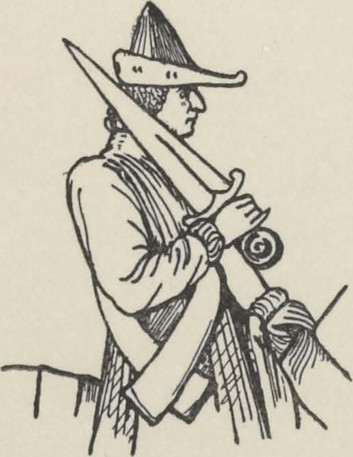
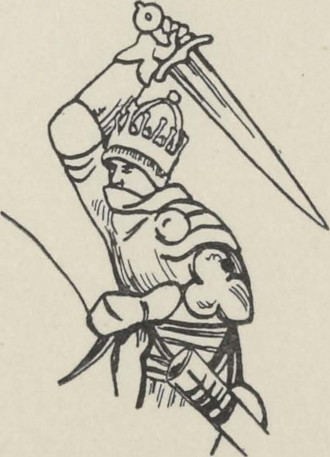
FIGS, 36-37. CINQUEDEAS, 1475· " GRANDES CHRONIQUES DE FRANCE "
BIBLIOTHEQUE NATIONALE, PARIS
It has long been confused, especially by English writers, with a dagger known as anelace. The latter is no\v included within the group of basilards. Of the various forms represented in our figure 3 8, the earliest was apparently the "Veronese" type (1450–1475): it was a short, wide-bladed dagger with a curious flat, somewhat knife-like hilt; it suggests in proportions the knightly sword known about I 4 7 5 in French manuscripts, a sword which, however, while \vide-bladed and reasonably short, had a spindle-shaped grip and a great counterpoised wheel-shaped pommel (figs. 3 6-3 7). The blade in this group of daggers was exceptionally heavy at its base, and when counterpoised by the hilt could have delivered a formidable chopping blow at close range-suited obviously to combat in the narrow streets or in the pressing crowd of mediaeval towns. 1
Alas for our theory! The only contemporary documents accessible (figs. 37 and 42) picture this arm used as a sword in a very normal way.
The beauty of
the blade lies in its ridges and longitudinal grooving, the latter often executed in separate
zones-as many as five of these appearing from guard region to tip, bearing successively five grooves, four, three, two, and one. These transverse zones of ornament
may be enriched by damascene, by gilding and engraving, in an endless variety of
designs symmetrical and asymmetrical-often by artists of high rank, e. g., Ercole dei
Fideli.
The richest blades are usually of the Venetian type {p. I 3) with wide tangs
forged in the outline of the handle, whose grip plates are held in place by rosettes in
filigree which serve as rivets. It is this general type which we consider below.
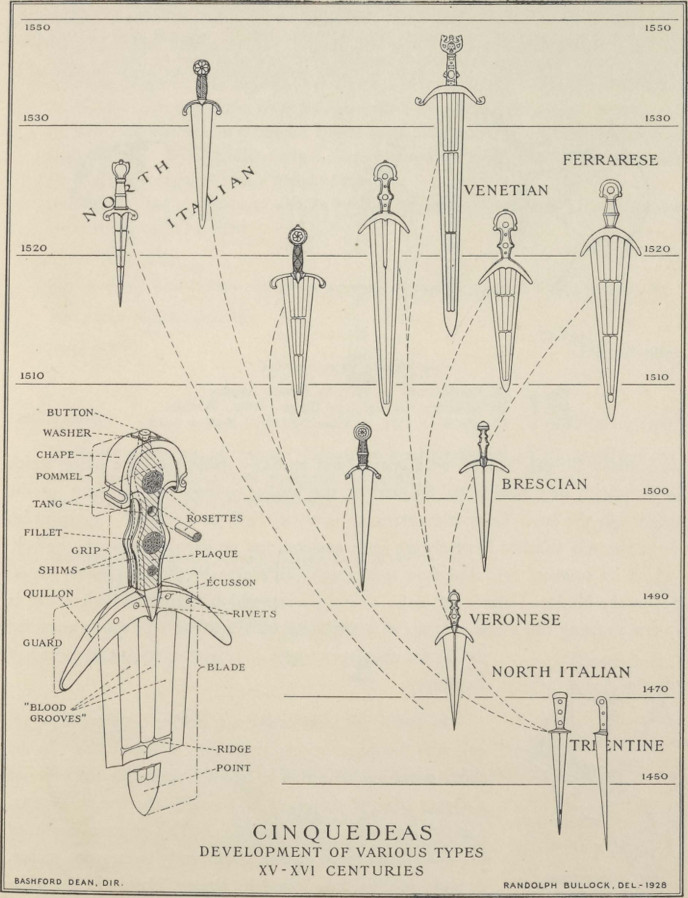
FIG. 38
Quillons, made in halves or so split as to admit the base of the blade (fig. 3 8), are
riveted to the latter on either side. Grip enclosed by flat plates (e. g., of bone or ivory)
whose chamfered edges project beyond the enclosed tang, leaving between them a space
filled in by a ribbon of metal (brass) often bearing inscription. The deep, crescentic
chape, when present, is usually cast in bronze, its ornamentation often in relief, some
times finished with incised bands, lines, and ornaments. The rosette-shaped attaches of
handle to tang usually show geometric ornaments, sometimes in finest design, suggesting
even that they were prepared by artists in filigree. In the treatment of the hilt the effort
has been made to produce a grip which should be smooth (no projections apparent,
unless for the specific function of furnishing a guard to the little finger or to the space
between the fore- and middle finger). The feel of a cinquedea grip is sui generis: he
appreciates it best who holds a cinquedea lightly in his hand, closes his eyes, and then
manoeuvres it.
Sheath usually of hardened leather, strengthened with chape and ferrule in latten.
The sheath of the cinquedea was a favorite medium for the decorator of cuir bouilli;
nowhere else does one see better evidence of detailed design and painstaking workmanship.
Unfortunately scabbards of the present type are of supreme rarity. They occur
in Windsor Castle, the Victoria and Albert Museum in London (belonged to Caesar
Borgia), the Louvre and Musee de l'Armee in Paris, the Odescalchi Collection in Rome,
and in the Hermitage at Leningrad.

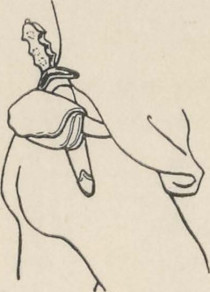
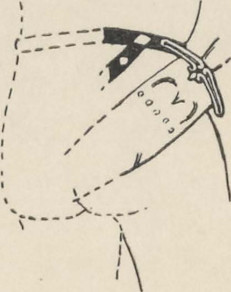
CINQUEDEAS. FROM PAINTINGS
Fig. 39· St. Bartholomew, c. 1502, by Niccolo Alunno.
Fig. 40. St. Sebastian, I 502-1503, by Genga. Uffizi, Florence.
Fig. 41. Crucifixion, c. 1481, by Bianchi-Ferrari. Modena Gallery.
The cinquedea was usually carried on the right side, attached at the belt and held at the back obliquely, adapting itself more or less to the small of the back. In this position it is seen in a figure in sculptured stone (Landsknecht), about I 5 oo, in the Louvre; in the Procession to Calvary (before 1497), by Boccaccio Boccaccino, in the National Gal lery, London; in the Martyrdom of St. Bartholomew by Niccolo Alunno (1502 ), in the Chiesa di S. Bartolomeo di Marano, near Foligno (fig. 39); in a Saint Sebastian (1503) by G. Genga, in the Uffizi (fig. 40). In these cases the cinquedea is ot small model and is tucked under the belt behind the purse; it was probably made fast by a lacing which passed through slits (which are known) in the leather covering of the back of the scabbard-in the latter figure the cinquedea is on the left, as a S\Vord. A cinquedea of large size was attached in nearly the same position, but on the right, outside the belt, to which its scabbard was doubtless laced, in a Crucifixion by Bianchi-Ferrari (about 1481) in the Modena Gallery (fig. 41). Curiously enough, the number of documents is very few showing the actual carrying of a cinquedea, although this arm was in extended use by the great personages of several countries for over half a century.
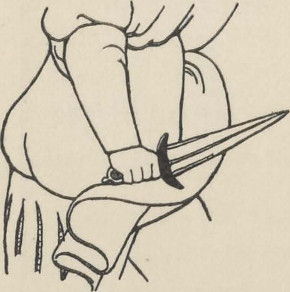
FIG. 42. CINQUEDEA EARLY XVI CENTURY STORY OF JOSEPH BY UBERTINI VILLA BORGHESE, ROME
In actual use a cinquedea was held as a sword (figs. 3 7, 42 ), with the guard resting at the side of the thumb. In the above notes no distinction is drawn between the cinquedea as a dagger and the cinquedea as a sword; the one, it appears, merged insensibly into the other. The greatest length of the blade (from tip to guard) is apparently twenty-one inches. A blade of this type found its nearest kinship in the wide-bladed and richly engraved swords of northern Italy of about 1475.
75· DAGGER
Italian (Veronese), 1450-1475
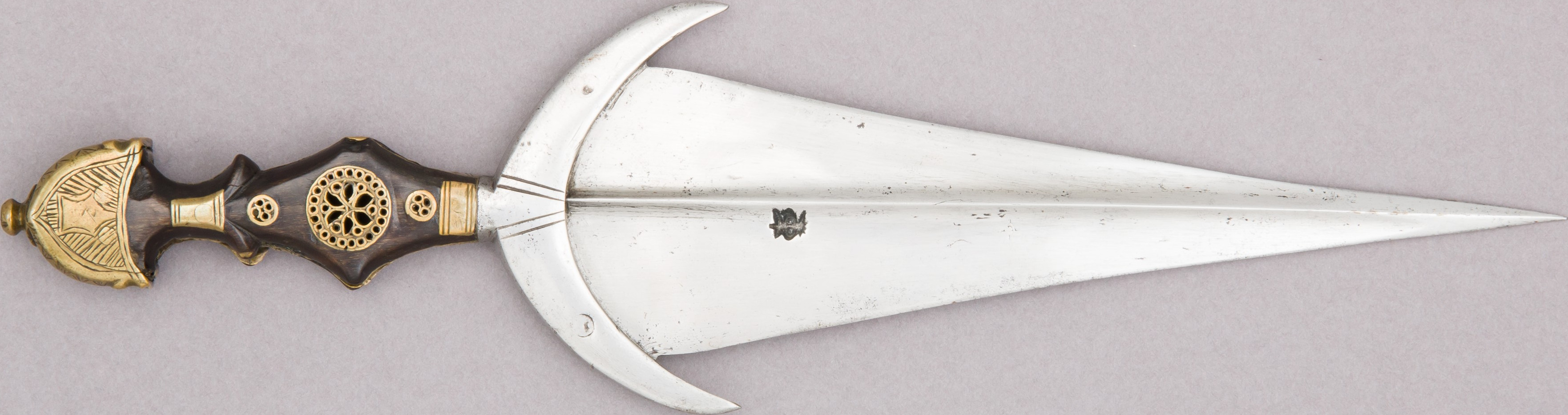
Earliest of the cinquedea group. The pommel is small and cap-shaped, latten, with terminal
button. Hilt includes pommel engraved with zigzag, lozenge-shaped, and diagonal lines
with a shield on each side, and with terminal button with quatrefoil. Quillons of steel,
crescentic, engraved with diagonal lines in groups of two at center. Grip of two horn plaques
divided into two zones, the lower lozenge-shaped, the upper spool-shaped, secured to tang
by two small and one large pierced filigree brass rosaces, above and below which an inset
strip of latten. On each side of grip is a latten plaque the upper part of which is cannelated,
the lower part engraved with a design of chevrons.
Blade bears central ridge and armorer's mark, tapers acutely, passes through quillons to
which it is secured by rivets.
14.25.1264
L. 30.5 Wt. 245
Bibliography: Viollet-le-Duc, Dictionnaire raisonne du mobilier français, VI, pp. 203-205, fig.
Provenance: Meyrick Collection.
Plate XXVI Riggs Benefaction

76. DAGGER
Veronese, 1450-I475
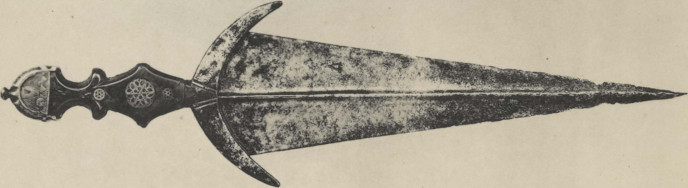
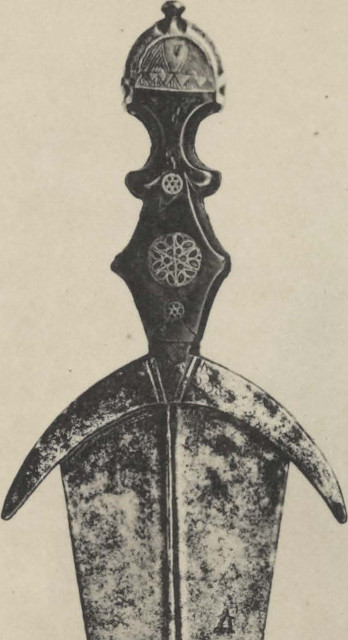
Similar to preceding, but larger. Pommel of bronze engraved with herring-bone pattern,
and a shield. Quillons with crescentic ornaments.
Blade bears armorer's mark on each side.
04·3 .126
L. 35 Wt. 311
Bibliography: De Cosson, Dina Catalogue, G. 6, pl. I 7.
Dean, Catalogue, 1905, p. r66, fig. 86 E.
Laking, III, p. 67, fig. 849.
Provenance: Ressman and de Dino Collections.
Plate XXVI
Rogers Fund, I 904

77. CINQUEDEA
North Italian, 1500–1525
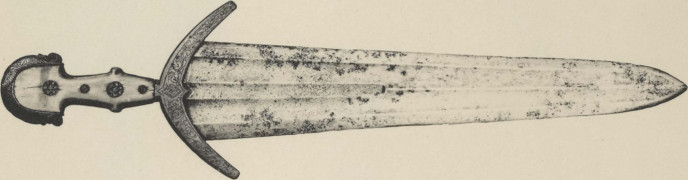
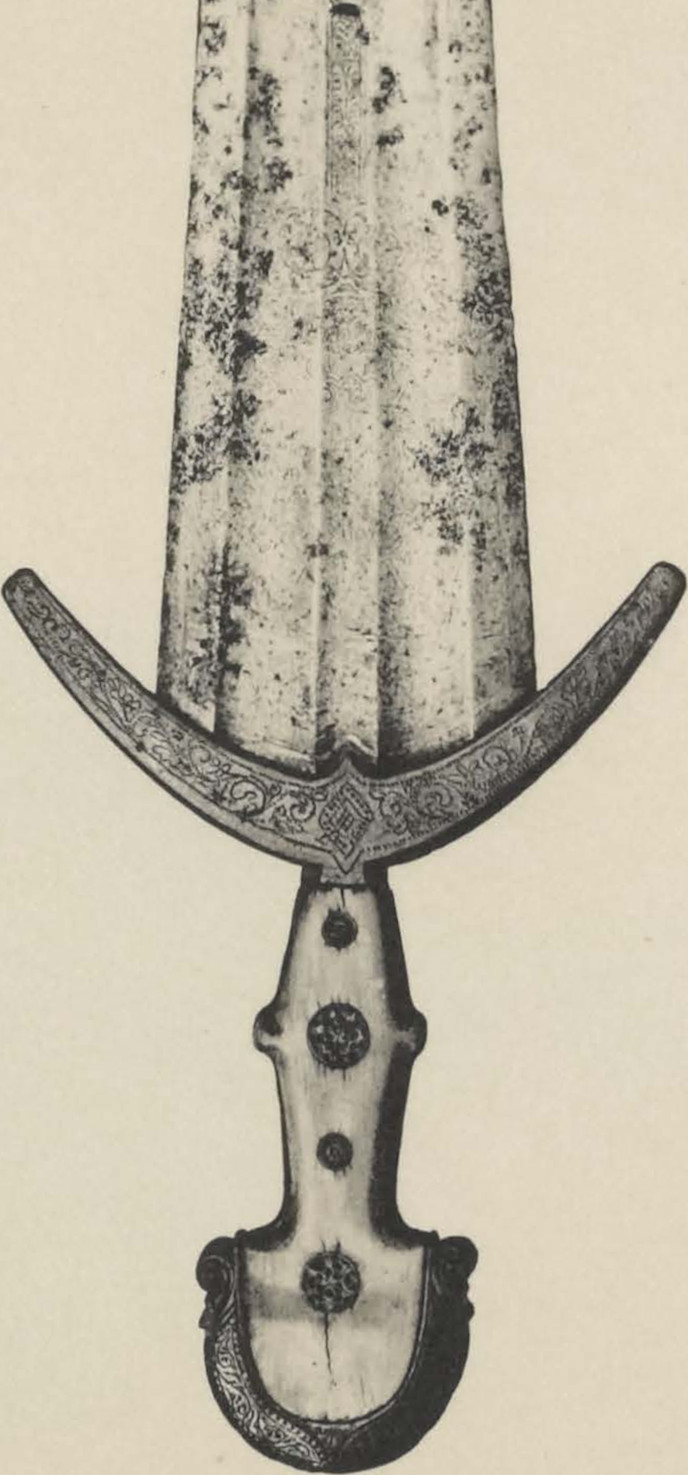
Pommel, grip, base of blade, and lateral plates of grip enriched with foliate designs in punched
work. Quillons of steel gilded.
Blade with basal half divided into three shallow grooves, two of which continue to the point,
ornamented with foliation, human figures, and heraldic shield, etched and gilded.
14.25.1265
L. 61 Wt. 1200
Provenance: Pourtales Collection.
Plate XXVII
Riggs Benefaction
78. CINQUEDEA
North Italian, 1500-1525
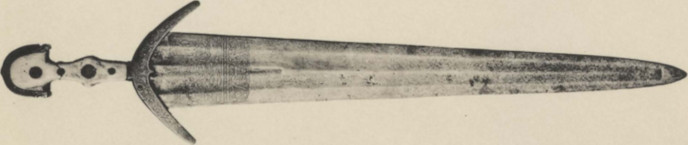
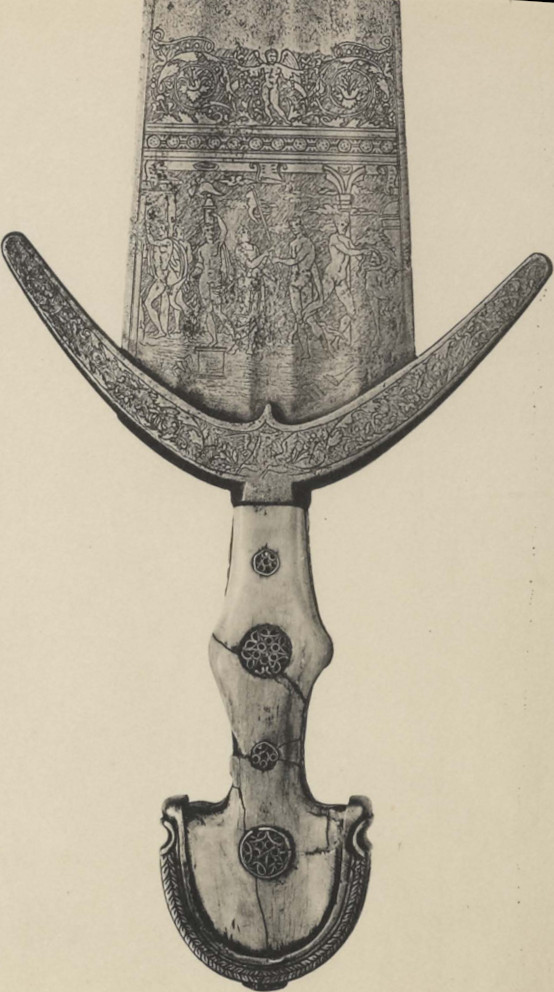
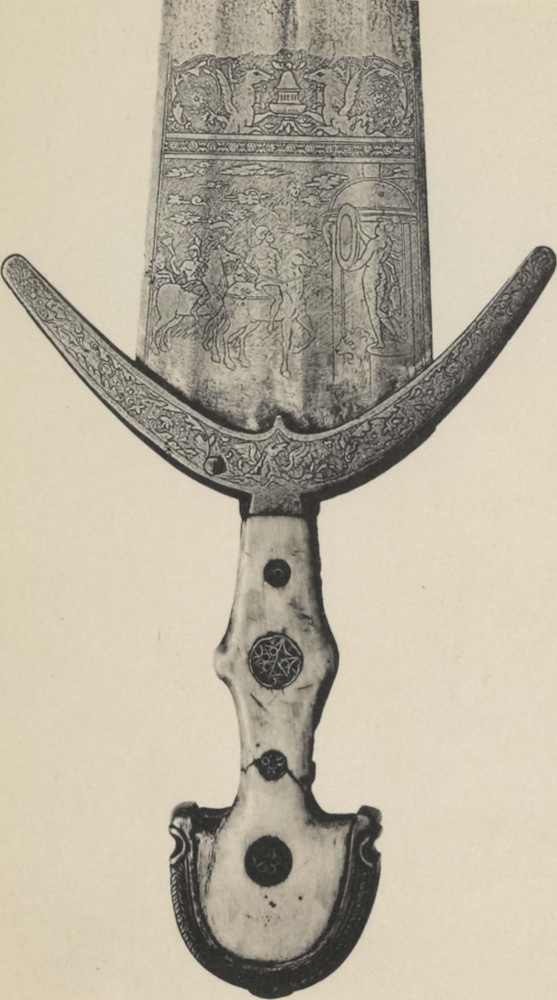
Exceptionally long specimen. Pommel chiseled with dolphins and scrolls at top and leaf
design at sides; foliate washer at apex. Quillons etched with griffin at ecusson. At sides
of grip two latten plaques inscribed: AVXICTVM. A. SVPER. RAEBENT. VICTORIAM.
Base of blade gilded; engraved on each side with scenes from classical mythology; basal quarter
hollow ground and divided into five longitudinal zones; remainder hollow ground and divided
into four longitudinal zones.
L. 1331.59
L. 70 Wt. 1015
Comparisons: A cinquedea with blade etched in same style and with same subject was in the collection
of the Comte de Nieuwerkerke; now in the Wallace Collection.
Bibliography: J. Jacquemart, Collection d'armes de M.le Comte de Nieuwerkerke, 2 figs.
Ed. de Beaumont, Sangdedez -Epee vénitienne du XV Je siecle, in Ed. Lievre, Les collections celebres d' ceuvres d'art, 1866, pl. 69.
Camp, Wallace Collection Catalogue, 1920, no. 94.
Provenance: Albertie Collection, Florence.
Plate XXVIII
Lent by Bashford Dean
79· CINQUEDEA
Italian, 1500-1530
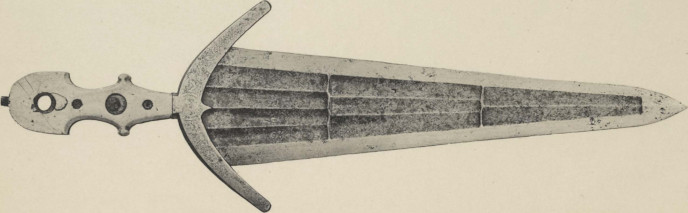
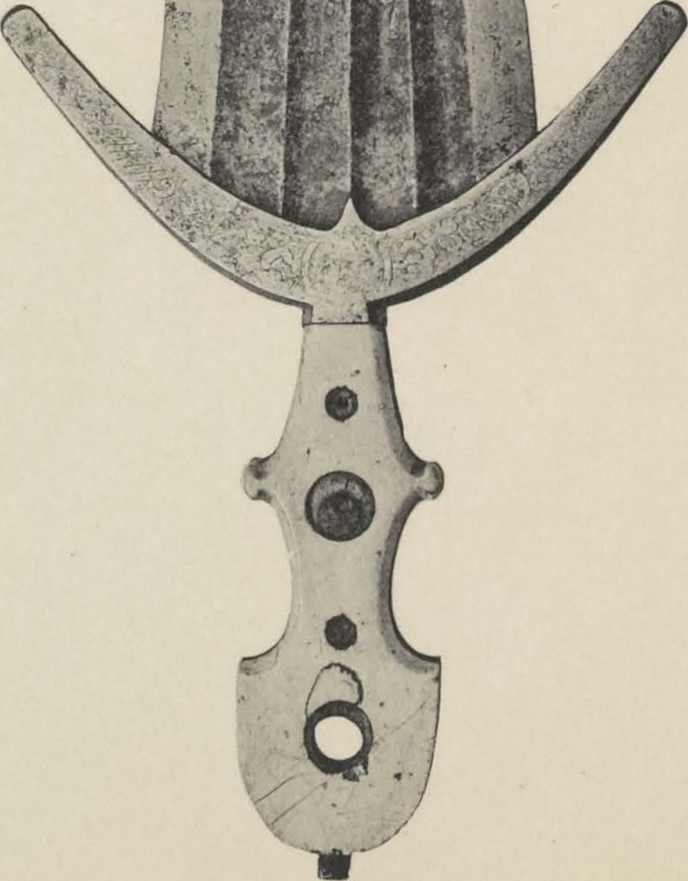
Hilt lacks pierced rosaces, ornamental side plaques, and pommel. Quillons enriched with
etched ornaments including portrait medallion, cherubs, shields, and geometric lines.
Blade, channeled in zones of four, three and two, retains traces of design in gold damascene
on a blued background; in one of the shallow grooves in middle zone an armorer's mark.
14.25.1263
L. 55 Wt. 907.5
Provenance: Meyrick Collection.
Plate XXIX L Riggs Benefaction

80. CINQUEDEA
Italian, 1510-1530

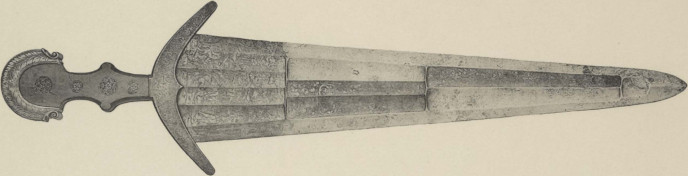
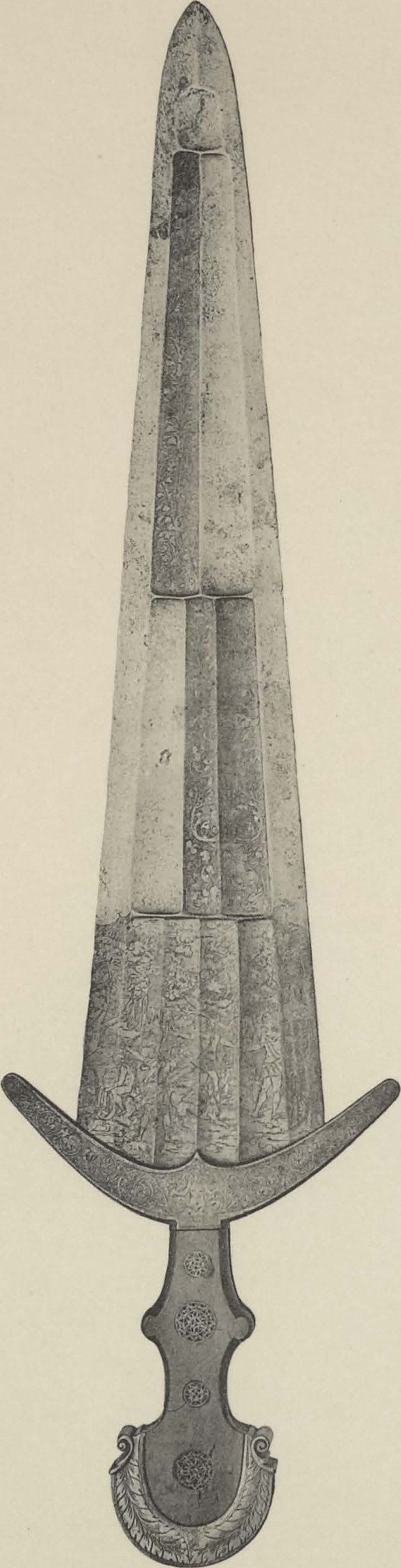
Grip of horn plaques.
Blade with one of the grooves of upper zone and two of middle zone gilded and etched with
foliation on striate background; basal zone gilded and etched with Actaeon and Diana. Bears
armorer's mark.
14.25.1266
L. 58.5 Wt. 908
Provenance: Duke of Medina-Celi Collection.
Plate XXIX
Riggs Benefaction

81. CINQUEDEA
Venetian, 1510–1530
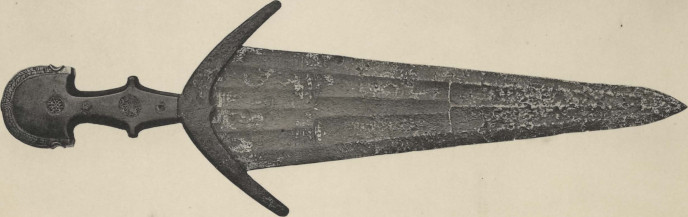
In ornamentation of pommel a nude boy is pictured standing on pedestal of acanthus leaves;
also warrior with lance. Quillons retain traces of original etched ornament and gilding
Grip of two horn plates, partly fossilized. At sides of grip the gilded plaques bear in relief
on one side AVXILIVM. A. SVPE (RIS), on the other, AVDACES FORTVNA. The latten mountings,
including the perforated rosettes, have undergone mineralogical changes, developing pyrites
at certain points.
Blade here and there deeply invaded by lines of rust which follow the "damascus" layering
of the steel; near hilt is an etched and gilded design of nude figures (Bacchanalian) closely
resembling the work of Ercole dei Fideli; on either side in the middle zone is the armorer's
mark (letter P).
16.154.1
L. 50 Wt. 740
Comparisons: A cinquedea in the Royal Collection at Windsor Castle bears the same armorer's
mark (letter P) impressed (Laking, Armoury of Windsor Castle, no. 30, pl. 2, and Laking,
European Armour and Arms, III, p. 71, fig. 854). A cinquedea with blade stamped with
the letter P formerly in the Thewalt Collection, Cologne (Lempertz, 1903, no. 1609, fig. pl. 25).
Bibliography: Volpi Sale (American Art Association, 1916, no. 731).
Dean, Venetian Short Sword, in Bulletin Metropolitan Museum of Art, 1917, XII, pp. 38-40, fig.
Provenance: Recovered from the mud of Venetian canal. Enrico Grego and Elia Volpi Collections.
Plate XXX
Rogers Fund, 1916

82. CINQUEDEA
Italian, 1525–1550
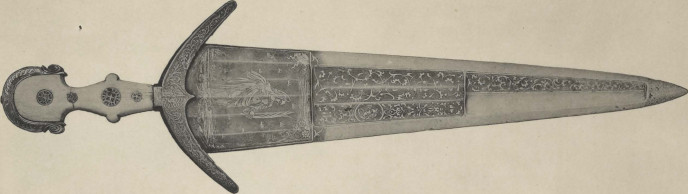
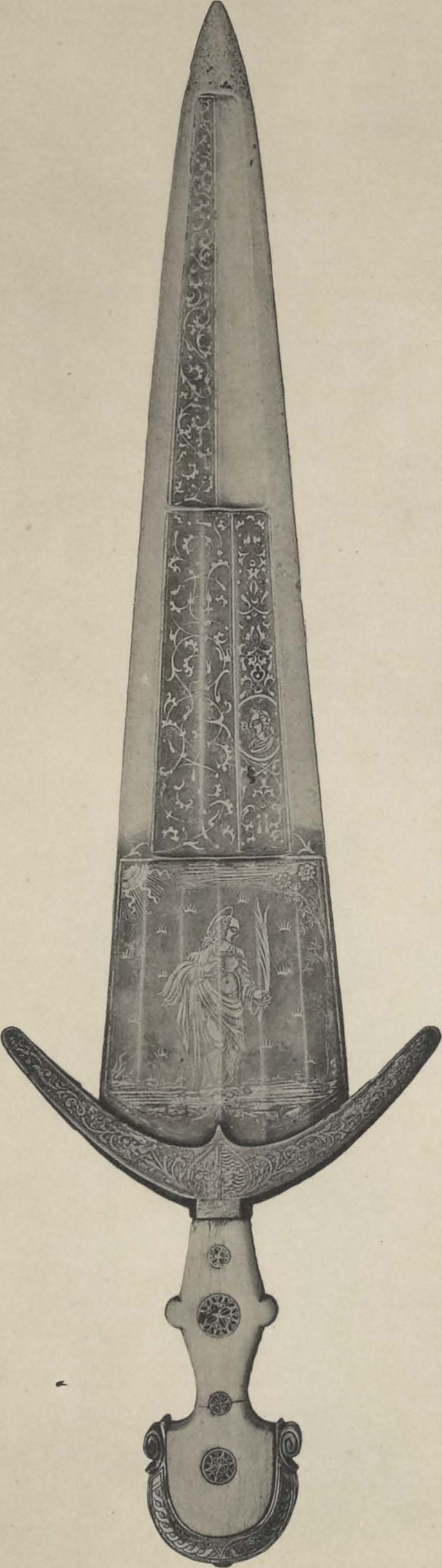
On one side at ecusson a shield with undetermined blason; on the other side a similar shield
enclosing the letters A M s v M. Grip at side bears inscriptions: ANIMO. A. QVARIR. E. and
ARDVA. DETVRBANS. VI.
Blade divided into three zones with two, three, and four shallow grooves respectively; on each
side, one of the upper grooves and all the other grooves enriched on a blued background with
damascene traceries. On basal zone are represented in gold damascene on one side Adam and
Eve, on the other a female martyr. In middle zone on one side a medallion encloses a portrait
head, on the other the letters A M s v M (Ave Mater Sanita Virgo Maria). On either side of
middle zone an armorer's mark.
14.25.1267
L. 60 Wt. 979·5
Comparisons: The same armorer's mark appears on three cinquedeas in the Wallace Collection (Camp,
Catalogue, nos. 90-92), and on a cinquedea in the Tower of London (ffoulkes, Catalogue, CI. IX,
146, pl. XXIX).
Provenance: Collection de Sargec (Paris).
Plate XXX
Riggs Benefaction

83. CINQUEDEA
Italian (Spanish ?), 1550
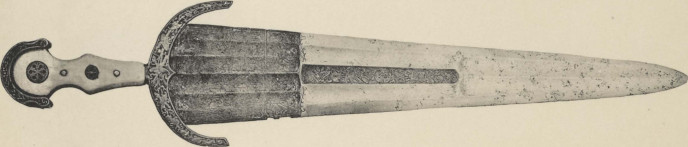
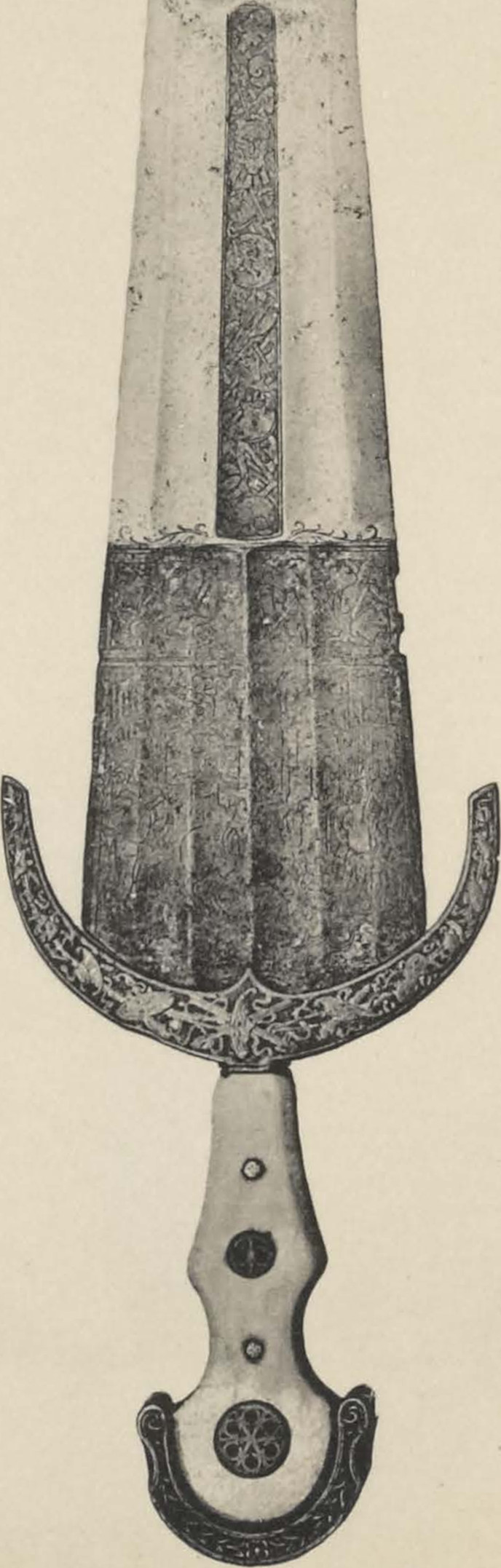
In spite of its early provenance the present arm is disappointing. Grip and pommel date
1820–1840 (?).
The blade is of latest type, corresponding with decadent quillons of bronze; its tang is arranged
to pierce quillons and grip, as in the usual swords of this period. Its basal section pictures
on one side Horatius at the Bridge, on the other Marcus Curtius.
14.25.1268
L. 59 Wt. 814
Bibliography: Thoumas, Exposition retrospective militaire en 1889, I, p. I 3, fig.
Provenance: Juste and de Courval Collections.
Plate XXXI
Riggs Benefaction
84. SWORD OF CINQUEDEA TYPE
Venetian, 1525-1550
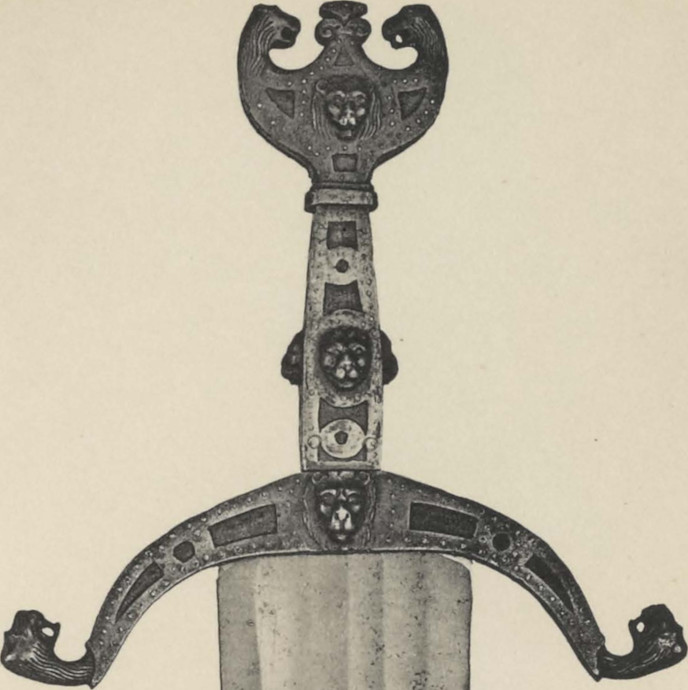
Hilt of steel blackened, ornamented with sunken areas, silver nail-heads and lion heads, the
last sculptured in relief on either side of pommel and quillons and on each face of quadrangular
grip. Pommel escutcheon-shaped, the upper part terminating in three prongs, the outer
sculptured as lion heads, the central as trefoil. Quillons decurved, terminating in lion heads,
sculptured.
Blade with the usual grooves, but without etched ornamentation; on each face armorer's
mark as lance-head ( coronel).
14.25.1172
L. 83.5 Wt. 1251
Note: This has long been known as an Ordinance Sword of the Council of Ten (fide Mr. Riggs).
Provenance: Uboldo Collection.
Plate XXXI
Riggs Benefaction

85. CINQUEDEA
Italian (Ferrara ?), 1490-1510
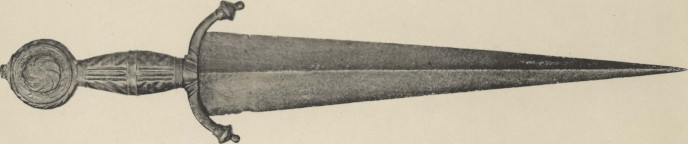
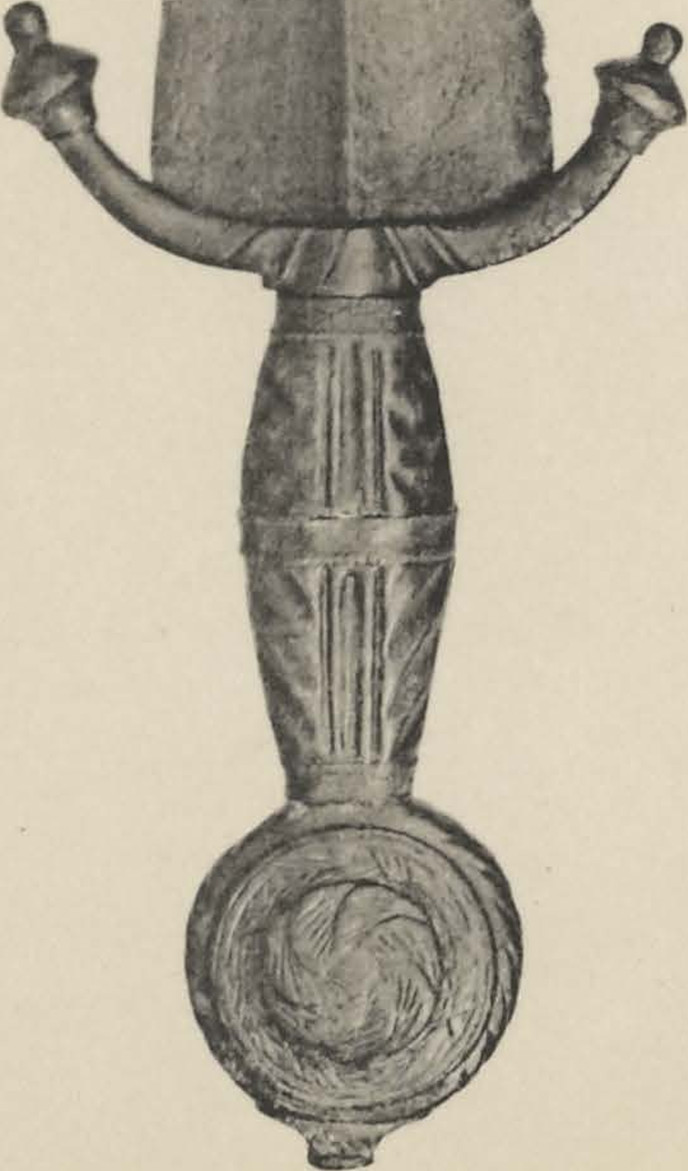
Hilt of bronze. Pommel wheel-shaped, of latten gilded; its central boss flattened, and decorated with incised ornament. Guard with short drooping quillons terminating in bulbs,
with ring ecusson and with ridges at the sides. Grip of two plaques, ornamented asymmetrically; diamond-shaped eminences and sunken slashed ornament separated by longitudinal
grooves; rim of grip formed by three transverse bands.
Blade double-edged, hollow-ground, with keel running entire length.
26.145.58
L. 46 Wt. 441
Plate XXXII
Reubell Benefaction
86. CINQUEDEA
Italian (Brescian ?), 1500–1525
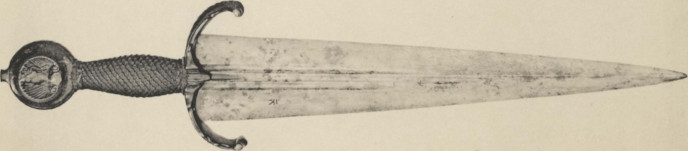
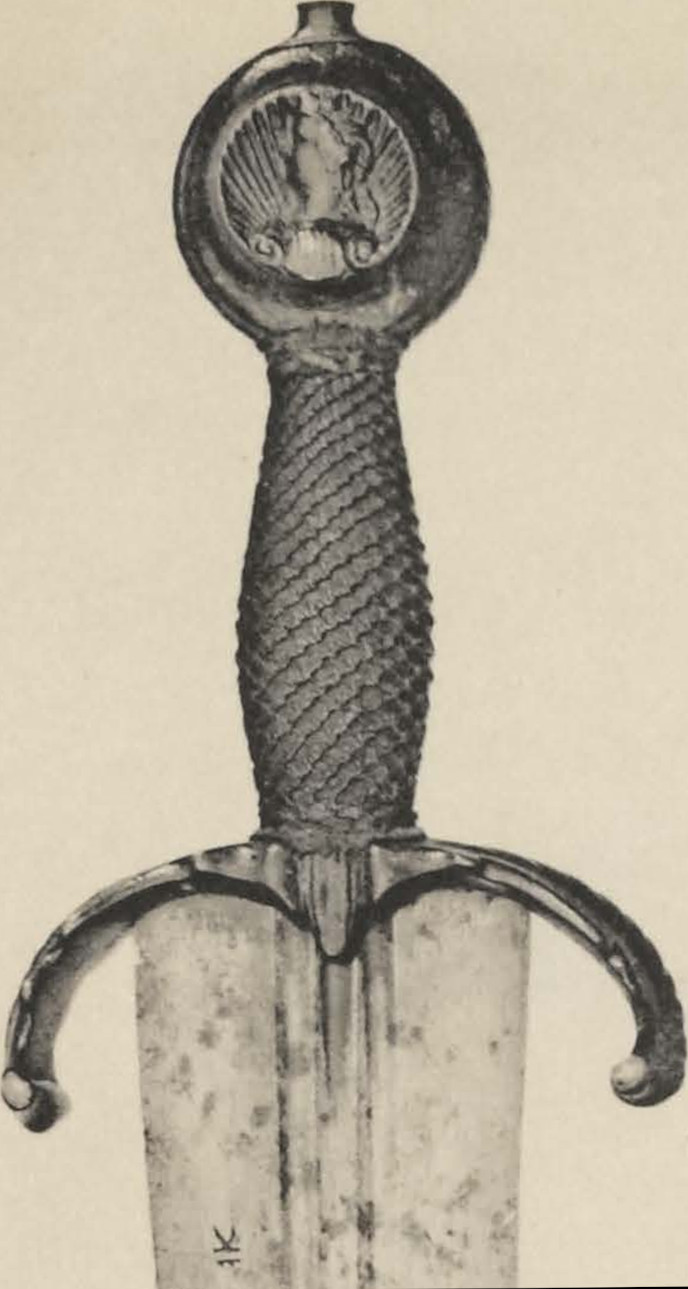
Pommel and guard of bronze, with traces of original gilding. Pommel discoidal, with roped
border; a boss on either side takes the form of a scallop shell in whose hollow is modeled a
classical portrait. Guard with wide quillons bending abruptly toward the. point of blade,
with lobate terminals, molded edges, and cusped at ecusson. Grip spindle-shaped, netted
with fine copper wire.
Blade with median groove for seven-eighths and lateral grooves for half its length. In the
basal region armorer's mark.
26.145.59
L. 47 Wt. 642.5
Comparisons: Similar armorer's marks appear on swords in Leningrad (Lenz, p. 185); Wallace
Collection, London (Camp, no. 688); Musee d'Artillerie, Paris (Robert, III, p. 57, J. 142).
Provenance: Purchased in Geneva from the antiquary Meyer.
Plate XXXII
Reubell Benefaction

87. CINQUEDEA
Milanese, 1500–1525
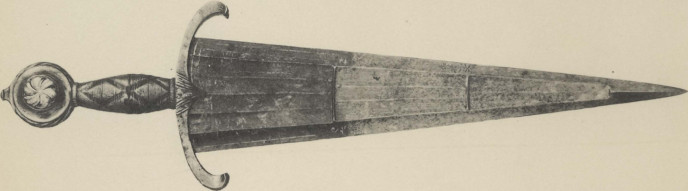
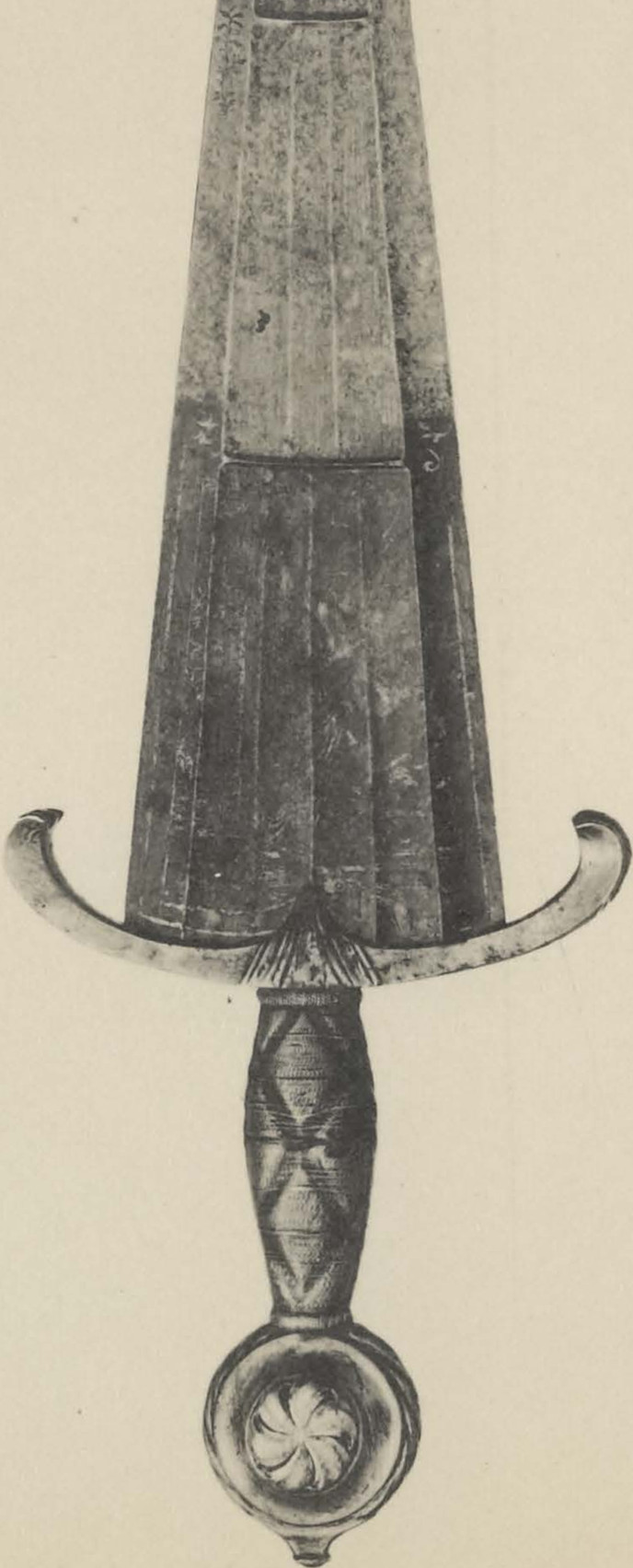
Pommel and guard designed with great simplicity, with surfaces curving gracefully and
enriched with roping. Pommel wheel-shaped, of latten, gilded; on either side a prominent
boss as spiral rosace. Guard decurved, rectangular in section, at each end molded into a
conventional leaf. Grip wrapped with silver wire, in which concave bands were pressed,
forming diamond-shaped ornaments.
Blade of wide model, divided by sharp transverse ridges into zones of two, three, and four
shallow longitudinal grooves; basal third of blade richly blued and decorated with gold-filled
lines in the manner of niello, in a design of Ceres(?). On each side, near the middle, armorer's
mark. Point heavily reinforced.
26.145.57
L. 53 Wt. 799
Note: An incident of the purchase was told by Mr. Reubell. His competitor at the sale was the
Florentine antiquary, Bardini. The latter hesitated to bid for himself; his limit was high,
and confident that the object would be his, he left his agent in order to examine an object in
a neighboring gallery. When the price rose beyond the assigned limit the agent rushed off
to confer with Bardini. Returning with a revised limit, he was only in time to see the object
knocked down to Mr. Reubell.
The decurved guard cusped at center, which is characteristic of cinquedeas, was in use at least
as early as the twelfth century according to Kingsley Porter (Romanesque Sculpture, VI, pl. 895).
Comparisons: A cinquedea in the Musee d'Artillerie, Paris, bears the same armorer's mark (Robert,
III, p. 170, J. 774). See also mark on cinquedea No.82.
Provenance: Baron d'Hoquert sale in Florence.
Plate XXXIII
Reubell Benefaction

88. CINQUEDEA
Italian (Milanese ?), 1500
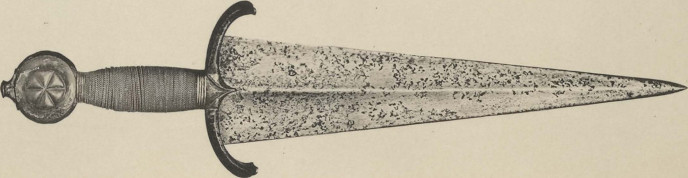
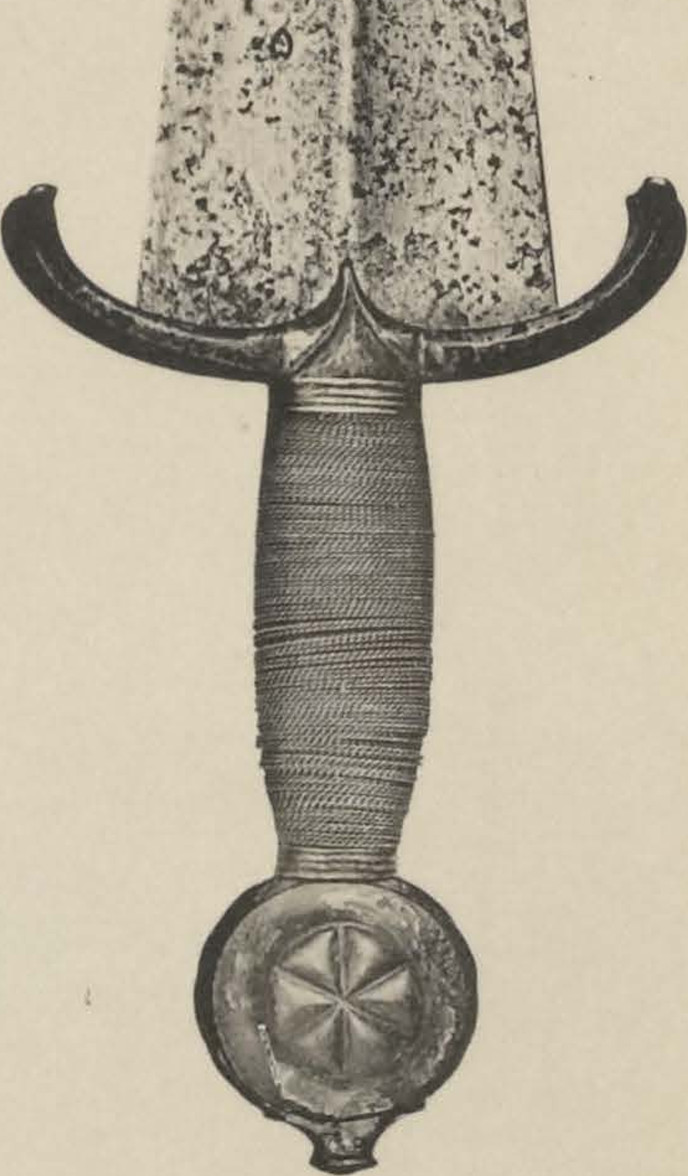
Similar to foregoing, but of simpler type. Pommel and guard of steel, retaining much of
their original silvering.
Blade with median ridge; bears on either side armorer's mark (heart).
26.145.61
L. 38 Wt. 346
Provenance: Baron de Cosson Collection.
Plate XXXIV
Reubell Benefaction

89. CINQUEDEA
Italian (Brescian ?), 1500
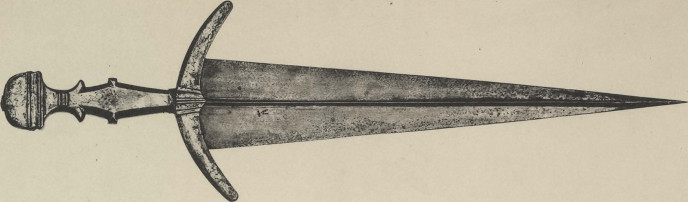
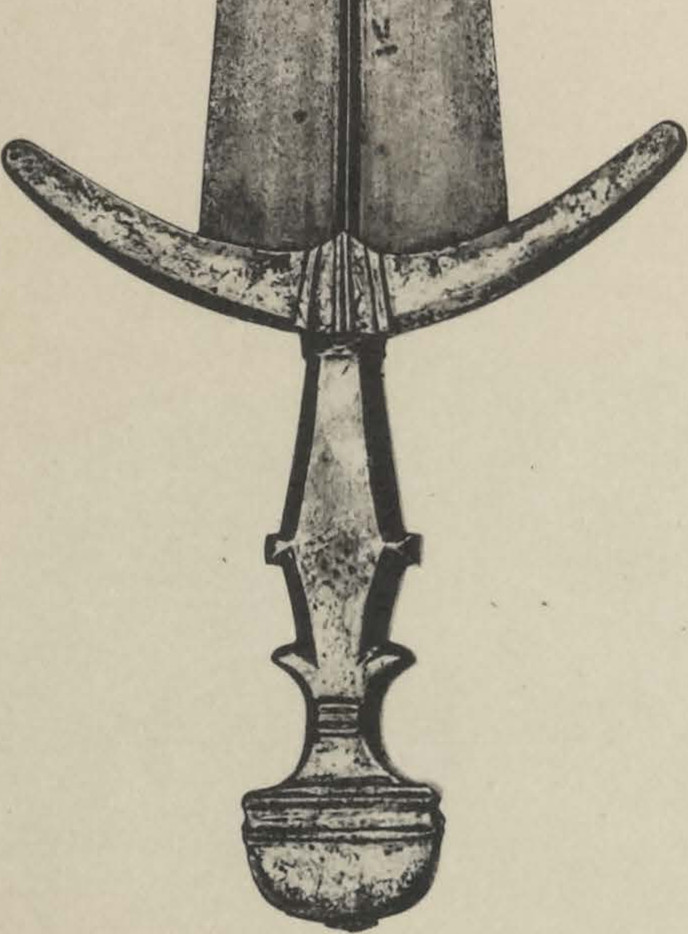
Hilt of bronze gilt. Pommel semi-elliptical with transverse base ornamented with sunken
bands; quillons flattened, decurved, with ecusson cusped and ridged. Grip flat, sides chamfered, and with angular offshoots.
Blade with narrow sharp keel; bears armorer's mark (Brescian ?).
26.145.55
L. 42 Wt. 389.5
Comparisons: A similar mark appears on a kidney dagger in the Stuyvesant Collection (Dean,
Stuyvesant Catalogue, no. 103).
Plate XXXIV
Reubell Benefaction

90. CINQUEDEA
Italian, 1535-1550
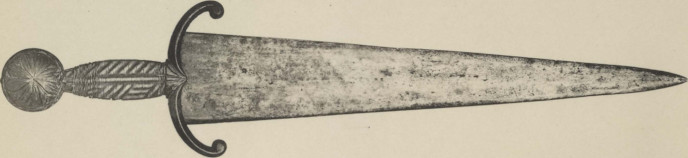
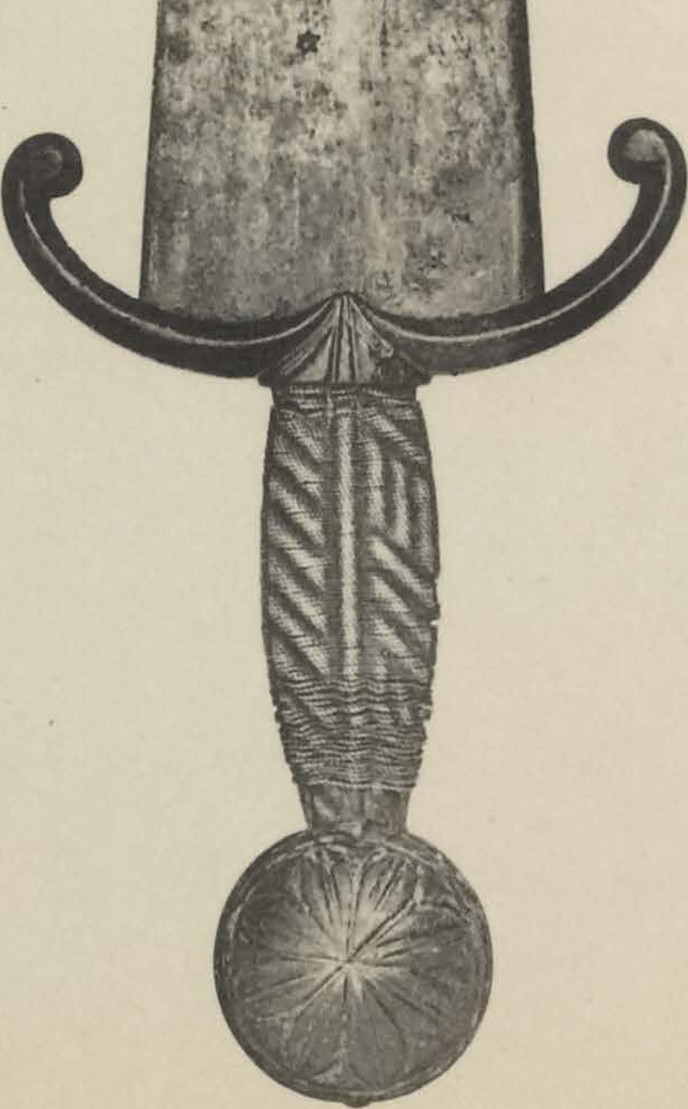
Similar to No. 87, but with hilt of iron, silvered. Pommel engraved with floral design. Grip
bound with wire molded in asymmetrical design with longitudinal ridge in median line; on
the one side a band of diagonal lines and on the other alternate bands of diagonal
and longitudinal ridges.
Blade simple; armorer's mark (six-pointed star) on each side.
26.145.60
L. 47 ·5 Wt. 411.5
Comparisons: A cinquedea with blade bearing a similar mark was disposed of at the American Art
Galleries, New York (Sale Catalogue of European arms and armor, Nov. 19-20, 1926, no. 218,
fig.). A six-pointed star appears on a dagger in Leningrad (Lenz, p. 190); on a polearm in the
Tower of London (ffoulkes, Cl. VII, 182); on the blade of a cinquedea in the Berlin Zeughaus.
Documents: Traite d'escrime dedie au Roi Henri III, by G. A. Lovino (pis. 32-37), shows this type
of dagger still in use.
Provenance: Purchased at Hotel des Ventes, Paris.
Plate XXXIV
Reubell Benefaction

91. CINQUEDEA
North Italian, 1525-1550
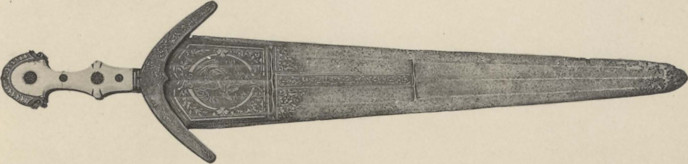
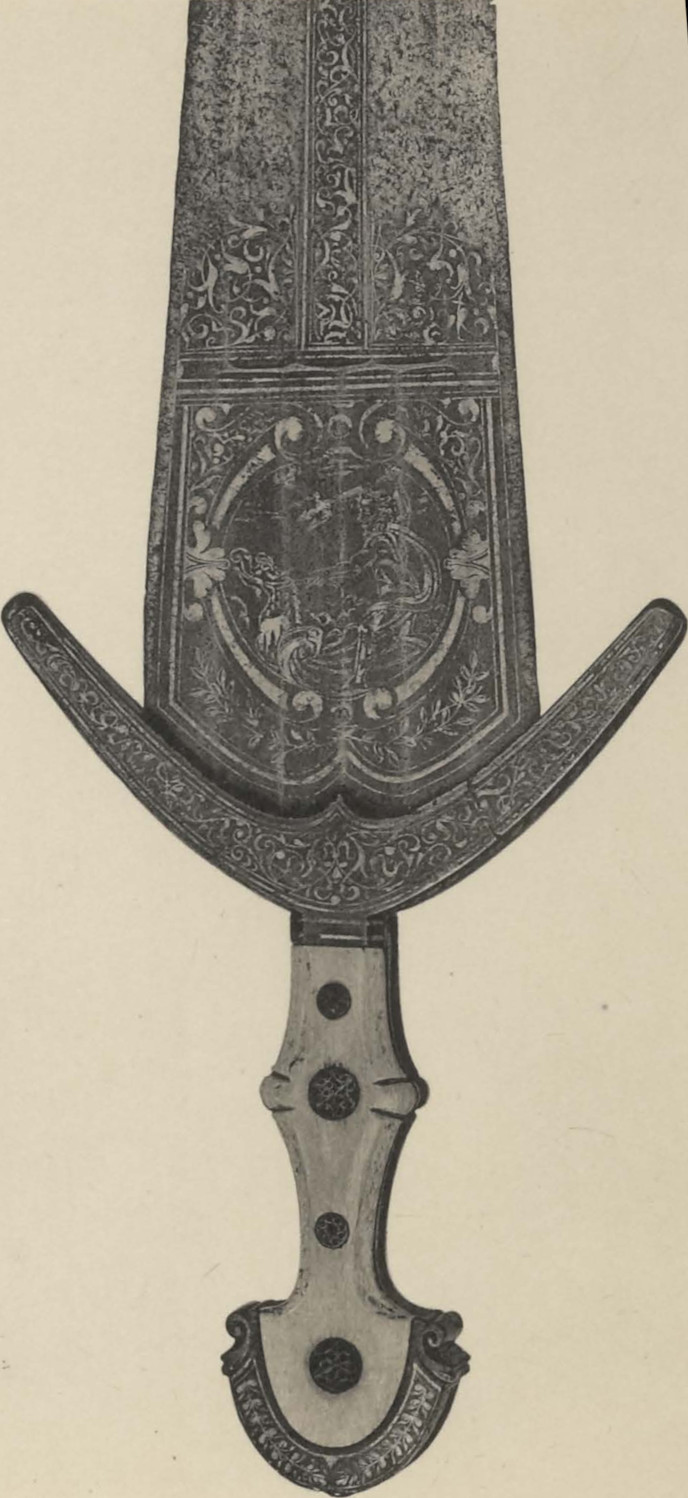
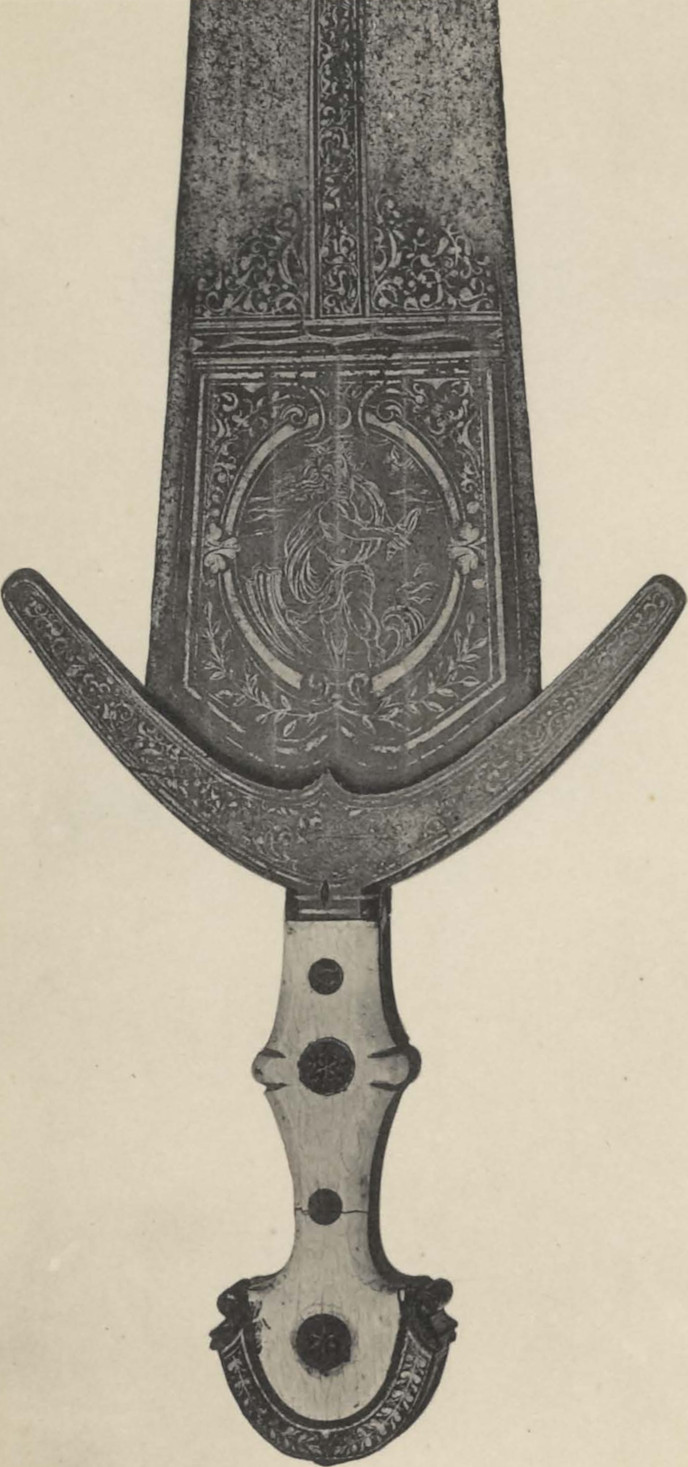
Rich specimen in splendid preservation. Pommel and guard damascened with arabesques.
Pommel arch-shaped with diamond-shaped washer at apex. Flattened decurved guard cusped
at center. Grip of two ivory plaques expanded at center and arch-shaped at top, ornamented
with four brass filigree rosaces, alternately large and small; at each side of grip etched and
gilded plaque.
Blade double-edged, on each side divided into three zones of two, three and four shallow
grooves in turn. Basal region damascened in gold with Renaissance medallions, on the one
side picturing Charon and on the other Neptune. Anterior region of the blade enriched with
a median band of traceries with basal motif in arabesque.
26.145.56
L. 59 Wt. 940.5
Provenance: Purchased in Paris.
Plate XXXV
Reubell Benefaction

QUILLON OR SWORD-HIL TED DAGGERS
From I 300 onvvard daggers occur which in hilt, gdp, guard, or blade correspond with the S\vord it accon1panies. Instances of likeness of dagger to sword with guard bearing q uillons occur in paintings dating fifteenth and sixteenth centuries. Thus from a Resurrection (fig. 43 ), Catalan school, I 4 7 5 (Dean Collection), one notes a dagger with quillons, vvhosc potnmel ajoure copies accu rately that of its neighboring svvord. 1 In certain cases daggers with similar hilts may differ conspicuously in blade, e. g., one may have a straight blade, another curved or cutlass-shaped (coutelas). In . still another direction and in numerous instances daggers of different types may agree with one another in details, e. g., a rouelle dagger may be provided with the pommel of a quillon or kidney dagger. In the group of sword-hilted or quillon daggers a wide range occurs in the form of the guard. In the earliest the quillons were short, suggesting the sword ornamentally, rather than functionally: at the most these early quillons could have served only as a toggle to prevent the dagger slipping through the hand when in use-for when struck sharply into a body (experiments on butchered sheep), so easily does the blade enter (" like piercing butter "-as Mr. Reubell notes) that the dagger vvithout a guard might sink too deeply to be quickly withdrawn. • " This sword a dagger had his page, that was but little for his age. , {HUDIBRAS) FIG. 43 QUILLON DAGGER ABOUT 1475 94 92. CROSS-HILTED DAGGER 2 5 .I 88.I 6 EUROPEAN DAGGERS English, I380-I400 Brass guard and pommel, decorated with design chiseled and punched. Grip modern, but follows the hexagonal lines of the ancient handle, as indica ted on pommel and base of guard. L. 42 Wt. 226 Bibliography: Laking, III, p. 5, fig. 733· Keasbey Sale, American Art Association, 1925, no. 206, pl. XX. Provenance: Found in the Thames at Mortlake. Laking and Keasbey Collections. Plate XXXVI 93. CROSS-HILTED DAGGER Gift of George D. Pratt, I925 Burgundian, I450-I480 Pommel and guard of bronze decorated with incised lines. Pommel crown-shaped. Quillons treated en torsade. Grip of wood (boxwood ?) carved with bossets. Blade single-edged, triangular in section, the back divided into five zones alternately flattened and beveled; armorer's mark in latten. 2 5 .I 88.I 7 Bibliography: Dean, Catalogue of a Loan Exhibition, 191 r, no. 147, fig. Laking, III, p. 8, fig. 742. Keasbey Sale, American Art Association, 1925, no. 208, pl. XX. Provenance: Found in the Thames. Keasbey Collection. Plate XXXVI L. 37 Wt. 215 Gift of George D. Pratt, I925 94. DAGGER French, XV Century Simple in form but admirable in lines and treatment. Hilt of bronze gilded. Pommel a transverse disk ornamented with sunken radiating lines. Quillons flattened, cusped at center, slightly bent downward. Grip guillochee. Blade with apical third reinforced; on one face near center armorer's mark (Gothic A) inlaid in gold (la tten ?) . Wt. I92 L. 33·5 Bibliography: Giraud, Collection Spitzer, VI, no. 209, pl. XIX. Spitzer Sale, 189 5, no. 176, ill. De Cosson, Dino Catalogue, G. 4, pis. 16-17. Dean, Catalogue, 1905, p. 166, fig. 86 F. Provenance: Carrand, Beraudiere, Spitzer and de Dino Collections. Plate XXXVI Rogers Fund, 1904 QUILLON DAGGERS 95• QUILLON DAGGER 95 Second Half of XV Century Pommel octagonal, flattened transversely, with button at apex. Quillons flattened, expanding toward tips. Grip of boxwood, its ends encased in deep steel ferrules. Blade triangular in section. 26.!45 .63 Provenance: Bach Collection. Plate IV 96. DAGGER OF MAXIMILIAN TYPE L. 34·5 Wt. I69 Reubell Benefaction German, r 500 Hilt of steel, blackened. Pommel grooved spirally. Quillons drooping, terminating in bulbs spirally grooved. Grip of two zones, wide and narrow, has now a black patine. Blade double-edged for four-fifths of its length; near the grip it is grooved on each side, and presents a flattened back. An armorer's mark present (cf. No. 32). 26.I45·7I L. 34 Wt. I82.5 Comparisons: A dagger with similar hilt was in the collection of Max Kuppelmayr (Lempertz, I 89 5, no. 3 r6, pl. XXV). Plate XXXVII Reubell Benefaction 97· DAGGER German, I 500-I 525 Similar to foregoing, particularly the blade. Hilt of steel, blackened. Pommel melon-shaped, in four surfaces, alternately sculptured with an acanthus leaf and a band of diagonal lines. Guard drooping, terminating in two bulbs, larger and smaller, at each end and having a blunt eminence at center. Grip oval in section, expanding at center, decorated asymmetrically with engraved lines, diagonal and horizontal. Blade diamond in section, double-edged for about three-quarters of its length; back flattened and grooved in ricasso. 26.!45·72 98. DAGGER L. 3I Wt. 134 Reubell Benefaction French, I soo Pommel and guard of bronze. Pommel circular, with roped border and with central spiral rosace; button at apex. Guard with drooping shell-shaped ornament at center. Quillons decurved, with roped median ridge, expanded at ends. Blade double-edged, tapering, of flattened diamond section, bears on one side armorer's mark (Brescian ?) which retains in part brass inlay. 26.145.62 L. 32.5 Wt. 226 EUROPEAN DAGGERS Comparisons: A dagger with similar pommel in the collection of Comte Raoul de Rochebrune (Collections du Comte R. de Rochebrune. Les armes. Extr. de la Revue du Bas-Poitou, 1912, pl. 21). A similar arm was found by Georges Pauilhac in the Garonne near Toulouse. The mark is similar to that on a sword in the Riggs Collection (14.25.1 121), and on a sword in the Armory at Madrid (Valencia, Catalogo, G. 181). It appears also on a dagger in the Turin Armory (Angelucci, Catalogo, p. 320), and on a dagger in The Hermitage, Leningrad (Lenz, Catalogue, p. 190). Provenance: Bought in Paris. Plate XLIII 99· DAGGER Reubell Benefaction Burgundian, I 500-I 52 5 Pommel shaped as fleur-de-lis. Quillons short, slightly drooping, bulbous at tips. which are sculptured en torsade. Grip of wood. Blade hollow ground, with bold ridge. 26.I45.70 L. 37 Comparisons: Similar dagger in the Wallace Collection (Camp, Catalogue, 1920, no. 127). Provenance: Purchased in Paris. Plate XXXVII Wt. I8I Reubell Benefaction Ioo. "FISH-TAIL" DAGGER North Italian, I 525 Hilt gilded bronze whose rich decoration in flowers, scrolls, and masks suggests the work of the medallist. Pommel fish-tail in type. Quillons bent toward blade, cusped at center, richly sculptured, terminating in acanthus leaves and fishes' heads as volutes. Grip hexagonal in section, covered with braided wire. QUILLON DAGGERS 97 Blade stout, double-edged, tapering to an acute reinforced point; flat on one face, faceted on the other so as to form five transverse zones. L. 3B.s Wt. 373·5 Comparisons: A dagger with blade of this type in the Wallace Collection (Camp, Catalogue, no. 120). Bibliography: De Cosson, Dino Catalogue, G. 14, pl. 17. Dean, Catalogue, 1905, p. 167, fig. 86 G. Laking, III, p. 65, fig. 847. Provenance: Ressman and de Dino Collections. Plate XXXVIII Rogers Fund, 1904 LANDSKNECHT DAGGERS .... ------------------------------------------------------------------------------------------------------------------------------------------------------------------------------------------- LANDSKNECHT DAGGERS Quillon daggers, I soo-I 6oo, compact and heavy forms, -vvith guards S-shaped (as in Landsknecht swords), or sharply decurved, adapted in parrying stout, wide-bladed s-vvords. -- FIG. 44· LANDSKNECHT DAGGER, SOUTH GERMAN, XVI CENTURY ITS DEVELOPMENT OF POMMEL, GRIP, GUARD, AND METAL SCABBARD MOUNTS They were particularly designed for close combat. Even the sheath, stubby and heavily metal-bound, became a formidable part of this arm. For the development of this dagger, German type, in hilt and scabbard, see figure 44: here the chapes increase in length to such a degree that the scabbard becomes entirely of iron, and may function as a mace. I02 EUROPEAN DAGGERS IOI. DAGGER OF LANDSKNECHT TYPE French, I soo Pommel a discoidal plate with concave top chiseled with late Gothic tendrils and foliation. Guard formed at back by coalesced loops, and in front by a hoof-shaped outgrowth which is broken into three perforated areas by Gothic tendrils. Pommel and guard of cast bronze gilded. Grip of wood, round in section, expanding towards pommel; its base retains in part wire wrapping. Blade broad, double-edged, slightly concave on one face on which is etched a saint in Gothic armor; on the other face, ridged, are etched arabesques; traces of gilding on both sides; point reinforced. z6.145.4I Provenance: Baron de Cosson Collection. Plate XI 102. QUILLON DAGGER (LANDS KNECHT) z6.I 45.40 L. 36 Wt. zog.5 Reubell Benefaction French (Swiss?), 1500–1525 Hilt of bronze having faceted hexagonal motif. Pommel shaped like a capital, its flat terminal element embracing the pommel by means of small lappets. Guard with anneau and with short quillons decorated en suite with grip. Grip of baluster form, expanded into pommel. Blade flattened on one face; traces of gilding near hilt. L. 30 Wt. I 84.5 Comparisons: Kidney dagger No. 52 in the present collection has similar grip and pommel. Provenance: Found in France. Bach Collection. Plate XI 103. DAGGER OF LANDS KNECHT TYPE Reubell Benefaction French, Late XV Century Guard of bronze, hi-annular, with short quillons horn-shaped. Grip of bone, faceted, grooved along each side, expands toward a fish-tailed pommel of bronze gilt decorated with punched work, developing at its base a long stem which forms part of the grip, the latter encased near guard by bronze ferrule. Blade double-edged, of flattened diamond section, dulled in ricasso region. z6.r 45 ·43 L. 34·5 Wt. I 97 Reubell Benefaction 104. SMALL DAGGER OF LANDSKNECHT TYPE German, I 500 Pommel a deep bronze cap with elongated lozenge-shaped top, fish-tailed in profile. Guard S-shaped, ornamented with long roping, its ends bulbous. Grip of bone, quadrangular in section, of two segments separated by a narrow transverse band of latten. LANDSKNECHT DAGGERS 26.145 ·44 103 Blade double-edged, of flattened diamond section, bears an armorer's mark inlaid in copper on one face. L. 35 Wt. 213.5 Provenance: Bach ( ?) Collection. Plate XXXIX 105. DAGGER OF LANDS KNECHT TYPE 26.145-45 Reubell Benefaction German, 1500 Similar to preceding. Guard heavier and without torsade ornament. Grip of black bone with median longitudinal groove which continues to end of pommel. Blade hollow ground with rounded median ridge on each side. Wt. 209 L. 38 Provenance: Bach (?) Collection. Plate XXXIX 106. DAGGER OF LANDSKNECHT TYPE 26.145 ·42 Reubell Benefaction French, I 500 Hilt of bronze; pommel and grip cast in one piece. Pommel fish-tailed in profile with button at apex. Guard S-shaped, with roped border. Grip enlarged toward pommel, faceted, with lateral groove extending from pommel to guard, encircled at the center by beveled transverse ridge. Blade as in No. 104, but somewhat wider. L. 28 Wt. 143 Reubell Benefaction 107. DAGGER OF LANDSKNECHT TYPE 26.!45 ·36 French, 1500–1525 Small. Pommel discoidal. Guard hi-annular, with two prongs at base. Pommel and guard of bronze with green patine. Grip of wood. Blade as in No. 104, with glossy brown patine. L. 27 Wt. 124 Provenance: St.-Denis; found during the demolishment of an ancient house. ro8. DAGGER OF LANDSKNECHT TYPE 26.145.35 Reubell Benefaction French, rsoo-1525 Pommel discoidal, with button at apex. Guard tri-annular. Grip of bronze, circular in section, expanding toward pommel and decorated with engraved lines. Blade double-edged, with single median ridge on one face; ricasso flattened; point broken. L. 26 Wt. 175 Reubell Benefaction 104 EUROPEAN DAGGERS 109. DAGGER OF LANDSKNECHT TYPE 26.I45·39 French (Swiss?), I500-I525 Hilt of bronze. Pommel discoidal and slightly convex at top with button at apex. Guard hi-annular, with rudimentary quillons at base. Grip round in section, expanding toward pommel. Blade double-edged, with pronounced median ridge on each side; ricasso flattened. L. 25 Wt. I53 Provenance: Found in France Bach Collection. rio. DAGGER OF LANDSKNECHT TYPE 26.I45.38 Reubell Benefaction I 500-I 525 Hilt of bronze gilded. Pommel discoidal with button at apex, engraved with foliation. Guard annular, with rudimentary quillons at base. Grip round in section, engraved with foliation. Blade double-edged, faceted on one face; ricasso flattened. L. 23 Wt. I35 Reubell Benefaction 1 I I. DAGGER OF LANDS KNECHT TYPE 26.I45 ·37 French (Swiss?), I500-I525 Hilt of bronze. Pommel mushroom-shaped with corded border, engraved with zigzag lines; button at apex. Guard annular with rudimentary quillons. Grip circular in section, expands towards pommel. Blade double-edged, flat on one face and triple-ridged on the other. L. 30 Wt. I 29·5 Provenance: Found in France. Bach Collection. 112. DAGGER OF LANDSKNECHT TYPE Reubell Benefaction German, I525-I550 Pommel semi-ellipsoidal, developed in raised ridges, concentric, alternately small and large. Guard of simpler type, cusped at center, decurved, the upper part chiseled with roping and sunken rectangular ornament repeated. Grip oval in section covered with san~e (sharkskin). Blade with slender median groove; in basal region etched design of floral and foliate ornament on blackened ground. 09.2 IO.S L. 42.5 Wt. 365.5 Documents: A sword with dagger en suite, showing pommel similar to that of present dagger, appears in the Portrait of a Nobleman, dated 1523, by Christoph Amberger, in the Gallery at Augsburg. Plate LVI Rogers Fund, 1909 LANDSKNECHT DAGGERS ros 113. DAGGER OF LANDSKNECHT German, Second Half of XVI Century Of steel throughout, including case of scabbard. Surface blackened (probably blued -now covered with lacquer). Pommel an oval plate divided into ten segments; button at apex. Guard trifid, with central element like a violet leaf. Quillons two, down-curved, flattened, prongs expanding asymmetrically toward tips. Grip an inverted cone grooved spirally. Blade double-edged, tapering, of diamond section flattened. Sheath of wood, covered with black velvet, with compartments for dagger blade, knife and pricker, and encased in metal scabbard of two zones decorated with punched work and pierced foliation; lower zone circled by two rings, and half way round the upper zone semi-circular bands in series of two and three. At back two metal bands for supporting strap. 26.r 45.48 L. 37 (43) Wt. 393 (893 .5) Note: Although pistol superceded dagger as side arm, this type of dagger was worn together with pistol for a time (See Sir W. S. Maxwell, Antwerp delivered in MDLXXV II, 1878, p. 33, pl.). Comparisons: Five similar daggers in Wallace Collection (Camp, Catalogue, Part I, p. xiv). Note similar specimens in the Johanneum, Dresden; in the Zeughaus, Berlin; in the National Museum, Munich; in the Dean Collection, etc. Documents: Similar dagger, showing suspension from waist by chains attached to ferrules at back of sheath, in a drawing by Hans Doring, dated r 545 (Breunner-Enkevoerth, Kriegsvolker im Zeitalter der Landsknechte, r883, pt. 3, pl. 36). Cf. also figures in Ernst Ehlers, Hans Doring, ein hessischer Maler des I6. Jahrhunderts. Darmstadt, 1919. Daggers of this type appear in the Crucifixion, dated 1573, by Lucas Cranach the Younger in the Dresden Gallery. Bibliography: G. Hiltl, Die W affensammlung des Prinzen Carl von Preussen, pl. LI I, nos. 644 and 646. Provenance: Hotel des Ventes, Paris. Plate XXXIX Reubell Benefaction 114. LANDSKNECHT DAGGER WITH SHEATH, KNIFE AND BODKIN South German, r 540 Similar to preceding specimen. Ricasso of blade stamped with a large Latin cross. Steel mountings of scabbard form virtually an outer case, reinforced with three separate semi-circular rings ornamented with filed lines, instead of rings in groups. The inner wooden scabbard, covered with velvet, visible between upper and lower sections of outer case. 14.25.1299 L. 39 (44) Wt. 508 (976.5) Note: In the forms of this type of dagger we observe, as in figure 44, a progressive development in its metal mounts, those of hilt and scabbard entirely enclosing and ultimately replacing the wooden grip and scabbard. In highly developed specimens the great ornamental rings mark in broad lines zones of coalescence of the various ferrules of which the scabbard was made originally; the quillons, drooping and flattening, become actually a cup guard. Provenance: Meyrick Collection. Plate XL Riggs Benefaction 106 EUROPEAN DAGGERS II5. LANDSKNECHT DAGGER AND SHEATH German, I 550 Mountings of steel blackened. Pommel and sheath decorated with transverse circular ridges which bear coarse "milling." Pommel of three plates, the lowest a band of steel with serrated edge, which grasps the great end of a spiral. Guard trifid with large central plate concave. Grip of wood. Ri casso grooved Ia terall y. Sheath tapering toward point, divided into three sections by three semi-circular bands and a circular band formed of bow-shaped steel strips; at end a larger band similarly formed. L. 35·5 (39) Wt. 304.5 (740) Bibliography: De Cosson, Dino Catalogue, G. 27, pl. 17. Dean, Catalogue, 1905, p. 170, fig. 87 D. Provenance: Ressman and de Dino Collections Plate XL Rogers Fund, I904 II6. DAGGER OF LANDSKNECHT TYPE Saxon, Late XVI Century Pommel of steel blackened, sub-conical, with a silver disk finely etched with foliation. Grip of sharkskin with steel crown-shaped ferrule at base and apex. Blade with median groove from base for three-quarters of its length; ricasso triple-grooved on each face. Scabbard of black leather with pockets for knife and bodkin; mountings of silver pierced with fleur-de-lis and etched elaborately; stamped at back, where there are two ferrules for suspension, with the mark of the Dresden goldsmith w P (Wolf Paller, t I 583) and the mark of Dresden. L. 2743.I2 L. 38.5 (4I) Wt. 371.5 (633) Comparisons: Similar specimens in the johanneum, Dresden. About a dozen specimens have been ceded from the Electoral Cabinet to collections public and private: some of these have appeared at auctions, e. g., Porzellane und W affen a us den K gl. sachsischen Sammlungen in Dresden (Berlin, Lepke, 1919, no. 632, fig. And Lepke, 1920, no. 1700, fig.); Anonymous (American Art Association, Nov. 19-20, 1926, no. 277, fig. pl. XXXIX); S. j. Whawell (Sotheby's, 1927, no. 52, fig.). Provenance: Dresden Armory. Probably worn by Guard of Christian I. Plate XLI Lent by Bashford Dean LANDSKNECHT DAGGERS I I 7. DAGGER OF LANDS KNECHT TYPE 107 Saxon, Late XVI Century Hilt and scabbard finely and richly etched. Pommel top-shaped, divided into eight facets. Grip wire-bound, with crown-shaped ferrule at base and apex. Blade grooved from base for three-quarters of length; ricasso triple-grooved on each face. Scabbard of steel, with pockets for knife and pricker; knife blade bears mark. Scabbard molded at end, reinforced with eight heavy rings, is bound with steel wire; at back are two metal bands for suspension. L. 2743.13 L. 40 (45 .5) Wt. 378 (946) Comparisons: A similar dagger (sheath dated I 599), with sword en suite, in the Dresden Historical Museum (E. Haenel, Kostbare Waffen aus der Dresdner Rustkammer, I923, pl. 58): the inventory of the Dresden Gewehrkammer I 677 mentions eleven such daggers, and Dr. Haenel records seven in the Historical Museum in I923. Another in the Musee d'Artillerie (Robert, Catalogue, III, J. I89; Album, pis. 42, 43). Two others in the collection of Prince Carl of Prussia (G. Hiltl, Album, pl. XL, nos. 652 and 655) passed into the Zeughaus, Berlin. A similar specimen was in the famous Mention and Wagner Collection (Jolimont et Gagniet, Recueil d'objets d'art ..... I837, pl. I7i Sale Catalogue, Paris, rue des jeuneurs, I838, no. 147, fig.); another in the Prince Soltykoff Collection (Asselineau, Armes et armures ...... , 1845, pl. 135); a third in the sale of Porzellane und W affen aus den sachsischen Staatssammlungen in Dresden (Lepke, 1920, no. 1703, fig.). Provenance: Dresden Armory. Probably worn by Guard of Christian I I. Plate XLI Lent by Bashford Dean I POIGNARDS AND LEFT-HAND DAGGERS ' POIGNARDS AND LEFT-HAND DAGGERS ·rhese (p. 8), often en suite with sword (fig. 4 5), functioned as parrying daggers (mains gauches). Later specimens have usually longer quillons tipped with buttons, and are straight or down-curved, the down-curved quillons serving not only to gain greater reach and retain the thrusting sword blade, but to enable the dagger to be carried more comfortably in its position in the hollow of the back. These daggers -vvere more generalized than the Spanish 1nains gauches later described; i. e., they were arms of offense as well as defense; some of them were even used as short swords. Spanish mains gauches, on . PIG. 45· POIGNARD AND SWORD << EN SUITE " FROM A PORTRAIT BY NICOLAS NEUFCHATEL, C. I 560 CASSEL GALLERY the other hand, were highly specialized for parrying in a day when sword play developed at long distance, and -vvhen devices were studied for avoiding the lengthening blade of the dagger. In the earlier fence the poignard was used in the left hand for turning aside the s-vvord thrust and for stabbing; in the later the blade of the main gauche served these two functions and deflected as \vell as caught the opposing main gauche. This technique, involving complicated and instant coordination, is paralleled by the musician who reads notation for both hands and expresses at once appropriate muscular reactions. The blade in the parrying daggers was highly specialized; it was so designed that it resisted severe shocks by impact with blades in numerous directions; had its metal been soft it would have been bent or cut; if too hard it would have broken like glass. Rigid ity coupled with elasticity was gained in numerous instances by ridges on the one hand, and by lines or zones of perforations on the other (blades often spoken of as " poisoned"). 112 EUROPEAN DAGGERS The high degree of precision in this matter is best understood by reference to figures 46 48, drawn from blades in the present collection. In figure 46 ridges and perforations appear in a progressive series, as many as six rows of perforations being present at the end of the series. In figures 4 7 and 48 the blades are shown dissected from base to point; figure 4 7 illustrates types in which a deep median groove is present; figure 48 ' • • • • t • • A • • • • t • • • • • • • • • • • • • • • • • I • I : I • • • . ' . • t • I • ' • t : t : • • • • • • t • t • . * . t • t • • • • • • • • • • • I • • • : • • • • • • • • z • • • • • • • • • • • t FIG. 46. PATTERNS OF PERFORATIONS IN GROOVED POIGNARDS IN MUSEUM COLLECTION pictures a line of development in which a median ridge or keel is evolved; in its supreme specimen (last in the series), not only is this keel grooved and perforated, but perforated in four parallel lines. Scab bards are shown in numerous instances in the present collection; they were hung from the sword belt, often by strap and buckle, by means of metal loops welded or brazed to the chape (fig. 8). They frequently bear smaller sheaths for small knives and skewers. POIGN ARDS FIG. 47. BLADES OF POIGNARDS FROM UNPERFORATED EXAMPLE TO ROWS OF APERTURES IN GROOVES I 13 I 14 EUROPEAN DAGGERS FIG. 48. BLADES OF POIGNARDS DEEPLY GROOVED,SHOWING RIDGED AND PERFORATED PATTERNS POIGNARDS II5 118. POIGNARD Italian, 1550-1575 Pommel melon-shaped, ridged in groups of two which divide the surface into alternate narrow and wide ridges. Guard with rectangular ecusson, ornamented with two transverse deep file lines. Quillons short, so filed as to present in section a small cross. Grip of wood (semi-fossil) carved with bosses somewhat in manner of ragged staff. Blade double-edged, with pronounced median ridge; blunted in ricasso. 26.145.64 L. 33·5 Wt. 212.5 Provenance: Milan. Plate XXXVII Reubell Benefaction 119. POIGNARD French, r 5 so Similar to foregoing. Pommel and guard of blackened steel chiseled with acanthus leaves and parcel-gilt. Grip (of earlier type) faceted and made up of two segments, the basal wider, the distal conical; its covering of leather bears the impression of the original wire binding. Blade sharply keeled and grooved. 26.145.65 L. 36 Wt. 245 Plate XLII Reubell Benefaction 120. POIGNARD Venetian, 1550-1570 Somewhat of Landsknecht form. Massive hilt of steel, with entire surface richly and finely sculptured in arabesque traceries. Pommel urn-shaped, hexagonal in section. Guard with rectangular ecusson, cusped at the center. Quillons quadrangular in section expanding toward the tips. Grip faceted, expanded at the center, merges into pommel. Blade double-edged, heavy, wide, and short; acute median groove from tip to guard; deep lateral grooves in ricasso. 26.145.68 L. 40 Wt. 391 Bibliography: Collection of Graf L. Th ..... , Sale Catalogue, Heberle, 1893, no. 373, fig. Ullmann Sale, Heberle, I 891, no. 310, fig. Provenance: Graf L. Th ..... , Ullmann and de Cosson Collections. Plate XLII Reubell Benefaction I 16 EUROPEAN DAGGERS 121. POIGNARD Italian, 15so-r6oo Pommel grooved spirally and engraved, terminates in button. Guard with rectangular ecusson with sides grooved longitudinally; at each end a button-shaped terminal sculptured as in pommel. Blade with median ridge, retaining traces of gilding, appears too heavy for present grip. 26.r4s .66 L. 35 Wt. 293 Plate XXXVI I Reubell Benefaction 122. POIGNARD English (?), 1550 Form suggests cinquedea. Hilt of russet steel, parcel-gilt. Pommel bilobed, overlaid with four acanthus leaves, and provided with small button-shaped eminences at tips of lobes and at apex. Guard with ecusson quadrangular in section, cusped in the middle. Quillons drooping, overlaid with acanthus leaves chiseled in relief. Grip expands toward the center and is encircled by grooved and gilded ferrules at center, base, and apex. Blade of flattened diamond section, engraved and gilded at base with foliation on one side and bust of a saint on the other. 26.I4S.83 Comparisons: Similar types dug up in London (Dean Collection). Provenance: Bach Collection. Plate LIX 123. SMALL POIGNARD L. 37 Wt. 27S·5 Reubell Benefaction French (?), r S so Pommel and guard of steel blackenep. Pommel urn-shaped, with button. Ring guard; quillons decurved, flattened, expanded at tips. Grip of wood, round in section, lacking wrapping. Blade with pronounced median ridge on each side running to ricasso, which has blunt edges and flattened faces for the thumb. 26.14S.III L. 28 Wt. 89 Reubell Benefaction 124. POIGNARD French, r s so Hilt suggests derivation from the type of No. r2r. Pommel develops basal support and is chiseled in vertical sectors alternately with grooves and overlapping scales. Quillons deeply drooping; boldly grooved en torsade and terminating in bulbs chiseled as in pommel. Blade as in No. 121, but more slender and ridged in ricasso, which retains in part its orna mental punched work and gilding. 26.I4S·73 L. 3S·S Wt. 232.s Comparisons: Sword with similar pommel in the collection of Comte Raoul de Rochebrune (Catalogue, pl. I 6). A similar dagger said to have been dredged in the Isar was purchased by the writer in Munich. Another, similar in pommel, is in the Berlin Zeughaus. P01GNARDS 117 Documents: A sword with a pommel corresponding to the pommel of the present dagger appears in the Portrait du rebaptiseur David Joris, by Score! (1495-1562), in the Baste Museum. Provenance: Purchased from Philibert Bachereau, Paris. Plate XLIII 125. POIGNARD 26.145·74 Reubell Benefaction French, r 550 Pommel (similar to No. 124) chiseled alternately with grooves and with bands of overlapping scales. Quillons drooping, boldly grooved, terminate in bulbs chiseled as in pommel. Grip of wood with ferrule of copper wire at base and apex. Blade of flattened diamond section; point reinforced; base blunt-edged, bears armorer's mark inlaid with copper. Wt. 191 L. 35·5 Reubell Benefaction 126. POIGNARD 26.145·77 German, 1560 Pommel chestnut-shaped, divided into six segments. Guard with ecusson of quadrangular section, cusped at center. Quillons drooping, terminating in bulbs, chiseled as in pommel. Grip grooved spirally, bound with brass wire. Blade with two ridges on each side converging from base to point; in ricasso two additional ribs. L .. 36 Wt. 258 Reubell Benefaction 127. POIGNARD Italian (?), 1575 Hilt of bronze, flattened. Pommel develops a flanged volute; guard with rectangular ecusson. Quillons heavy, terminating in volutes. Grip of rectangular section, with sunken band around the middle and four rectangular niches enclosing human figures in relief. Blade double-edged, with median ridge; ricasso with double groove on each side and flattened edges of unequal length retains part of original gilding. 26.145 ·79 L. 40 Comparisons: Similar daggers, gilded, in the Louvre and the Musee d 'Artillerie, Paris. Plate XLIV Wt. 335 Reubell Benefaction 128. POIGNARD French (?), r 57 5 Pommel chestnut-shaped, six-sided, with button at apex. Guard with broad cusped ecusson and short slender drooping quillons representing conventionalized leaves. Grip grooved spirally and bound with copper wire. II8 EUROPEAN DAGGERS Blade similar to No. r 20, but much more slender. 26.145 ·7 5 Provenance: From Paris-les-Bains. Plate XLIII L. 36 Wt. 333 Reubell Benefaction r2g. POIGNARD French, I580-1590 A derivative of No. 128, but heavier, richly chiseled, and gilded. Pommel divided into six segments, chiseled with trophies. Guard with ecusson chiseled with medallions enclosing on one side classical helmet, and on the other classical armor. Quillons drooping, massive, terminate in volutes. Blade. with median groove greatly reduced and with lateral grooves of ricasso slender and deep; between them appears armorer's mark. 26.145·78 L. 43 wt. 416.5 Comparisons: A dagger with somewhat similar hilt was in the Spitzer Collection (Giraud, op. cit., VI, no. 214, pl. XXVII). This dagger, of which the blade is associated, now in the Dreger Collection (Waffensammlung Dreger, no. 14, pl. 7). A similar specimen, also with blade associated, in the Riggs Collection (14.25.1285). A sword with hilt of this type was in the Meyrick Collection (Skelton, Engraved illustrations of antient armour, II, pl. CIV). Another with similarly chiseled hilt in the Musee d' Artillerie, Paris (Album, pl. 41, J. 98; also Catalogue, 1927, II, pl. IV). Another in the Armeria Real, Madrid (Valencia, Catalogue, G. 49, p. 222, fig. 148). A sword with pommel of this type was also in the Spitzer Collection (Giraud, VI, no. 121, pl. XXXII). Another similar sword in the Wallace Collection, London (no. 410). The Meyrick specimen went to Spitzer, then to Dreger. Paris catalogue says "probably Italian, mid-XVI century." Provenance: Purchased in Lausanne. Plate XLIII Reu bell Benefaction 130. POIGNARD French, 1550-1575 Pommel, guard, and scabbard mounts enriched with true damascene traceries in gold on a russet background. Pommel urn-shaped, with lateral grooves and terminal button. Guard with rectangular ecusson from which projects a ring. Quillons flat, narrow at neck and drooping, enlarged distally, ending in disk-shaped ornaments. Grip slightly tapering, bound with steel wire with alternate strands of braided brass wire. Blade slender, diamond in section for seven-eighths of its length, rectangular in section at base. Scabbard of black leather, with ferrule at mouth bearing at back ring for suspension; chape tubular, terminating in button. 26.145.85 L. 39 (42) Wt. 182 (210.5) Plate XLV Reubell Benefaction POIGNARDS 131. POIGNARD 119 French, 1560-1575 Hilt of steel, its surface exhibiting a damascened arabesque in gold of closest and finest pattern. Pommel urn-shaped, faceted, twelve-sided in section, with molded base. Faceted ring guard, grooved on the inner side at junction of ecusson and ring. Quillons long, stout, drooping, faceted, terminating in close scrolls, which are slightly bent outward. Grip rectangular in section, tightly bound with silver wire. Blade heavy, of flattened diamond section, with perforated grooves in ricasso and with median groove doubled. 26.145.87 Provenance: Paris. Plate XLV I 32. POIGNARD L. 44 Wt. 450 Reubell Benefaction Italian, Late XVI Century Pommel and guard of steel gilded. Pommel ovoid, with ten sides. Ring guard grooved on the inner side at junction of the guard and quillon. Quillons slender, drooping, of diamond section, terminating in bulbs which are slightly twisted backward, enabling the dagger when worn to be fitted comfortably against the small of the back. Grip bound spirally with wire of brass and steel admirably woven. Blade ground concave, with pronounced median ridge running full length on one side, and nearly to guard on reverse; here the ridge is flattened as thumb rest. 26.145.86 Plate XLV 133. POIGNARD L. 39·5 Wt. 268.5 Reubell Benefaction Swiss (?), I 560 Hilt of steel, originally dare en plein, of conventional flower-petal design; this is developed by means of sharp furrows, which radiate more or less longitudinally, the enlarged rounded ends of the petals given relief by means of deep transverse grooves. Pommel pear-shaped with button at apex. Guard with heavy ecusson, from which projects a broad ring with floriate ornament at center. Quillons drooping, terminate in bulbs chiseled to correspond with ring guard. Grip oval in section, fusiform, girdled by deep transverse groove just below the middle. 26.145.90 Blade as in No. 120, but with grooves of great depth and perforated almost throughout their length; only in the median groove do isthmuses appear (three in number) to strengthen or consolidate the blade L. 40 Wt. 498 Comparisons: A sword and dagger with similar type of hilt, but damascened in gold, in Quirin von Leitner's Die Waffensammlung des Artillerie-Arsenal-Museums in Wien, 1866-70, pl. IV, no. I. Also in Boeheim's Album, 1894, pl. XXIV, no. 4. A sword with similar hilt in the Musee d'Artillerie, Paris (Catalogue, 1927, II, pl. V, no. 2); another in the Wallace Collection. Laking 120 EUROPEAN DAGGERS (IV, p. 299) refers to it as a distinctive Spanish type, and illustrates it in Titian's portrait of Philip II (c. I5SO-I55I) in the Prado. Documents: Portrait of a Cavalier, by Nicolas Neufchatel, dating about I 560, in the Gallery at Cassel. Provenance: Paris (purchased of Boutet). Plate XLVI Reubell Benefaction 134. POIGNARD French, I575-I6oo Hilt of steel encrusted in silver with foliation, tendril work, and beaded bands in high relief. Pommel pear-shaped, with button at apex. Guard with rectangular ecusson from which projects a ring, from which in turn projects a fusiform eminence, like a quillon tip, running parallel to blade. Quillons slightly curved in reverse, with fusiform ends. Grip expanded at center, bound with steel wire and divided into six vertical areas. Blade as in foregoing, but more specialized; the perforated slots are wider, and are margined by grooves. 26.145.92 L. 40.5 Wt. 366 Provenance: Collections Bachereau and Zschille (R. Forrer, Die Waftensammlung Zschille, no. 440, pl. I53). Plate XL VI Reubell Benefaction 135. POIGNARD Swiss, Dated 1585 Hilt of bronze, heavily gilded. Pommel of two plates with chiseled heads and female figures; button of steel at apex. Guard with rectangular ecusson bearing the date I 585 on one side, and a chiseled face at the center on each side, and on forte a ring chiseled with a head at the center and foliation at the sides. Quillons curved in reverse, ornamented with chiseled acanthus leaves and terminating in grotesque faces. Grip expanded at center, with vertical ridges at sides, elaborately chiseled on each side, panel-fashion, with shield, foliation, and female figure wearing girdle of chastity. Blade with tall rounded median ridge running full length on one side and up to ricasso on the other; on each side two lateral grooves extending about three-quarters of length of blade from base; on one side median ridge is flattened to give support to thumb. 26.145·95 L. 45 Wt. 450 Note: Mr. Reubell indicates that blade does not belong with grip. Comparisons: A Swiss dagger with similar hilt, retaining chiseled sheath, in the Wallace Collection (Camp, Catalogue, no. I so). Provenance: Heirloom of the Boccard family of Fribourg (Switzerland). Purchased from the dealer Calame in Lausanne. Plate XLVI Reubell Benefaction POIGNARDS I2J 136. POIGNARD German, 1575-r6oo A derivative of type of No. r 26. Pommel chestnut-shaped, six-sided, with button at apex. Guard with great ecusson of rectangular section cusped at the center. Quillons in baluster fashion, finials six-sided. Grip of wood covered with leather and strengthened with longi tudinal metal bands and crown-shaped ferrules. Blade with brass-inlaid armorer's mark (five-pointed star). 26.145 ·76 L. 35 ·5 Wt. 279 Provenance: Nuremberg. Plate XLIII Reubell Benefaction 137. POIGNARD Swiss (German ?), I s6o Pommel and quillons of blackened steel, divided into lozenge-shaped projections decorated with incised lines. Pommel globular with button at apex. Guard with rectangular ecusson. Quillons drooping and turned outward, terminate in buttons. Blade of diamond section. Ricasso with flattened sides and beveled edges. 26.145.IOI L. 34 Wt. 203.5 Note: This type of dagger is probably ancestral in the series of stylets; though slightly larger, it is similar in blade, blackened steel, proportions and style of pommel and of tips of quillons; it needs but to develop a metal baluster grip and to reduce its quillons to give us a typical early stylet. Plate XLVII Reubell Benefaction 138. POIGNARD French (?), 1575-r6oo Pommel urn-shaped, terminates in button. Guard with rectangular ecusson and small ring. Quillons straight, molded at base and expanded toward end. Grip carved in longitu dinal grooves and bound with brass wire. Blade double-edged; median ridge paralleled on either side by groove closely pierced with a series of dots and dashes. 26.145.107 Provenance: Pontresina (Switzerland). Plate XLVII 139. SMALL DAGGER (POIGNARD) L. 40 Wt. 165 Reubell Benefaction French, 1575-r6oo Pommel, guard and scabbard mounts of russeted steel, damascened in gold. Pommel urn shaped with surface grooved longitudinally. Guard with rectangular ecusson from which projects a ring. Quillons straight, round in section. Grip of rectangular section, bound with brass wire, tapers toward pommel. 122 I40. POIGNARD EUROPEAN DAGGERS 26.I45 .Io6 Blade as in No. I76, but with area of perforation confined to a shorter zone, and with simple point. L. 32 Note: This is the first dagger bought by Mr. Reubell (Hotel des Ventes, Paris, 1869). Plate XLVII Wt. Io6 Reubell Benefaction Italian, Late XVI Century Hilt of steel blackened. Pommel ovoid with spindle-shaped disks at base and apex. Quillons straight, expanding toward tips; at base spindle-shaped disks. Ecusson rectangular; ring guard with scroll-like ornaments at base. Grip grooved longitudinally and covered with braided brass wire. Blade as in No. I 43. 04·3·I49 Bibliography: De Casson, Dino Catalogue, G. 20, pl. 17. Dean, Catalogue, 1905, p. 169, fig. 87 K. Provenance: Ressman and de Dino Collections. I4I. POIGNARD L. 44 (47) Wt. 275 (329) Rogers Fund, I 904 Italian, Late XVI Century Hilt of russet steel gilded. Pommel vase-shaped, with button. Rectangular ecusson and ring guard. Quillons drooping, with expanded ends acuminate. Grip bound with copper wire. Blade moderately heavy, diamond in section. L. 35-5 Wt. 2II Riggs Benefaction 142. POIGNARD 14.25.1279 French, r 6oo Grip grooved spirally, bound with twisted brass wire. Pommel truncated cone-shape, with button at apex. Quillons straight, terminating in knobs. Anneau encloses cylindrical plaque pierced and gilded. Base of pommel, button, and quillon knobs retain gilding. Blade as in No. 143. L. 42 Wt. 326 Provenance: Louis Carrand Collection 143. POIGNARD Riggs Benefaction Italian, r 57 5 Hilt richly encrusted with silver in mascarons, leaves, scrolls, and bands of beading. Button of pommel and guard retain some of original gilding. Pommel urn-shaped, octagonal. POIGNARDS 123 Guard with rectangular ecusson cusped at the center and with projecting ring. Quillons straight, flattened, enlarging distally. Grip beautifully bound with steel wire in torsade pattern, in which wide sunken bands alternate with corded wire in high relief. Blade as in No. I76, but with smooth edge and simple point. 26.I45.I03 L. 39 Wt. 257 Provenance: Paris. Plate XLVII I Reubell Benefaction I44· POIGNARD Italian (?), I58S Pommel, guard, and quillons of steel russeted, chiseled with foliation, bordered with pearls and overlaid with silver, retain traces of original gilding. Pommel urn-shaped, with button at apex. Guard as in foregoing, but with quillons widely expanded distally, and terminating acuminate. Grip bound with copper wire and grooved spirally Blade as in foregoing. 26.I45 .I09 L. 32 Wt. ISO Provenance: Antiquary Victor Bachereau, Paris. Plate XLVIII Reubell Benefaction I45. POIGNARD Italian (?), Late XVI Century Hilt ornamented with alternate convex and concave segments separated by grooves, the convex areas being chiseled with foliation encrusted with silver and bordered with silver beaded ornament, the concave areas and grooves enriched by gilding. Pommel ovoid, with button. Guard with rectangular ecusson from which projects a ring with oval bulb at center. Quillons straight, decorated with grooved lines and terminating in oval bulbs. Grip in torsade motif, wound with ornamental copper wire. Blade as in foregoing. 26.I45.IOS L. 38.5 Wt. 317 Plate XLVIII Reubell Benefaction I46. POIGNARD French, I s8o Hilt of iron, dare en plein, sculptured somewhat coarsely with birds and foliation. Pommel sub-ovoidal, with button. Flattened ring guard of large size enclosing pierced, chiseled plate. Quillons large, drooping and out-curved, expand at the ends, terminating in minute bulbs. Grip of wood, bound with braided brass wire and constricted spirally. Blade with median ridge, of diamond section, with faces ground slightly concave; the basal half divided into a checker pattern with staggered areas alternately bright and decorated with foliation etched and gilded. 26.!45-97 L. 38.5 Wt. 353 . 124 147. POIGNARD 26.145·96 EUROPEAN DAGGERS Comparisons: Dagger blade in the Zeughaus, Berlin (PC. 8427 AB), ornamented in a checker pattern. Provenance: Paris. Plate XLIX Reubell Benefaction French, 1550-1575 Hilt and blade originally damascened richly with gold. Pommel sub-ovoidal, with button. Ecusson octagonal and ring guard flattened. Quillons decurved, expanded at ends. Blade wide, flamboyant, with slight median ridge; badly corroded but retaining part of the gold damascening in rosaces and arabesques. L. 37·5 Wt. I88 Provenance: Gift of the Baron de Cosson to Mr. Reubell. Plate XLIX 148. DAGGER Reubell Benefaction French, 1550-1575 Hilt of steel, finely sculptured, russeted and gilded. Quillons flattened, deeply drooping. Grip grooved longitudinally, bound with silver wire. Blade wide, undulated (flamboyant); at base an oval cartouche with a wreath border enclosing ornamental design etched and gilded; above this traces of damascene. 04.3.1 24 L. 31.5 Wt. 185.5 Note: This dagger resembles in style several daggers which bear the signature of Pollet or his mark, composed of S (croises), two of which are in the Musee d'Artillerie. The armor in the Musee de Draguignan bears this same mark repeated on nearly all of its pieces and is probably by the same master. Bibliography: De Cosson, Dino Catalogue, G. 17, pl. 17. Dean, Catalogue, 1905, p. 168, fig. 86 Q. Provenance: De DiP A Collection. Plate L 149. DAGGER Rogers Fund, 1904 Spanish, Late XVI Century Pommel pear-shaped, perforated with "key-holes" and richly damascened. Grip bound with engrailed bands and coilrd wire of copper. Ricasso on one face bears armorer's mark (initials L Band initial M crowned). 04.3.145 L. 37 Wt. 286.5 POIGNARDS 125 Comparisons: A dagger with somewhat similar hilt was in the Friedrich Rudolph von Berthold Collection (Heberle, I 885, no. 496). Swords with similar pommels are not rare, e. g., Spitzer Collection (Giraud, La Collection Spitzer, VI, no. ro6, pl. XIV). Documents: A similar pommel appears in a Portrait of Gabriel Cambry, by the Master of South Netherlands, in the Royal Museum at Antwerp (No. 545); in a Catalan painting, Resurrection, of the late fifteenth century (Dean Collection). Note also in double-handed swords (Stocklein, Munchener Klingenschmiede in Zeitsch. kist. Waffenkunde, I9I8-1920, VIII, p. 201, fig. 3). Such a sword in the Dean Collection. Provenance: Ressman and de Dino Collections (de Cosson, Dino Catalogue, G. 23, pl. 17). Plate L 150. DAGGER WITH SHEATH Rogers Fund, 1904 Italian, Second Half of XVI Century Hilt and scabbard mountings of steel, elaborately chiseled on gilt ground. Blade finely pierced as in No. 143; ricasso flattened on reverse face for thumb. L. 42 (44.5) Wt. 317.5 (396) Bibliography: Ed. de Beaumont, Gazette des Beaux-Arts, 1882, 2. s. XXV, pl. opp. p. 470. Giraud, La Collection Spitzer, VI, no. 127, pl. XXVII. The sword en suite (no. 126, pl. XXXIII) is also in the Riggs Collection (I4.25.t199). Spitzer Sale, 1895, no. 190. Provenance: Spitzer Collection. Plate LI 151. DAGGER AND SHEATH Riggs Benefaction Italian, 1560-1575 Hilt, including grip, and scabbard mountings richly damascened in gold and silver in design of foliate scrolls. Blade tapering acutely, with median groove on either side running almost full length. Damas cening of ricasso and basal part of groove corresponds with hilt. Scabbard of black morocco with compartment for sheath knife. L. 2743.18 L. 38 (41) Provenance: Member of Saxe-Weimar family. Plate LI Wt. 316.5 (389) Lent by Bashford Dean 126 EUROPEAN DAGGERS 152. DAGGER AND WHEELLOCK PISTOL COMBINED German (Saxon ?), I sBo Construction of this dagger apparently unique. Entirely of steel gilded, richly etched and sculptured. Guard rectangular tn section. Grip, ricasso and blade delicately engraved with folia tion and figures. Blade with tall flattened mid-ridge running full length is bored, forming pistol barrel, which can be unscrewed at ricasso; at base of blade is a tubular flange into which fits the serrated wheel; in front of the latter the priming pan; the lock mechanism which passes through grip and pommel is manipulated by key which is the shaft of the arrow-head point of the blade and is detachable. Sliding pan cover on outer face of ricasso, and the trigger on inner. The pyrites is held between the inner side of guard and a metal plate screwed to the guard. Ring guard pivoted at side of ricasso, so that pyrites may be brought into contact with wheel. 04.3.12I L. 51 Wt. 1449 Bibliography: De Cosson, Dino Catalogue, G. 25, pl. I 7. Dean, Catalogue, I905, p. I69, fig. 87 J. Provenance: Ressman and de Dino Collections. Plate LI I Rogers Fund, 1904 153. DAGGER WITH WHEELLOCK PISTOL Saxon, r6oo Hilt, blade, and lock finely etched with strapwork and arabesques. Pommel six-sided, pyramidal. Quillons with expanded tips. Guard a flattened plate projecting laterally, cusped at center. Grip grooved longitudinally, lacks covering. Blade double-edged and hollowed to form barrel of pistol; point of blade removable, so that the weapon may be used as a pistol. 14.25.1280 L. 48.5 Wt. 766 Comparisons: The sword en suite also in the Riggs Collection, Metropolitan Museum of Art (I4.25. II47). A similar sword in the Musee de l'Armee, Paris (Catalogue, I927, II, pl. XX, J. 360). Bibliography: J. Skelton, M eyrick collection, pl. ex, no. I 4· J. B. Planche, A Cyclopaedia of Costume, I879, I, pl. 7, no. 9· Castellani Sale, Drouot, I879, no. 149. Provenance: Meyrick and Castellani Collections. From details of ornament we are led to place it in the armory of Christian I I. Plate LI I Riggs Benefaction POIGNARDS 127 I54· POIGNARD Italian, End of XVI Century Hilt of blackened steel. Quillons decurved, rounding outward, so as to accommodate themselves to the inbent back of the wearer. Ring guard. Grip bound with steel wire. Blade deeply grooved, perforated, serrated, with tall median ridge; arrow-head point, diamond in section at apex. Under side of ricasso flattened for the thumb. Sheath of black leather with mountings corresponding to hilt. 04.3.I8 L. 42.5 (46) Wt. 276 (369} Bibliography: De Cosson, Dina Catalogue, G. 19, pl. 17. Dean, Catalogue, 1905, p. 169, fig. 87 I. Provenance: Ressman and de Dine Collections. Plate LIII Rogers Fund, 1904 I 55. POIGNARD French, End of XVI Century Hilt of steel chiseled with cherubs' heads and lion masks, and overlaid with silver in scallop pattern and in applied chain ornament of silver in the style of Claude Savigny (1578-95), of Tours (Laking7 IV, p. 296). Guard with rectangular ecusson. Quillons straight. Ring guard with indentation into which an ornament originally fitted. Grip bound with copper wtre. Blade similar to preceding specimen. I 4.2 5. I 284 L. 38.5 Wt. 272 Comparisons: Two swords with hilts ornamented in this same style in the Musee d'Artillerie, Paris (Catalogue, 1927, II, pl. XI, J. 135; pl. XV, J. 192 -this last attributed to Henri Ier de Bourbon, Due d'Enghien and Prince de Conde, 1552-1 588). In the Berlin Zeughaus is a sword with dagger en suite, with chain ornament applied. Provenance: Londesborough Collection (no. 878 ?). Plate LIII Riggs Benefaction I56. POIGNARD German, 1575 Ecusson sub-rectangular. Quillons curved in reverse, flattened. Ring guard encloses perf ora ted disk. Blade as in No. 145, but with serrated edges. 04·3·I I4 L. 42 Wt. 270.5 Bibliography: De Cosson, Dina Catalogue, G. 24, pl. I 7. Dean, Catalogue, 1905, p. r68, fig. 87 H. Provenance: De Dino Collection. Plate LIV Rogers Fund, I 904 128 157. POIGNARD 14.25.1286 EUROPEAN DAGGERS German, 1 6oo Hilt of steel, chiseled in relief with foliation and masks. Guard with anneau and rectangular ecusson. Quillons straight, widening toward tips. Grip grooved longitudinally. Blade as in No. I 66, but less heavy. L. 38 Wt. 240 Bibliography: Spitzer Sale Catalogue, 1895, no. 263, fig. Provenance: Spitzer Collection. Plate LIV 158. POIGNARD Riggs Benefaction German, Early XVII Century Hilt and scabbard mountings of steel russeted, encrusted with silver in floral design, retaining traces of gilding. Pommel grooved longitudinally. Quillons straight, expanding toward tips. 14.25.1293 Ecusson rectangular. Ring guard. Grip round in section, expanded at center, covered with brass wire rings in groups of five and longitudinal bands of silver wire, forming a checquer pattern. Blade same type as foregoing. Scabbard of brown leather. L. 41 (44) Wt. 328 (397) Bibliography: Spitzer Sale, I 89 5, no. I 88, fig. Provenance: Spitzer Collection. Plate LIV 159. POIGNARD 04.3.II2 Riggs Benefaction Italian, Early XVII Century Hilt of steel, russeted and engraved, with cockle-shell motif sculptured and gilded. Blade with point in form of arrow-head; median groove with a series of perforations; in ricasso double groove, one shallow, the other deep and perforated, on either side of median groove. L. 39 Wt. 352 Comparisons: The hilt of a sword in the Dreger Collection has a shell sculptured in relief no less than seventy-six times (W affensammlung Dreger, no. 98, pl. 54). Bibliography: De Cosson, Dino Catalogue, G. 18, pl. I 7. Dean, Catalogue, I905, p. 168, fig. 87 G. Provenance: Ressman and de Dino Collections. Plate LV 160. POIGNARD Rogers Fund, 1904 French, r6oo Hilt of gilt-bronze with terminal scallop shell ornaments. Grip grooved longitudinally; bound with braided brass wire. POIGNARDS 14.25.1288 Blade bears on ricasso circular and oval marks with serrated borders. Scabbard of leather; mountings of steel gilded in scallop motif as on hilt. L. 40 (4r) 129 Wt. 301.5 (373) Comparisons: A sword with hilt of scallop shell ornaments was in the Brett Collection (Edwin J. Brett, Pictorial and descriptive record ..... , I 891, pl. LX, no. 5). Provenance: Louis Carrand Collection. Pia te LV r6r. HEAVY DAGGER Riggs Benefaction German, 1560 Hilt of blackened steel. Pommel fish-tailed in type, with gadrooned ornament. Quillons terminate in stout volutes and bear at ecusson similar volutes which replace annular guard. Ricasso faceted. 04·3.125 Bibliography: De Cosson, Dino Catalogue, G. 22, pl. I 7. Dean, Catalogue, I90S, p. I69, fig. 87 E. Provenance: De Beaumont, Ressman and de Dino Collections: Plate LVI r62. DAGGER 14.25.1 290 L. 42.5 Wt. 477.5 Rogers Fund, r 904 English, 1620 Pommel and guard ornamented with punched design and with disks of silver inlaid. Pommel globular, faceted, terminates in a button. Guard with short, flattened, expanded quillons. Blade tapers abruptly to the point which is reinforced; triple groove on either side running from base to point; in ricasso two additional grooves. Wt. 429.5 L. 43 Comparisons: A "pillow" sword with hilt similarly ornamented in the Rutherfurd Stuyvesant Collection (Dean, Stuyvesant Catalogue, no. 79, fig. pl. XXVIII), Provenance: Panciatichi Ximenes Collection, Pia te LV I r63. POIGNARD Riggs Benefaction German, r6oo Hilt of blackened steel with elements hexagonal in section. Decoration in hollow grooved sections in sculptured foliation. Blade with median groove running almost entire length; three grooves on ricasso; in each of these on "obverse" a copper inlaid armorer's mark. 14.25.1282 L. 46 Note: The blade is associated. The polished hollow ground section runs under the grip Wt. 377.5 I 30 164. POIGNARD EUROPEAN DAGGERS Bibliography: Giraud, La Collection Spitzer, VI, p. 43, no. 187. Spitzer Sale, 1895, no. 266. Cripps-Day, Armour Sales, p. 83, fig. 49· Provenance: Spitzer Collection. Plate LVII Riggs Benefaction Saxon, I630 Hilt of chiseled steel blackened. Pommel and quillon tips in the form of negro's head with ears pierced for earrings ("St. Mauritius" type, said to have been produced in the Moritzburg, near Dresden). Guard oval, with beaded and corded border, is pierced and chiseled with foliation. Grip with design of chevrons and interlaced strapwork. Blade having basal half with three grooves, pierced with circular perforations. 04·3 .I 5 I L. 42·5 Wt. 370 Comparisons: Similar sword in the Dreger Collection (Waffensammlung Dreger, p. 163, no. 79, pl. 41). Other specimens are in the Vienna Historical Museum (Boeheim's Album, I, pl. 28, fig. 2) and in the Musee d' Artillerie, Paris (Robert, Catalogue, III, J. 859). Bibliography: De Cosson, Dino Catalogue, G. 26, pl. I 7. Dean, Catalogue, 1905, p. I70, fig. 87 B. Provenance: Ressman and de Dino Collections. Plate LVII 165. POIGNARD Rogers Fund, 1904 South German, First Half of XVI I Century Hilt of steel, blackened. Pommel, quillon tips, and bulbous ornament of ring guard sculptured with rosettes interlaced. Ricasso with lateral grooves; between them armorer's mark (letter M). 04·3·I44 L. 33 Bibliography: De Casson, Dino Catalogue, G. 2 I, pl. r 7. Dean, Catalogue, 1905, p. I68. Provenance: Ressman and de Dina Collections. Plate LVII Wt. 233 Rogers Fund, I 904 I66. POIGNARD French, End of XVI Century Hilt of blackened steel enriched as in No. I33, in simpler manner. Quillons straighter and shorter. Blade similar but with smaller perforations still retained in grooves; from this arrangement the details of No. r 33 are apparently derived. 26.I45.9I L. 38.5 Plate LVIII Wt. 425.5 Reubell Benefaction POIGNARDS r67. POIGNARD I3I Swiss (?), End of XVI Century Hilt of steel, massive, russeted, retaining traces of original gilding. Pommel urn-shaped, with button at apex and ring at base. Guard with heavy ecusson and large broad ring. Quillons drooping, slightly turned outward, expand toward ends and terminate in small button. Grip as in No. r68, but with ferrules ornamented with acanthus leaves at apex and base. Blade as in No. r 33. 26.!45.89 Provenance: Duke of Osuna Collection. Plate LVIII r68. POIGNARD L. 37 Wt. 414 Reubell Benefaction German, End of XVI Century Pommel conical, squat, with button at apex. Ring guard backed by cusped ecusson. Quillons short, drooping, terminating in bulbs en suite with pommel. Grip of wood, oval in section, tapering toward pommel, with vertical grooves into which fit metal strips holding the leather binding; at apex and base a steel crown-shaped ferrule. Blade similar to No. 133, but with grooves unperforated, and with blade expanding beyond ricasso. 26.145.88 Plate LVIII r69. POIGNARD L. 38.5 Wt. 471 Reubell Benefaction French (?), Late XVI Century Hilt of gilded steel, ornamented with deep grooves arranged as roping. Pommel sub-ovoidal, with button. Guard with rectangular ecusson; ring guard enclosing a pierced shell. Quillons drooping, turned slightly outward, terminate in disks ornamented with rosaces. Grip spirally bound with steel wire in alternate chain and corded pattern, with wire-bound ferrule at apex and base. Blade with median ridge running entire length on one side and up to ricasso on the other; faces of blade ground slightly concave; ricasso with flattened sides, ornamented with six grooves on one face and four on the other; the median rigde flattened for the thumb. 26.145.99 Plate LIX 170. POIGNARD L. 48.5 Wt. 469.5 Reubell Benefaction French, Late XVI Century Hilt and mountings of sheath enriched with gilding and with a design of close-file roping. Pommel ovoid, terminating in a faceted button. Ring guard with long drooping quillons terminating in bulbs. Grip bound alternately with silver strips and braided wire and grooved spirally. I 32 EUROPEAN DAGGERS Blade with median ridge running to ricasso; here on each side an armorer's mark (Maltese cross). Scabbard covered with black velvet, includes sheath for dagger blade and for knife; rectan gular ferrule for dagger blade, semi-circular ferrule for knife; at the back is secured a ring for suspension; tubular chape terminates in globular bulb. Blade and hilt forged in one piece. 26.145.98 L. 46 (48) Wt. 445 (568} Comparisons: Similar marks appear on swords in the Musee d 'Artillerie, Paris (Robert, Catalogue, III, p. 55, J. 133) and the Berlin Zeughaus (Demmin, p. 1017). Provenance: Paris. Plate LIX 171. POIGNARD + Reubell Benefaction German, 1575-1600 Pommel urn-shaped, ringed at base, with chiseled acanthus leaves on top, arising from button. Guard with rectangular ecusson from which projects a large ring. Quillons of rounded section turned in reverse, terminating in bulbs chiseled with acanthus leaves and terminal disks. Grip wire-bound with brass and steel. Blade similar to No. 173, but with lateral shallow grooves added, and with edges flamboyant. 26.145.94 L. 40.5 Wt. 424 Comparisons: Sword with hilt similarly ornamented in the Rochebrune Collection (Catalogue, pl. 25). Provenance: Baron de Cosson Collection. Plate LX 172. POIGNARD Reubell Benefaction French (?}, r 6oo Pommel and guard of steel, sculptured with beaded ornament and rosaces. Pommel globular, with button at apex. Guard with rectangular ecusson, from which projects a ring guard with a ball in the center sculptured with rosaces, and enclosing a pierced shell. Quillons with similar ball-shaped ornaments at tips. Grip wire-bound, tapers toward pommel. Blade as in No. 126, but with unusual ricasso; this is scored with file lines and pierced with two rectangular panels, each filled in with baluster ornament - probably the latest phase of the condition noted in the ricasso of Nos. 133, 134 and 167. 26.145.100 L. 34·5 Plate LX Wt. 337 Reubell Benefaction 173. POIGNARD North Italian (Veronese ?}, Late XVI Century Hilt of steel. Pommel molded at base, terminating at apex in two crescentic antenniform prongs, secured to tang near molded button. Guard with ecusson of quadrangular section and ring. Quillons large, turned in reverse, terminating in prongs as in pommel. --------------------------~------------------------------------------~~~------~~~----~~--~ POIGNARDS 26.145 ·93 133 Blade ancestral form of No. 133; in the deep grooves the perforations are large, but have not yet broken into large fissures. L. 40.5 Wt. 283 Comparisons: A sword with similar antenniform pommel was in the Whawell Collection (Sotheby's, 1927, no. 327, fig.). Provenance: St. Moritz. Plate LX 174. POIGNARD Reubell Benefaction Italian (French ?), Late XVI Century Pommel and guard of steel, with russet surface, retaining much original gilding. Pommel ovoid, with molded base, terminating in flattened button; oval ecusson with ring guard. Quillons flattened, bent outward and expanded toward tips. Grip of wood carved spirally, bound with brass wire. Blade as in No. I 76, but with smooth edge and without high median ridge; in its place a deep groove with perforations. 26.145.108 Provenance: ParisJ Plate LXI 175 . POIGNARD L. 40 Wt. 279 Reubell Benefaction French (?), 16oo Pommel and guard of russet steel chiseled with circular and lozenge-shaped divisions bordered with ornament beaded in silver. Pommel depressed transversely, bears portrait bust and foliation overlaid with silver. Guard with rectangular ecusson from which projects a ring with two globose bulbs at the center. Quillons straight, terminating in globular tips. Blade as in No. 136, but with shallow median groove on ricasso; it is ornamented in pattern checquey, alternately blued areas and areas damascened in gold in pilaster ornament . . 26.145.104 Plate LXI 176. POIGNARD L. 32 Wt. 239.5 Reubell Benefaction French, Late XVI Century Pommel, guard, and quillons of steel russeted, enriched with scrolls in gold damascening (partly effaced) over a cross-hatched base. Pommel urn-shaped, decagonal in section, with button at apex. Guard with rectangular ecusson from which projects a faceted ring. Quillons straight, hexagonal, expanding toward ends. Grip encased in basket work formed by transverse silver bands of fine wire and longitudinal ribbons of gilded silver, encircled at apex, center, and base by silver-gilt grooved bands. I 34 EUROPEAN DAGGERS Blade with edges finely serrated running from ricasso to reinforced arrow-shaped point, its high, beveled median ridge grooved and pierced transversely; on either side of it two longitudinal grooves closely pierced with dots and dashes; the median ridge flattened in ricasso region for support of the thumb. 26.145.102 L. 39·5 Wt. 259 Note: The perforations were intended not to harbor poison, but to insure elasticity to the blade, preventing it from snapping during vigorous parries; the serrations were arranged not for producing an unpleasant wound, butfor securing attachment to an adversary's blade. Provenance: Paris. Plate LXI Reu bell Benefaction 177. POIGNARD German, Late XVI Century Pommel pear-shaped, faceted, with button at apex. Guard straight, faceted, expanded and grooved vertically at the center. Grip of wood, covered with shagreen, held in place by inset longitudinal steel bands and crown-shaped ferrules, the metal mountings retaining much of their original silver overlay. Blade wide, with median ridge on each side. 26.!45 .69 L. 46 Wt. 440 Reubell Benefaction 178. POIGNARD French (?), 1580 Pommel and guard of steel, silvered. Pommel globular, with button terminal. Guard with urn-shaped ecusson, terminates in two flattened bulbs. Grip of six longitudinal bands of wood with alternate strips of ridged silver; of these bands four are inlaid with silver trefoils, disks and rings. Blade double-edged for four-fifths of its length; on each side for a similar distance a wide, deep median groove, perforated with a line of dots and dashes; ricasso with flattened edges, bordered by groove. 26.145.84 L. 39 Wt. 258 Reubell Benefaction 179. POIGNARD French, End of XVI Century Pommel and guard of steel, parcel-gilt; the former globose, deeply chiseled with chimerical figures and grotesque faces -to a degree suggesting Aztec ornament. Guard en suite, with rectangular ecusson and with somewhat ovate quillons whose greater end, distal, bears acuminate button. Grip encased in silver showing checquey pattern formed by ribbons of silver interwoven basket-fashion, with bands of silver wire, the whole sheathing pressed into a torsade pattern by slender silver wire. LEFT-HAND DAGGERS I 3 5 Blade with deep median groove extending from tip to guard; in ricasso deep lateral grooves also present. 26.I45.67 L. 39 Provenance: Paris. Plate XLII Wt. 272 Reubell Benefaction I8o. DAGGER FOR LEFT HAND Spanish (or Italian), I 6oo Early or ancestral form of typical1nain gaucbe. Hilt of steel, russeted and gilded. Pommel globose, chiseled in relief with four grotesque heads; button at apex. Quillons straight, terminate in sculptured dragons' heads, with curved branch at back and shell guard in front, divided into four areas pierced and chiseled with masks and foliation; borders of guard merge into a sculptured animal head which touches pommel. Grip grooved spirally and wire-bound. Blade double-edged for two-fifths of length near point, the remainder of back-edge being beveled. 04·3·I I9 L. so Bibliography: De Cosson, Dino Catalogue, G. 37. Dean, Catalogue, 1905, p. I s8. Provenance: De Dino Collection. Wt. 480 Rogers Fund, 1904 181. DAGGER FOR LEFT HAND Spanish, I 620 Pommel a flattened disk, pierced with foliation and chiseled. Guard a concave oval plate, pierced and chiseled in design of flowers and birds, bordered by two branches, the inner one divided in two; these, together with a branch forged with guard, merge into a stem which terminating in chiseled button touches the side of pommel. Tips of quillons terminate in knobs corresponding with pommel. Grip carved with four longitudinal grooves, bound with steel wire, steel strips filling in the grooves. EUROPEAN DAGGERS Blade notably slender, quadrangular, its broad ricasso with beveled edges below which are two rings each bearing cylindrical prong on inner side; on reverse side ricasso bears depression for ball of thumb. Scabbard of leather, gauffred. 04·3·53 Bibliography: De Cosson, Dino Catalogue, G. 36. Dean, Catalogue, 1905, p. r6o. Laking, V, p. ros, fig. I527 B. Provenance: De Dino Collection. Plate LXII TYPICAL LEFT-HAND DAGGERS L. 6o Wt. 449 Rogers Fund, I 904 The following nine daggers for left hand (nzains gauches) are similar in construction . r. Guards are triangular, with recurved edges, and are riveted or welded to quillons. 2. Quillons are long, slender, cylindrical, terminating in knobs. 3. Ricasso is wide, rectangular, with beveled edges, and with large perforation or perforations on each side, complete or notched with prongs for sword catching. It bears on one side depression fitting ball of thumb. 4· Blade in apical section is double-edged and quadrangular; in basal section triangular with back notched and beveled for sword catching. s. Pommels are spherical, globular, sub-spherical, or discoidal (transverse), with button at apex. 182. DAGGER FOR LEFT HAND Spanish, r625-165o Quillons sculptured with leaves. Guard with recurved edges, everywhere finely pierced, filed and chiseled with scroll design; at base in grooved semi-circle a man's head chiseled; on inner side of guard semi-circular plaque decorated en suite; inner border of guard ornamented with row of concave sections separated by file lines. Guard screwed to quillons. Grip and pommel associated. Blade in apical half double-edged, diamond in section, adjacent part pentangular in section with notched back-edge; ricasso flattened, with beveled edges, bears depression for thumb; at base two oval perforations with prong on inner side for sword catching; between these on one face is maker's mark (cross). 04·3·17 L. 54·5 Wt. 669 Bibliography: De Cosson, Dino Catalogue, G. 38. Provenance: De Dino Collection. Plate LXII Rogers Fund, I 904 LEFT-HAND DAGGERS 137 183. DAGGER FOR LEFT HAND Spanish, Mid-XVII Century Plaque, pierced and chiseled with foliation having background of velvet, is riveted to interior of guard. Provenance: Panciatichi Ximenes Collection. 184. DAGGER FOR LEFT HAND Fan plate riveted to interior of guard is pierced and chiseled. Armorer's mark (letter B) below thumb notch on ricasso. 14.25 .I 306 Provenance: Panciatichi Ximenes Collection. 185. DAGGER FOR LEFT HAND • • • • • •. B .• • • • • • • • L. 54·5 Wt. 560 Riggs Benefaction Spanish, Mid-XVI I Century L. 56 Wt. 581 Riggs Benefaction Spanish, Mid-XVI I Century Semi-circular plate with serrated edge riveted to interior of guard. Armorer's mark on each side of ricasso between two crescentic perforations. 14.25.1304 L. s6.s Wt. 587 Provenance: Panciatichi Ximenes Collection. Riggs Benefaction 186. DAGGER FOR LEFT HAND Italian, Mid-XVII Century Grip bound with braided and chain-patterned steel wire strengthened by longitudinal steel strips joining apical and basal ferrules. g6.5.75 L. 53·5 Wt. 733 Provenance: john Stoneacre Ellis Collection. Given in Mr. Ellis's memory by Augustus Van Horne Ellis 187. DAGGER FOR LEFT HAND Spanish, 1650-I700 Guard engraved with foliation; to interior of guard is screwed triangular plaque pierced and chiseled with double-headed eagle and foliation. Armorer's mark below thumb notch on ricasso. L. 53·5 Wt. 754·5 ' Riggs Benefaction I 38 EUROPEAN DAGGERS r88. DAGGER FOR LEFT HAND Spanish, r650-I700 Guard ornamented on each face with a plaque pierced and chiseled, that on the front presenting a double-headed eagle crowned with foliate scrolls and supported by eagle on either side at base; plaque on inner side pierced and chiseled with foliate scrolls; upper end of guard fits into a nick in pommel; guard welded to quillons. Grip bound with wire alternately brass and steel. Blade shorter than in typical specimens, and enriched; includes more elaborate provision for sword catching. L. 42 04·3·!66 Bibliography: De Cosson, Dino Catalogue, G. 39. Dean, Catalogue, 1905, p. 1601 Provenance: De Dino Collection. Plate LXII r89. DAGGER FOR LEFT HAND Wt. 548 Rogers Fund, r 904 Neapolitan, Late XVII Century Guard pierced and chiseled with foliate scrolls, shield-shaped ornaments, and scallop shell of St. James in central medallion. Grip modern. Blade similar to No. r 82 but more elaborately developed; thus in ricasso perforations follow the lateral edges and are present in its anterior zone, which is decadent in form. Armorer's mark on ricasso. L. 6o Bibliography: De Cosson, Dino Catalogue, G. 40· Dean, Catalogue, 1905, p. I 59· Provenance: De Dino Collection. Wt. 533 Rogers Fund, 1904 190. DAGGER FOR LEFT HAND I tali an, XVI I Century Hilt, including grip, sculptured in bold relief with foliation and monsters; pommel globular surmounted by molded finial; guard triangular, welded to the slender quillons, filed en torsade. Blade of perforated type with reinforced point. 14.25.1313 L. 46 Wt. 666.5 Note: Composed specimen: guard is taken from main gauche of late date, 1650-1700; blade from poignard of late sixteenth or early seventeenth century. The rapier en suite is in The Metropolitan Museum of Art (14.25.1 188). Provenance: Panciatichi Ximenes Collection Riggs Benefaction STY LETS STYLETS The stylet or stiletto is the smallest of daggers, easily concealed, lightest in weight, its blade strong, quadrangular or triangular in section; it provided the officer (or soldier) of the period (seventeenth to eighteenth century) a formidable \veapon at minimum cost of space or effort. Many of these small daggers are admirably executed with steel grip and ricasso with baluster ornament, designed by North Italian swordsmiths. The scabbard of stilettos follows very closely the contour of the blade, enabling it to be protected adequately without increasing notably its size. Its mounts, corresponding, fit the scabbard neatly. An excellent series of stylets is figured in Skelton's Afeyrick Collection {pl. CXII), and also in the catalogue of the Christian Hammer Collection (Stockholm, r 892, pl. opp. p. 56). Docunzents. From their small size stylets are not apt to be pictured in contemporary documents. The earliest record appears to be in Tortorel and Perris sin's Les gran des scenes historiques du X VJe siecle (ed. Franklin, Paris, 1886)-La prise de Valence en Dauphine, 1562. Wearing. FIG. 49 WEARING OF THE STYLET IN I 562 FROM TORTOREL AND PERRISSIN'S "LES GRANDES SCENES HISTORIQUES" A stylet is here shown (fig. 49) attached at the back of the belt, handle toward the right, the guard parallel and close to the backbone of the wearer. Stylets may be grouped under (a) forms closely related to poignards {parrying daggers) (Nos. 191-204); (b) typical forms (Nos. 205-226); (c) stylets as combination arms (No. 227; refer also to Nos. 214, 236-238); (d) stylets with ornate grips of irregular form (Nos. 228-235); (e) stylets of artillerists (Nos. 236-238; refer also to No. 214). EUROPEAN DAGGERS STYLET-PARRYING DAGGERS The following fourteen numbers represent early types of sty lets, ~uhich in fact, were it not for their small siz.e and slender blades, might iustly be included with parrying daggers. 191. STYLET (OR SMALL DAGGER) French, 1550-I6oo Pommel and guard of steel gilded. Pommel globular, with molded base, decorated with circular ridges and scale ornament. Guard with oval ecusson and anneau. Quillons flattened, curved outward, terminating in scroll, their upper border roughened with ornamental scales. Grip bound with silver wire. Blade double-edged, with beveled median ridge for three-quarters of its length on one side, and running to the ricasso on the other; on either side of median ridge are a shallow and a deep groove. Ricasso with flattened edges, and under face flattened for the thumb, bears rectangular perforation bordering each edge. The treatment of the ricasso suggests that this blade is the "descendant" of a form which had numerous perforations in its grooves (as in No. 192); those in the ricasso have now coalesced, those in the anterior grooves have failed to be expressed; it is inconceivable that the long slot-like perforations of the present ricasso, which have a definite value in adding to the elasticity of the blade in use, should thus have appeared fully developed. Also the treatment of the lateral grooves denotes a stage when the perforated grooves of the blade are becoming restricted to a definite transverse zone, the present grooves fading away at the boundaries prescribed. 26.145 .I I 7 Plate LXIII I92. STYLET (OR SMALL PARRYING DAGGER) L. 26.5 Wt. So Reubell Benefaction French, I550-I6oo Pommel and guard of steel gilded. Pommel globular, terminates in button. Guard with rectangular ecusson and anneau. Quillons straight, round in section. Grip bound with steel wire. Blade finely pierced, with flamboyant edges and a high beveled median ridge running full length on one side, and up to ricasso on the other. Ricasso with flattened sides, and median ridge blunted for the thumb. L. 25 26.145.II6 Provenance: Purchased in Paris Plate LXIII Wt. 72.5 Reubell Benefaction STY LETS 193. DAGGER FOR LEFT HAND 143 Italian, 1550-I 6oo Pommel, quillons and guard of steel russeted. Pommel oval, with deep longitudinal grooves. Ring guard with short straight quillons, round in section. Grip bound with steel wire, blackened. 26.I45.II5 L. 33·5 Wt. 96 Reubell Benefaction I94· STYLET I tali an, I 57 5 Pommel, guard, and ricasso enriched with arabesque traceries in silver damascene. Pommel urn-shaped, with molded base and button at apex. Guard of band design with rectangular ecusson and oval anneau. Quillons decurved, with expanded tips. Grip round in section, bound with brass wire. Blade slender, short, of diamond section. 26.I45.II2 L. z6.5 Plate LXIII Wt. Bo Reubell Benefaction I95. STYLET French-Swiss (?), I575 Pommel urn-shaped with cannelated surface. Quillons faceted, turned slightly upward and expanding. Ricasso bears armorer's mark (fleur-de-lis) on two of its faces. 26.I45·I I4 L. 30 Provenance: Purchased in Switzerland (Samaden ?). Wt. 68 Reubell Benefaction 196. STYLET French (Swiss?), I575 Hilt, including ricasso, of russet steel damascened in gold in delicate arabesque pattern upon cross-hatched field. Pommel urn-shaped, decorated with wide vertical grooves, molded at base and terminating in button. Guard with rectangular ecusson and anneau. Quillons straight, faceted, expanded toward tips. Grip tapering toward pommel, faceted. Blade short, of diamond section, tapers to slender point. 26.I45.II3 L. 29 Provenance: Purchased in Switzerland (Samaden ?) Plate LXIII Wt. 77 Reu bell Benefaction 197. STYLET I tali an, 1590 Pommel globular, encircled by three ridges. Guard with ecusson engraved with acanthus leaves. Quillons straight, ornamented with numerous filed transverse moldings. Grip 144 EUROPEAN DAGGERS 26.145.122 sheathed in silver with grooved longitudinal bands, alternating with bands chased with vertical and horizontal lines. Blade of diamond section; ricasso bears armorer's mark on two of its faces. Sheath of black leather; ferrule and chape with eminences as fleurs-de-lis. L. 33 (34.5) Provenance: Lucerne. 198. STYLET (OR PARRYING DAGGER) 04.3.I47 I Wt. 107 (134.5) Reu bell Benefaction Italian, r 6oo Pommel, guard and quillons ornamented with curved lines chiseled and inlaid with silver. Rectangular ecusson and straight flattened quillons. Anneau present. Grip of wood, grooved longitudinally and covered with twisted brass wire. Blade diamond in section, double-grooved for two-thirds of length. L. 28.5 (30.5) Wt. 84.5 (roo) Bibliography: De Cosson, Dino Catalogue, G. 33, pl. 17. Provenance: Ressman and de Dino Collections. 199. STYLET Rogers Fund, 1904 French, r 6oo Hilt of steel, blackened. Pommel globose with button. Quillons straight, expanding toward tips. 14.25 .I 300 Small ring guard. Grip of wood bound with alternate bands of copper and twisted steel wire. Blade as in No. 196. Scabbard of black leather with roughly finished mountings; chape of exaggerated length reaching above the center. L. 30 (32) Wt. 72.5 (99) Bibliography: Viollet-le-Duc, Dictionnaire, VI, pp. 204-205. Provenance: Wagner Collection and Hotel des Ventes, Paris. 200. STYLET Riggs Benefaction German, I 6oo Pommel globular, with short transverse moldings filed at base and apex. Quillons straight, corresponding in ornament with pommel. Grip sheathed in silver, chased in vertical and horizontal lines. Blade of diamond section; ricasso octagonal. 26.145.121 L. 34·5 Wt. I 17 Reubell Benefaction STY LETS 201. STYLET 145 North Italian, r6oo-1625 Hilt finely chiseled and charmingly designed. Pommel oval, with scalloped border and button at apex; guard circular with concave steel plate which retains its bluing near the hand. Grip tubular, expanding toward pommel, elaborately chiseled with acanthus leaves and foliation ajoure; within grip is a tube of blued steel which serves as a colored background for the chiseling. Blade triangular in section. L. 21 26.145.110 202. STYLET Wt. 68 Reubell Benefaction Late XVII Century Hilt mounted with brass. Pommel and quillon tips acorn-shaped. Grip of wood, divided into longitudinal segments by strips of brass. Sheath of steel. 26.145.147 L. 28 Wt. 88 Reubell Benefaction 203. STYLET Italian, I 590 Hilt enriched with a design of acanthus leaves, russeted. Grip sheathed with silver arranged in longitudinal bands alternately raised and depressed, the raised bands decorated with chased acanthus chevrons. Pommel vase-shaped, with numerous turned moldings. Guard with rectangular ecusson. Quillons like pommel, elongated. Blade triangular in section. 26.145 .I 20 L. 37 Plate XLVII Wt. I13 Reu bell Benefaction 204. STYLET German (?), r6oo Hilt russeted. Grip similar to foregoing, but decorated with an embossed design of delicate tendrils. Blade triangular in section, bears armorer's mark on heavy four-sided ricasso. 26.I45.1 I9 L. 32.5 Plate XLVII Wt. I2I Reubell Benefaction EUROPEAN DAGGERS TYPICAL STYLETS Length usually under JO cnz. Hilt of steel, blackened or russeted; ornanzentation, ricasso included, in turned or baluster pattern, ~uith or without sculptured ornamentation; quillons corresponding ~uith grip, tenninating as in ponunel. Blade alnzost square in section, sometimes triangular, suited to piercing 1nail or padded pourpoints. The following twenty-huo nunzbers are of this category. 205. STYLET Italian (Spanish ?), 1590-I6oo Hilt unusually slender. Pommel oval, shaped like a pineapple. Quillons with reduced tips, one curving forward, one backward. Blade bears armorer's mark on two faces. 26.145.II8 L. 29 Wt. I05 Comparisons: A similar mark appears on a dagger disposed of at the American Art Galleries, New York (Sale Catalogue, November 23, 1923, no. 44). Provenance: From the Engadine, Switzerland (Samaden or Pontresina). Plate LXVI I Reubell Benefaction 206. STYLET Italian, I 6oo-162 5 Similar to No. 21 r. Pommel and quillon tips as stout, stalked rosettes filed in torsade lobes. Grip built up of numerous narrow segments -torsade, discoidal, pineapple. 26.I45.I33 L. 29 Wt. III Plate LXIV Reubel1 Benefaction 207. STYLET Spanish (?), XVI I Century Hilt blackened, relieved with gilding, sculptured baluster-fashion in spool-shaped ornaments whose transverse lines dotted in relief suggest the thread; four large "reels" or "spools" make up the pommel and the main zone of grip; two sma11er ones form the right and left lobes of the quillons. 26.I45.I29 Plate LXIV 208. LARGE STYLET L. 30·5 Wt. I 70·5 Reubell Benefaction Italian (Spanish ?), I65o Grip, sculptured in decadent acanthus ornament, divided into lower and upper halves, sepa rated by a drum-shaped ornament built up of disks. Pommel and quillon tips formed STY LETS similarly, 26.I4S.I24 melon-shaped, chiseled with foliation. Plate LXIV 209. STYLET 26.I4S .I30 147 Guard with ecusson as rosette. L. 3S Wt. I so Reubell Benefaction German, XVII Century Pommel and quillon tips mushroom-shaped, with top sculptured radially. Grip ridged longitudinally and encircled at center with crown of acanthus leaves. L. 28 Wt. I20 Plate LXIV zro. STYLET 26.I4S .I 34 Reubell Benefaction Italian, XVI I Century Similar in form to No. 207, of which it may, ornamentally speaking, have been the progenitor; its baluster-rail motif is cut into transverse segments, whose borders are decorated with narrow roping or beading. These segments when exaggerated may well have become the spools of the former model. L. 29 Wt. I 34·5 Plate LXIV 2II. STYLET 26.I4S.I3I Reubell Benefaction Italian, XVII Century Pommel and quillon tips discoidal, engraved with rosaces. Grip broken elaborately into discoidal and vase-shaped areas, the latter sculptured in a design of acanthus leaves. Ricasso rectangular, with sharp ridges on each edge. L. 29 Wt. I2I.5 Plate LXV 21 2. STYLET Reubell Benefaction I tali an, I 6 so Pommel and quillon tips hemispherical, chiseled with foliation and pierced. Grip of baluster form sculptured, divided into lower and upper halves, separated by discoidal ornament; above and below filed in close coils. 26.I4S.I25 L. 3I Plate LXV Wt. I49 Reubell Benefaction 2I3. STYLET 26.145.126 North Italian, I6So Similar to foregoing, but with grip in simple bold torsade, sculptured with scrolls in low relief. Blade with rows of grooves simulating blood drops; ricasso with armorer's mark. L. 29.5 Wt. 143 Plate LXV Reubell Benefaction EUROPEAN DAGGERS 214. STYLET 26.I45.128 I tali an, End of XVI Century Designed to be used as compass of artillerist or engineer. Similar to No. 238, but lighter, with slender steel grip, which with ecusson is delicately chased with tendrils and foliation. L. 31 Wt. 213 Comparisons: Cf. Demmin, Zweiter Erganzungsband der Kriegswaffen, p. I 59; Bibliography: R. Forrer, Die Waffensammlung Zschille, no. 433, pl. I 52. Provenance: Zschille Collection. Plate LXV Reubell Benefaction 0 215. STYLET Similar to No. 21 r, but with grip in bold torsade Ricasso bears armorer's mark. 26.145.132 Plate LXV ""'"' Italian, 1650 L. 33 Wt. I 20.5 Reu bell Benefaction 216. STYLET 26.145.I37 Brescian, XVI I Century Hilt with ovoid pommel and quillon tips. Grip richly sculptured in rinceaux with figure and animal motifs. Blade bears armorer's mark. Scabbard of black leather; ferrule and chape sculptured as on hilt. L. 27.5 Wt. 107 (133.5) Plate LXVI 2I7. STYLET Similar to foregoing, but with pommel and quillon tips globular. 26.145 .I 38 Plate LXVII 218. STYLET Reubell Benefaction Brescian, First Half of XVII Century L. 29 Wt. 113.5 Reubell Benefaction Italian, 1650 Hilt with ovoid pommel and quillon tips, as in No. 216. Grip richly sculptured with a dolphin, goose, and foliation. Ricasso with armorer's mark. L. 26.s 26.I45·I36 Plate LXVII Wt. I I8 Reubell Benefaction STY LETS 149 219. STYLET German, XVII Century Grip, pommel, and quillon tips composed of spirally out-rounded bands, whose coils are separated by fillet and bordered with dots. Ricasso bears armorer's mark. 26.145 .I 23 Plate LXVIII 220. STYLET L Similar to No. 222, but slightly more ornate. Hilt of polished steel. Ricasso bears armorer's mark. 26.145 .I 50 L. 30·5 Wt. I 19·5 Reubell Benefaction Italian, XVII Century L. 26 Wt. 81.5 Comparisons: A similar specimen is in the Wallace Collection (no. I 148), and another was in the collection of Max Kuppelmayr (Sale Catalogue, 1895, no. 333, pl. XXV). Plate LXIII Reubell Benefaction 221. STYLET I tali an, XVI I Century Pommel and quillon tips ovoid, sculptured in spiral. Guard with rectangular ecusson. Grip divided into lower and upper halves, separated by a sculptured spiral ornament. Blade triangular in section. Ricasso filed in spiral. 26.145-135 Plate LXIII 222. STYLET Similar to foregoing, but without ornamentation in spiral. 26.145.149 Plate LXIII 223. STYLET L. 16.5 Wt. 41 Reubell Benefaction Italian, XVII Century L. 20.5 Wt. 73·5 Reubell Benefaction Italian, XVII Century Hilt suggests No. 210, but is less important. Blade and probably guard are substitutions. 14.25.1302 L. 22 Wt. 76 Provenance: Soltykoff Collection. Riggs Benefaction 224. STYLET Brescian, XVII Century Similar to No. 213, but less ornate. The surface has been cleaned with acid. r4.2s.r3or L. 28.5 (29) Wt. 121.5 (132) Provenance: Collection of Viscount de Courval. Riggs Benefaction ISO EUROPEAN DAGGERS 225. STYLET Brescian, XVI I Century Similar to No. 217. Blade associated; the tang is threaded and screws into the guard. Blade with two grooves of unequal width on each side is not of stiletto type. 14.25.1296 L. 36 Wt. 154 Provenance: Panciatichi Ximenes Collection. 226. STYLET Similar to No. 219, but simpler. Ricasso bears armorer's mark. 04·3·!!6 Riggs Benefaction I tali an, XVI I Century L. 20.5 Wt. 49 Comparisons: A similar specimen was in the Max Kuppelmayr Collection (Sale Catalogue, 1895, no. 331, pl. XXV). Bibliography: De Cosson, Dino Catalogue, G. 3 5, pl. 17. Dean, Catalogue, 1905, p. 170, fig. 87 C. Provenance: Ressman and de Dino Collections . .J Rogers Fund, I 904 STYLET AS COMBINATION ARM INCLUDING DAGGER, PRIMER AND KEY In co1nbination with measuring instrurnents of engineers, see Nos. 2 I 4 and 2 y6-2 y8. 227. STYLET WITH PRIMER AND KEY I tali an (Brescian), 1620 Hilt of steel, richly sculptured, its grip enclosing powder for priming. Tips of the quillons formed as key for winding lock of pistol or harquebus. 04·3·118 L. 31 Wt. 112 Bibliography: De Cosson, Dino Catalogue, G. 34, pl. 17. Dean, Catalogue, 1905, p. 169, fig. 87 A. Provenance: Ressman and de Dino Collections. Plate L Rogers Fund, I 904 STY LETS STYLETS WITH GRIPS OF IRREGULAR FORM The following eight specimens are all richly ornamented. 228. STYLET Brescian, I 6oo Hilt of sculptured steel, formed of two apes, the upper balanced on the head of the lower; on quillons appear small dolphins. 26.145 .I45 L. 3 I Wt. ro8 Comparisons: Similar specimens in the collections: Prince Carl von Preussen (Hiltl, op. cit., pl. XLVI. Hiltl, Catalogue, nos. 566 and 586); Zschille (R. Forrer, op. cit., no. 471, pl. 157); Brett (Edwin J. Brett, A pictorial and descriptive record of the origin and development of arms and armor, pl. 86, no. 4); Berthold (Sale Catalogue, Heberle, 1885, no. 489, fig.); Soyter, later Seyffer (Sale Catalogue, 1887, no. 7 30, fig.); Angst (Sale Catalogue, Zurich, Heberle, 1909, pl. 3); Keasbey (Sale Catalogue, American Art Association, 1925, no. 198, pl. XX). Plate LXVIII 229. STYLET Similar to foregoing, but with three monkeys forming grip. 26.!45.!46 Plate LXVIII 230. STYLET Reubell Benefaction Brescian, r 6oo L. 29 Wt. 96 Reubell Benefaction Venetian, XVI I Century Hilt in bronze; its grip sculptured to represent the body of a dolphin with tail wound spirally and with head as pommel; quillons as small dolphins. 26.145.143 L. 30 Wt. 164 Provenance: Mr. Reubell saw this fished out of the canal in Venice. Plate LXVI Reu bell Benefaction 231. STYLET French, XVI I Century Hilt of bronze. Grip rectangular in section, enriched with foliation; as a pedestal it supports a grotesque animal's head (heraldic?). Guard short, with globose terminals. 2 6. I 4 5 . I 44 L. 2 7 w t. I I 2 Plate LXVI Reubell Benefaction 152 232. STYLET 26.145.142 EUROPEAN DAGGERS French, r6oo-r625 Hilt retains much of original gilding. Pommel chiseled as portrait head with face overlaid with silver, the crown and hair gilded. Guard with acorn-shaped terminals. Grip sculp tured ajoure as two dolphins, back to back. L. 33 Wt. 131 Comparisons: Similar stilettos: joliment and Gagniet, Objets d'art et de curiosite, pl. 3; Estruch Collection (Museo-Armeria de D. Jose Estruch y Cumella. Barcelona, I 896, pl. XCIV, no. 907); Zschille Collection (R. Forrer, op. cit., no. 46I, pl. I 57); collection of Casper Whitney, New York; Narodowe Museum, Warsaw. Plate LXVI 233. STYLET Reu bell Benefaction North Italian, r6oo-r6so Similar to No. 217, but with pommel and quillon tips in shape of dolphins' heads treated decadently with foliation. 26.145 .I 39 L. 28 Plate LXVII Wt. 84 Reubell Benefaction 234. SMALL STYLET Italian, XVI I Century Smaller than No. 235. Grip sculptured with animal-and-tendril motif. Ricasso bears armorer's mark. 26.145 .I 41 Plate LXVII 235. STYLET L. 19 Wt. 43 Reu bell Benefaction North Italian, r6oo-r65o 26.! 45 .I 40 Similar to No. 233, but less carefully treated. Grip with sculptured scale ornament and wavy sides, simulating the body of a dolphin. Ricasso bears armorer's mark. L. 28 Wt. roo.5 Plate LXVII Reu bell Benefaction STY LETS 153 STYLETS OF ARTILLERISTS An1ong typical sty lets occurred a form, No. 2 I 4, so designed that it could be used not as dagger only but as co1npass-designed probably for an officer of artillery. A for1n of stylet, dating from the second half of the seventeenth century and the early eighteenth, has come to be definitely associated with artillerists, for it often bears nuasures of caliber incised on its triangular · blade. These stylets, sonzetimes over 40 em. in length, have commonly wooden grips, large and spindle-shaped; pommels reduced; quillons rudimentary. Three specimens of this type are here noted. 236. STYLET OF ARTILLERIST German, Second Half of XVII Century Similar to No. 219, but with grip of segments alternately metal and wood. Blade inscribed: soN .... SINE ME ..•• on one face; on the other rulings are graduated irregularly from one to one hundred. Scabbard of leather, two faces of which are stamped with ornamental rosettes. 26.145.148 L. 31 Wt. 118 Plate LXVIII Reubell Benefaction 237. STYLET OF ARTILLERIST Flemish (?), Second Half of XVII Century Similar to foregoing, but simpler in form. Grip of horn, expanded at center, sculptured spirally and studded with brass nails. Blade incised with graduated lengths marked from one to one hundred and twenty. 96.5-54 L. 42.5 Wt. 283 Comparisons: Sale catalogues of: Sammlungen Hauptmann D ...... , Professor V ..... (Lepke's, 1912, no. 185, pl. 23); Ullmann Collection (Cologne, 189I, no. 3I4, fig.); Windisch-Graetz Collection (Dorotheum, I 9 I 9, no. I40, fig. pl. 4); Plumacher Collection (Lepke's, I 903, no. 287, fig.). See also Skelton, Meyrick Collection, pl. CXIII. Provenance: john Stoneacre Ellis Collection. Given in Mr. Ellis's memory by Augustus Van Horne Ellis 238. STYLET Italian, Second Half of XVII Century Pommel and quillon tips globular, depressed, encircled by a transverse ridge. Guard with faceted ecusson. Grip separate, of large model, divided into bands by longitudinal ridges. 26.145.127 L. 30.5 Wt. 182.5 Plate LXVIII Reubell Benefaction DIRKS, CLASP KNIVES, PUNCTILLAS AND SHEATH KNIVES DIRKS, CLASP KNIVES, PUNCTILLAS AND SHEATH KNIVES Dirks, used for many purposes as knives, and as daggers at need, were carried by civilians of lower caste, as well as by seafaring men, notably during the seventeenth and eighteenth centuries. These " sheath knives " were especially fashionable in Mediter ranean countries, and here they were apt to attain a decorative character which has caused them to be preserved by collectors. We distinguish two types, both merging grip and pommel as a handle, which is usually circular in section, fitted to the blade with ferrule and having a baluster-shaped . ncasso: Type A-Single-edged (double-edged, it at all, at or near the point), with ricasso emerging near the back of the blade. Type B-Double-edged, with ricasso arising from the middle of the blade. In a general way these arms are structurally related to hunting knives of the period. Clasp knives, belonging to the same category, furnished the transitional stage between the dirk and the modern pocket-knife. Its blade could be folded and tucked in a sheath. In certain cases clasp knives became identified -vvith special localities. Their various forms, large or sn1all, might alone furnish the material for a monograph. In places where the wearing of daggers was forbidden by edict, clasp knives grew to large propor tions. One of their varieties, when opened, furnished a sword-like arm five feet in length; in certain cases the handles of these clasp knives are bone delicately ajoure and backed by colored tinsel, forming a striking part of the outfit of the peasant wayfarer. EUROPEAN DAGGERS 239. DIRK French, I 560 Metal parts of hilt, flattened surfaces of blade, also mountings of scabbard damascened in delicate traceries in gold. Pommel urn-shaped, capped by discoidal buttons. Quillons forged with the blade, turn bladeward and terminate in volutes. Grip of baluster form, overlaid with two plaques of black horn, beaded transversely at center, riveted to tang. Blade lanceolate, constricted at base, double-edged for two-thirds of its length, bears armorer's mark inlaid in copper; basal region of blade with flattened edges of unequal length. A gilt band on each side follows the back-edge of blade. Scabbard mountings: the ferrule enclosing the mouth of the scabbard includes a compartment for small knife and pricker; its back carries a flange arranged diagonally for supporting strap; chape a deep cone with molded tip and with basal ridge. 26.I45.8I L. 30 Wt. I62 Comparisons: Similar specimens, typically French, and probably Lyonnaise, occur in: Paris, in the Pauilhac Collection, and in the Musee de rArmee (Catalogue, 1927, II, pl. XXVII, j. 803); Lyons (de Beaumont, Catalogue of the Count Nieuwerkerke Collection); Rutherfurd Stuyvesant Collection (Dean, Stuyvesant Catalogue, no. 109, pl. XXXI II). A somewhat similar blade, but larger, appears in a bayonet in the present collection (cf. No. 331). Plate XLIV 240. DIRK Reubell Benefaction French, I 560 Hilt of ivory. Pommel globose, faceted, with a convex steel washer at apex. Guard with triangular ecusson, on either side of which degenerate quillons in heavy scroll bend toward the blade. Grip in baluster form divided into upper and lower zones by a grooved disk. Blade as in No. 239. 26.145.15I L. 30.5 Plate XLIV Wt. I24 Reubell Benefaction 240 A. DAGGER SHEATH Dutch, r6oo Of boxwood, with gilded brass ferrule engraved with reticulate pattern and foliation. The entire surface finely and deeply carved, on front and back biblical subjects, and on sides inscriptions in Dutch. Scenes: Front-r. Lot and his daughters; at right, St. Andrew; at left, St. Peter; below is inscription: VAN LOT. 2. Salome dancing before Herod; at right, St. Bartholomew; at left, St. Simon; below is inscription: SALOM. 3· Head of St. john the Baptist presented to Herod; at right, St. james the Greater; at left, apostle with lance or staff. 4· Under inscription: svsANN, Susanna and the elders; on either side swathed figures. 5. Under inscription: SAMS, Samson with the gates of Gaza; below is inscription KOP. 6. On tip, David playing harp. Back-r. Creation of Eve; below is inscription: ADAM. 2. The Temptation; below DIRKS IS9 is inscription: HIERIA. 3· The expulsion from Eden; below is inscription: BARSA. 4· David and Bathsheba; below is inscription: ENFR. 5. Samson in the Temple; below is inscription: KOP. 6. On tip, head of bearded man crowned. On one side of sheath carved inscription: DIE MI MET SCHOENE VOERDEN DIENT ENDE METTER HARTEN NIET EN MIIENT DIE SAL ICK VEDER (Whoever serves me with fine words and not with his heart, him will I serve in like manner). Reverse inscribed: OCH DIE VETEN KONDE OFT HI VAER OP GOEDE GRONDE ERT HI SIN ANCKER VALLE LICT DAT VAER DIE [Ah, he who is wise enough to know when he is on good ground and lets his anchor fall, there will he find light (i. e., wisdom)]. 27.202.I L. 24 Wt. 79·5 Comparisons: An almost identical sheath in the Museum of Decorative Arts, Butchers' Hall,Antwerp. Rogers Fund, 1927 24I. DIRK Brescian, XVII Century Handle of ivory sculptured with figure in the manner of caryatid. Guard a square plate of ivory grooved at sides and decorated with small acanthus leaves. Blade narrow, triangular in section, with grooves on its three faces simulating blood drops. Ricasso beveled, bears on the under face: CARLO BOTTARELLO, BRESCIA. Scabbard of leather; silver mountings with scalloped borders. 26.145.I52 L. 27.5 (29.5) Wt. 74 (88) Comparisons: The name Carolus Bottarelli Brixensis Fecit in I665 appears under Nomi di Armajuoli in Angelo Angelucci's Catalogo della Armeria Reale (Torino, 1890). But the page reference is wrong, so that the writer has not found what object in the Turin Armory this artist made. Plate LXIX Reubell Benefaction 242. DIRK French, First Half of XVI I I Century Type A. Handle of boxwood admirably carved with two female figures at whose feet a fox; at sides are foliation and trunk of tree. Blade bears an armorer's mark. Scabbard of boxwood, richly carved with acanthus leaves and figures in cartouches. 2 6. I 4 5 . 2 3 6 L. 2 7 ( 2 9) w t. 8 I (I 00) Comparisons: The same mark appears on a dagger in the Musee d' Artillerie, Paris (Robert, Catalogue, III, p. 171, j. 780); also on a hunting trousse in the Dino Collection (cf. No. 15). Plate LXIX ... • Reubell Benefaction 160 243. DIRK EUROPEAN DAGGERS French, Late XVI Century Hilt of ivory. Grip with pilaster-like parallel bands, merges into pommel sculptured as walrus head; at base of grip a gilded steel ferrule ornamented with incised zigzag lines and a shell guard whose upper face bears mascaron and radiating lines. Blade scalpel-shaped, double-edged for half its length, bears an armorer's mark. Ricasso beveled, back and basal edges of blade engraved with foliation and gilded. 26.I45.I53 Plate LXIX L. 26 Wt. 72.5 Reubell Benefaction Catalan, Late XVIII Century 244. DIRK Type A. Handle of boxwood, sculptured with three short, stocky figures dos-a-dos, standing on a capital and surmounted by three heads with swags. Back of blade sculptured with a serpent, from whose mouth projects an arrow; the blade itself is decorated with late baroque foliation, incised and ajoure. L. 35·5 26.I45·237 Plate LXX 245. DIRK Type A. Handle of boxwood, boldly carved with story of Antaeus. 26.145·235 Plate LXX 246. DIRK Wt. 209 Reu bell Benefaction I tali an (French ?), I 7 40 L. 34·5 Wt. I23.5 Reubell Benefaction Italian, I 72 s-I 7 so Type A. Handle of horn, sculptured with nude figures and an acanthus leaf entwined by a serpent. 26.145·238 L. 34 Plate LXX Wt. 158 Reubell Benefaction 247. DIRK 26.145·232 South French (?), XVI I I Century Type A. Handle of ivory, cylindrical, sculptured with female figure, foliation, and heads; lozenge-shaped washer of brass at apex. L. 40 Wt. 279.5 Plate LXXI Reu bell Benefaction DIRKS 248. DIRK Type B. Handle of ivory, sculptured in bust of a lady. Blade grooved longitudinally and chiseled at base with crude foliation. 26.145.234 Plate LXXI 249. DIRK I6I Catalan (?), Late XVIII Century L. 31 Wt. 142 Reu bell Benefaction Sardinian (?) or French (?), XVIII Century Type B. Handle of ivory sculptured crudely with female figures. 26.145.233 Plate LXXI 250. DIRK L. 33 Wt. 26r Reubell Benefaction French, Late XVII Century 26.I45·23I Type A. Similar to No. 251, but with shorter, wider blade, and with bone handle less care fully carved; in this case Christ is pictured, guarded by Roman soldiers. L. 30 Wt. !23 Plate LXXI 251. DIRK 26.r 45.230 Reu bell Benefaction Italian, Dated 1730 Type A. Handle of bone sculptured with Mercury, Vulcan and Venus standing upon "capital" of acanthus leaves and sheltered above by a wide decorative rosette. Base of blade engraved on the one side with cock and escutcheon, on the other with warrior. L. 39 Wt. 200.5 Plate LXXI 252 . DIRK AND SHEATH Reubell Benefaction Italian, Late XVIII Century Type A. Pommel of two silver caps simulating flower petals surmounted by a button. Grip of horn with alternate rounded and sunken areas; strips of silver engraved with stagger pattern on sunken areas; silver ferrule engraved in similar design. Blade double-edged for about two-fifths of its length; basal back-edge beveled with wavy borders. 26.!45.225 Plate LXXII 253. DIRK WITH SHEATH L. 29·5 Wt. I 14 Reu bell Benefaction Italian, XVIII Century T.ype A. Handle of ebony, octagonal in section, flattened; on alternate faces inlaid with circular and oval disks of mother-of-pearl engraved with acanthus leaves, and longitudinal EUROPEAN DAGGERS strips of silver ornamented with foliation; the handle, slightly irregular on one side, expands toward the pommel, which is a silver lozenge-shaped cap engraved with acanthus leaves. Blade of watered steel, double-edged for a third of its length, curving abruptly near the point; at base of grip is silver crown-shaped ferrule. Sheath of shagreen with ferrule and chape of silver. 26.145.220 Plate LXXII 254. DIRK WITH SHEATH L. 29 Wt. 107 Reubell Benefaction Sardinian (?), XVIII Century Type A. Pommel and ferrule thimble-shaped, encircled with grooved lines. Grip silver mounted, of dark wood with longitudinal ridges reinforced by silver points; between the ridges numerous longitudinal furrows. Blade with two grooves on either side, incised with lines and with an inlaid strip of silver engraved with scrolls; to the base of the blade on each side is riveted a plaque of silver chased with foliation and cusped lines. Scabbard silver-mounted, of brown morocco with slit strap for suspension. 26.145.184 Plate LXXIII L. 32 Wt. 170 Reubell Benefaction The dirks described as Nos. 255) 256) 257 and 258 are probably the derivatives of the uzodel sho~un in No. 2 54· Their place of origin is doubtful). si11zilar fornzs have been collected in the Balearic Islands) but they 1nay be North Italian) Sardinian) or Corsican. They differ front the earlier speci11zens in having handles polygonal in section) and nzounted ~uith silver in caps) fer rules) and longitudinal bands of ornanzent. 255. DIRK Italian (?), XVIII Century Type B. Handle of horn with longitudinal ridges, reinforced by slender silver rim; between them in the grooves are silver shields inlaid; at apex a silver cap, and at base a ferrule. Short slender quillons are present, curved, one up one down, though we may doubt whether these structures are quillons in the strict sense, i. e., as derived from the ancient blade-catching protectors of the hand; they are, rather, newly developed organs designed to support fingers and thumbs when thrusting, arising merely as separate reinforced basal edges of the blade. 26.145.224 Blade near base perforated in design of foliation; nearby appear acanthus leaves sculptured. L. 35·5 Wt. 187 Plate LXXII Reubell Benefaction DIRKS 256. DIRK Italian (?), I 790 Type B. Grip of horn divided longitudinally into alternate grooved and ridged areas, in the grooved areas are strips of silver, embossed with masks and foliation. Quillons, reverse-curved, chiseled with acanthus-leaf ornament. Blade transitional between B and A; its central areas ajoure, showing delicate foliation and an escutcheon, the one side bearing the letters A c F L, the other an illegible monogram; at base of blade on either side is sculptured an acanthus leaf; a finger and thumb guard is present (cf. note under No. 286). L. 32 26.145.228 Plate LXXIII 257. DIRK Wt. 139 Reubell Benefaction Sardinian (?), I Boo Type B. Similar to No. 258. The basal ornament of blade is of large size sculptured naively in low relief, on the one side Samson and Delilah, on the other foliation and a lady seated on a bench; on adjacent areas are engraved on one side a fox, on the other a crow. 26.145.229 Plate LXXIII 258. DIRK L. 39·5 Wt. 343·5 Reubell Benefaction Sardinian (?), End of XVI I I Century Type B. Hilt of horn, faceted, ornamented on alternate faces in silver inlay, ajoure, with engraved foliation arising from central figures; the faceted edges inlaid with vertical strips of silver, engraved with bands of chevrons. Blade with three grooves, engraved with foliation; its basal ornament is the lion of St. Mark sculptured, engraved, and ajoure. Sheath of black leather overlaid with strips of green embossed leather; a tassel of red leather at tip. 26.145.226 Plate LXXIII L. 27 Wt. 127.5 Reubell Benefaction 164 EUROPEAN DAGGERS 259. DIRK 26.I45 .I 82 Catalan, End of XVI I I Century Type B. Handle derived probably from No. 254, but grooved spirally and enriched with silver ferrules; about the grip is wound a slender serpent in silver, delicately scaled, its eye and tongue of red copper. Base of blade elaborately sculptured with foliation and animals, on the one side a collared lion, on the other a wild boar. L. 36 Wt. 287 Plate LXXIV 260. DIRK WITH DEATH'S-HEAD 26.I45.I8I Reu bell Benefaction Catalan, XVIII Century Type B. Handle as in No. 26I, but finely ridged as well as grooved. Blade ridged, its base ornamented with sculptured skull and crossbones, and with engraving. L. 3I Wt. I8I.5 Plate LXXIV 26r. DIRK 26.I45.I8o Reubell Benefaction Balearic Islands (?}, XVIII-XIX Century Type B. Handle grooved longitudinally, built up of disks of horn, dark and light, with narrow plates of lead intermediate. Blade hollow ground with three wide longitudinal bands on each face, the central band being engraved with foliation and inlaid with brass; point reinforced; at base of blade the ornament developed is a Spanish (Austrian) eagle engraved and ajoure. L. 33 Wt. 238 Plate LXXIV 262. DIRK 26.I45.I95 Reubell Benefaction Spanish (Catalan or Balearic Islands ?}, I 700 Type A. Handle of disks alternately of bone studded with brass nail-heads and of brass; it is divided into two zones by a spindle of bronze at the center, and is capped by a flattened bronze pommel engraved with radiating lines. Toggle prominent, filed baluster fashion with mushroom-shaped terminal. Wt. I64 L. 32 Plate LXXV 263. DIRK Reubell Benefaction Spanish, I 700 Type A. Handle bound with brass and formed of five bead-like zones, three large and two intermediate small ones, suggesting in form the usual Spanish hilts built up of groups of disks of bone and brass (cf. Nos. 262 and 265). In the present dirk the great element which forms the pommel is enclosed in a deep ferrule of brass whose file lines suggest component DIRKS disk-shaped elements. The two other large brass-bound elements of the grip are slashed obliquely, and through the slashes one sees a core which is a thick disk of leather. 26.!45.192 Plate LXXV 264. DIRK L. 34 Wt. I53 Reubell Benefaction Spanish (Catalan ?), XVIII Century Type A. Handle of brass, of baluster-rail form, built up like string of beads, large and small; prominent are two great "beads" formed as rouleaux of disks (copper, horn, and brass), these connected with longitudinal rods of brass which reinforce the hilt and furnish a grip to the hand - at the same time furnishing a cage for other ornamental beads of the handle, of which the middle one is of white bone. In the pommel region the beads give rise to a tall terminal ornament, ajoure like a brazier. Blade decorated with lines of punchwork and pierced with four small circular holes and two heart-shaped. 26.145.17! Plate LXXV 265. DIRK L. 28 Wt. 97 ·5 Reubell Benefaction Spanish (Catalan or Balearic Islands ?), r 8oo Type A. Handle built up of octagonal disks alternately of brass and bone, and studded with brass nails; it develops three areas divided by spindle-shaped disks of bronze. A bronze pommel is present, dome-shaped, made up of three transverse segments, whose borders are sculptured as petals. Blade engraved with scrolls and foliation; its back-edge filed in stagger pattern and inset with brass, quite in the Gothic fashion. Toggle with unusually bulbous terminal, formed of counter-placed rosettes of brass. 26.!45.!94 Plate LXXV 266. DIRK L. 36 Wt. 192 Reubell Benefaction Spanish (Aragonese), Late XVIII Century Type A. The discoidal bands of the handle are here alternately of blackened horn and brass. The terminal or pommel element is not, however, a disk, but carved as the head of a seal. 166 EUROPEAN DAGGERS Between grip and pommel is a molded column of silver, and to steady the pommel there is fastened on either side a silver band. L. 30 Wt. 127 Provenance: Purchased in Milan Plate LXXVI Reubell Benefaction 267. DIRK Spanish (?), I 690 Type A, but with handle atypical, rather in the I tali an manner, filed boldly en torsade, and capped by a steel pommel which develops at apex antennae-like prongs. 26.I45.I93 L. 29 Wt. I I2.5 Plate LXXVI Reubell Benefaction 268. SMALL DIRK Spanish, XVII-XVIII Century Type A. Handle of horn, studded with brass nail-heads, similar to No. 270, but simpler. Back of blade chiseled with deep diagonal lines and sunken areas. 26.I4S.I67 L. 23·5 Wt. 77·5 Plate LXXVI Reubell Benefaction 269. DIRK WITH SHEATH Italian (?), I8oo Handle of horn sculptured fusiform. Pommel a small trifid cap of silver. 26.r45.2II L. 29 Wt. II9.5 Plate LXXVI Reubell Benefaction 270. SMALL DIRK North Italian, XVII-XVIII Century Handle of horn studded with silver nail-heads and boldly sculptured en torsade as three twigs conjoined but whose ends separate. Guard small, shell-shaped, ajoure and chiseled. Blade wavy, slender and short. 26.145.166 L. 24.5 Wt. 59 Plate LXXVI Reubell Benefaction DIRKS 271. DIRK 26.145.168 Southwest Italian, XVIII Century Type A, but with pommel carved as grotesque head, which is pierced laterally in the nape region for suspending strap. Brass ferrule with scalloped upper border engraved with acanthus leaves. Grip of horn studded with ivory disks and brass nails. Back of blade in basal half chiseled with geometrical lines. L. 33 Wt. r26 Plate LXXVI 272. DIRK 26.145.178 Reu bell Benefaction Catalan (?), XVIII Century Type A. Handle built up of closely-set thin, discoidal "plaques alternating brass and horn, which in diameter enlarge gradually toward the pommel. At apex is fez-shaped pommel of brass ornamented with crudely chiseled acanthus leaves. L. 38.5 Wt. 172.5 Plate LXXVI I 273. DIRK 26.145.170 Reubell Benefaction Spanish (Catalan ?), r 8oo Type A. Handle of horn; separated by two smooth sunken bands are three spool-like cylinders grooved vertically and reinforced with longitudinal strands of brass wire alter nately plain and twisted; at the base a brass ferrule with scalloped upper border and engraved lines; pommel a brass cap decorated with engraved lines. Blade of irregular type since near base its sides are indented. L. 35 Wt. rrz Plate LXXVII 274. DIRK Reu bell Benefaction Spanish (Catalan ?), XVIII Century Type A. Handle of brass built up of alternating larger and smaller globular elements, reinforced with six longitudinal brass rods. Pommel sub-conical, of three superimposed saucer-shaped and inverted disks. Blade engraved and at its base reinforced on either side by applied brass plate punched with lines and circles. L. 31 26.145·177 Plate LXXVI I 275. DIRK Wt. 169 Reubell Benefaction Spanish (Catalan ?), XVIII Century Type A. Within the handle a brass tube encircles the tang, and this in turn is enclosed in large part by an engraved brass cylinder; deep ornamental ferrules occur at pommel and near 168 EUROPEAN DAGGERS blade, and from one to the other pass lozenge-shaped strands of twisted brass wire. Blade heavily reinforced at point, and at base overlaid by a brass strip engraved as foliation. 26.145.172 L. 35 Wt. 147 Plate LXXVI I Reubell Benefaction 276. DIRK Spanish (Catalan ?), I 700 Type A. In the handle a brass tube encloses the tang, and is in turn partly enclosed in disks of horn reinforced by longitudinal strands of twisted brass wire. The latter extend from apical to basal ferrules. These are of brass with scalloped borders engraved as acanthus leaves. 26.145 .I 6g L. 37 Wt. I 64 Plate LXXVII Reu bell Benefaction 277. STYLET (ALBACETE) Spanish, I 700 Similar to No. 280. Handle of wood, carved spirally with scallop shell of steel at apex. Quillon terminates in rosace. Blade quadrangular in section with back-edge flattened in basal region and chiseled with chevrons, with points on opposite sides; ricasso bears armorer's mark. o4.3.II5 L. 35·5 Wt. 109.5 Bibliography: De Cosson, Dino Ct;ltalogue, G. 42, pl. 17. Dean, Caf,alogue, 1905, p. I s8. Provenance: Ressman and de Dino Collections. Rogers Fund, 1904 278. DIRK WITH SHEATH Spanish, I650-I7oo Type A. Handle of horn, octagonal in section, with ·a row of small stamped rings (which originally held in place minute brass rosettes) on each face; it expands toward a flattened pommel fashioned as a scallop shell, which motif reappears in a rudimentary guard or toggle. Ricasso flat on both faces, with beveled edges, bears on each side two armorer's marks; at base of blade a rudimentary hook. Scabbard of leather molded as though bound with a cord; on exposed side a sheath for small knife, its opening reinforced by a steel ferrule with chiseled scallop shell; near mouth of scabbard a ring for suspension. Chape long, with serrated upper .edge, engraved with diagonal and lateral lines; its slender tip expands suddenly as a button on which reappears the scallop shell. The small knife corresponds in grip with dirk, retaining some of the small brass rosettes which earlier ornamented both grips; blade bears the letter A stamped on one face. z6.I45.197 L. 32 (38) Wt. 134.5 (247) Plate LXXVIII • 0 Reubell Benefaction • DIRKS 279. DIRK Italian, XVII-XVIII Century Type A. Handle of steel, oval in section, expanding toward apex, and sculptured crisply in late Renaissance slender spiral foliation; at pommel chiseled an animal-like head. Toggle present, shaped as an arm terminating in grotesque face (evil-eye charm). Blade bears armorer's mark (a feathered arrow). 26.145.199 Plate LXXVIII z8o. DIRK WITH SHEATH L. 35 Wt. 260 Reubell Benefaction Spanish, XVI I-XVI I I Century Handle a bent stag-horn prong, capped by an oval steel pommel chiseled with foliation. Blade slender, its three faces richly engraved with tendrils, birds, and banded foliate orna ment; on one face inscription: QVIEN OFENDIERE A MI DVENO, NO TENGA PESADO EL SVENO. Toggle arises on baluster staff from molded ricasso, terminating in flower-shaped button. Sheath similar to No. 278. Sheath knife with blade and grip forged in one piece, the grip being perforated with crescentic opening at pommel. 26.145.198 L. 34 (38) Wt. I85 (261) Plate LXXVIII Reubell Benefaction Another type of sheath knife nzay be known as A or B, French. It is a late nzodel having a handle like that of a table-knife of the epoch Louis X VI, i.e., with a wide tang sheathed by a pair of plates held in bosition by several ornamental rivets. 281. DIRK WITH SHEATH. French, About I Boo Type A. Silver-mounted handle of horn, showing on either side four oval chiseled rivet heads; sides formed by band of silver chiseled with foliation against a stippled background. 26.145.217 L. 30.5 Wt. 162 Plate LXXIX Reubell Benefaction 170 282. DIRK WITH SHEATH EUROPEAN DAGGERS French, I 8oo Type A. Plaques of horn grooved longitudinally, attached to tang on each side by five oval chiseled rivet heads of silver with pearled borders; sides decorated with silver bands engraved with -checker ornament and foliation. Back of blade chiseled en suite with silver band of hilt. Sheath of leather with silver ferrule. 26.145.216 L. 29·5 Plate LXXIX Wt. I 10 Reu bell Benefaction 283. SMALL DIRK WITH SHEATH French, I8oo-I85o Type A. Plaques of tortoise-shell attached to the tang by five silver rosace-headed rivets on each side; edges covered with bands of silver ornamented with engraved foliation and scalloped borders. Sheath of green leather with silver ferrule. 26.145.2I5 L. 22 Plate LXXIX Wt. 54·5 Reubell Benefaction 284. DIRK WITH SHEATH French, Late XVIII Century Type A. Plaques of bone secured to tang by three oval rivet heads of silver chiseled with grotesque heads and pearled border; sides ornamented with silver band having engrailed median ridge and marginal stagger pattern; silver pommel, bonnet-shaped. Blade develops small blunt prong at base of cutting edge (a convenient support for fore finger, little finger or thumb). 26.145.2I9 L. 25 Plate LXXIX Wt. 100 Reubell Benefaction 285. SHEATH KNIFE French, XVIII Century Type A. Handle of two plaques of horn secured to tang by four oval silver rivet heads each chiseled with portrait on stippled background; it is rectangular in section, expanding toward the apex as a pointed arch; its sides decorated with bands of silver chiseled with foliation. Base of blade enclosed with ornamental silver plaques engraved with portrait medallion and trophies. 26.145.218 L. 32 Plate LXXIX Wt. I 52.5 Reubell Benefaction DIRKS 286. DIRK 171 Italian (?), XVIII Century Type A. Grip of horn with twisted silver wire and concave bands of silver following the spiral grooves. At base of blade small prong represents a finger or thumb rest, not as yet liberated as the sep.arate guards of Nos. 255 and 256; this rest cannot be regarded as a degenerate quillon, since in the series of earlier Spanish dirks quillons, as sword quillons, do not exist; at the most a toggle occurs which may readily have originated independently as a belt hook. In view of the series of nascent and developing finger rests which our specimens present, it is hard to conclude that a true quillon was here transplanted bodily from another and different type of arm. 26.!45.2!4 Plate LXXX 287. DIRK L. 38.5 Wt. 205 Reubell Benefaction Italian (?), XVIII Century Type transitional A to B. Grip of horn with twisted wire and concave bands of silver in the spiral grooves. Basal ornament of blade a trophy of banners (Turkish) and kettledrum, sculptured and ajoure; chiseled on back of blade a serpent with a flower emerging from its mouth. 26.!45.2!2 L. 26 Plate LXXX Wt. IOI.5 Reubell Benefaction 288. DIRK Italian (?), XVIII Century Type B. Cf. Nos. 255 and 256. Grip of horn with twisted silver wire and with inset ribbons of silver with indented lozenge-shaped ornament following the spiral carving. Basal ornament of blade an acanthus leaf; median basal half of blade pierced with delicate scrolls about an oval cartouche which on one side bears the initials L L; thumb and finger guard slender; quillons flattened, one upward, one downward. L. 31 26.145.2!3 Plate LXXX 289. DIRK 26.!45 .200 Wt. 133 Reubell Benefaction Spanish (?), XVIII Century Concave pommel of silver, unusually deep, engraved with radiating lines. Grip encased in silver bands and twisted wire bound spirally. Finger grip present (cf. Nos. 286-288). L. 34 Wt. I 66 Plate LXXX Reubell Benefaction 172 EUROPEAN DAGGERS 290. DIRK WITH SCABBARD Italian, I 7 so-I Boo Type A. Handle octagonal in section, of longitudinal bands of tortoise-shell separated by delicate strips of bone, expands toward a flattened pommel which suggests a cap with scalloped lower borders. All metal mountings of silver, including those of shagreen scabbard. 26.I45.203 L. 36 (37.5) Wt. I43 {I81) Plate LXXXI Reu bell Benefaction 291. DIRK WITH SHEATH (ALBACETE) Spanish, XVIII Century Similar to No. 2 54, but more highly specialized inasmuch as the thimble-shaped pommel and ferrule have increased in size, largely enclosing the grip. Mountings entirely of metal, which here include the scabbard, of brass, chased with spiral tendrils and foliation against a background of fine zigzag lines produced by a rocking tool. 26.I45.I83 L. 31 (32) Wt. 199.5 {267.5) Plate LXXXI Reubell Benefaction 292. DIRK French (?), I 8 so-I 870 Type A. Mounted in silver throughout. Handle of silver, octagonal in section, expands toward the pommel, which is a circular cap surmounted by a ringed button; the grip is engraved with a chevron-shaped ornament and radiating lines. Scabbard of wood, covered with blue velvet on one side and red velvet on the other. Details of the chased design suggest the above date. 26.145.22 I L. 26 (27.5) Wt. 133 (167) Plate LXXXI Reubell Benefaction 293. DIRK WITH SHEATH Italian (Neapolitan ?), 1840-1860 Type A, silver-mounted throughout. Handle of tortoise-shell, divided into longitudinal, slightly concave areas by vertical bands of silver. Sheath of tortoise-shell inlaid with scrolls and small disks, and with a silver band along the cutting and back edges. The character of the chased decoration is the style of r840-I86o. 26.145.205 L. 34 (35) Wt. 189 (217) Plate LXXXI Reubell Benefaction DIRKS 173 The three dirks follo~uing represent tbe punctilla, a variety of type B, Spanish, with blade wider and shorter; it ~vas essentially a herdsn1an' s knife with which he severed the spinal 1narro~u at the base of the skull of ~uounded horse or cattle-an arm which survives today in the bull-ring. 294. PUNCTILLA 26.145.!76 Spanish (?), XVI I I Century Mounted with brass and steel. Handle of baluster type, the main portion made up of two segments of horn, octagonal in section. The pommel is curious; it terminates in brass antennae, suggesting in form certain fourteenth-century daggers, or even Hallstadt arms, with which obviously it has nothing to do; the structure has been developed de novo as a convenient support for the thumb. L. 24 Wt. 187 Plate LXXXI I 295. PUNCTILLA WITH SHEATH Reubell Benefaction Spanish, XVIII Century Similar to preceding, but with longer blade. This is engraved naively in mid-region on one side with a pedestal inscribed: AOILA FUER, surmounted by a double-headed eagle above which are foliate scrolls; similarly on the other face is a lion on whose pedestal is engraved a fleur-de-lis and the inscription: LEON FIEM. At base of blade is riveted a brass plate, orna mented with small punched circles against a stippled background. Sheath of leather covered with brocade over which is a leather sheath with pierced foliate design; to the back iss titched a strip of leather for suspension. 26.!45.175 Plate LXXXII 296. PUNCTILLA L. 30.5 Wt. 341 (404.5) Reu bell Benefaction Spanish, XVI 1-XVI I I Century Handle as in No. 265. Blade pierced with quatrefoil and a cross surmounted by a crown (Savoyard); base of blade develops marginal scrolls and is overlaid with a brass plate. 26.!45.174 L. 19 Plate LXXXII Wt. 134.5 Reubell Benefaction 297. SMALL DIRK French, XVIII Century Type A. Handle of wood, sculptured with female figures and foliation. 26.145.239 L. 15.5 Wt. 16 Reubell Benefaction 174 EUROPEAN DAGGERS 298. DIRK WITH TWO SHEATHS Italian, XVIII Century Type A. Handle of horn carved en torsade with twisted silver wire in the grooves; oval flower-shaped pommel of silver. Sheath of steel with straight lower edge, and with back grooved and cusped. This fits into a second sheath of black shagreen silver-mounted. 26.145.210 299. DIRK WITH SHEATH L. 19.5 (20.5) Wt. 35·5 (5r.5) Reubell Benefaction Spanish, XVI I I Century Type A. Handle built up of alternating disks of brass and horn, and reinforced with numerous ornamental longitudinal bands of brass; it gradually enlarges toward a brass pommel, the latter formed of three concave plates studded with bossets and engraved with lines. 26.145 .I 79 300. DAGGER WITH DEVICE FOR WEIGHING L. 34·5 (36} Wt. 195 (229.5) Reubell Benefaction Italian, 1785 Grip tubular, of brass wire closely coiled, expands toward a cap-shaped pommel. To an apical button is secured a ring, which when pulled reacts against a spring and shows a graduated scale. By this device the dagger held inverted could be used for weighing - suggesting the small spring scales carried by the modern angler. Blade, dated 1785, single-edged, triangular in section, is barbed near the point - suggesting that the dirk could be used as an angler's gaff. 26.145.186 301. DIRK 26.145.165 L. 24 Wt. 104 Reubell Benefaction Italian (?), XVII Century Grip of ivy root, oval in section, expands toward the top which is concave to fit the thumb. Blade double-edged for two-thirds its length. Wt. 98 L. 36 Reubell Benefaction 302. SMALL DIRK WITH SHEATH Spanish, XVI I I Century Type A. Handle of brass baluster tube encircling the tang; three series of brass disks with cusped borders joined by vertical strands of brass ornamented with file lines. Pommel an inverted ten-petaled flower with a button of glass; the latter encloses a minute red rooster. DIRKS 175 Blade inlaid on either side with five brass circles, engraved with scrolls and pierced with irregular perforations; blade at base reinforced as in No. 274. 26.145·173 L. 18 Wt. 38 Reu bell Benefaction 303. DIRK Spanish (Catalan or Balearic Islands ?), 1700 Type A. Handle of disks alternately of brass and bone studded with brass nail-heads; it is broken into two zones by a central bronze spindle and reinforced at sides by four longi tudinal brass rods filed spirally. Pommel a bronze concave plate fashioned as flower. Toggle grooved spirally, terminating in a deeply grooved rosace. 26.145.196 L. 32 Wt. 123 Reubell Benefaction 304. DIRK WITH SHEATH Italian, XIX Century Type A. Handle of bone, expanded at mid-region, ringed at top and bottom; its apex and base enclosed with silver ferrules punched with stars and dots against a striate back ground. Brass pommel, button-shaped. Ring at base of blade for suspension. Sheath of copper. 26.145.189 L. 26.5 Wt. 85 Reubell Benefaction 305. DIRK Spanish, XVIII Century Type A. Handle of ivory, cylindrical, beveled at both ends; its mid-region encircled by a groove. Toggle ornamented with filed lines. 26.145.190 Bronze ferrule encircles base of blade. L. 24.5 Wt. 121 Reubell Benefaction 306. DIRK Catalan, XVI I I Century Type A. Similar to No. 278. Handle of horn octagonal in section, slightly curved, expanding toward the pommel which is an octagonal steel plate filed as a scallop shell. Toggle small, terminating in mushroom-shaped bulb. 26.145·191 L. 33 Wt. 123 Reubell Benefaction EUROPEAN DAGGERS The three following dirks are late derivafi'ves of type B. They appear about the Spanish coast and the Balearic Islands, and doubtless have their counterparts in Sardinia, and along tbe Italian coast. Their blade bears a basal ornament; handle is spindle-shaped; ricasso shotus orua nLental ferrules or baluster filing, or both. 307. LARGE DIRK Italian, XIX Century Type A. Handle of horn, expanding toward apex, grooved vertically and divided into alternate wide convex areas and ridged areas; molded button of brass at apex; brass ferrule encircled by grooves at base. Blade slightly grooved in basal half. 26.145.201 308. DIRK L. 48 Wt. 440 Reubell Benefaction South French, XIX Century Handle of horn, expanded toward apex, is divided into wide flattened areas and longitudinal grooved areas; ringed ferrule at base. Blade of type A; small prong near base of cutting edge. 26.145.202 309. DIRK L. 32 Wt. 181 Reubell Benefaction Sardinian, XVIII Century Handle of horn, round in section, grooved longitudinally, expands toward pommel, which is a brass cap encircled by ridges; base of grip enclosed in ferrule of brass similarly ridged. Blade engraved with scrolls on each face, and with broad shallow groove down the center; its base is pierced with two long narrow rectangles, in each of which is a brass rod filed spirally; from this region the blade curves inward, merging with the molded tang. The latter presents two irregular perforations. 26.145.204 310. DIRK WITH SHEATH L. 31 Wt. I56 Reubell Benefaction Italian, XVIII Century Hilt of ivory, oval in section, with alternate convex and grooved areas, capped by an orna mental silver pommel; at its base thimble-shaped ferrule. Blade divided into two areas; apical area narrow, of diamond section, acutely pointed; about 3.8 em. from the point a perforation which served as a needle-eye when dirk was used for repairing sails; basal section single-edged, its beveled back followed on each side by a wide shallow groove. DIRKS Sheath of wood covered with shagreen; steel tip. 26.I4S.206 177 L. 29 Wt. 8I Note: Mr. Reubell indicates that when local edicts forbade the carrying of dirks, they were still borne as "sail-mending implements." Reubell Benefaction 3II. SMALL DIRK WITH SHEATH French, XVIII-XIX Century Type A. Handle of bone plates with silver escutcheon at each side; at base are engraved silver bands and a series of disk-shaped ornaments; each side of tang is enclosed with a silver strip with engrailed surface. Silver pommel bonnet-shaped. Blade fits into a German silver sheath within a scabbard of horn, silver-mounted. 26.I4S.I63 L. I6 Wt. so Reubell Benefaction 312. DIRK Italian, Late XVI I I Century Type A. Grip of horn inlaid with circular and lozenge-shaped silver ornaments; crown shaped ferrule of silver at base; deeply grooved at pommel region, the groove lined with a silver plaque held in place by a silver button securing the flattened end of tang. Blade double-edged for about three-fifths of its length; ricasso molded. Scabbard of leather with silver mountings. 26.145.223 L. 31 Wt. I 19 Plate LXXII Reubell Benefaction 313. DIRK Italian, I 7 so-I Boo Type A. Handle of blackened bone inlaid in silver with corded wire, oval plaques, and nail heads, expands toward pommel which is grooved transversely in the fashion of the eared dagger. At base of grip silver crown-shaped ferrule. Blade of watered steel, its back-edge inlaid with copper strips in stagger pattern. 26.14s.222 L. 32.5 Wt. I42.s Plate LXXII Reubell Benefaction 314. DIRK Italian, I7S0-18oo Silver-mounted. Handle knife-shaped, of longitudinal plaques of horn, grooved, alternating with strips of silver engraved. Blade of type A. 26.145.207 L. 31.5 Wt. I3o Reubell Benefaction EUROPEAN DAGGERS 315. DIRK WITH SHEATH 26.145.208 Corsican, XIX Century Similar to No. 290. Brass-mounted. Handle made up of alternate wide bands of horn and disks of brass, octagonal in section, expands toward the pommel, which is a disk of brass surmounted by globular button. Blade of type A. L. 25.5 Wt. 63 Reubell Benefaction 316. DIRK 26.!45.209 Corsican (?), XIX Century Similar to No. 290. Brass-mounted. Handle of horn octagonal in section, a smooth face alternating with one decorated with vertical grooves. At center three transverse brass disks, and one each at apex and base. L. 26.5 Wt. 68 Reubell Benefaction 317. DIRK WITH SHEATH Italian, 1750-r8oo Mounted in brass. Grip of horn grooved longitudinally and inlaid with narrow and wide strips of brass bearing corded and stamped guilloche ornament. Pommel thimble-shaped; deep brass ferrule at base. Near base of blade a spring is fitted which held the truncate steel scabbard closed; on either side of base is riveted a brass plaque decorated with stamped ornament. Sheath of steel engraved with ornaments corresponding to hilt. L. 27.5 (28) 26.!45 .1 87 318. SMALL DIRK WITH SHEATH 26.145.188 Wt. 88 (118) Reubell Benefaction Italian, 1750-r8oo Type A. Grip similar to No. 263, without toggle, of two tubular segments of bone, showing alternately smooth and vertically grooved facets; between these segments appear bronze spindles. Steel sheath resembles a blade; it is truncated and engraved with stagger pattern. L. 11.5 (r2) Wt. 14.5 (20) Reubell Benefaction , SHEATH KNIVES 179 SHEATH KNIVES, OR BASTARDEAUX Types of slender knives ~uitb fiat handles ~uhich fitted into the side of scabbards of s~uords and daggers fran~ (at least) the fourteenth century; during the sixteenth century ,tbey were espe cially conznzon; in certain instances they appear in the sa11ze scabbard in a range of {orn1s and sizes, suggesting surgical instrunzents-a condition conznzon in scabbards of hunting swords of the sixteenth to the eighteenth century (Waidpraxis, troussequin). 3I9. SHEATH KNIFE Italian, About I soo Handle flat, on either side of which are three small brass rivets with ornamental heads which secured the bone plaques to the tang; pommel region plaque with brass engraved with arabesques; handle mended at base. Blade single-edged, tapering. 2I.I83·7 L. 29 Wt. 43 .s Comparisons: The bastardeau herewith described belonged in the sheath of a fish-tailed Italian sword, successor of the type pictured in Laking, European Armour and Arms, II, p. 275. Bibliography: Sale Catalogue, American Art Association, November 18-19, 1921, no. 23 I. Gift of Thomas E. Kirby, I 92 I 320. SHEATH KNIFE Italian, XVI Century Hilt of bronze gilded, divided into smooth and stippled areas, with scroll-like ornament at pommel. Blade single-edged; ricasso molded. 26.I 45 .I 6o 321. SHEATH KNIVES L. I9 Wt. 32 Reubell Benefaction Swiss, I s8o Grip and blade forged in one piece. Grip capped with silver pommel, with engraved foliation on one side, and sculptured bust of woman on the other, surmounted by shield. 180 EUROPEAN DAGGERS Blade single-edged, bears armorer's mark. 26.145 .I 6!-I 62 L. 17 Wt. 26 and 27 Comparisons: Similar mark on a cinquedea in the Musee d'Artillerie, Paris (Robert, Catalogue, III, p. 170, J. 775). c c Reubell Benefaction 322. SHEATH KNIFE French, XVII Century Handle of rectangular section, etched with foliation and trophies, gilded. Blade knife-shaped, whose apical area is double-edged, etched with foliate scrolls, and at base on either side a shield enclosing fleur-de-lis. 25.135-41 L. 21 Wt. 75·5 Riggs Benefaction HUNTING KNIVES HUNTING KNIVES Hunting knives, sixteenth to eighteenth century, are typically single-edged and broad-bladed, representing a special line of development from daggers of type A {p. 7). From the simple hunting knife arose forms vvith very heavy blades. In these forms a transverse outstanding prong was present in the region of the guard which served as a toggle to anchor this arm in the belt. They are not closely akin to the hunting sword, which is derived from the court sword. 1 The scabbard of hunting knives presents an interesting range of variations corres ponding in type with the blade it encloses. In simpler forms the sheath is flat, somewhat broad, bearing a single knite or bastardeau (p. I 79 ). With wider blades the scabbard broadens and may bear two bastardeaux, or even three. In still wider forms the length of the blade and sheath rarely increases, while the number of bastardeaux multiplies. In some specimens a whole battery of these little knives, together with skewers and saws, forms a veritable surgeon's kit, enabling the hunter to dissect the game. The heavy, broad, and often short blade in a hunting knife of this kind had evidently lost to a large degree its cutting function; it was no longer used in opening the body cavity of game, nor even in skinning; this function had passed to its accompanying surgical knives. The great blade developed a blunt or rounded tip and a chisel-like edge, which served to chop bones and cartilage. As the scabbard became wider, its metal mountings attained greater depth, affording in their surface a conspicuous field for decoration. 1 Bashford Dean, The Metropolitan Museum of Art. Catalogue of Court Swords and Hunting Swords. New York, 1929, p. 65. 184 323. HUNTING KNIFE EUROP,EAN DAGGERS German, I 500-I 5 I 5 Handle of latten incised with foliate and scroll ornaments and inset with triangular plaque of ebony and ivory; in the center of two of its faces is a mother-of-pearl shield bearing the ancient arms of Austria. Pommel a cap with roped upper border. Guard is L-shaped, terminating in grotesque animal head; an arch-shaped prong projects from one side. Blade single-edged, expanded toward point; the back-edge at the point blends into a crescentic sharpened edge; a groove on each side follows the back-edge; armorer's mark (arrow-head) inlaid in brass. L. 47.5 Wt. 822 Note: From its quality and blason the present arm may well have belonged to one of the huntsmen of Maximilian I. Bibliography: De Cosson, Dino Catalogue, G. 45, pl. 17. Dean, Catalogue, 1905, p. 158. Provenance: Ressman and de Dino Collections. Rogers Fund, 1904 324. HUNTING KNIFE COMBINED WITH WHEELLOCK PISTOL German, Dated I 540 (r 546 ?) Of greatest rarity, combining splendid calendar blade and enriched wheellock pistol. Handle of buck-horn enriched with rose-shaped rivet heads and steel guard with Maximilian fluting. Blade knife-shaped, of heavy type, beautifully etched as a calendar; the border of back-edge inscribed: AMBROSI GEMLICH MITBVRGER ZVO MINICHENN HAD DISSE KOLLENDER GEMACH; in groove on opposite side is delicately foliated scroll; near point of blade appear scrolls and initials B A. Pistol barrel, smooth bore, secured over back of blade; faceted in stagger fashion; bears scrolls and inscription: ............ ; .... LT VNND REICHTHUM JESVS SIRACH AM XI CAPPIDELL I 540 ....... ; ..... S DU SOLT NICHT URTEILEN EHE DU DIE SACHEN HOREST LAS DIE LEUT ZUOR AUSREDEN. The sighting pin is brass, button-shaped. The wheellock is etched with foliation and gilded; bears armorer's mark. 04.3 .I 58 L. 47 Wt. I 467 HUNTING KNIVES Bibliography: De Cosson, Dina Catalogue, G. 46, pl. I 7. Dean, Catalogue, 1905, p. r6o, fig. 87 0. Provenance: Carrand, Ressman and de Dino Collections. Plate LXXXIII • 325. HUNTING KNIFE WITH TROUSSE. Rogers Fund, I 904 German (Bavarian ?), I 570 Of rare quality. Plaques of handle secured by rivets studded with silver beads and sculptured with heads in silver. Guard grooved for thong, and provided with button-shaped toggle; it bears also a transverse flange chiseled and inlaid with silver ornaments. Blade single-edged, with three hollow ground grooves running entire length, and with flattened back which terminates in a crescentic niche at point (for cutting tendons ?); basal half of blade etched with foliation on a dotted and blackened background; bears armorer's mark inlaid in copper. Sheath covered with black leather at back, black velvet in front, with steel mountings at mouth and base, chiseled with an ornament repeated of incrusted rosettes in silver; chape terminates in a globose button. Five pockets in scabbard to enclose knives and pricker; flange on back of scabbard for suspension. 04.3.I53-I57 L. 32 (35.5) Wt. 436 (928) Documents: Similar knives worn by the Emperor Charles V and his suite may be seen in the painting by Lucas Cranach the Elder of the Hunt Given by the Emperor for the Duke of Saxony (I 550), now in the Prado, Madrid. In the Sleeping Hercules and Dwarfs, dated I 55 r, by Lucas Cranach the Younger (Dresden Gallery), appears a hunting knife with trousse. Bibliography: Castellani Sale, Drouot, r 879, no. I 5 I. De Cosson, Dina Catalogue, G. 47, pl. I 7. Dean, Catalogue, I905, p. I6o, fig. 87 N. Provenance: Castellani, Ressman and de Dino Collections. Plate LXXXIV 326. HUNTING KNIFE (COUTELAS) 26.145 .I 54 f I Rogers Fund, 1904 Swiss (Zurich), XVI I I Century Grip of plaques of buck-horn secured to tang by five steel rivets, the ends of which are flattened over hollow brass studs which pass through the tang; at base of grip is riveted an L-shaped plate which terminates in a heart-shaped bulb; to the outer face of this plate is secured ring guard. Blade double-edged at point. L. 36.5 Wt. 32I .5 Reubell Benefaction 186 EUROPEAN DAGGERS 327. HUNTING KNIFE (CO UTE LAS) 26.145.155 Swiss (Zurich), XVI I I Century Upper half of grip sheathed in buck-horn plaques, the lower half strengthened by an L-shaped plate of steel riveted to the tang, this plate bearing ring guard. Blade of laminated steel, double-edged near the point; bears armorer's mark. L. 36 Wt. 454·5 Comparisons: A dagger with similar mark is in the Musee d' Artillerie, Paris (Robert, Catalogue, III, p. 173, J. 788). Reu bell Benefaction 328. HUNTING KNIFE (COUTELAS) Swiss (Zurich), XVI I I Century Similar to No. 326, but with back-edge of tang decorated with scrolls. Blade single-edged, slightly curved, showing steel surface against softer matrix. 26.145 .I 56 L. 40 Wt. 409.5 Reubell Benefaction 329. STATE BALDRIC OF GRAND VENEUR OF SPAIN Spanish, XVI I Century Buckskin; exterior embroidered with a foliate ornament in multi-colored silk (yellow, blue, and red predominant) and silver thread; obverse faced with buckskin, and the two layers of buckskin bound with blue silk tape; right side (as worn) merges into the shoulder band which has a circular terminal ornamented with a large rosette, suggesting chrysanthemum, formed of pink and blue ribbons; on left side (as worn) two pockets for hunting knives; on right side fifteen pockets, arranged vertically in groups of three, in which were placed a battery of knives or instruments for dissecting game; each pocket, including the two for hunting knives, ornamented with a lozenge of red silk bordered by silver thread; above knife-pockets a wide pocket for arrows. Here are embroidered the insignia of the Grand l~"eneur d'Espagne. At side of arrow-pocket a buckle and at opposite side formerly a strap; these prevented the baldric from shifting. 14.25.1 246 Provenance: Collection of Ramon de Ocafia, Valencia. Riggs Benefaction PLUG BAYONETS PLUG BAYONETS Closely related to stylets and dating tram the early seventeenth century to about I 7 2 5. Their handles are of wood, fitting neatly into the mouth of the musket or pistol (p. 9 ). The follovving specimens are of the best of their class. One of them retains its scabbard vvith bastardeau (as plug bayonet for pistol), and has a spring blade which by means of trigger button opens as trident. 330. PLUG BAYONET French (?), 1620-1660 Handle so fashioned as to fit into barrel of harquebus. Quillons straight, one rectangular, the other sharpened as a screw-driver. Blade double-edged, with flattened edges of unequal length in basal region ; here blade is etched with foliation, gilded, and stamped with maker's mark (letter M surmounted by crown). 04·3·113 L. 40.5 Wt. 209 Note: Compare in type of blade with eared daggers (Nos. 68-70), and French dirks (e.g., Nos. 282-283). Bibliography: De Cosson, Dino Catalogue, G. 4I, pl. I 7 Dean, Catalogue, I 90S, p. I 58. Provenance: Ressman and de Dino Collections. Rogers Fund, 1904 190 EUROPEAN DAGGERS 331. BLADE-CATCHING DAGGER Italian, XVII Century Grip of horn, brass-capped, plug-shaped, adapted for use as bayonet in barrel of gun or pistol. Straight baluster quillons. Blade of three elements, the lateral ones springing open when released by button on one side of ricasso. Scabbard of fish-skin ornamented in reticulate design with compartment for dagger blade and a pocket for a knife. The knife has a handle en suite. Two loops on scabbard for suspension. 14.25.1289 L. 45 (46.5) Wt. 305 (404) Comparisons: Three specimens of this type of blade illustrated in Skelton's M eyrick, pl. XCI I. Bibliography: A. von Essenwein, Springdolch vom 16. Jahrhundert, in Mitt. Germanischen National museum, 1886, I, pp. 40-42,5 figs. F. M. Feldhaus, Ein federnder Dolch von I757, in Zeitschrift fur historische Waffenkunde, 1917, VI I, p. 326, fig. Eduard von Lenz, Parierdolche und Springklingen, ibid., 1902, II, pp. 351-355, 7 figs Provenance: Collection of Henri le Chapelier. Plate LXXXV Riggs Benefaction 332. PLUG BAYONET English, 1685-1688 Pommel and guard, of brass, and blade retain traces of original gilding. Pommel thimble shaped, terminates in a sculptured helmeted head. Guard straight with oval ecusson, terminates in helmeted heads. Plug-shaped grip of ebony. Blade flamboyant, bears on either side armorer's mark (Tudor rose crowned); on one side is engraved: GOD SAVE KING JAMES THE 2ND, on the other a crown. 25.188.14 L. 42 Wt. 236 Note: Type with flamboyant blade was probably carried by non-commissioned officers. Comparisons: A similar bayonet, but with straight blade, in the Tower of London (cf. Sir Sibbald David Scott, The British Army, r 868, vol. 2, pl. opp. p. 320). Another is in the Ashmolean Museum, Oxford (ffoulkes, European arms and armour in the University of Oxford, 1912, pl. XI, no. 47). Provenance: Keasbey Collection (American Art Galleries, 1925, no. 194). Plate LXXXV Gift of George D. Pratt, r 92 5 BIBLIOGRAPHY BIBLIOGRAPHY References are here given only sparingly; an extended bibliography and index on arms and armor, dealing i.a. with daggers, is accessible in The Metropolitan Museum of Art; this will soon be published. AssELINEAU, L.A. Armes et armures du Moyen Age et de Ia Renaissance. Paris, 1854. 2 vols. BOEHEIM, WENDELIN. Album hervorragender Gegenstande a us der Waffensammlung des Allerhochsten Kaiserhauses. Wien, 1894. CAMP, S. J. Wallace Collection catalogues. European arms and armour, tions, historical and critical notes and numerous illustrations. London, 1920-1924. with short descrip Parts I and I I. CRIPPS-DAY, F. H. A record of armour sales, 1881-1924. London, 1925. DEAN, BASHFORD. Catalogue of European arms and armor in The Metropolitan Museum of Art. New York, 1905. DEAN, BASHFORD. Catalogue of a loan exhibition of arms and armor in The Metropolitan Museum of Art. New York, February 6th to April 16th, 1911. DEAN, BASHFORD. The collection of arms and armor of Rutherford Stuyvesant, 1843-1909. New York, 1914. DE CossoN, BARON C. A. Le cabinet d'armes de Maurice de Talleyrand-Perigord, Due de Dino. Paris, 1 90 I . FFOULKES, CHARLES J. Inventory and survey of the armouries of the Tower of London. London, 1916. 2 vols. FoRRER, RoBERT. Die Waffensammlung des Herro Stadtrath Richard Zschille in Grossenhain (Sachsen). Berlin, 1894. 2 vols. GIRAUD, J. B. La collection Spitzer. Vol. VI. Armes et armures. Notice par J. B. Giraud, descriptions par Emile Molinier. Paris, 1892. HILTL, J. G. Die Waffensammlung des Prinzen Carl v. Preussen. Mittelalterliche Abteilung. Berlin, 1876. joLIMONT ET GAGNIET. Recueil d'objets d'art et de curiositesi dessine d'apres nature. Paris, 1837. LAKING, SIR Guy FRANCIS. The armoury of Windsor Castle; European section. London, 1490. EUROPEAN DAGGERS LAKING, SIR GuY FRANCIS. A record of European armour and arms through seven centuries. With an introduction by the Baron de Cosson. London, 1920-22. 5 vols. LENZ, EDUARD VON. Imperatorskij Ermitaz. Ukazatel otdelnija srednich bekov i epochi vozrozdenija. Uast I. Sobranie oruzija. St. Petersburg, 1908. LIEVRE, EDOUARD. Les collections celebres d'reuvres d'art. Paris, 1866-69. 2 vols. MEYRICK, SAMUEL RusH. Engraved illustrations of ancient arms and armour from the collection at Goodrich Court, Herefordshire; after the drawings, and with the de scriptions of Sir Samuel Rush Meyrick, by joseph Skelton. London, 1854. 2 vols. MusEE DE L'ARMBE. Armes et armures anciennes et souvenirs historiques les plus precieux. Vol. I pub lie so us Ia direction du General Niox, Paris, 19 r 7. Vol. I I publie so us Ia direction du General Mariaux, Paris, 1927. ROBERT, L. Catalogue des collections composant le Musee d'Artillerie en 1889. Paris, 1889 1893. 5 vols. MARKS • MARKS No. I~ 8 I2 13 14 R No. 54 55 57 58 72 No. t ) ' 89 90 93 94 ... •• r~ No. 165 170 182 184 I85 No . 226 234 + ~ • • • • •• B .• • • • • • • • 235 239 • 241 242 243 277 278 279 321 323 324 325 330 J r t + C arloBoct~:r~~ '&-t>sci.r. w • ... c{} • 0 f 1\ c t • f .tJ iV\ A c I PLATES 2 I BASI LARDS XIV-XV CENTURY PLATE I 3 PLATE II Imp. de Vaugirard, Paris. 5 BASILARDS. TYPE WORN WITH CHAIN XIV CENTURY 6 PLATE III 8 9 DAGGERS OF BASILARD TYPE XIV-XVI CENTURY 7 .. II 95 SWISS BASILARD AND QUILLON DAGGER XIV AND XV CENTURY PLATE IV Imp. de Vaugirard, Paris 12 SWISS DAGGER DATED 1567 PLATE V Imp. de Vaugirard, Paris. 14 SWISS DAGGERS I 550-1560 PLATE VI Imp. d~ Va1tgirard p . ' 13 arts. PLATE VII _Jj. __ IS !6 SWISS DAGGERS 1570 Imp. de Vaugirard, Paris. .. 27 ....... ~ to ~.!.~· ,.' ~-, ' l ~ .. ' ~ r' .. ·~ I t~~4: .. i ... .. ~. ·.I \ -~. ' .. • I . ' l '! { 26 ROUNDEL DAGGERS XIV-XV CENTURY PLATE VIII Imp. de Vaugirard, Par1's. 17 • r 8 32 ROUNDEL DAGGERS XIV TO EARLY XVI CENTURY PLATE IX 1 mp. d-e Vat~ girard, Paris. 28 22 19 ROUN DEL DAGGERS XV CENTURY PLATE X Imp. de VattgiraTd, Paris. 21 PLATE XI • 25 102 IOI ROUNDEL AND LANDSKNECHT DAGGERS XV TO EARLY XVI CENTURY 34 so KIDNEY DAGGERS 1380-1 soo 44 PLATE XII Imp. de Vaz,girard, Paris. PLATE XIII Imp. de Vaugirard, Paris. 52 35 KIDNEY DAGGERS SI 1400-1500 42 4 KIDNEY DAGGERS AND BASILARD XIV AND XV CENTURY PLATE XIV I mp. de Va1{girard, Paris. PLATE XV 39 Imp. de Vattgirard, Paris. 37 KIDNEY DAGGERS XV CENTURY 40 KIDNEY DAGGERS XV-XVI CENTURY PLATE XVI Imp. de Vau girard, Paris. • PLATE XVII Imp. de Vat,girard, Paris. 57 55 KIDNEY DAGGERS 1450-r6r o 41 43 54 KIDNEY DAGGERS XV-XVI CENTURY PLATE XVIII PLATE XIX 53 47 KIDNEY DAGGERS XV TO EARLy XV I CENTURY I mp. dt Vaugirard, Paris. 45 PLATE XX 58 KIDNEY DAGGERS XV AND LATE XVI CENTURY 59 HIGHLAND DIRKS XVII-XIX CENTURY I . PLATE XXI 1 mp. de Vaugirard, Paris. PLATE XXII 62 EARED DAGGERS 1450-1 soo • , PLATE XXIII I Imp. de Va1,girard, Paris. 66 67 EARED DAGGERS AND DAGGER OF BASILARD TYPE XVI CENTURY IO ) PLATE XXIV 68 EARED DAGGER ITALIAN, I 530-1560 Imp. de Vaugi1a1d, Pa1is. PLATE XXV 71 EARED DAGGERS OF DEGENERATE TYPE SPANISH, XVI CENTURY CINQUEDEAS OF VERONESE TYPE I 450-147 5 75 PLATE XXVI • imp. de Vaugirard, Paris. .. PLATE XXVII Imp. de Vaugirard, Paris. 77 CINQUEDEA NORTH ITALIAN, 1500-1525 PLATE XXVIII Imp. de Vaugirard, Paris. 78 CINQUEDEA NORTH ITALIAN, 1500-1525 PLATE XXIX Imp. de Vaugirard, Paris. 79 8o CINQUEDEAS IT ALlAN , I 5 00-I 5 3 0 PLATE XXX I mp. de Vattgirard, Paris. 81 CINQUEDEAS IT ALI AN, I 5 I 0-I 5 50 PLATE XXXI 0 .,. ,. ~-~ . ~ ~ ~~: I • ~ .. --~ . .,. "' .. ; ,t.• >1.' r ' r' .. •" 'I Imp. de VaHgirard, Paris. CINQUEDEAS ITALIAN, 1525-1550 PLATE XXXII Imp. de Vaugirard, Paris. 86 ss CINQUEDEAS BRESCIAN AND FERRARESE, I 490-I 52 5 ·------------------------------------------~------------------------------------------------------------------------------------------------------------------------ PLATE XXXIII 87 CINQUEDEA MILANESE, I 500-1525 imp. de Vaugirard, Paris. 88 90 CINQUEDEAS ITALIAN, I 500-1550 PLATE XXXIV l PLATE XXXV 91 CINQUEDEA ITALIAN, 1525-1550 • . ~ ti ~ \ i 1:! ·~ ij ~ ~ t " PLATE XXXVI . .. ~~ ' ' # ...... . ; .-; " .~ it"' ·. ~ •. I ~: ~ ' r,J l 94 ., • 0 92 QUILLON DAGGERS 1380-1480 93 • PLATE XXXVII g8 121 96 I QUILLON DAGGERS XVI CENTURY 18 IOO (( FISH-TAIL" DAGGER NORTH ITALIAN, I 525 PLATE XXXVIII , Imp. de VaHgirard, Pa1is. PLATE XXXIX 105 113 DAGGERS OF LANDSKNECHT TYPE XVI CENTURY 104 PLATE XL Imp. de Vat1girard, Pans. I 14 I LANDSKNECHT DAGGERS GERMAN, I 540-1550 I 5 I I 7 SAXON DAGGERS OF LANDSKNECHT TYPE LATE XVI CENTURY II6 PLATE XLI lmp. d~ Vattgirard. Paris. 179 120 POIGNARDS XVI CENTURY PLATE XLII II9 PLATE XLIII 124 129 QUILLON DAGGERS AND POI GNARDS 1500-1600 128 PLATE XLIV 239 127 POIGNARD AND DIRKS XVI CENTURY PLATE XLV 130 131 POIGNARDS I 550-1590 132 • PLATE XLVI 134 ' 135 PoiGNARDS IS60-I600 133 .. 203 POIGNARDS AND STYLETS I PLATE XLVII J ., :~ :e .f e I ., .. J " fj .. ~ ~ · ~ '! t! ~ fl I . 137 560-1600 204 139 Imp. de Vaugirard, Paris. ' 145 144 POIGNARDS ITALIAN, 1575-1600 PLATE XLVIII Imp. de Vaugirard, Paris. 143 PLATE XLIX Imp. de Vaugirard, Paris. 147 POIGNARDS FRENCH, ISS0-1580 149 227 POIGNARDS AND STYLET I 5 50-I 620 PLATE L Imp. de Vaugtrard, Paris. ISO POIGNARDS ITALIAN, ISS0-1575 I 5 I PLATE LI Imp. de Va.ugirard, Paris. .. 152 153 DAGGERS WITH WHEELLOCK PISTOLS GERMAN, IS80-I600 PLATE LII Irnp. de Vaugirard, Paris. I 54 POIGNARDS END OF XVI CENTURY PLATE LIII ,' ;. ~ .. ' ·-·~·-· "· I ' .. 1 , • I I, • ·.-. ' .. -...... . -.-r----;. . .. -.:r?ib:·:·.,_'_-.~---. ,1 ~ ...... ~·-,:;..-~-\. . . ,, ••.. :-~--,. i •. :-.. -'~;:;. ·' ~-. { r ·! I I 'I . I I I I o . : .. l ,, i l I I I •. ,, ' '•' !ti . •' I ' I I I ~ ~ . I I . I I' t I t l I : I I I: I 'I I ISS Imp. de Vaugirard, Paris. PLATE LIV rs8 POIGNARDS GERMAN, LATE XVI TO EARLY XVII CENTURY !57 PLATE LV '\1 159 Imp. de Vat,girard, Paris. 160 POIGNARDS EARLY XVII CENTURY • , 162 161 POIGNARDS AND DAGGER OF LANDSKNECHT TYPE XVI AND EARLy XVI I CENTURY PLATE LVI 112 , I 1 I6S POIGNARDS I600-I6SO PLATE LVII • 168 !67 POIGNARDS END OF XVI CENTURY PLATE LVIII 166 1 PLATE LIX Itnp. de Vaugirard, Paris. 122 POIGNARDS SECOND HALF OF XVI CENTURY 172 POIGNARDS I 57 S-1600 173 PLATE LX Imp. de Va1tgira1'd p . , arts. 174 175 POIGNARDS LATE XVI CENTURY PLATE LXI ••• •• •• •• ••• ... . . . .. . ... -." .. ~·· ..... • • • •••••• •• • • • • .. . .. • • •••• • • • • •• • • ••• 181 LEFT-HAND DAGGERS SPANISH, 1620-1700 PLATE LXII Imp. de Vaugirard, Paris 188 221 220 STY LETS I 550-1650 196 PLATE LXIII 222 194 206 207 208 STY LETS I600-I6SO PLATE LXIV 209 210 PLATE LXV ... ..; ... ~ Q., ··£ ~ ·~ " '>I) ~ ::::.. ~ ~ l:: ....... I l 2 II 212 214 STY LETS END OF XVI CENTURY TO I 700 213 215 PLATE LXVI 216 I 205 STY LETS 590-1650 232 ' PLATE LXVII 233 217 234 STY LETS XV II CENTURY 218 235 1 PLATE LXVIII 229 219 STY LETS XVII CENTURY 228 - ... 241 242 DIRKS LATE XVI TO EARLY XVIII CENTURY PLATE LXIX 243 244 245 DIRKS XVIII CENTURY 'PLATE LXX . . , j .. I 247 249 DIRKS XVI II CENTURY PLATE LXXI • PLATE LXXII ,, .. \ r 3I2 255 DIRKS XV I I I CENTURY 313 . ~ ·!' ·: .. -~ ' . : .. . ' I. 253 PLATE LXXIII , .. , . I ' ., 1 I 257 DIRKS XVl II CENTURY 258 254 • .. 259 260 DIRKS CATALAN, XVIII CENTURY PLATE LXXIV { 261 Imp. de Vaugirard, Paris. / 262 DIRKS SPANISH, XVIII CENTURY . . ... . .. ·· . .... . . . , .. . w . .. ·0 .. . . . , ·o··o. . ' .. . . <·o:·_· ·. ·cv . . PLATE LXXV Imp. de Vaugirard, Paris. PLATE LXXVI \ .. Imp. de Vaugirard, Pari~. 266 268 269 ' DIRKS LATE XVII AND XVIII CENTURY • .r J~J '?~ h I • • ... .... "' (3 ~ .... ''!;:f ~ · ~ 1>0 ~ <:s ~ ~ ~ " ~ .::; ''I ~ \ I I I ' . I "' , I ' J. ' j J 273 274 DIRKS SPANISH, XVIII CENTURY PLATE LXXVII t I \ r l 275 I • . ': r~ \ .. .. ,, I 01 > . ~ ( PLATE LXXVIII 279 DIRKS SPANISH AND ITALIAN, XVII-XVIII CENTURY 280 PLATE LXXIX I 285 DIRKS FRENCH, END OF XVIII TO EARLY XIX CENTURY bxP de Vaugira1d, Paris. ,. I I I I \ I . 286 PLATE LXXX 288 289 DIRKS ITALIAN TYPE, XVIII CENTURY PLATE LXXXI 293 DIRKS XVIII-XIX CENTURY J PLATE LXXXII .... vi r -... <::! ~ ..,; -... <::! 'to ~ <::! :::::.. .., ""' ~ ;: ...... 294 295 SPANISH PUNCTILLAS END OF XVII TO XVIII CENTURY ... PLATE LXXXIII Imp. de Va'llgirard, Paris. 324 HUNTING KNIFE INCLUDING WHEELLOCK PISTOL GERMAN, DATED 1540 (1546 ?) PLATE LXXXIV • ,. ., Imp. de Vaugirard, Paris. 325 HUNTING KNIFE WITH TROUSSE GERMAN, I 5 70 PLATE LXXXV 332 I PLUG BAYONETS LATE XVII CENTURY ·, .. I . ..,:. ~·; ·~ \ 331 Imp. de Vattgirard, Paris. • • • • NINE HUNDRED COPIES PRINTED AT THE IMPRIMERIE DE VAUGIRARD, PARIS JULY MCMXXIX • •
記載日
2026年10月17日