III
A RECORD OF
EUROPEAN ARMOUR
AND ARMS •
VOL. Ill
A RECORD OF
EUROPEAN ARMOUR
AND ARMS
THROUGH SEVEN CENTURIES
BY
SIR GUY FRANCIS LAKING, Bt.
C.B., M.V.O., F.S.A.
LATE KEEPER OF THE KING'S ARMOURY
VOL. Ill
LONDON
G. BELL AND SONS, LTD.
MCMXX
[,\%c>S
w •d
a'
u
800
L35
v. 3
PRINTED IN GREAT BRITAIN
CHISWICK PRESS: CHARLES WHITTINGHAM AND GRIGGS (PRINTERS), LTD.
TOOKS COURT, CHANCERY LANE, LONDON
CONTENTS OF VOLUME III
CHAPTER XIX
DAGGERS
Early brief allusions in this work to the dagger
—Its popularity with the armour collector
—
The previous small interest in the study of its evolution and family groups
—The fine
examples in the Wallace Collection, and in public collections abroad
—Private collections
that possess representative series
—From the middle of the XIVth to the middle of the
XVIth century the six distinctive groups consisting of varieties of the quillon dagger,
of the rondel dagger, of the so-called " kidney" dagger, of the so-called "ear pommel "
dagger, of the dagger of the transitional XVth-XVIth century types, and of the so
called cinquedca
—The quillon dagger of the XIVth century shown on the efifigy of
Sir Roger de Kerdeston of about 1335
—Other representations of the type of dagger
of this century
—Extant examples
—The basilard to be placed in the same category
—Some existing examples
—The possible evolution of the rondel dagger, the great
popularity of that type of hilt
— As shown on the brass of Sir Edward Cerne of
1393, and on other brasses and effigies of that century
—Extant examples
—The
rondel dagger of the XVth century, and onwards to its close
—Its contemporary
representation, and extant examples
—Variations in the medium of the hilts
—The
latest type of the rondel dagger, first half of the XVIth century
— The "kidney"
dagger, the origin of its name—An early dagger of the type shown on the brass of
Sir William de Aldeburgh, about 1360—Others represented on effigy and brass
—Some
extant examples dating from the end of the XIVth century to the end of the XVth
century
—Variation in form and media
—A family of English made " kidney" d^gers
that date as late as the second half of the XVIth century
—The final evolution
of this type of dagger hilt early in the XVIIth century
—The borrowed Eastern form of
the "ear pommel" dagger; the comparatively late date of the European adaptation of
this form
—Their introduction in the latter part of the XVth century
—Some notable
examples extant—Reputed historical dagger of the type: pictorial evidence of the
continued use ofthe"ear pommel " dagger in the first half of the XVIth century
—Various
daggers of the transitional years of the XVth-XVIth centuries
—The Holbein dagger
—
Other daggers difficult to class into families, but distinctive in type
—Those of Italian,
and those of German origin
—The cinquedea
—The cinquedea dagger-sword—The
probable origin of the name—The popularity of these daggers in Northern Italy through
out the XVth century, and in the first quarter of the next
—The suitiptuousness of the
weapon
—The many forgeries that exist
—The Veronese type bf the middle of the XVth
century: The Venetian type
—Some famous enriched examples extant in the public
collections of England and on the Continent
V
.........
PAGE
EUROPEAN ARMOUR AND ARMS
CHAPTER XX
HAFTED WEAPONS IN GENERAL USE 1-ROM THE MIDDLE OF THE XIVth
CENTURY TO THE COMMENCEMENT OF THE XVIth CENTURY
The lance
—Chaucer's description
—An extant war lance of the early years of the XVth
century
—Contemporary mention of the proportions of the lance—Late XVth century
lances
—The coronel, the bo'cte, the bourdon, the Swedish-feather—The lance attributed
to Charles Brandon, Duke of Suffolk
—The vamplate, the war-hammer, the pole-axe, and
battle-axe
—The great antiquity ofthese weapons
—The similarity in combat of the use of
all such weapons
—Some war-hammers ofdistinction
—The true pole-axe and hammer as a
double-handed weapon, its use on foot as a knightly fighting weapon, and its popularity in
those fights
—Some pictorial illustrations ofits practice—Arguments on the class ofinfantry
weapons which go by the name ofglaive, voulge, partisan, ranseur, spetum, bill, and guis
arme
—Illustrations and extant examples
—What is termed the battle-axe
—The Austrian
hardisclu
—The Lochaberaxe and the Jedburgh axe
—The halberd class of weapon
—The
probable derivation of its name, and its reputed age as a hafted infantry arm—The various
types and extant examples
—The knightly mace—Allusions to it
—Extant examples of
the XIVth and XVth centuries, and early years of the XVIth century
—Weapons originally
ofpeasant origin
—Examples of comparatively late date
—The war flail
—The " holy water
sprinkler," and the " morning star "
—Some historical references
—Secret hafted weapons
CHAPTER XXI
THE CROSSBOW
Continuation from pages 4, 5,65, 123, 124 in vol. i
ofour briefhistory of the long and crossbow
—
The crossbow of the XIVth century, with both horn and steel bow—The age and probable
origin of the horn bow—Peter the Saracen, crossbow maker to King John, one of the
makers of the so-called horn bow—A remarkable crossbow of the middle of the XVth
century, with a description of its media
—The description of the XVth century crossbow
—
The range of its bolts
—The arbalestes ribaudequins
—The windlass a tour
—An historical
example
—The windlass a cranequin
—An historical example
—The w'wxAXTiSspieddechevre
—-An historical example
—Other windlasses of possibly individual construction
—The
small graffle charging tackle
—The crossbow called the " latch "
—The pellet crossbow,
arbalete ajalet
—A sumptuous late example
—The various types of bolts discharged from
the crossbow
—The long bow, the Englishman's droit inesurer
—The Morris or short bow—
An existing long bow of the early part of the XVIth century
—The constant endeavour
made by the King and his Council to encourage the use of the long bow
.
CHAPTER XXn
HORSE ARMOUR, THE BIT, SADDLE, AND SPUR FROM THE BECilNNING OF
THE XIVth century TO THE END OF THE XVIIth CENTURY
The possible date of the first protective apparel for the horse
—An unsubstantiated suggestion
of its use in the Xlth century
—A quotation from Matthew Paris referring to an armed
horse early in the Xlllth century
—The chanfron of cuir bouilli, mentioned in the
vi
PAGE
8i
.
.127
CONTENTS OF VOLUME III
list of the famous Windsor Tournament of 1278
—Pictorial illustration of the complete
chanfron of about 1350—Other illustrations and allusions to horse armour of the
second half of the XIVth century
—The Musee d'Artillerie chanfron, dating from the
end of the XIVth century; the famous Warwick chanfron; the " Attila" chanfron in the
Arsenal of Venice, its possible date
—Pictorial evidence as to horse armour in the first
half of the XVth century
—The war saddle of the XVth century, and the early and
historical example from the tomb of King Henry V in the Abbey Church of West
minster
—Pictorial and sculptural evidence of the formation of the war-saddle in the
Xlllth and XIVth centuries
—Some fine extant bits of the latter part of the XIVth
century
—Others of later date
—The spur from the end of the Xlllth century
—Illustra
tion of types of the prick order
—The rowel spur
—Some sumptuous extant examples of
the XIVth and XVth centuries
—XVth century saddles other than those used solely for
purposes of war
—Some highly finished examples in ivory, bone, and gesso duro
—Plate
armour for the horse in the first half of the XVth century
—The few and very rare
extant examples
—After about A.D. 1460 our knowledge of the subject made more
thorough by the existence of more specimens
—Certain complete horse armours, now
existing, but of slightly later date
—The strange absence from Italian pictorial and
sculptural art of representations of horse defence
—Extant chanfrons as evidence of the
style of horse defence in the third quarter of the XVth century
—The wholly complete
horse armour of the latter years of the century, both English and Continental
—
Horse armour in the Tower of London—Examples in the Imperial Armoury of Vienna
—The deterioration in workmanship towards the second half of the XVIth century
Eccentricities of horse armour intended for the tilt yard
—The beauty of horse apparel
in the second quarter of the XVIth century, when accompanying en suite the suits
made by great armourers of the epoch for great personages
—Horse armour of the
"Spanish" school
—Note on the pair of spurs illustrated in Figs. 971 and 971A and
on a sword bearing the arms of the House of Dreux
PACK
... .... 147
CHAPTER XXIII
THE DAWN OF THEXVIth CENTURY
—THE TOWER OF LONDON ARMOURY
The dawn of the XVIth century
—Certain types of decorated armour
—The rivalry of
armourers that led to the excessive decoration upon armour as the century progressed,
which decreased its protective quality and disguised its indifferent construction
—The
gradual transition from the so-called Gothic armour to the so-called Maximilian
—
Early XVIth century armour of foremost interest to the English collectors; extant
examples in our national armoury, the Tower of London—An endeavour to establish
their identit)- with royal ownership accredited to them
—The Curators of the armouries
at the Tower—The possible makers ofcertain of the Tower Henry VIII suits discussed
—
The suit formerly preserved in the Chateau de Bonnelle said to have been worn by
Gourdon de Genouilhac, its great likeness in form to the double suit of Henry VIII
—
The armourers of the French school
111
Vll
209
EUROPEAN ARMOUR AND ARMS
CHAPTER XXIV
THE MAXIMILIAN SCHOOL
The first recognized group of XVIth century armour, all classed under the heading of the
Maximilian school, irrespective of nationality
—This group in itself divided into three
schools, the plain, the fluted, and the grotesque
—All contemporaneous and made during
the period we might roughly estimate from about 1510 to 1545
—Some characteristic
examples of the plain Maximilian harnesses, Italian and German—The fluted Maximilian,
some characteristic examples, both Italian and German—Examples of extreme rarity
—Under the heading of the Grotesque Maximilian, puffed, slashed, and strangely visored
helmets appear, suits of great rarity and of superb workmanship, but bizarre and curious
—The grotesqueness in the fashioning of the suits followed the civil dress of the day,
expressing in iron the prevailing modes; and the desire to sacrifice the elongated
"gothic" lines of a previous generation to those that lend width and sturdiness to
the figure
—Some very famous puffed and slashed suits, Italian, German, and possibly
PAGE
French
—A forged brass in St. Denis and an absurd tradition
—Tradition and armour .
240
CHAPTER XXV
ARMOUR OF A TYPE NOW VAGUELY TERMED LANDSKNECHTA^D XVIth
CENTURY ARMOUR UNDER CLASSICAL INFLUENCE
type of armour belonging to the second quarter of the XVIth century and later, now
vaguely classed under the heading of Landsknecht for the want of a more comprehensive
name—The greater part of the more ordinary mid-XVIth century armour comes within
this category
—Some fine examples principally of German make—XVIth century
armour, the actual form and decoration of which is influenced by the feeling of the
Renaissance
—One of the most famous historical suits of the first half of the XVIth
century belonging to this group
—The master of this school, Bartolommeo Campi of
Pesaro, though many armourers, notably of Italy, made classically fashioned suits
—
Some famous examples
—The classical motifs retained throughout the XVIth and even
during the XVIIth century, though the classical forms of the actual plates are more
directly influenced by the fashion of the time as the century progresses
—The Baron
de Cosson on the work of Bartolommeo Campi
—L'Armure aux Lions and the "Lion "
suit in the Tower
CHAPTER XXVI
ARMOUR TERMED " SPANISH
Armour termed " Spanish," a description of a particular type of war harness chiefly supplied
to the Spanish Court, made chiefly in Germany
—The finest armourers of Augsburg,
Landshut, and Innsbriick all worked for Charles V, Philip II, and the grandees of Spain
viii
272
CONTENTS OF VOLUME III
—The armourers of Northern Italy also requisitioned, their finer appreciation of
decorative motifs stimulating their German rivals
—Descriptions of the most famous and
historical suits of their so-called " Spanish "
types
CHAPTER XXVII
THE SCHOOL OF LUCIO ITCININO
The school of Lucio Picinino of Milan, the distinct phases of the style
—In the latest phase
the marked deterioration, both in workmanship and design, very apparent
—Much
decorated armour of this latter type, only of the school of Picinino, not even from his
workshops, but from the hands of very indifferent imitators
—Certain very fine suits, and
portions of suits, belonging to the first phase of Lucio Picinino
—Certain fine suits, though
less grand in the conception of their ornamentation, that we class in the later manners
of Picinino
CHAPTER XXVIII
ARMOUR TERMED "FRENCH "
Armour termed " French," in the same category as that termed " Spanish," not directly the
work of the country, but made for the court and nobility of France
—A suit, though
now not in France, we can establish as having been made for Henri II
—The Henri II
suit in the Mus^e d'Artillerie of Paris; its unknown maker, but its likeness to the pro
ductions of Northern Italy
—The unfinished so-called suit of Henri II in the Louvre,
the chief of a group of works by a goldsmith-armourer whose work is familiar, but
whose identity and even nationality have not been ascertained
—The arguments ofexperts
on the technique and style of the decoration as compared with existing drawings, and
with othe'r works of art
—Certain suits or parts of suits which may be compared in style
with the Louvre suit, though certainly not by the same hand
IX
PAf.K
302
330
342
LIST OF ILLUSTRATIONS IN VOLUME III
''('••
725. Dagger shown on the effigy of Sir Roger de Kerdeston, early
XIVth century. Reepham Church, Norfolk. After Stothard .
.
726. From the brass of,Sir Miles Stapleton, arout 1370. Ingham Church.
Norfolk. After Stothard
727. Dagger, middle of the XIVth century. Found in London. Guildhall
Museum
PACK
3
3
............ 3
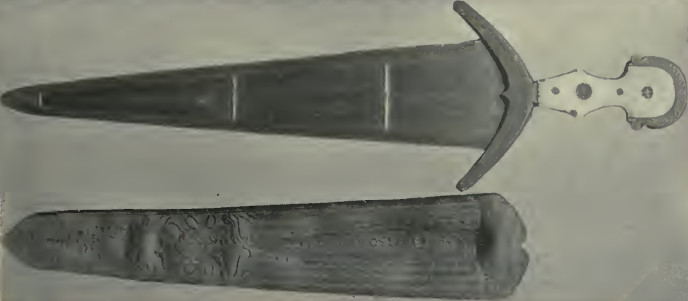
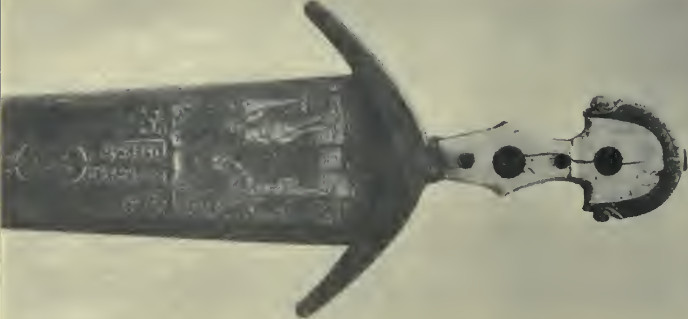
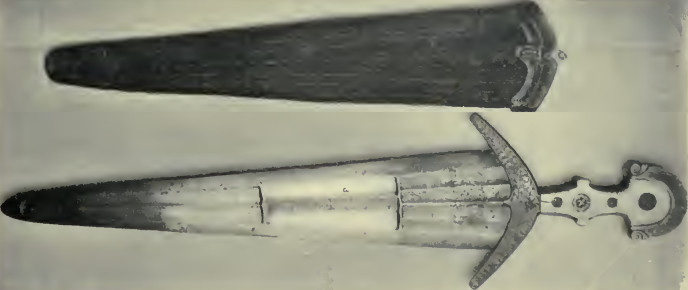
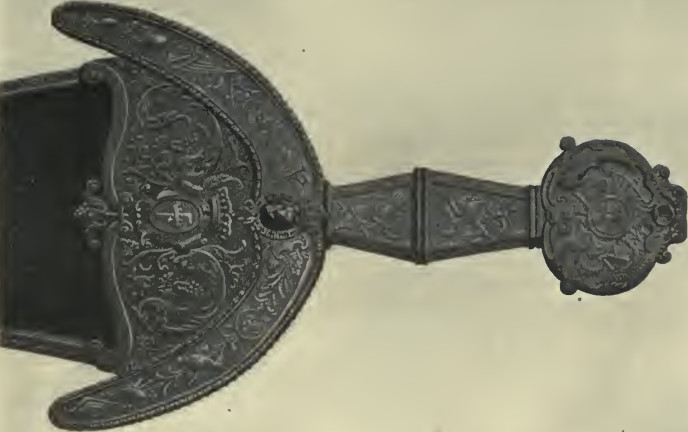
728. Dagger, late XIVth century. Found in London. Guildhall Museum .
3
729. Dagger, North German, late XIVth century. Collection: Author .
730. From the brass of 1392 of John Cray, Esquire. Chinnor Church,
Oxfordshire
4
............ 4
731. Dagger, English, about 1390. Found in the Thames at Westminster.
Collection: Mr. W. J. Pavyer
.
.
.
.
.
.
.
.
732. From the brass of Ralph de Knevyngton, 1370. Aveley Church, Essex.
After Waller
^2,2,.
Dagger, English, about 1400. Found in the Thames at Mortlake.
Collection: Mr. H. G. Keasby
734. Dagger, probably middle of the XIVth century. Found at London
Wall. Guildhall Museum
735. Dagger, probably middle of the XIVth century. London Museum .
736. Dagger, with bronze hilt, probably North Italian, early XVth
century. Collection :
Author
72)7
Quillonless bronze-hilted dagger with the crescent-shaped pommel,
probably Venetian, about 1400. Ex collection: Signor Ressman
.
738. Bronze crescent-shaped dagger pommels (actual size).
North Italian,
about 1400. Collection: Author .
.
.
739.
Bronze-hilted dagger, Venetian, about 1480. Metropolitan Museum of
New York
5
5
5
6
6
6
7
7
............ 7
740. Dagger, bronze and ebony hilt, Venetian, about 1480. Collection:
Author
7
741. From a picture attributed to Gentile Massi (Da Fabriano), showing
A Northern Italian dagger of about 1440-50
742. Dagger, probably Burgundian, about 1470-80. Collection: Mr. Henry
G. Keasby
7
.........••• 7
xi
EUROPEAN ARMOUR AND ARMS
riG.
743. From the effigy of Sir Hugh Caveley, about 1390. Bunbury Church,
Cheshire. After Stothard
744. From the brass of John Corp, 1391. Stoke Fleming Church, Devonshire.
After Waller
745. From the brass of a Franklin, about 1370. Shottesbrooke Church,
Berkshire
PAGE
9
............. 9
9
746. Basilard knife, probably XIIIth century. Found in the Thames.
London Museum
........... 10
747. Basilard dagger, late XIVth century. Found in Brook's Wharf, Upper
Thames Street. Guildhall Museum
.
.
.
.
.
.
.10
748. Basilard dagger, German, early XVth century. Found near Frankfort
on-Main. Collection: Author
749. From the effigy of Johann von Holzhausen, about 1410. Kaiser Dom
of Frankfort
750. Basilard dagger, North German, early XVth century. Collection:
Author
751. Basilard dagger, late XIVth century. Found in London. Guildhall
Museum
.
.
.
•
.
.
.
.
.
.
.
10
10
10
.10
752.
Slender basilard dagger, German, about 1420. Collection: Sir H. Farn
ham Burke, K.C.V.0
753. Dagger of basilard type. North Italian, first half of the XIVth
century. Victoria and Albert Museum
.
.
.
.
.
11
.12
754. Dagger of basilard type, French work, second half of the XIVth
CENTURY. Hermitage, Petrograd
755.
Dagger of basilard type, probably Venetian, first half of the XIVth
CENTURY. Collection: Dr. Bashford Dean, New York
.
.
12
.12
756. Dagger, English, late XIVth century. Found in- London. British
Museum
•
.
•
.
.
.
.
.
.
.
.
757. Dagger, English, late XIVth century. Enriched with figures of saints
in enamel. Found at Duston, near Northampton. Collection: Mr. Henry
G. Keasby
H
............ 14
758a;. Dagger, English, late XIVth century (side view). Found inXondon.
Guildhall Museum-14
758(5.
The same dagger, VIEWED from THE front, SHOWING THE inscription
.
759. Dagger, English, late XIVth century. Found in the Thames, West
minster. London Museum
760. Dagger, English, late XIVth century. Found in Kingsway, London.
London Museum
14
15
........... 15
xii
LIST OF ILLUSTRATIONS IN VOLUME III
FIG.
761.
From the brass of Sir Edward Cerne, 1393. Draycot Cerne Church,
Wiltshire
762. From the brass of John Cressy, Esq., 1414. Dodford Church, North
.
amptonshire .
763.
.
.
.
.
.
.
.
.
From the brass of Ystase de Seron, about 1382. Chapel of Ease at
Seron, near Forville
,
.
.
.
.
.
,
.
...........
764. Engraving by H. Schauffelin from the Theuerdank, showing the
rondel dagger
765.
766.
Rondel dagger, early XVth century. Found in Old Swan Lane, 1867.
Guildhall Museum
.
.
.
.
.
.
.
From the brass of Thomas Beauchamp, Earl of Warwick, 1401.
St. Mary's Church, Warwick
.
.
.
.
.
.
767. Rondel dagger, English, about 1400. Found at Walthamstow. London
Museum
PAGE
16
.
.
.
.
.16
.16
1 7
.17-19
............ 19
768. From the brass of an unknown knight, about 1405. Laughton Church,
Lincolnshire
.
.
.
.
.
.
.
.
.
.
............. 19
770.
.19
769. From the brass of Sir Reginald de Cobham, 1403. Lingfield Church,
Surrey
Rondel dagger, English, about 1430. Found in Upper Thames Street
on the shore of the Thames. London Museum .
.
.
.
............. 20
771.
.19
From the brass of Sir William Vernon, 1467. Tong Church, Shrop
shire
j-ji.
TJT^.
Rondel dagger, first half of the XVth century. Wallace Collection
(Laking Catalogue, No. 114)
.
.
.
.
.
.
.
.20
Rondel dagger, English, about 1450-60. Found in the Thames, London.
Collection: Mr. Henry G. Keasby
....... 20
774. Rondel dagger, probably English, about 1440. Ex collection :
Signor
Ressman
............ 21
775. Rondel dagger, English, early XVth century. Found at Brook's
Wharf, Upper Thames Street. Guildhall Museum
.
.
.
.21
776. Rondel dagger, English, early XVth century. Found in the
Clerkenwell Road in 1864. Guildhall Museum
•JTJ.
From the brass of John Daundelyon, gent., 1445. Church of St. John
the Baptist, Margate
778. Rondel dagger, English, about 1430. Found in the Thames, London.
British Museum
779. Rondel dagger, English, about 1440. Found in Horseferry Road,
Westminster. London Museum .
•
21
22
22
• . •
22
.
.
.
.
xiii
EUROPEAN ARMOUR AND ARMS
'
FIG.
j2>oa,b. Rondel dagger, probably French, about 1450. Found in a peat fen in
the north of France. Wallace Collection (Laking Catalogue, No. no).
(«)
The hilt; {b) general proportions
PACK
....... 23
781. Rondel dagger, probably English, about 1450-60. Found in the Thames.
Collection: Author
.......... 23
782. Rondel dagger, English, about 1460-70. Found at Broken Wharf,
Thames Street. London Museum
....... 25
783. Rondel d.\gger, English, about 1460-70. The scabbard, though of the
right type, does not belong to the dagger. Found in the Horseferry
Road, Westminster. London Museum
.
.
.
.
.
.
784. Rondel d.\gger and its sheath, Italian, probably Belunese, about
1470. It is said to have belonged to the Archduke Sigismund of Tyrol.
Imperial Armoury, Vienna .
.
.
.
.
.
.
.
25-27
785. Rondel d.\gger with its sheath, Burgundian, about 1480. National
Bavarian Museum, Munich
......... 27
786. Rondel dagger, Burgundian, about 1480. Ex collection: Signor
Ressman
...... ...... 27
787. Rondel dagger with its sheath, Burgundian, about 1490-15 10. Ex
collection: Bernal. Victoria and Albert Museum
.
.
.
.28
788. Rondel dagger, Burgundian, about 1500. Collection: Mr. Henry G.
Keasby
............ 28
789. Rondel dagger and sheath with Renaissance decoration, of uncertain
age, but in the style of the early years of the XVIth century.
Collection: M. Edmond Foulc, Paris .
.
.
.
.
.
790.-29
From a portrait attributed to Colin de NeufchAtel, showing the
mid-XVIth century case of a rondel dagger. Collection: Mr.
George Durlacher
.......... 29
791. Dagger or dirk, Scottish, lateXVIIth century. Ex collection :
the late
Sir Noel Paton, Royal Scottish Museum, Edinburgh .
.
.-31
792. From the brass of Sir William de Aldeburgh, about 1360. Aldborough
Church, Yorkshire
.
.
.
.
.
.
.
.
.-31
793. From the br.\ss of Robert Parys, 1379. Hildersham Church, Cam
bridgeshire
............ 32
794. Dagger, on the effigy of John Fitz-Alan, Earl of Arundel, about
1434. Church of Arundel .
'
.
.
.
.
.
.
.-32
795. Dagger, French, about 1400-20. Ex collection: Baron de Cosson.
Metropolitan Museum of New York-32
796. Dagger, French, about 1430-50. Metropolitan Museum, New York
xiv
.
2)2t
LIST OF ILLUSTRATIONS IN VOLUME III
FIC.
797. Dagger, French, about 1430-50. Multi-sectioned blade. Metropolitan
Museum, New York
..........
798. Dagger and sheath, probably Flemish, about 1450-60. Wallace Col
lection (Laking Catalogue, No. 113)
.
.
.
799. Dagger, English, about 1470. Found in Horseferry Road, Westminster
London Museum
..........
800. Dagger, English, about 1480. Found in the Thames, Westminster
Author
Collection :
801. Dagger, English, about 1480.
.........
...........
Found in London. Guildhall
Museum
...
802. Dagger, English, about 1460. Collection: Author
803. Dagger, English, about 1440-50. British Museum
804. Dagger, about 1470. Found in the Rhine. Collection: Mr. Henry G
Keasby
...........
805. Dagger and sheath, Flemish, about 1460. Ex collections: M.Victor
Gay and Baron de Cosson, now collection of Author
806. Dagger, about 1460. Collection: Author
807. Dagger, tri-quilloned type, French, about 1460. Collection: Mr. Henry
G. Keasby
...........
808. Dagger, Flemish, about 1460. Ex collection: Sir Samuel Meyrick, now
collection of Mr. Henry G. Keasby
.
...
809. Dagger, Flemish, about 1460. Collection: Mr. Henry G. Keasby
810. Dagger, Flemish, about 1460. Found in the Moselle. Collection: Mr
Henry G. Keasby
.
.
.
.
.
.
.
.
...........
811. Dagger, probably Flemish, about 1460. Collection: Mr. Henry G
Keasby
812. Dagger, probably English, about 1470. Found in London. Guildhall
Museum
............
813. Dagger, with an elaborated ivory hilt of "kidney" type. North
Italian, about 1490-1500. Wallace Collection (Laking Catalogue,
No. 116)
.
.
.
814. Dagger, WITH two views of its leather sheath. English, about 1540
From the Proceedings of the Society of Antiquaries, 16 February 1888
Dr. Figdor, Vienna
Collection :
8i5«. Dagger, WITH ITS SHEATH. English, about 1 540. Collection: Author
.......
8 1 5(5.
The SAME dagger, differently VIEWED. Collection: Author .
816. Dagger, English, about 1540. Collection: H.M. the King, Windsor
Castle
............
Ill
XV
PAGE
35
35
35
36
36
36
Zl
2,7
2>7
39
39
39
39
41
41
41
42
42
42
43
C
EUROPEAN ARMOUR AND ARMS
FIG
817. Dagger, English, ABOUT 1540. From Woodbridge, Suffolk. Collection:
Mr. Henry G. Keasby
818. Dagger and sheath, English, about 1540. Found in the thatch of a
cottage at Weldrake, Yorkshire, 1846. Collection: Mr, Henry G. Keasby
819. Dagger, English, about 1540-60. Salting Bequest to the Victoria and
Albert Museum
820. Engraving from the Theuerdank, by H. Schauffelin, showing the
" kidney "
dagger, worn in civil costume
PAGE
43
43
45
...... 45
821. Dagger, German, 1541. Victoria and Albert Museum
R.A. ;
.... 45
822. Daggers, {a) Dagger, sheath, and knives, English, about 1620. Collec
tion: Mr. S. Willson; {J}) Dagger, English, about 1620. Found in a
cottage at Gloucester. Collection: Mr. J. Seymour Lucas, R.A. ; {c)
Dagger and sheath, English, about 1620. Found in a cottage at
Gloucester. Collection: Mr. J. Seymour Lucas, R.A; [d) Dagger, with
inscription on blade, dated 1626. Collection: Mr. J. Seymour Lucas,
{e) Dagger, sheath, and knife, English, dated 1628. Collection:
Mr. H. G. Radford; (/) Dagger, English, about 1630-40. Collection:
H.M. the King, Windsor Castle
47
823. Bronze yataghan hilt, about a.d. 400-600. From Ardabil, Persia.
British Museum
824. Dagger, silvered bronze hilt, probably English, about 1480. Found
in the Thames, Westminster. Collection: Author
.
.
.
49-49
825. Dagger, iron hilt, probably Spanish, about 1500. Collection: Baron
de Cosson
826. Dagger, iron hilt, Italian (Venetian), about 1500. Wallace Collec
tion (Laking Catalogue, No. 109)
49
........ 49
827. Dagger, PROBABLY Spanish, about 1490. Collection: Viscount Astor
.
828. Daggers. («, t)
Probably North Italian, about 1500; {b, d) Hispano
MooRisii, about 1490. Ex collection: Signor Ressman, now in the
Bargello Museum, Florence .
•
.
.
.
.
.
.
.
829. Dagger, Italian, about 1500, with silver niello PLAQUt;s on the grip,
gilt plaquettes on the pommel. Ex collection: Lord Londesborough.
Metropolitan Museum, New York
.
.
.
.
.
.
50
51-52
830. Dagger, Spanish, about 1500, with silver niello plaques on the grip.
Collection: Prince Ladislaus Odescalchi, Rome .
.
.
.
.52
831. Dagger, gilt hilt, with settings of turquoise and mother-of-pearl.
In the style of the XVIth century. Metropolitan Museum, New
York
xvi
54
LIST OF ILLUSTRATIONS IN VOLUME III
FIG.
832.
833
834 «,
835
836.
837
838.
838A.
839
840.
841.
842.
843
844.
845
846.
847.
848.
849.
Dagger, Italian (Venetian), about 1500. Metropolitan Museum, New
York
Dagger, Italian (Venetian), about 1500. Wallace Collection (Laking
Catalogue, No. iii)
.
b.
Ear Daggers, with carved ivory grip.s and gold damascened mounts,
PROBABLY Spanish, about 1490. Biblioteca Ambrosiana, Milan
Ear Dagger, reputed to be the weapon with which Galeazzo Sforza
WAS murdered by Andrea Lampugnano. Biblioteca Ambrosiana, Milan
Portrait of Edward VI, showing the king wearing an "ear" pommel
dagger. Collection: H.M. the King, Windsor Castle
Dagger and sheath
—"Holbein" type, German or Swiss, about 1530
Imperial Armoury, Vienna
........
Dagger sheath from an original wash drawing by Hans Holbein, the
497- 1543. Bale Museum
Drawings of dagger sheaths by Hans Holbein
....
younger, 1
Dagger and sheath
—"Holbein " type, German or Swiss, about 1540,
Musee du Louvre
.........
Dagger and sheath, German, Landsknecht type, about 1540. Collec
tion: Mr. Henry G. Keasby
.
.
.
Dagger, German, Landsknecht type, about 1520. Collection: Mr,
Henry G. Keasby
Dagger, German, Landsknecht type, but probably of English worK'
mansihp, about 1520. Found at Brook's Wharf, Thames Street, 1866
Guildhall Museum
,
.
.
.
.
Engraving by Heinrich Aldegrever, from Die Hochzeitstanzek,
showing the " Holbein " dagger and the skirt from which the
fashion of the tonnlet was derived
..........
Pommel, Italian, about 1520. Collection: Signor Ressman, Bargello
Museum, Florence
Dagger hilt. North Italian, about 1520. Collection: H.M. the King,
Windsor Castle
...........
.......
Dagger of the cinquedea type. North Italian, about 1520-40. Collec
tion: H.M. the King, Windsor Castle
Dagger of the cinquedea type, bronze gilt hilt. North Italian, about
1520. Metropolitan Museum, New York
......
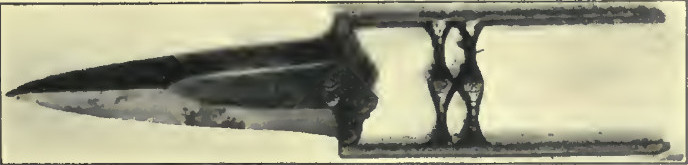
Thrusting dagger, known as a katAk, peculiar to India
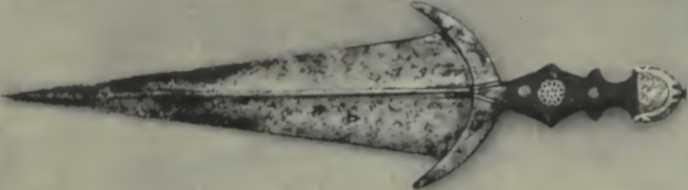
Dagger of the cinquedea type, Italian, probably Veronese, about 1440
50. Metropolitan Museum, New York
......
xvii
PAGE
54
54
55
55
56
57
57
58
59
60
60
60
61
62
63
64
64
66
^1
EUROPEAN ARMOUR AND arms:
FIG.
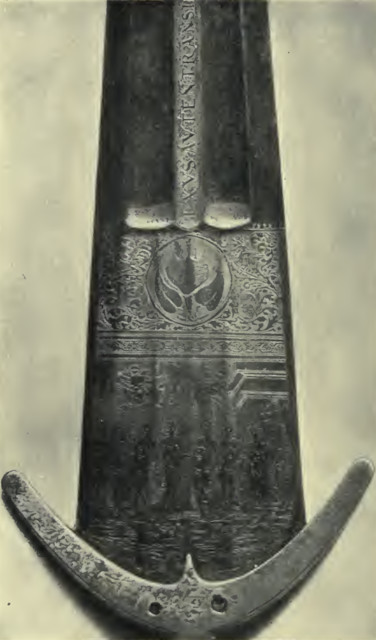
850. Blade of a cinquedea, etched and gilded in the manner of Ercole dei
FiDELi, end of the XVth century. Collection: the late Mr. Frederick
Stibbert, Florence
.
.
.
.
.
.
.
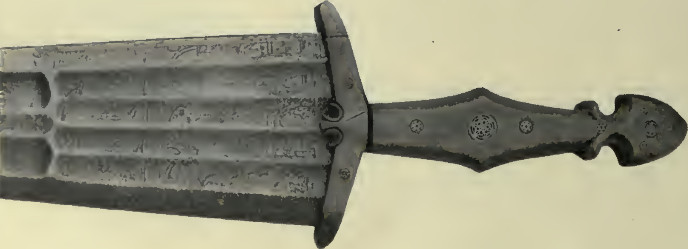
851. Cinquedea, Italian (Venetian), about 1480. Wallace Collection (Laking
Catalogue, No. 98)
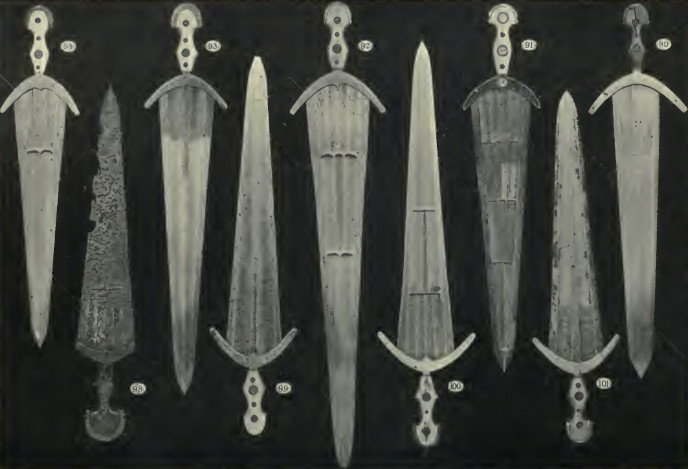
852. Nine cinquedea sword daggers of late XVth and early XVIth century
date Wallace Collection (Laking Catalogue, Nos. 90, 91, 92, 93, 94, 98, 99, 100, and 101
PAGE
.
.
.
68
69
......... 70
853. Cinquedea, Italian (Venetian), about 1500. Victoria and Albert Museum
72
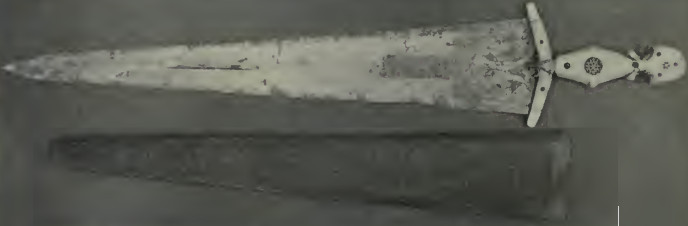
854. Cinquedea with its original scabbard. North Italian, about 1490.
Collection: H.M. the King, Windsor Castle
.
.
.
.-72
855. Cinquedea, pommel and grip overlaid with silver decorated with
niello. North Italian, about 1490-1500. Ex collection :
Lord Car
michael
............ 74
856. Cinquedea, with MOTHfeR-oF-PEARL plaques applied to the grip, North
Italian, about 1490-1500. Ashmolean Museum, Oxford .
'
•
•
857. Cinquedea with its original scabbard, North Italian, about 1490-1500.
Ex collection, Lord Londesborough
.
.
.
.
.
.
75-75
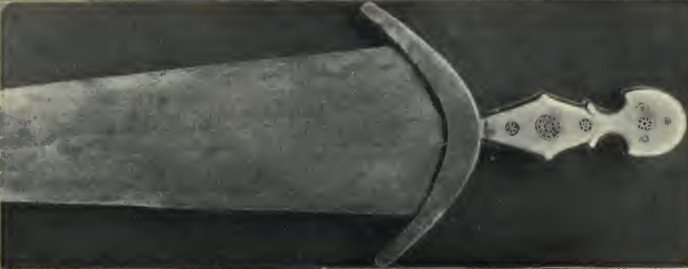
858. Cinquedea, North Italian, ABOUT 1490-1 500. Tower of London .
.
859. Cinquedea, North Italian, late XVth century, with etched blade.
Musee du Louvre
75
.......... 76
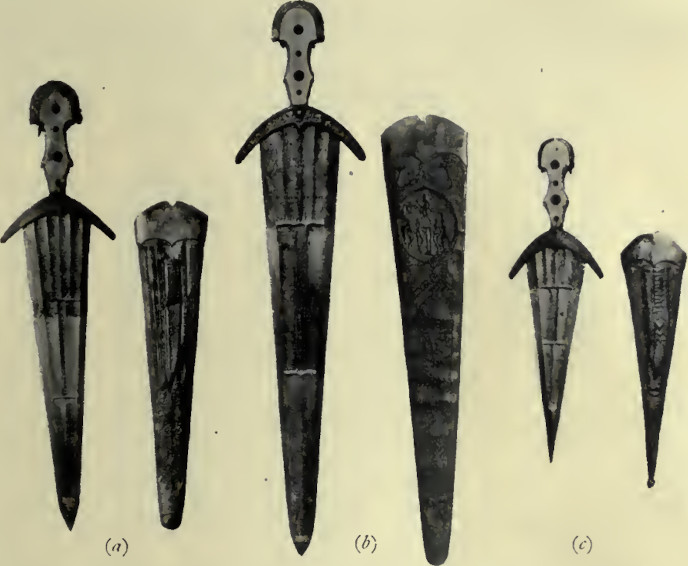
860. Cinquedea. (a) With original scabbard. North Italian, about 1490- 1500.
J 776, Musee d'Artillerie, Paris; (d)
With original scabbard, North
Italian, about 1 490-1 500. J 774, Musee d'Artillerie, Paris; (c)
With
original scabbard. North Italian, about 1490-1500. J 775, Musee
d'Artillerie, Paris .
.
.
.
.
.
.
.
.
.-77
861. Cinquedea with its original scabbard. North Italian, about 1490
1500. Musee du Louvre .-78
862. Cinquedea, Italian, probably Bolognese, about 1490-1500. Collection:
Signor Ressman, Bargello Museum, Florence
.
.
.
.
.78
863. Cinquedea with its original scabbard, probably Venetian, about 1500.
Collection: Prince Ladislaus Odescalchi, Rome
..... 78
863A. Cinquedea, said to have been presented by Charles V to Francis I.
Collection :
Prince Collorado of Prague
...... 79
864.
War lance, probably of early XVth century. Collection :
Sir Edward
Barry, Bart.
.
.
,
.
.
.
.
.
.
.
.82
865. Coronel heads of a tilting lance, (a) Late XVth century; (d)
Early
XVIth century. Imperial Armoury, Vienna
xviii
82
LIST OF ILLUSTRATIONS IN VOLUME III
FIG.
866. Central portion of the large but hollow lance, known as that of
Charles Brandon, Duke of Suffolk. Tower of London, Class VII,
No. 50
PAGE
82
867. Vamplate of a tilting lance, late XVth century. Wallace Collection .
83
868. From the picture of Mars and Venus. Painted for Lorenzo the Mag
nificent by Alessandro Filipepi, known as Sandro Botticelli. National
Gallery
869. Central portions of two tilting lances, late XVIth century. Wallace
Collection
84
............ 85
870. Swedish feather, XVIth and XVIIth centuries. Collection: the
late Mr. Rutherford Stuyvesant, New York
...... 86
871. War-hammer, probably French, first half of the XVth century.
Wallace Collection (Laking Catalogue, No. 23) .
.
.
.
.88
872. War-hammer, probably French, first half of the XVth century.
Metropolitan Museum, New York
873. War-hammer, probably French, first half of the XVth century. Ex
collection: Due de Dino. Metropolitan Museum, New York
.
.
Collection :
874. War-hammer head, Italian, or possibly Spanish, late XVth century.
Mr. Felix Joubert
875.
Mace head, probably XIVth century. London Museum
88
88
88
... 90
876. Relief figure from the sleeping guards armed with a mace, second
half of the XIIIth century. From the Easter Sepulchre, Lincoln
Cathedral
.
.
.
.
.
.
.
.
.
.
.
.90
877. Mace head of iron, possibly of the middle of the XIVth century.
Collection: M. Charles Boissonnas, Geneva .
.
.
.
.
.91
878. Mace with a head of iron, late XIVth century. National Bavarian
Museum, Munich
.
.
.
.
.
.
.
.
.-91
879. Mace, probably French, about 1470. Wallace Collection (Laking
Catalogue, No. 621)
.
.
.
.
.
.
.
.
880. Mace, French, about 1480. Collection: Baron de Cosson
.-91
... 92
881. Mace, French, about 1480. Collection: M. Charles Boissonnas, Geneva. 92
882. Mace, probably Bavarian, about 1490. From the collection of Prince
Mikhailovitch Galitzine. Now in the Hermitage, Petrograd
.
.
883. Mace, originally hafted with wood, late XVth century. Collection:
Author
92
............ 93
884. Mace, from an incised slab, late XI
Vth century. Formerly in the Church
of Culture-Sainte Catherine, Paris. After Planche
.... 93
885. Mace, Italian, about 1520. Collection: Viscount Astor .
.
.
xix
94
EUROPEAN ARMOUR AND ARMS
flG.
886. Knightly pole-axe and hammer, first half of the XVth century.
Wallace Collection (Laking Catalogue, No. 23)
PAGE
..... 96
887. Knightly pole-axe and hammer, probably French, third quarter of
the XVth century. Wallace Collection (Laking Catalogue, No. 54) .
96
888. Knightly war-hammer, third quarter of the XVth century. National
Bavarian Museum, Munich
96
889. Knightly pole-axe, third quarter or the XVth century. Ex collec
tion: Lord Londesborough. Collection: Mr. S. G. Fenton .
.
.96
890. Sir John Astley's fight with Philip Boyle at Smithfield in 1441-2.
Hastings MS.
........... 97
891. Three knightly pole-arms, (a) Pole-axe, probably French, about 1480.
Metropolitan Museum, New York; (d) War-hammer, Italian, about
1500.
Noel Paton Collection, Royal Scottish Museum, Edinburgh;
{c) Pole-axe, about 1480. The head of this weapon was found at
Newbury. Collection: Mr. Godfrey Williams
892. Douce MS., Bodleian, No. 271
893. From "The History of St. Ursula." By Vittore Carpaccio, showing
the heavy pole-hammer and the Mc/ie (Tarmes carried by the knights
and soldiers. Accademia, Venice
98
99
....... 100
894. " How A man schall be armyd at his ese when he schal fighte on foote."
Hastings MS
100
895. From ThePageantofRichardBeauchamp, Earl of Warwick. Richard
Beauchamp fighting Pandolph Malatete en champ clos, armed with war
hammers, showing the protective rondels on the hafts .
.
.
.101
896. From a woodcut. No. 18, Lirer Swabian Chronicle, about 1484. Graf
von dem Rotenfan fights for the honour of Queen Kathay .
.
.102
896A. Pole-axe, probably English, early XVIth century. K 84, Musee
d'Artillerie, Paris .
.
897. Pole-axe, probably Burgundian, about 1480. Ex collections: Meyrick
and Noel Paton. Royal Scottish Museum, Edinburgh
103
.... 103
898. The " Luzern" hammer, Swiss, about 1560. Collection: Author .
.
899. Glaives, (a) Italian (Venetian), early
XV Ilth century. Wallace Collection
(Laking Catalogue, No. 740) ;
{d) Probably made in Italy for Francois
de Bourbon, Due de Montmorency, 1539- 1592. Wallace Collection
(Laking Catalogue, No. 733)
103
........ 105
900. From the side of a carved ivory casket of the early XIVth century,
SHOWING A warrior ARMED WITH A SHIELD AND A HAFTED WEAPON, NOW
TERMED THE VOULGE
.......... Io6
XX
LIST OF ILLUSTRATIONS IN VOLUME III
FIG.
goia. Hafted weapon that might be termed the voulge, late XVth century,
Ex collection: Baron de Cosson
90i<5.
Hafted weapon that might be termed the voulge, late XVth century
Ex collection: Baron de Cosson, now Tower of London
.......
....... ....
902. Spetum, about 1480. Noel Baton Collection, Royal Scottish Museum
Edinburgh
903. Spetum, Italian, about 1530.
K 514, Musee d'Artillerie, Baris
904. Spetum, Italian, about 1530. Wallace Collection (Laking Catalogue
No. 339)
905. Bartizan, Italian, ABOUT 1540.
K 394, Musee d'Artillerie, Baris
906. Bartizan, about 1480. National Bavarian Museum, Munich .
907. Hafted weapons, inclusive of the bill, from the perished frescoes of
THE first half OF THE XIIIth CENTURY. Formerly in the Bainted
Chamber, Westminster
.
.
.
.
.
.
908. Bill head, late XVth century. National Bavarian Museum, Munich
909. Bill head, early XVIth century. Noel Baton Collection, Royal Scottish
Museum, Edinburgh
.........
910. Large bill, early XVIIth century, etched with the arms of Louis XI11
OF France. K 197, Musee d'Artillerie, Baris
....
911. Small Bill, EARLY XVIth century. Tower of London .
912. Bill, Italian, early XVIth century. Wallace Collection (Laking Cata
logue, No. 310) .
913. Bill, early XVIth century. Noel Baton Collection, Royal Scottish
Museum, Edinburgh .
.
.
.
.
.
.......
914. "Brown" Bill, English, late XVIth century. Found at Sudbury
Suffolk. Collection: Author
915. Miniature bill, probably of English workmanship, early XVIth cen
TURY. Wallace Collection (Laking Catalogue, No. 724)
916. Guisarme, late XVth CENTURY. Tower of London
917. Guisarme, LATE XVth CENTURY. Collection: Baron de Cosson
918. Fighting AXE, LATE XIVtii century. Wallace Collection (Laking Cata
..........
logue. No. 20)
919. Fighting axe, probably from Northern Europe, late XIVth century
Metropolitan Museum, New York
......
920. Austrian bardische, first half of the XVth century, probably decor
ated in Venice. Metropolitan Museum, New York .
921. Lochaber axe, Scottish, early XVIIth century. Noel Baton Collec
tion, Royal Scottish Museum, Edinburgh
xxi
.....
PAGE
106
106
108
108
108
109
109
.
I I I
I 12
I
12
I 12
H3
114
114
116
116
117
117
117
117
EUROPEAN ARMOUR AND ARMS
FIG.
922.
923
924.
925
926.
927.
928.
929.
930
931
932.
933
934
935
936.
937
LOCHABER AXE, PROBABLY SCOTTISH, EARLY XVI ItII CENTURY. K 74, Mus^e
d'Artillerie, Paris
...........
LoCHABER AXE, SCOTTISH, LATE XVI ItH CENTURY. ToWCr of London
Battle-axe, of the type of the Jedburgh axe, probably of early
German XVIth century. K 69, Musee d'Artillerie, Paris
Hacberd of the voulge type, commonly known as the " Sempach " hal
berd, early years of the XVth century. Collection :
M. Charles
Boissonnas, Geneva
..........
Halberds, (a) German or Swiss, about 1440. Collection: M. Charles
Boissonnas, Geneva; (d)
German or Swiss, about 1450. Wallace Collec
tion (Laking Catalogue, No. 341); (c) German, about 1460. Collection:
M. Charles Boissonnas, Geneva; (d) German, about 1470. Ex collec
tion: Baron de Cosson; (e) Swiss, about 1460. Collection: M. Charles
Boissonnas, Geneva; {/) Probably German, about 1470. Wallace
Collection (Laking Catalogue, No. 333)
Military flail, probably late XVIth century. Noel Paton Collection,
.......
Royal Scottish Museum, Edinburgh
Holy water sprinkler, Swiss, late XVIth century. Collection :
M.
........
Charles Boissonnas, Geneva
Morning star, late XVIth century. Found in the valley of Conches,
Haut-Valais, in 191 2. Collection: M. Charles Boissonnas, Geneva
The head of " King Henry ye 8th walking staff," early XVIth cen
tury. Tower of London
.........
............'
Secret ranseur, Italian, middle of the XVIth century. Tower of
London
" Les Chroniques d'Angleterre "
(temp. Edward IV). Roy. MS. 14,
E. iv, fol. 210, British Museum
........
The great wall crossbow compared in size to the ordinary crossbow
and archer's PAVOis. National Bavarian Museum, Munich .
Drawing showing the working, of the windlass a tour
....
Crossbow with stirrup, probably Italian, about 1490- 1500, presented
by King Louis XII of France to the Archduke Philip of Austria.
Imperial Armoury, Vienna
.........
.....
Crossbow, German, about 1460, which belonged to Ulrich V of Wur
temberg. Metropolitan Museum, New York
Crossbows, {a) German, dated 1575, showing the moulinet in position.
From the Franz Thill Collection, Vienna; {b) German, about 1470-80,
showing the twisted cord. From the Franz Thill Collection, Vienna .
xxii
PAGE
118
118
118
120
122
123
123
123
125
129
131
132
134
135
LIST OF ILLUSTRATIONS IN VOLUME III
FIG.
938. Crossbow, probably NorthernFrench, about 1470. Wallace Collection
(Laking Catalogue, No. 143)
.
.
.
,
.
.
939. Crossbow, Spanish, about 1550, made by Juan de Ensinas for Ferdinand,
King of the Romans, younger brother of Charles V. Wallace Col
lection (Laking Catalogue, No. 1327) .
.
.
.
.
940. Crossbow levers. Wallace Collection (Laking Catalogue, Nos. 1287 and
1291)
941. Crossbow with attached lever showing methods of discharge, French,
about 1570. Tower of London .
.
.
.
.
,
942. Miniature reproduced from the MS. of Gaston Phoebus, showing the
bending of the crossbow by means of the graffle. National Library
of France
PAGE
.
.
.
.136-138
139
,140
............ 141
943. The double cords AS used ON the ^A-iJ^zAr^ iy.-i/.£7'
.
.
.
.142
944. Crossbow prodd, Italian, late XVIth century, showing the use of the
double strings. Wallace Collection (Laking Catalogue, No. 1018)
.
» 945. Pistol arbalete, Nuremberg make, end of the XVIth century. Col
lection: Author .
.
.
.
.
.
.
.
.
.
142
.143
946. Bolt heads of various types, XVth and XVIth centuries. From
various collections
.
.
.
.
.
.
.
.
.
.144
947. Bow stave of yew. Recovered from the wreck of the " Mary Rose,"
sunk near .Spithead in 1545. Tower of London
..... 145
948. Mail caparisons as depicted on a fresco from the Painted Chamber,
Palace OF Westminster, EARLY XII Ith CENTURY.
949.
.... 148
Mail caparisons as depicted on a fresco from the Painted Chamber,
Palace OF Westminster, EARLY XII Ith CENTURY.
.... 149
950. Seal OF Patrick Dunbar, iotii Earl of March, 1292
95 1 .
.... 149
A probable Celtic bronze chanfron, found at Torrs, Kirkcudbright
shire. National Museum of Antiquities, Edinburgh
.... 149
952. From a miniature in the Hofbibliothek, Munich, about 1350. After
John Hewett
............ 149
953. From a miniature, showing chanfron and crinet. Add. MSS. 15477,
British Museum
........... 149
954. Chanfron, profile view, about 1370.
G 578, Musee d'Artillerie, Paris .
150
955. Chanfron, front view, about 1370.
G 578, Musee d'Artillerie, Paris '. 150
956. Carved ivory chessman, about 1370. Formerly in the collection of the
Rev. J. Eagles
.
.
.
.
.
.
.
.
.
.
.150
957. Two Views of a chanfron, late XIVth century. Warwick Castle Arm
oury. After Grose
.
.
.
.
.
.
.
.
.
III
xxiii
d
151
152
LIST OF ILLUSTRATIONS IN VOLUME III
FIG.
973. Bronze gilt rowel spurs. (a) Italian, about 1380; (d) Italian, about
1370; (c) Italian, about 1370. Collection: the late Signor Ressman,
Bargello Museum, Florence .
.
.
.
.
.
.
974. Bronze rowel spur, probably German, about 1440. Collection: the late
Signor Ressman, Bargello Museum, Florence
.
.
975. Cantle plate of a saddle in carved ivory, North Italian, first half
OF THE XIIIth century. Musee du I ouvrc
976. Cantle plate of a saddle in carved ivory, probably Italian, first
quarter OF the XIVtii CENTURY. Musee du Louvre .
.
977. BoNE-COVERED SADDLE OF WeNZEL I,
KiNG OF THE ROMANS, ABOUT 1380.
Imperial Armoury, Vienna .
.
.
.
.
.
.
978. BoNE-COVERED SADDLE, PROBABLY ITALIAN, LATE XIVtII CENTURY. Metro
politan Museum, New York .
.
.
.
979.
.
.
.
BoNE-COVERED SADDLE, ITALIAN, EARLY XVtH CENTURY. Metropolitan
Museum, New York .
.
.
.
.
.
.
.
980. BoNE-COVERED SADDLE, GeRMAN, OR POSSIBLY ITALIAN, FIRST HALF OF THE
XVth CENTURY. Ex collection: Meyrick. Now in the Wallace
Collection (Laking Catalogue, No. 296)
.
.
.
.
981. BoNE-COVERED SADDLE, GeRMAN, FIRST HALF OF THE XVtH CENTURY.
Wallace Collection (Laking Catalogue, No. 298) .
.
.
982. Saddle covered with gesso duro. North Italian, middle of the XVth
CENTURY. Wallace Collection (Laking Catalogue, No. 297) .
PACE
.
.
.
.
.
.
.
.
.
.168
.
(68
169
.169
.170
.170
•
'7i-173-173-173
983. Bone-covered saddle, German, EARLY XVth CENTURY. Tower of London 174
984. BoNE-COVERED "SADDLE, ITALIAN, MIDDLE OF THE XVtH CENTURY. Ex
collection: Herr Richard Zschille .
.
.
.
.
.
.
.174
985. BoNE-COVERED SADDLE, ITALIAN, FIRST HALF OF THE XVtH CENTURY. Col
•
.
.
.
.
.
lection :
Signor S. Bardini, Florence .
986. Chanfron AND CRINET. From Monsieur E. Fremiet's equestrian statue ot
the Due d'Orleans
.
.
.
.
.
.
.
•
.
175
.176
987. Equestrian armour, composite and of French character, about 1475.
G I,
Musee d'Artillerie, Paris
988. Equestrian armour, comprehensively French, about 1475. Wallace Col
lection
989. Verrocchio's equestrian statue of Bartglommeo Colleoni, Venice, cast
BY LeOI'ARDI about 1476
.
•
•
.
•
.
.
.
.
990. Donatello's equestrian statue of General Gattamelata, Padua
.
991. St. George. From the painting by Vittore C'arpaccio in the Scuola
of San Giorgio degli Schiavoni, Venice
XXV
^n
179
180
iSi
182
EUROPEAN ARMOUR AND ARMS
KIG.
992. From Vittore Carpaccio's picture of " The Ten Thousand Martyrs."
Accademia, Venice
.
.
.
.
.
.
993. Equestrian armour, composite, but comprehensively Italian, about
1460-70. Collection: the late Mr. Frederick Stibbert, Florence.
994. Chanfron, probably Spanish, about 1480. From the armoury of
Charles V. F no, Royal Armoury, Madrid
995. Chanfron, late XVth century, traditionally supposed to have been
used by Francis I at the battle of Pavia. From the armoury of
Charles V. F 113, Royal Armoury, Madrid
996. Chanfron in the flamboyant "Gothic" style, French, about 1480.
The Rotunda, Woolwich .
.
.
.
.
997. Chanfron, about 1480. Collection: Sir Edward Barry, Bart.
998. Chanfron, possibly Italian, 1470. Collection: Mr. Alfred W. Cox,
Glendoick, Perthshire
.
.
.
.
999. Chanfron, possibly English, about 1500. Collection: H.M. the King,
Windsor Castle .
.
.
.
.
.
.
1000. Equestrian armour made for Rupert, Count Palatine of the Rhine,
Augsburg WORK, about 1502. Imperial Armoury, Vienna .
1
001. PoiTREL, FROM AN EQUESTRIAN SUIT, ABOUT 1500. Tower of London
1002. Horse armour, possibly an Italian foundation worked upon in Ger
many, ABOUT 1500-10, presented BY THE EmPEROR MAXIMILIAN ELECT
TO King Henry VIII. Tower of London
PAGE
.
.
.
.
.
.
.
.
.
.183
.
.
.
.
184
185
185
186
186
.187
.187
.
.
.
189
190
...... 192
1003. Equestrian armour, probably decorated in England about 15 15 to
complete the Seusenhofer suit sent by the Emperor Maximilian I
to King Henry VIII. Tower of London
...... 193
1004. The harnischmeister of the Archduke Maximilian of Austria, 1480,
showing a complete equestrian armour. From a picture in the
Imperial Armoury, Vienna . .
.
.
.
.
.
.
1005. From Hans Burgkmaier's "Trumph OF Maximilian"
.195
.... 196
1006. Croupi£re for a horse in cuir bouilli, one of a large number
purchased in 1547 for the Scottish campaign. Tower of Lon
don
............. 197
1007. Padded poitrel for jousting, known as the uourt ok stechkissen, late
XVth century. Imperial Armoury, Vienna
1008. From Hans Burgkmaier's "Triumph of Maximilian," showing the
padded hourt in position .
198
• 1
.
.
.
.
.
.
.
J009. A " blind " chanfron made in 1530 for Ferdinand I. Imperial Armoury,
Vienna
.
.
.
.
.-.
.
.
.
.
.
99
.199
xxvi
LIST OF ILLUSTRATIONS IN VOLUME III
FIG.
loio. Model of a German jousting harness of about 1540 with the horse
ARMOUR, SHOWING THE HORSE AND THE PADDED STECffA'JSSEJVlH POSITION.
National Bavarian Museum, Munich
PAGE
....... 200
101 1.
Saddle of wood covered with hide and partly with canvas. Tower of
London. From the collection of the Baron Peuker, Berlin .
.
.
1012. Equestrian armour made for Maximilian I,
the Emperor, in Nurem
berg, about the year 1508. Imperial Armoury, Vienna .
.
.
1013. Equestrian armour made by Sigismund Wolf of Landshut in 1554 for
Philip II of Spain. A 243 to 262, Royal Armoury, Madrid
.
.
1014. Chanfrons. («)
From the armour of Henry, Prince of Wales, English,
Greenwich School, early XVI Ith century. Collection: H.M. the King,
Windsor Castle ; [b) Italian, first half of the XVIth century. Wallace
Collection (Laking Catalogue, No. 137); {c) English, late XVIth cen
tury. From the armour of George Clifford, Earl of Cumberland, 1558
1605. Tower of London; (d) German, under Italian influence, first
half of the XVIth century. Tower of London ;
(e)
French (remade),
first half of the XVIth century. Metropolitan Museum, New York ;
[/) Probably English, early XVIIth century. Tower of London
.
1014A. Sword, probably French and of about 1340, the pommel bears the
arms OF the house of Dreux. Collection: Mr. S. J.
Whawell .
1015. The horse armoury of the Tower of London in 1809. After Rowland
son. From Ackermann's " Microcosm of London "
.
.
.
151 1
201
202
204
205
.'
207
.215
1016. Suit of armour presented to Henry VIII, made some time between
and 1^14 for the Emperor Maximilian I of Germany, the
work of Conrad Seusenhofer of Innsbruck. Tower of London .
219
1017. From a drawing dated 1510 (signed A. D ).
A sui.t of armour much
like the Henry VIII Seusenhofer suit in the Tower. Gallery of
Engravings, Berlin
.
.
.
.
.
.
,
.
.
.220
1017A. Tonnlets. Riggs Collection, Metropolitan Museum, New York .
1018. Suit of armour for fighting on foot, made- for King Henry VIII,
probably English, first quarter of the XVIth century, (a) Front
[b)
Back view. Tower of London
.221
view ;
...... 223
1019. Inside view of the culette of the suit illustrated in fig. 1018, show
ing THE working of THE SLOTTED ALMAINE RIVETS. Tower of
London
.
.
.
.
.
.
.
.
.
.
.-225
1020. Suit of armour for fighting on foot, made for Henry VIII, first
QUARTER of THE XVItH CENTURY, POSSIBLY ENGLISH, PRODUCED UNDER
Italian influence. Tower of London
...... 226
xxvii
EUROPEAN ARMOUR AND ARMS
FIG.
•
I02I a, b. Suit of armour for man and horse, probably of French make,
DATED 1537, BY TRADITION MADE FOR JaCQUES GoURDON DE GeNOUILHAC,
Grand Master of artillery to Francis I,
showing {a)
the armour as
WORN WHEN MOUNTED, WITH SADDLE AND HORSE ARMOUR, AND [d)
THE
ARMOUR ON A DISMOUNTED FIGURE. Formerly in the possession of the
Duchesse d'Uzes, now in the Riggs Collection, Metropolitan Museum,
New York .
.
.
.
.
.
.
.
.
1022. Locking gauntlet of the Genouilhac suit, showing the design of
THE etching
.
.
.
.
.
.
.
.
1023. One part of the great suit of armour made for Henry VIII, prob
ably OF French make, about 1540. With the exception of the
saddle steels, the horse armour is associated. Removed from the
Tower of London to Windsor Castle in 1914 by command of H.M.
the King
PAGE
.
.
.
.
.229
.231
............ 232
1024. The other part of the great suit of armour, also illustrated in
FIG. 1023, made for Henry VI 11.
The poitrel and croupiere are asso
ciated. Tower of London
......... 233
1025.
A " falling "
buffe, etched. Tower of London .
.
.
.
.
1026. Brayette, belonging to the suit illustrated in figs. 1023 and 1024.
Removed from Windsor Castle to the Tower of London in 1914 by
command of H.M. the King
234
........ 234
1027.
A locking gauntlet, a bridle mitten gauntlet, a pair of cuisses, two
grand-guards, a pair of mitten gauntlets, a reinforcing elbow
plate, and the cantle plates of a saddle. Removed from Windsor
Castle to the Tower of London in 1914 by command of H.M. the King 235
1028. Plates, probably from the croupiere of the horse armour, Henry VIII
suit. Removed from Windsor Castle to the Tower of London in 1914
by command of H.M. the King .
.
.
.
.
.
.
1
028a. Reinforcing plate of the breastplate of the Genouilhac suit show
ing the designs of the etching
236
....... 237
1029. The Emperor Maximilian at his armourer's. From the Weiss Kunig .
240
1029A. Gothic pauldrons {a, b).
The Rotunda, Woolwich
.
.
.
.241
1030. Suit of armour, stated to have been made for Count Andreas von
SoNNENBURG, about 1508, BY KOLOMAN KoLMAN OF AuGSBURG.
Imperial Armoury, Vienna
......... 242
1031. Suit of armour, probably Italian, but in the German fashion, first
QUARTER OF THE XVIth CENTURY. Wallace Collection (Laking
Catalogue, No. 316) .
.
.
.
.
.
.
xxviii
.
.
.
242
LIST OF ILLUSTRATIONS IN VOLUME III
FlC'
103 1 A. Breastplate, early XVIth century, bearing the marks of one of the
Seusenhofer FAMILY. Collection: Mr. S. J. VVhawell
.
1032. Suit of armour, German (Nuremberg), first quarter of the XVIth
century. Collection: the late Mr. Frederick Stibbert, Florence
1033. St. George. From the picture of " St. George and the Dragon," by
Paris Bordone
PAGE
•
.
.
.
243
244
........... 245
1034. Suit of armour, said to have been made for Count Eitel Friedrich von
ZoLLERN, about 1503, OF ITALIAN FASHION. Imperial Armoury, Vienna 247
IO34A. CUISSE, KNEE-COP, JAMB, AND SOLLERET, FROM THE SO-CALLED BayARD SUIT.
The Rotunda, Woolwich
......... 247
1035. Part of a suit of armour, probably made for Charles de Bourbon,
Constable of France, Italian (Milanese), Missaglia School, first
quarter of the XVIth century. Riggs Collection, Metropolitan
New York
1036. Suit of armour, German (Nuremberg), first quarter of the XVIth
century. Ex collections: Lord Stafford at Costessey Hall, Norfolk;
Cosson; Stuyvesant Collection. Now on loan to the Metropolitan
Museum, New York
248
.......... 250
1036A. Breastplate. The Rotunda, Woolwich
251
1037. Suit of armour (composite), German (Nuremberg), first half of the
XVIth century. Ex Dino Collection, Metropolitan Museum, New York 253
1038. Suit of armour (composite), German (Nuremberg), middle of the
XVIth century. Ex Meyrick Collection. Now Wallace Collection
(Laking Catalogue, No. 779)
.
.
.
.
.
.
.-253
1039. Suit of armour (slightly composite), (a) front view; (d) profile
VIEW.
Possibly the work of Franz Scroo of Brussels, first
quarter of the XVIth century. Ex Dino Collection, Metropolitan
Museum, New York
.......... 255
1040. Suit of armour, .said to have been made for Wilhelm, Freiherr von
Rogendorf by Koloman Kolman of Augsburg about 1520. Imperial
Armoury, Vienna
.......... 259
104 1. Slashed armour, as represented in Jacopo da Pontormo's (Carrucci's)
portrait of Ippolito de' Medici in the Pitti Palace, Florence
.
1042. Portions of a suit of armour, German, first quarter of the XVIth
century. Ex Meyrick Collection. Wallace Collection (Laking Cata
logue, No. 380)
1043. Portions of part of a slashed suit, German, first quarter of the
XVIth century. Tower of London. Purchased in 1841 .
.
.
xxix
261
262
263
EUROPEAN ARMOUR AND ARMS
FIG.
•
1044. Right arm-piece of a slashed suit, German, first quarter of the
XVIth century. It was apparently never finished. Collection: Ladj'
Zouche, Parhani
PAGE
........... 263
1045. Suit of armour for fighting on foot, Italian (Milanese), School of
MissAGLiA, dated 1515. Probably made for Giuliano II or Lorenzo II
de' Medici. G 179, Museed'Artillerie, Paris
264
1046. Armour made for fighting on foot, Italian (Milanese), School of
Negroli, first quarter of the XVIth century. G 178, Musee
d'Artillerie, Paris
.......... 266
1047A. Effigy of the Constable de Montmorenci. Preserved in the Louvre,
Paris
............. 267
1047B. The armour of the Constable de Montmorenci in Wilton House.
Collection: The Earl of Pembroke and Montgomery
.... 267
1047c. The armour of Louis de Bourbon, Due de Montpensier, in Wilton
House. Collection: The Earl of Pembroke and Montgomery .
.
1047D. The armour of the Constable de Montmorenci, with the helmet
worn by him at Dreux. Musde d'Artillerie, Paris
267
.... 267
1047E. Portrait of the Constable de Montmorenci. From Jakob Shrenck von
Nozing's series published in 1601
... .
.
.
.
.271
1048. Suit of armour, said to have been m.\de for Fran.cis I
of France,
probably the work of one of the Kolmans of Augsburg, about
1530-35.
G 117, Museed'Artillerie, Paris.
.
.
.
.
1049. Suit of armour, with the mark on the breastplate of one of the
Kolmans of Augsburg, about 1540. Wallace Collection (Laking
Catalogue, No. 402) .
.
.
.
.
.
.
.
.
.
1050. Suit of armour, made for Lazarus Schwendi, Freiherr von Hohen
landsberg, probably produced at Augsburg, but decorated by
Peter Speier of AnnabeRg about 1550-60. Imperial Armoury,
Vienna
1
274
274
............ 275
05 1. Classically fashioned suit of armour, presented to Charles V
BY GuiDOBALDO II,
DuKE OF Urbino, IN 1546. Made by Bartolommeo
Campi of Pesaro in 1546.
A 188, Royal Armoury, Madrid
.
.
1052. From a picture attributed to Jacinto Geronimo de Espinosa, in which
one OF THE FIGURES IS DEPICTED WEARING THE SUIT ILLUSTRATED IN
Fig. 105 1. Collection: the late Sir Charles Robinson, C.B.
.
.
1053. Pair of stirrups made, in the opinion of the author, for the suit
ILLUSTRATED IN FiG. 1051. Salting Collection, Victoria and Albert
Museum
277
280
............ 282
XXX
LIST OF ILLUSTRATIONS IN VOLUME III
^"''
1054. Breastplate fashioned on classical lines, made by Bartolommeo Cami'i
OF Pesaro akout 1540. probably for Duke Guidobaldo II ok
Urbino. From the ancient armoury of the Medici. Bargello Museum,
Florence
PACE
............ 286
1055. Half suit of armour, made for Antonio Martinengo III, Italian
(probably Milanese), about 1560. C 11, Royal Armoury, Turin
.
Negroli.
1056. Breastplate, Italian (Milanese), about 1540. Signed by Paolo
Ex collection :
Magniac. Now in the Riggs Collection,
Metropolitan Museum, New York
287
....... 290
1057. Breastplate, taces, and tassets, by Filippo Negroli of Milan, about
1540. Musee du Louvre .
.
.
.
.
.
.
.
.291
1058. Backplate and garde-de-rein, belonging to the breastplate illus
trated in Fig. 1057
1059.
1060.
Half suit of armour. Originally in the collection of the Archduke
Ferdinand of Tyrol. Attributed by the late Herr W. Boeheim as
the work of Giovanni Battista Serabaglio of Milan. Middle of the
XVIth century. Imperial Armoury, Vienna
.
.
.
.
.
UArmure Aux Lions, Italian (probably Milanese), about 1560.
G 50,
Musee d'Artillerie, Paris
.
.
.
.
.
.
... .
106 1. Suit of armour for a youth, probably of French workmanship under
Italian influence, late XVIth or early XVIIth century. Tower
of London
292
293
296
............ 298
1062. Part of a series of suits (all one set), made for the Emperor
Charles V by Koloman Kolman of Augsburg in the second quarter
OF the XVIth century. A 19, Royal Armoury, Madrid .
.
.
1063. Interchangeable elbow-cops from the suit (fig. 1064). In an English
private collection
304
.......... 306
1064. Part of a series of suits (all one set).
Made for the Emperor
Charles V by the brothers Negroli of Milan and dated 1539.
A 139, Royal Armoury, Madrid.
.
.'
1065. Part of a series of suits (all one set), German work, dated 1544.
It is known as the Muhlberg armour. Royal Armoury. Madrid
.
1066. Titian's portrait of the Emperor Charles V at the battle of
Muhlberg. Charles V is portrayed wearing portions of the suit (Fig.
In the Prado, Madrid
1065).
1067. Reconstruction from Titian's portrait of the Emperor Charles V
showing the Emperor wearing the Muhlberg suit. A 164, Royal
Armoury, Madrid
III
xxxi
€
307
308
309
309
EUROPEAN ARMOUR AND ARMS
FIC.
1068. Suit of armour with its interchangeable parts, probably the work
«
of Desidkrius Kolman of Augsburg, about 1550. Ex collections:
Bernaj, Londesborough, and Dino. Now in the Metropolitan Museum,
New York .
.
.
.
.
.
.
.
.
1069. Portions of a suit of armour, German work, probably that of
Koloman Kolman of Augsburg, about 1540. Wallace Collection
(Laking Catalogue, No. 428)
.
.
.
.
.
1070. Composite suit of armour which, with the exception of the breast
plate, backplate, gorget, taces, and tassets, is part of a great
HARNESS made FOR KiNG PhILIP OF SPAIN IN ABOUT 1554 BY WoLF OF
Landshut. Ex collection: Dino. Now Metropolitan Museum, New
.
.
.
.
.
.
.
.
York .
1071. Escutcheon from the chanfron of the Philip II (1554) harne.ss,
showing the arms of England borne in pretence on the arms of
Philip II.
A 261 and 262, Royal Armoury, Madrid .
1072. Suit of armour, made for Philip, when Infante, by Desiderius Kolman
OF Augsburg, assisted by Jorg Sigman, between 1549 and 1552.
A 239-242, Royal Armoury, Madrid .
1570.
.
.
.
1673. Portrait of Philip 1 1,
painted by Alonzo Sanchez Coello about
The King is seen wearing the armour shown in Fig. 1072,
made for him as Infante between 1549 and 1552. Collection: Sir
John Stirling Maxwell
.
.
.
.
.
.
1074. Saddle belonging to the suit (fig. 1072), showing the front saddle
steel. Royal Armoury, Madrid
.
1075.
.
.
.
PAGE
.
.
.
.
.
.
.
.
.
.
.310-314
.
.
.
.
.316-317
.318-319
.322
Back SADDLE STEEL OF the same SADDLE. A 242, Royal Armoury, Madrid 322
1076. Chanfron belonging to the suit (fig. 1072). Musee d'Artillerie, Paris,
now in the Royal Armoury, Madrid .
.
.
.
.
.
.324
1077. Palettes from the suit (fig. 1072). Musee d'Artillerie, Paris, now in
the Royal Armoury, Madrid
........ 324
1078. Interchangeable elbow-cops belonging to the suit (fig. 1072) to be
worn over a chain mail shirt. Mus^e d'Artillerie, Paris, now in
the Royal Armoury, Madrid
1079.
........ 324
Interchangeable gorget, belonging to the suit (fig. 1072), to be worn
WITH THE elbow-cops (fIG. IO78) OVER A CHAIN MAIL SHIRT. Royal
Armoury, Madrid
.
.
.
.
.
.
.
.
.
.325
1080. Suit of armour, said to have been made for King Sebastian of
Portugal (1554- 1 578), THE work of Anton Peffenhauser of Augs
burg. A 290, Royal Armoury Madrid
xxxii
326
LIST OF ILLUSTRATIONS IN VOLUME III
"f
io8r. Suit of armour, ./ /../ faco.v d'/t.i/je, hut prcjhahly tmk work of a
Wolf of Lanoshut, about 1550. The Arsenal. Venice .
1082. A half suit of armour, probahly made for Don Gonzalo ue Cordoba,
DuKK OF Sessa, Italian, in the first manner of Lucio Picinino of
Milan, about 1560. Metropolitan Museum, New York .
1083. Chanfron belonging to the Sessa suit (fig. 1082), Italian, in the first
manner of Lucio Picinino of Milan, about 1560. Riggs Collection,
Metropolitan Museum, New York
PACK
.
.
.
328-331
....... 333
1084. Suit of armour, i'Robably made for Alessandro Farnese, Duke of
Parma, Italian, in a later manner of Lucio Picinino of Milan,
about 1570. Imperial Armoury, Vienna
1085.
...... 334
Half suit of armour, stated by Sir Samuel Meyrick to have been
MADE for Alfonso II, Duke of Ferrara, Italian, ix a later
manner of Lucio Picinino of Milan, about 1570. The morion head
piece is associated, and does not belong to the remainder of the armour.
Wallace Collection (Laking Catalogue, No. 483)
.... 336
1086. Half suit of armour (incomplete), Italian, in a later style of
Lucio Picinino of Milan, about 1580. Wallace Collection (Laking
Catalogue, No. 473)
1087. Breastplate, Italian, in a later style of Lucio Picinino of Milan,
ABOUT 1570. Collection: Mr. D. M. Currie
1088. Half suit of armour, presented by the Duke of Terranova to the .
Infante, afterwards KIng Philip III, Italian, in a later manner
of Lucio Picinino, about 1590. B 4, Royal Armoury, Madrid .
.
io88a. Saddle steels. The work of Antonio Picinino. Collection: the late Earl
Kitchener of Khartoum, K.G. .
.
.
.
.
.
.
338
339
340-341
1089. From the small equestrian portrait of Henri II, attributed to Jean
Clouet. The suit the King is wearing is that shown in Fig. 1090.
Formerly in the collection of the King of Holland, later in the Magniac
Collection. Now in that of Madame Steinkoff
..... 343
1090. Suit of armour that belonged to Henri II of France, of unknown
workmanship, about 1550. From the collection of Colbert, minister
to Louis XIV. Ex collections: M. Stein and M. Sigismund Bardac.
Now in the collection of Viscount Astor of Hever
1
.... 345
09 1. Suit of armour, made for Henri II of France by an unidentified
armourer, ABOUT 1550.
G 118, Musce d'Artilleric, Paris .
.
.
1092.
Unfinished suit of armour, rei'uted to have belonged to Henri II of
France. It appears, however, to be of later date, and is to be
xxxiii
347
EUROPEAN ARMOUR AND ARMS
FIG.
assigned to the Louvre school, of about 1560-70. Musee du
Louvre
PAGE
............ 347
1093. Suit of armour, said to have been made for Charles IX of Sweden,
THE Louvre school, about 1570. Stockhohn Museum
•
.
.
1094. The rondache, saddle steels, and chanfron that go with the suit
(fig. 1093) said to have been made for Charles IX of Sweden.
Stockholm Museum .
.
.
.
.
.
.
.
.
351-352
1095. Left cuisse and knee-cop, from the so-called Henri II suit (fig.
1092). This shows the comparatively unfinished state of the lower
part of the suit. Musee du Louvre
....... 353
1096. Chanfron and saddle steels (finished), apparently part of the so
called Henri II suit (fig. 1092) in the louvre. Lyons Museum .
355
1097. Saddle steels, made under the influence of the Louvre school, about
1570, but most probably the work of Heinrich Knopf of Munster.
Biblioteca Ambrosiana, Milan .
.
,
.
,
.
.
.
1098. Backplate from the famous suit of Duke John-George of Saxony,
bv Heinrich Knopf of Munster. Dresden Gallery .
.
.
356-357
XXXIV
A RECORD OF
EUROPEAN ARMOUR AND ARMS
THROUGH SEVEN CENTURIES
CHAPTER XIX
DAGGERS
P to this point we have made no special mention of the dagger,
contenting ourselves with noticing it here and there, where an
early appearance of the weapon in effigy or in missal seemed to
call for comment. But now, in view of the fact that its evolution
is a subject of great interest, and one, too, that has rarely received
serious consideration, we propose to give it a separate chapter. Although
writers upon armour and upon weapons have to a large extent neglected the
dagger, it has always received considerable attention from collectors. To them
it has much to commend it: it is of a handy and convenient size occupying
little space, while the period of its manufacture is generally indicated clearly
by its shape and by the details of its decoration. Unfortunately the collector
has generally remained content with acquiring specimens and has seldom
cared to proceed to a systematic investigation into the history of the weapon.
In the early days of the revival ofinterest in arms and armour, Sir Samuel
Meyrick possessed what was then considered a representative series illustrat
ing the fashions in daggers from 1400 to 1670. But, with a few exceptions,
every Meyrick specimen that has come to light since the collection was dis
persed has proved unsatisfactory under examination. In other words, few of
the daggers are found to be in their original complete states. The pommel
is either a restoration or one that has belonged to some other weapon ;
the
guard has perhaps been altered to accentuate the unusual character of the
form; or the hilt and blade are strangers. Lord Londesborough in his famous
collection had just such another unsatisfactory series of daggers ;
although
he possessed individual weapons of great rarity and beauty. The Tower of
London has practically nothing to show, save one fine cinquedea; in the
Victoria and Albert Museum are a few rare and fine examples. At Hertford
House the Wallace Collection exhibits quite a remarkable series; if we con
B
III
«
I
EUROPEAN ARMOUR AND ARMS
sider the period at which it was brought together. Turning to continental
collections we may mention that the Arsenal, or Zengliaus, of Berlin, so
recently augmented, contains a splendid series of daggers from the earlier
mediaeval times onwards, which has been mainly acquired by the purchase
of the collection formed by the late M. Victor Gay, author of the famous
Glossaire Archdologique. The Musee dArtillerie of Paris has very fine
individual examples coming from Napoleon IIPs collection at Pierrefonds;
while Dresden, Vienna, Turin, Brussels, and finally the Metropolitan Museum
of New York, through the purchase of the Due de Dino's and the gift of the
Riggs' Collections, all possess examples of this interesting little arm in great
variety. Among private collections of the first order we must include that
of Mr. Henry G. Keasby and that of Mr. J. Reubell of Paris. Almost every
known type may be found in Mr. Reubell's superb collection, for the most
part in splendid condition, and cared for in such a way as to mark its owner
as a true collector. Mr. Reubell has made a life study of this subject, and
his collection stands as a monument to his perseverance.
We may perhaps
be allowed to express the hope that this perfect collection will remain intact;
since more than half its value lies in its very completeness.
For daggers of the latter part of the XIVth and of the commencement
of the XVth centuries type we have as usual to turn to the brasses and
effigies, especially to the former, in order to discover what particular forms
the knights of old were wont to use. Broadly speaking, six different types
of hilt can be classified :
(i)
The " Quillon "
dagger
(2)
The " Rondel "
dagger
(3)
The so-called " Kidney"
dagger
(4)
The so-called " Ear" pommel dagger
(5)
The transitional XVth to XVIth cen
tury types
(6)
The so-called " Cinquedea."
Practically the first three types were in concurrent use; for each can be
found represented in monumental brasses from about 1360 to 1500. How
ever, to simplify the subject, we will take each family of hilt separately.
THE FIRST TYPE OF DAGGER—VARIETIES OF THE
QUILLON ORDER
Of the "quillon" dagger little can be said; for its name describes its chief
characteristic, which is its quillon guard. The general construction of this
weapon varied but slightly through the centuries in which it was in use,
2
DAGGERS OF THE QUILLON ORDER
except for the innumerable and diverse shapes taken by the quillon itself:
apart from this the only variation of note is in the fashion of its decoration.
One of the first instances of the quillon dagger represented in detail is that
to be seen on the effigy of Sir Roger de Kerdeston in Reepham Church,
Fig. 725. Dagger shown on the effigy of Sir Roger de Kerueston
Early XIVth century. Reepham Church, Norfolk, ^^^er Stothard
Norfolk, about 1335 (Fig. 725). Here are shown a decorated hexagonal wheel
pommel, a faceted grip, and straight quillons; but, as the latter are some
what damaged, their original form is difficult to make out. Another variation
of the late XIVth century dagger was to be seen depicted on the brass of
Sir Miles Stapleton formerly in Ingham Church, Norfolk, a brass which
Fig. 727. Dagger (pommel Fig. 726. From the brass of Sir
wanting)
Miles Stapleton
Middle of XIVth century
Found in London
Guildhall Museum
About 1370. Ingham Church,
Norfolk
After Stothard
Fig. 728. Dagger
Late XIVth century
Found in London
Guildhall Museum
has been dated at about 1370 (Fig. 726). The pommel is of simple wheel
form, the grip appears to be bound with wire, and the quillons are straight,
drooping at their extreme ends. There is in the Guildhall Museum (Fig. 727)
a dagger that was found in London, minus its pommel, that might well belong
to that period: the quillons and their ends droop towards the blade, which is
3
EUROPEAN ARMOUR AND ARMS
of flattened diamond-shaped section and wide at the hilt. Another dagger
(Fig. 728) in the same museum, the short quillons of which, however, are
straight, resembles the dagger on the Stapleton brass in its great length of
grip. Our next example (Fig. 729) is a quilloned dagger,
found in northern Germany, that we date at about this period.
Fig. 729. Dagger
North German,
late XIVth cen
tury. Collection :
Author
Though it is in a poor state of preservation, it may be con
sidered an interesting document; since it has the proportions
of a miniature sword hilt, with the wheel pommel and slightly
drooping quillons that are associated with the bastard sword
of 1370 onwards. Next we give as an illustration of a quil
loned dagger of the end of the XIVth century that repre
sented on the brass of John Cray, Esquire, in Chinnor Church,
Oxfordshire (Fig. 730). This dagger appears to be a little
shorter; but the blade is widely proportioned, and the details
of the sheath are admirably rendered. Our next illustration
(Fig. 731) is that of a dagger that was found in the Thames
at Westminster; it must date towards the closing years of the
XIVth century. It is now in the collection of Mr. W. J. Pavyer.
In Aveley Church, Essex, there is a brass, curiously Flemish
in style, of Ralph de Knevyngton, of 1370 (Fig. 732), that
shows a variation of the quilloned dagger. In this instance
there is no pommel; but the grip
widens towards the top, where there
is a loop by which it is attached to a
chain, fastening it to one of the mame
lidres of the surcoat. The shape ofthis
dagger is suggestive of the basilard, of which we shall
shortly speak.
A dagger recovered from the Thames
at Mortlake shows some of the characteristics of that
found on the Knevyngton brass (Fig. 733). The quil
lons are in this case straight, and are of bronze; as
is the flat cap pommel that fits on the top of the
grip, which extends in circumference towards the top.
This dagger is now in the collection of Mr. Henry G.
Keasby; its probable date is from 1400 to 1430. The
next two daggers illustrated, an example found at London Wall (Fig. 734),
now in the Guildhall Museum, and an almost similar weapon in the London
Museum (Fig. 735), are somewhat difficult to date even approximately; for
4
Fig. 730. From THE BRASS
ov 1392 OF John Cray,
Esquire
Chinnor Church, Oxfordshire
DAGGERS OF THE QUILLON ORDER
though in the present writer's opinion they belong to the end of the XIVth
century, the types of quillon and pommel are such as in northern Europe
Fig. 731. Dagger
English, about 1390,
the grip a restoration
Found in the Thames
at Westminster
Collection: Mr. W. J.
Pavyer
Fig. 732. From the brass of Ralph
DE KNEVYNGTON, 1370
Aveley Church, Essex
After Waller
Fig. 733. Dagger
English, about 1400,
the grip a restoration
Found in the Thames
at Mortlake
Collection: Mr. Henry
G. Keasby
are met with at a very early date. The hilts are of iron, the quillons drooping
slightly and thickening towards the ends. The pommels take this same form,
EUROPEAN ARMOUR AND ARMS
only in a reversed order, curving upwards as seen in the case of those
Hungarian swords which have the antennae pommels of the later bronze
Fig. 736. Dagger
Bronze hilt. Probably North Italian,
early XVth century
Fig. 734. Dagger
Probably middle of
XIVth century. Found
at London Wall
Guildhall Museum
Collection :
Author
Fig. 735. Dagger
Probably middle of
XIVth century
London Museum
age. That the form remained in use until the opening years of the XVth
century we know on the evidence furnished by a small bronze-hilted dagger
of Italian origin that we can date at about 1420 (Fig. 736). In this instance
6
Fig. 738
EUROPEAN ARMOUR AND ARMS
the pommel is almost crescent shaped. Another illustration (Fig. 737) shows
this same shaped pommel even more pronounced, though it is on a quillon
less hilt. This example was considered by the late Signor Ressman, in whose
collection it was, to be Venetian of the closing years of the XIVth century.
We next represent (Fig. 738), full size, two bronze crescent-shaped dagger
pommels, both found in Italy and of about the same period. Belonging to
the close of the XVth century are two daggers that indirectly appear to have
been evolved from the daggers which have duplicated pommel and quillon.
One (Fig. 739) is a highly enriched Venetian example of 1480. The other
(Fig. 740) is of the same nationality and of about the same period, though of
a rather different type.
When it is considered that throughout the XVth century the dagger
was the only weapon worn with the civil dress of the time, the sword not
being worn with a gentleman's ordinary attire until the next century, the
multitude of shapes which the quillon dagger assumed is not surprising.
We shall therefore content ourselves by only illustrating two others
that we can assign to the XVth century, without encroaching upon other
types which will be discussed under other headings. The first illustra
tion (Fig. 741), which is a detail taken from a picture attributed to Gentile
Massi (da Fabriano), "The Adoration of the Magi," shows a dagger being
worn alone with a civil costume of about 1440-50; while the second (Fig. 742)
represents an excellent example of the more ordinary late XVth century
quillon dagger, on the hilt of which may be traced the early influence of the
Maximilian feeling as regards decoration.
Affiliated to the class of the quillon dagger is the type that figured not
only as the weapon of a knight, but also as that of the merchant franklin
or freeholder. It has been called the basilard. We must retrace our steps
to follow its history. Included among the Sloane MSS. (2593) is a satirical
song of the reign of Henry V which mentions the basilard:
—
There is no man worth a lake
Be he sturdy, be he meke
But he here a baselard.
Its blade was stiff, strongly tapering, with a section as a rule of flattened
diamond form. Its hilt consisted in a grip of wood or some other hard sub
stance, which, having its smallest circumference in the middle, splayed out
towards either end in the manner characteristic of those early XVIth century
Swiss daggers, the decoration of which is always associated with the name of
Holbein. At the pommel end of the grip and at its junction with the blade
8
DAGGERS OF THE BASILARD ORDER
two oblong pieces of iron or of bronze were added, the lower forming a true
quillon. The knightly use of such a dagger can be seen on the effigy of
Sir Hugh Caveley in Bunbury Church, Cheshire, 1390 (Fig. 743); and its
use by the franklin in the late Mr. Waller's fine drawing of the brass
Fig. 743. From the effigy of
Sir Hugh Caveley
About 1390. Bunbury Church,
Cheshire
After Stothard
Fig. 744. I'RUM THE brass of
John Corp
1391. Stoke Fleming
Church, Devonshire
After Waller
III
Fig. 745. From the brass
of a franklin
About 1370. Shottes
brooke Church,
Berkshire
of John Corp in Stoke Fleming Church, Devonshire, 1391 (Fig. 744). In
the case of the latter brass the basilard is shown hanging under the arm
from a baldric passing round the neck, a circumstance which led Mr. Waller
to remark that the only other brass on which the basilard so worn can be
9
c
j.<*
Fig. 746
Fig. 747
Fig. 748
Fig. 750
Fig. 749
Fig. 751
Fig. 746. Basilard KNIFE. Probably XIIIth century. Found in the Thames. London Museum
Fig. 747. Basilard. Late XIVth century. Found in Brooii's Wharf, Upper Thames Street.
Guildhall Museum
Fig. 748. Basilard. German, early XVth century. Found near Frankfort-on-Main. Collec
tion: Author
Fig. 749. From the effigy ok Johann von Holzhausen. About 1410. Kaiser Dom of
Frankfort
Fig. 750. Basilard. North German, early XVth century. Collection :
Author
Fig. 751. Basilard-DAGGER. Late XIVth century. Found in London. Guildhall Museum
10
DAGGERS OF THE BASILARD ORDER
seen is in an example to be found in Ore Church near Hastings of about the
year 1400. Another good illustration of such a dagger is shown on a brass
of a franklin (and a priest) which is in Shottesbrooke Church, Berkshire,
and may be dated about 1370 (Fig. 745).
Of the actual weapon we are able to give a few illustrations. The first
is a dagger-knife coming under the basilard category which is now in the
London Museum (Fig. 746). It was found in the Thames at Westminster.
This example, which is essentially a plebeian weapon, might be assigned to
a date even as early as the Xlllth century; indeed, it is the lamella of the
Italians. The blade is back-edged. Of the same proportions as the last
dagger mentioned, though of later date and more representative in form, is
the basilard in the Guildhall Museum collection (Fig. 747), which was found
in Brook's Wharf, Upper Thames Street. The blade in this case is double-,
edged, whilst the original grip of ivy root is in position.
A finer form of the
Fig. 752. Slender basilard
German, about 1420. Collection: Sir H. Farnham Burke, K.C.V.O.
basilard dagger is one in our own possession; for if a grip were added
to it,
a robust and knightly weapon would be the result. It was found
near Frankfort-on-Main (Fig. 748), a circumstance which recalls the fine
monumental slab in the Kaiser Dom of that city showing the relief effigy
of Johann von Holzhausen (Fig. 749).
On this slab Holzhausen is depicted
wearing, girded on his right side, a basilard-dagger with a stiff taper
ing blade and with a grip of considerable length which closely resembles
an actual dagger which is also in our possession. This dagger, which was
found in northern Germany (Fig. 750), is an interesting example, despite
the fact that the wooden grip is a modern addition; for the blade is of an
unusual section and a fine example of workmanship. Almost a duplicate
dagger to this is to be seen in the Guildhall Museum (Fig. 751); the latter
specimen was found in London. Yet another basilard of very slender pro
portions, also excavated in Germany, and of the early years of the XVth
century, is now in the collection of Sir H. Farnham Burke (Fig. 752). Three
II
Fig. 754. Da(;ger of
basilard type
French work, second
halfofXIVth
century
Hermitage,
Petrograd
Fig. 753. Dagger of basilard
TYPE
North Italian, first half of
XIVth century
Victoria and Albert
Museum
12
Fig. 755. Dagger of
basilard TYPE
(Blade modern). Prob
ablyVenetian, first half
of XIVth century. Col
lection: Dr. Bashford
Dean, New York
DAGGERS OF A COMPOSITE ORDER
enriched daggers that from their form come almost under the heading of
the basilard type should here be mentioned; these by virtue of their decora
tion possibly belong to the first half of the XIVth century. The first (Fig. 753)
is the important dagger and sheath in the Victoria and Albert Museum.
It was purchased in 1866 for ;i^i40. The grip which forms the entire hilt
is, like the scabbard, composed of ivory, probably walrus, carved in high
relief with a grotesque ornamentation almost Romanesque in style. It has
been accepted as North Italian, and possibly of as early a date as the first
quarter of the XIVth century. The second dagger illustrated (Fig. 754)
may be of somewhat later date, and France rather than Italy seems to be
the country of its manufacture. The hilt is grotesquely formed of four
figures placed back to back and feet to feet, the space between the bend of
their knees being occupied by a bearded mask. The sheath is of metal inlaid
with plaques of bone or ivory. To the dagger are still attached portions of
the belt decorated with a metal chape. This weapon we are inclined to think
dates within the third quarter of the XIVth century. It is now in the
Hermitage, Petrograd. The third dagger (Fig. 755) is in the collection of
Dr. Bashford Dean of New York. The hilt, which, like that of the other two
daggers, is composed entirely of ivory, is carved in the highest relief to re
present a dragon-like creature, almost oriental in style.
On the pommel is
the crouching figure of a mythical monster. There can be little doubt that
this fine hilt is Venetian, and might well be assigned to the early years of
the XIVth century. The blade, which is of flattened diamond-shaped section
tapering to an acute point, is modern, and is copied from those of the two
preceding daggers.
There are varieties of daggers extant that we are unable to class under
any particular heading; but of these perhaps a few may be said to bear
some kind of resemblance to one another. In the British Museum is a
fragment of a dagger found in London, which has the pommel formed of an
octagonal disk so pierced in the centre as to be actually an open ring. This
was forged from the flattened tang of the blade to which was applied the
substance of the grip.
Down either side runs a decorated strip of brass or
latten, while the junction with the blade is marked by a moulded band. The
blade is back-edged (Fig. 756). The fragment of just such another dagger, but
originally profusely decorated with polychromatic champlev^ enamels, was
recently found at Duston, near Northampton. It is worthy of the closest
scrutiny, for it is assuredly English, and must have originally been a weapon
of sumptuous richness. Its date is within the second half of the XIVth
century (Mg. 757). Mr. Henry G. Keasby was fortunate in
procuring this rare dagger for his collection. The next dagger
illustrated (Fig. 758, a, b),
which was dug up in London, and
is now in the Guildhall Museum, is practically a similar
weapon, and, in our opinion, is the work
of the same hand that produced the dagger
just alluded to. Down the sides of the grip
are gilt latten bands engraved with figures
of saints, which, like those seen on the
Duston dagger, have been enamelled. The
Guildhall dagger is more complete, possessing the plaques of latten attached by
two rivets to either face of the blade tang.
These are enriched with strips of silver
bearing the inscription aye maria gratia
PL.; the inscription, which appears to be
stamped, is divided by the rosette heads of
the rivets. The grip plaques are in one
with the flattened hemispherical plates that
cover the pommel, which is secured in
position by a central rivet, the large washer
of which on either side is a .sexfoil rosette.
The pommel plates are deeply channelled in
a cruciform manner and inlaid with strips
of silver stamped with inscriptions in a
similar way to those seen on the grip
plaques. Whatever form of guard the dagger
originally possessed is now missing, though
Fig. 759. Dagger
English, late
XIVth century
Found in the
Thames, Westminster
London Museum
the long tubular rivet that held it in position
is still extant. We suspect that it never possessed a quillon form of guard, but that the
hilt finished at the juncture with the blade
in some moulded form as seen on the later
" ear " pommel daggers. The blade is long,
slender, and back-edged, and when found
was bent in the centre almost to a right angle. It is to
be regretted that the locality in London where this dagger
was found is not recorded; for in the present writer's
15
Fig. 760. Dagger
English, late XIVth
century. Found in
Kingsway, London
London Museum
opinion it is one of the most interesting daggers that has ever come under
his notice. In the London Museum there is another of these ring pommelled
daggers (Fig. 759). This specimen, which was found in the Thames at Westminster, has its blade somewhat curved. Another dagger slightly varying
in form is also to be seen in the London Museum. In the case of this
example (Fig. 760), which was found in Kingsway, it will be noted that
the ring formation of the pommel has disappeared, the grip finishing above
in an octagonal disk fixed cap-wise. The original wooden grip is still in
position. The date of this dagger is, we should think, about 1400.
THE SECOND TYPE OF DAGGER—VARIETIES OF THE RONDEL ORDER
The construction of the last-named dagger affords us material assistance
in tracing the evolution of the dagger which has the rondel type of guard
—a
form of dagger hilt that seems to have superseded all others in popularity in
DAGGERS OF THE RONDEL ORDER
of Sir Edward Cerne, in Draycot Cerne Church, Wiltshire, of 1393 (Fig. 761),
illustrates a dagger attached to the knightly belt with a well developed rondel
guard fitting locket-wise over the top of the scabbard, but with a pommel of
P^IG. 764
Wie der Mannlich Held Theurdanck niit einem nnderen Ritter
einem Thurnier zu Fuss that und Iline ilberwand. (From
the Theuerdank, woodcut No. 102, by H. Schauffelin,
showing the rondel dagger)
Fig. 765. Rondel dagger
Early XVth century. Found
in Old Swan Lane in 1867
Guildhall Museum
cone-like formation. Again, the brass of John Cressy, Hsquire, of about 1414,
in Dodford Church, Northamptonshire (Fig. 762), shows the rondel type of
guard; but the pommel on the dagger is of wheel formation such as was
common on the sword hilts of the time, and is placed vertically upon the
grip in the ordinary manner. Next, on the brass of Ystase de Seron
III
D
EUROPEAN ARMOUR AND ARMS
of 1382, in the Chapel of Ease at Seron, near Forville (Fig. 763), can be seen
a rondel-hilted dagger; but in this instance both the pommel and guard
appear cylindrical, the grip swelling slightly in the middle. The hilt is large
for the length of the blade, and it closely resembles a small dagger in the
Reubell Collection, Paris. The whole hilt of this example, which we may
safely assign to the opening years of the XVth century, and which was
found in London, is overlaid with light-coloured horn, engraved with trefoil
ornaments. Further enrichment of the hilt has been effected by inlaying
certain exposed portions of the horn surface with arrangements of small
circles in silver. The pommel and guard disks are small and of like
diameter, though deep for their circumference, being built up of a central
plaque overlaid on either side with horn. The grip has its largest circum
ference in the middle. The blade is of flattened diamond-shaped section, and
bears an armourer's mark inlaid in silver. Very like the Reubell dagger in
the method of its enrichment is a rondel dagger which was found in Old
Swan Lane in 1867. It is now in the Guildhall Museum (Fig. 765). The
horn rondels are larger in circumference; but the grip, which is spirally
twisted, is inlaid with bands of ornaments in silver, pearls, or studs. The
blade in this case is back-edged. Turning once more to English brasses we
see on that ofThomas de Beauchamp, Earl of Warwick, in St. Mary's Church,
Warwick (Fig. 766) a rondel dagger with a flattened spheroidal pommel,
the rondel guard fitting within the locket mount of the scabbard. This
brass was supposed to have been completed in 1401, to which same period
must be assigned a dagger of similar type found at Walthamstow, and now
in the London Museum (Fig. 767). The brass of an unknown knight in
Laughton Church, Lincolnshire, of the early years of the XVth century
(Fig. 768), affords an illustration of another rondel dagger, this time with a
disk pommel of octagonal section, surmounted by a loose ring. From the
careful engraving of the dagger on the brass in question, it can be seen that
the weapon fitted deep within the top of the scabbard, which widened
sufficiently at the top to receive the rondel guard.
A dagger, probably of the
same construction, is to be seen on the brass of Sir Reginald de Cobham in
Lingfield Church, Surrey (Fig. 769). This brass is dated 1403. In the London
Museum is shown a dagger that was found near Upper Thames Street on the
shore of the Thames (Fig. 770). It is a fine largely proportioned weapon in a
good state of preservation. The rondel pommel and guard are of the same
proportions. They are hollow but built up to the thickness of a quarter of an
inch, each being of hexagonal formation. In the grip are four large ring
18
DAGGERS OF THE RONDEL ORDER
rivets; the actual grip is missing, but the tang of the blade is wide—its edges
Fig. ^66. From the brass of Thomas
Beauciiamp, Earl of Warwick, 1401
St, Mary's Church, Warwick
EUROPEAN ARMOUR AND ARMS
provenance, and of the first quarter of the XVth century. The strange
though not uncommon feature of large ring rivets attached to the grip of
daggers of this period may be explained as due to the fact that these rivets,
Fig. 771. From THE BRASS OF
Sir William Vernon
About 1467. Tong Church,
Shropshire
Fig. 772. Rondel DAGGER
First half of XVth century
(it has been subjected to restoration)
Wallace Collection (Laking
Fig. 773. Rondel dagger
EngHsh, about 1450-60
Found in the Thames, London
Collection: Mr. Henry G. Keasby
Catalogue, No. 1 14)
while holding the plaques of the grip in position, were made hollow, not as a
decoration, but for the purpose of freeing the palm of the hand from the
moisture of perspiration. At a somewhat later date in the XVth century this
feature may be noted in the case of the grip of the rondel dagger represented
20
DAGGERS OF THE RONDEL ORDER
in the brass of Sir William Vernon in Tong Church, Shropshire (Fig. 771).
The dagger on this brass bears a remarkable likeness to the example, No.
114, in the Wallace Collection (Fig. 772), which, though partially genuine.
r;
Fig. 775. Rondel dagger
English, early XVth century
Found at Brook's Wharf,
Upper Thames Street
Guildhall Museum
Fig. 774. Rondel dagger
English (?),
about 1440
Ex collection: Signor
Ressman
Fig. Tjd. Rondel dagger
English, early XVth century
Found in the Clerkenwell
Road in 1864
Guildhall Museum
and made in the first half of the XVth century, has had its enamelled enrich
ments added at some sub.sequent date. Still keeping within the period just
mentioned we illustrate four rondel daggers (Figs. 773, 774, 775, and 776)
21
EUROPEAN ARMOUR AND ARMS
that show a variation in form from those we have previously described; the
pommels are not flat but slightly hemispherical, and the grips swell in the
DAGGERS OF THE RONDEL ORDER
constructed rondel daggers, which in our opinion date before 1450, we
next illustrate (Figs. 778 and 779). The former, a long and solidly fashioned
weapon with a modern grip, is in the British Museum; while, the latter, a
small stiletto-like example with its grip and small rondels turned in ivory,
was found some few years ago in the Horseferry Road, Westminster,
and is now in the London Museum.
Fig. 780. Rondel dagger
Probably French, about 1450. Discovered u: a
peat fen in the north of France
Wallace Collection (Laking Catalogue, No. o)
(a) The hilt; {b) general proportions
Fig. 781. Rondel dacjger
English (?),
about 1450-60
Found in the Thames
Collection: Author
In tracing the evolution of the rondel dagger, we have endeavoured,
however vaguely, to bridge over the first fifty years of the XVth century,
and to show from the evidence of contemporary illustrations that it had
arrived at its final robust proportions in about 1450. Its peculiarities of form
distinguished it from other types of this period when it was in common
use throughout civilized Europe. In mid-XVth century times the hilts
23
EUROPEAN ARMOUR AND ARMS
with few exceptions consisted in a circular guard or rondel, known by the
name of "
besague," set on the top of the blade (and resembling to a great
extent the tsnba or guard on the Japanese sword) in a grip, and, placed upon
that, in place of the" pommel, a second rondel flat on the top and parallel to
the rondel guard. The rondel which protected the arm pit, seen on suits of
armour of XVth and early XVIth century dates, was also termed " besague."
We have been unable to arrive at the derivation of the word. A most pro
tective form of hilt, the rondel yet appears to have had its disadvantages; for
the very size of the pommel disk, which in most cases was as large or even
larger than the guard, must veryseriously have hampered any movement of the
wrist, more especially if the hand was armoured. This we can vouch for from
practical experience; for we have used a dagger of this description in modern
representations of XVth century fights.
We are, therefore, inclined to imagine
that this type of dagger was primarily used to kill a defeated opponent, and
was not employed in any school of fight. In its latest form the rondel dagger
is several times represented in the Freydal oi Maximilian I.
One of the most representative rondel daggers of mid-XVth century date
still extant is the example in the Wallace Collection, No. no (Fig. 780). Its
hilt is composed of a circular flat pommel and guard of equal proportions,
each formed of two slightly convex plaques joined round the edge. The grip
has applied plaques of wood secured in the centre by a quatrefoil-shaped brass
headed ro.sette; whilst bands of the same metal are inlaid down either side
of the wooden grip plaques. The blade is back-edged, triangular in section,
the two principal facets slightly hollowed; at the hilt there is an armourer's
mark inlaid in brass. This fine and complete weapon was dug up from a
peat-fen in the north of France. A smaller weapon of the same type and
period, but lacking its grip, is in the, collection of the author (Fig. 781). This
was found in the Thames at Westminster. The fact that it is precisely of the
same construction as that of the one found in the north of France, shows
the general use of this particular form of rondel dagger; others of exactly
the same type have been found in London excavations, in various parts of
Germany, and throughout France and Belgium.
Occasionally, instead of the rondels being hollow convex plates of metal,
they are solid with chamfered edges, as in the case of a very fine and massive
dagger in the Godfrey Williams' Collection. Another form of rondel is one
which is built up in layers of metal and other materials such as horn, bone,
ivory, or hard wood; but this type may be considered as belonging to a some
what later period, dating possibly within the third quarter of the XVth cen
24
DAGGERS OF THE RONDEL ORDER
tury.
A satisfactory tliough somewhat decayed example of the rondel daj^ger
so constructed is to be seen in the London Museum (Fig. 782), having been
Fig. 782. RonDEL d.vgger
English, about 1460-70
Found at Broken Wharf,
Thames Street
London Museum
III
Fig. 783. Rondel d.agger
Englisli, about 1460-70. The scabbard, tliough
of the right type, does not belong to the dagger
I'"ound in the Horseferry Road, Westminster
London Museum
found at Broken Wharf, Thames Street. The guard and pommel here each
consist of three plates of thin iron, between which was formerly a layer of
25
li
EUROPEAN ARMOUR AND ARMS
bone now much perished. The plates of the grip, only small fragments of
which exist, were also composed of bone. Another smaller dagger we also
select from the London Museum Collection (Fig. 783). The metal plates
of the hilt of this specimen are octagonal, and not circular in form; but the
wooden grip is a restoration. The cnir bouilli sheath shown with the dagger
is of the right type ;
but it does not belong to it.
The Broken Wharf dagger
(Fig. 782), like others with which we are acquainted, has the top plate of
the rondel flanged at the edge, concealing the lining of the wood. This,
however, was not a universal practice; for the last dagger described, being
of commoner make, shows simply octagonal plates of iron placed over the
wood. That the rondel dagger was often made the subject of the finest en
richment is evidenced by the contemporary monuments in which it figures;
but we are unacquainted with any existing enriched example that can date
earlier than the third quarter of the XVth century.
The next group of rondel daggers can be more definitely dated. They
figure in the Burgundian tapestries of the latter part of the XVth century,
and in the Freydal of Maximilian already alluded to. From this evidence,
and from that of their style and decoration, it may be inferred that they
date generally within the last quarter of the XVth century.
A very fine
and complete example (Fig. 784), which is supposed to have belonged to
the Archduke Sigismund of Tyrol, and to be Bellunese make of about
1470, is in the Imperial Armoury of Vienna. It is a sumptuous weapon
with a faceted grip of rock crystal and a rondel guard of engraved silver
gilt.
The flattened disk pommel has applied to it a hemispherical disk also
of rock crystal. The blade is of great length, back-edged and reinforced at
the point. It still retains its original tooled leathern scabbard with silver
ring mounts of Gothic character
—the chape mount is a XVIth century
addition. In the National Bavarian Museum of Munich (Fig. 785) there is an
even later example of the rondel dagger: its date is probably within the last
quarter of the XVth century. The grip, which is of horn, is carved to
represent the Burgundian knotted staff; it is mounted with engraved brass.
The scabbard is of tooled leather; in it is fitted an auxiliary knife with a
handle of rock crystal.
A rondel dagger of exactly the same type and period
was formerly in the Ressman Collection (Fig. 786).
A very fine dagger, with
its sheath, of the same class, which might belong to the early years of the
XVIth century, is in the Victoria and Albert Museum (Fig. 787). This
dagger was purchased by the Museum at the famous Bernal sale in 1855. In
the collection of Mr. Henry G. Keasby is a very similar dagger of somewhat
26
Fig. 784. Rondel dagger
and its sheath
Italian, probably Bellunese, about
1470. It is said to have be
longed to the Archduke
Sigismund of Tyrol
Imperial Armoury, Vienna
Fig. 785. Rondel dagger
WITH ITS sheath
Burgundian, about 1480
National Bavarian
Museum,
Munich
27
Fig. 786. Rondel
dagger
Burgundian, about
1480
Ex collection:
Signer Ress
man
EUROPEAN ARMOUR AND ARMS
simpler construction (lug. 788). The Zcitghaits of Berlin contains many fine
and complete specimens; while a superb example is to be seen in the Musee
Vw.. j'^-j.
Rondel dagger with its shf.atii
]5urgundian, about 1490-1510
Ex collection :
Bernal
Victoria and Albert Museum
l-'KJ. 788. RONDKI, DACGER
l?ur£Tundian, about i
500
Collection: Mr. Henry
G. Keasby
d'Artillerie of Paris. In the Museum at Berne is a rondel dagger in so
wonderful a state of preservation that it seems as though it had only just been
made. The blades of these later rondel tlaggers are in nearly every case stiff
28
DAGGERS OF THE RONDEL ORDER
aiul ljack-ctlL;ccl, as thouj^h they were intended in emergency to receive the
blow of a sword in the manner of the main gauche blades of the XVI Ith
century. The smaller daggers a rondclles appear generally to have had blades
of flattened diamond-shaped section; but towards the close of the century
I'iG. 789. Roxi)i:l dacger and siikatii
WITH Renaissanck dkcoration
Of uncertain age, but in the style of the
early jears of the XVIth century
Collection: the late M.Edmond h'oulc, Paris
J-'K;. 790. 1'"K()M a I'ORTKAiT ATTKlliUTKD
TO COIJN I)E NEUFCHATEI,
Showing the mid-XVIth century
case of the rondel dagger
Collection: Mr. George Durlacher
it is not uncommon to find the section of the blades varying. Some were
back-edged in combination with a double-edged point, and others are to be
seen reinforced at the point, in the manner of the \\\^\-^\\ peshkabz.
Before quitting the subject of the rondel dagger we must mention those
of a hybrid nature, which, while retaining the "besaguc
"
29
form of guard, vary
EUROPEAN ARMOUR AND ARMS
in respect of the pommel. A good example illustrating this type is the
remarkable dagger that was originally in the Forman Collection. It is of
such special interest that we give a full description of it, only regretting the
impossibility of obtaining a photograph of it.
The grip is of bronze, ribbed
and gilt, with the " besague "
guard of triangular form chased and gilt.
The
blade, which is of peculiar strength, tapers suddenly, the lower section being
quadrangular. The pommel is formed as a three-sided pyramid, each face
being engraved with (I) a shield of arms, a bendy of six in base, a human face
on a chief, a dragon on its back, above the words r30NEC. nvpsero., (II) a
shield bearing quarterly:
—i, a castle triple-towered; 2, a wolf salient; 3, an
eagle displayed; 4, three bars, (III) the figure of a man in the costume of
the latter part of the XVth century, holding in his left hand a dagger, his
right foot upon a globe, above him the motto non velvt agesilao. The
arms represented on the first face of the pommel closely resemble those of the
family of Orsini as given by Litta. This dagger, which Mr. Forman
acquired in Florence in 1859, is doubtless Italian and of the third quarter of
the XVth century.
It will readily be believed that when the spirit of Renaissance ornamenta
tion began to make itself felt, the rondel dagger was no more immune from its
influence than any other weapon of late XVth and early XVIth century date.
In the late M. Edmond Foulc's Collection was a rondel dagger illustrative of
such decoration (Fig. 789).
We give it, however, merely as a type; for we
regard its genuineness as being open to grave suspicion.
A mid-XVIth
century illustration of the rondel dagger appears in a portrait of a German
nobleman and his son, attributed to Colin de Neufchatel, in the collection of
Mr. George Durlacher. Hanging to the belt of the father is represented a
stout rondel dagger, with a flattened spheroidal pommel and a large circular
rondel guard, slightly convex, the whole most elaborately decorated (Fig. 790).
THE THIRD TYPE OF DAGGER—VARIETIES OF THE
"KIDNEY" ORDER
Thi<: dagger, known from the formation of the hilt as the dagiie a rognons,
" kidney" dagger, or dague a conillettes, had its origin in northern Europe;
but its evolution is somewhat difficult to determine. We are not acquainted
with any actual specimen that can be assigned to a date prior to the early part
of the XVth century. The early Scottish dirks, which more or less developed
30
DAGGERS OF THE "KIDNEY" ORDER
double swellings above the blade socket (Fig. 791) were of this same type.
This form is also represented on monumental slabs and effigies.
The earliest
we can record in England is perhaps that shown on the brass of Sir William
de Aldeburgh, in Aldborough Church, Yorkshire (Fig. 792). But on the Con
tinent it is to be seen at even an earlier date, first on the monumental slab
Fig. 791. Dagger ok dirk
Scottish, late XVI Ith century. Collection: the late Sir Noel Paton
Royal Scottish Museum, Edinburgh
of Jean and Gerard, seigneurs de Heers (1332-98), now preserved in the Musee
du Cinquantenaire, Brussels, and secondly, at Gothem.on the monumental slab
of Gerardus de Gothem, who died in 1358. In the latter case a clearly defined
" kidney "
dagger is to be seen, the hilt of which is attached by a chain to the
right mnmeliere. The next English " kidney "
dagger, about 1379, is depicted
on the brass of Robert Parys in Hildersham Church, Cambridgeshire
Fig. 792. From the bra.ss of Sir Wil-liam de Aldeburgh
About 1360. Aldborough Church, Yorkshire
(Fig. 793). Another good example is to be seen on another civilian brass of
about 1380 at Kings Somborne, Hampshire, and it is to be noted that the
kidney dagger, unlike the purely military rondel form, was worn with civilian
dress iff. also the illustration reproduced from the Theuerdank, Fig. 820).
On the effigy in Canterbury Cathedral of Thomas, second Duke of Clarence,
second son of King Henry IV, who was killed at Beauge in 1421,
a finely
31
EUROPEAN ARMOUR AND ARMS
developed " kidney ""
daj^ger is shown complete with its scabbard, though,
strangely enough, the dagger is carved with the hilt hanging downwards;
while a kidney dagger is sculptured on the effigy of John Fitz-Alan, Earl of
Arundel, about 1434, in the church of Arundel (Fig. 794). The dagger in this
DAGGERS OF THE "KIDNEY" ORDER
The roughest types, which are of course more commonly met with, would
appear to have been used by the poorer classes as a sort of combination of
domestic knife and of offensive weapon. As originally made, they must
Fig. 796. Dagger
French, about 1430-50
Metropolitan Museum of New
York
III
Fig. 797. Dagger
French, about 1430-50. Multi
sectioned blade. Metropolitan
Museum of New York
have sold at quite a cheap price; for, beyond a blade usually back-edged
and occasionally curved, their metal parts consist only in the simple plate
that divides the grip from the blade, which can hardly be called a quillon,
33
i"
EUROPEAN ARMOUR AND ARMS
and at the pommel edge in a simple cap upon which the blade tang is
riveted. Of this ordinary class, the favourite medium for the hilt was ivy
root, which is very durable, and from the very closeness of its grain less
liable to split than most woods. Even to-day, when such daggers are dis
covered in water-courses, the wooden grip is often found in position, though
necessarily much decayed.
The strange formation of the hilt of the " kidney "
dagger has been the
subject of considerable controversy. Circular in section at the pommel, it
diminishes in size to the smallest circumference at the base of the grip, from
which on either side issue two globular forms, more or less accentuated
according to the fancy of the maker. These rest upon the metal plate,
which is generally at the base of the hilt; though we have seen specimens of
the " kidney "
dagger which lack metal additions of any kind. As the dagger
was worn immediately in front of the girdle, it has been suggested that the
formation of the hilt has a phallic signification; indeed, it is sometimes
referred to by contemporaries as the " ballock knife."
The illustrations we give of the " kidney "
daggers we will roughly class
together under their periods. Perhaps one of the earliest with which we are
acquainted is an example in the Dino Collection, Metropolitan Museum of
New York (Fig. 795). Here it will be noted that the kidney forms immedi
ately above the small metal quillon are very developed. In the same collection
are two other daggers of this type, both of which can be safely dated as
coming within the first half of the XVth century. One (Fig. 796) has small
flattened quillons drooping strongly over the blade; while the other (Fig. 797)
is more elegantly modelled as regards the formation of the grip, the blade
being multi-sectioned. The Tower of London can show no example of the
"kidney" dagger; but the Wallace Collection possesses in No. 113 a good
and complete dagger with scabbard. This must, however, be assigned to the
closing years of the first half of the XVth century (Fig. 798). The London
Museum exhibits a well made, if somewhat crude and incomplete, example,
which is essentially of the English type. It was found in Horseferry
Road, Westminster (Fig. 799). Of this type many specimens of varying
proportions exist: they have been discovered from time to time by workmen
engaged in digging the foundations of buildings, or they have been dredged
up from the Thames. In our own collection is a large and strong example
belonging to the third quarter of the XVth century, which was found in
the Thames at Westminster (Fig. 800). This is almost duplicated by another,
also found in London, and now in the Guildhall Museum (Fig. 801); while
34
DAGGERS OF THE "KIDNEY" ORDER
a second, in our own collection, of smaller proportions, but of rather earlier
date, was also found in London (Fig. 802).
We illustrate a third which we
acquired a few years ago (Fig. 806). In the British Museum there is
i-mm
Fig. 799. Dagger
Fig. 798. Dagger and .sheath
Probably Flemish, about 1450-60
Wallace Collection (Laking
Catalogue, No. 113)
English, about 1470
Found in Hor.seferry
Road, VVestmiii'
ster
London Museum
Fig. 800. Dagger
English, about 1480. Found in the Thames, Westminster
Author
Collection :
another of mid-XVth century date (Fig. 803); while in the collection of Mr.
Henry G. Keasby there is a specimen of the Flemish type with silver enrich
ments which was recovered some years ago from the Rhine (Fig. 804).
In the Reubell Collection of daggers is a remarkable series of these
35
EUROPEAN ARMOUR AND ARMS
weapons, the strange form of grip being executed in various materials, ivy
root, sycamore, horn, ebony, ivory, or metal alone; while in our own collec
^^H
Fig. 8oi. DAU(;rj<
iMiglish, about 1480. I'oiind
'in London
Guildhall Museum
Fig. 802. Dagcser
English, about 1460
Collection: Author
Fk;. 803. Dagger
English, about 1440-50
British Museum
tion, acquired from the Cosson Collection, can be seen a splendid Flemish
" kidney "
dagger with Gothic mounts of silver, together with its leather
sheath. This was obtained from the collection of the late M. Victor Gay,
36
DAGGERS OF THE "KIDNEY" ORDER
who in turn purchased it in a small town on the French border (Fig. 805).
We are unacquainted with any " kidney "
dagger of the first half of the XVth
Fig. 804. Dagger
About 1470. Found in
the Rhine
Collection: Mr. Henry
G. Keasby
Fig. 805. Dagger and sheath
Flemish, about 1460. Ex collections:
M. Victor Gay and Baron de Cosson,
now collection of Author
Fig. 806. Dagger
About 1460
Collection: Author
century which possesses what we should regard as an elaboration of mount
ing; perhaps the richest example we know of is one to be seen in Mr. Godfrey
37
EUROPEAN ARMOUR AND ARMS
Williams' Collection at St. Donat's Castle. It has a hilt of bone or ivory,
hollow and of a twisted form, showing in the grooves of the spirals, which
are ajour, the tang of the blade encased in gilded copper. This specimen
must date within the third quarter of the XVth century, and is, in all
probability, Flemish, having been found, together with a sword now in the
same collection, in the river Scheldt. A variation of the " kidney" dagger
is also to be met with in Mr. Godfrey Williams' Collection, where a fine
and complete specimen of the trilobed kind can be seen, which has also
three small quillons. The Reubell Collection contains two similar daggers,
and the Keasby Collection one, the blade of which has an inscription inlaid
in gold (Fig. 807). All these specimens are smaller in their general propor
tions than the ordinary kidney type.
It is a fact worthy of comment that, despite the careful research and
close observation which distinguish every page of his great work, Sir
Samuel Meyrick never appears to have attempted any scientific classifica
tion by which armour or weapons could be grouped together under heads
according to their types; in place of this arrangement he treated each piece
individually. Thus he makes a general mention of daggers and illustrates
a wooden-hilted one describing it as a Scottish dirk, and alludes quite briefly
to a second
—which is really a most interesting specimen
—without any
comment on the way in which the latter departs from the common type. The
second Meyrick dagger is, as a matter of fact, a peculiar example, in which
the characteristic (kidney) lobes do not form part of the grip, but are of metal
and in one piece with the quillons. It is interesting to note that when it was
in Sir Samuel Meyrick's Collection, the quHlons and fine XVth century
blade were then associated with the grip and pommel cap of an early
XVIIIth century hunting sword, and that these incongruous additions, with
its XVIIIth century decorations, were accepted by Meyrick without demur.
This dagger is now in the collection of Mr. Henry G. Keasby; but since
Meyrick's time these unsuitable restorations have been removed, and a
grip and pommel cap of the period substituted (Fig. 808). It should be
noted that the upper portion of the blade is thickly overlaid with brass.
This has been engraved, and the remains of an inscription are apparent,
which, however, is now too much obliterated by over-cleaning to be decipher
able. By a curious coincidence, Mr. Keasby has in his collection a second
dagger, which is almost the duplicate of the Meyrick specimen, though gener
ally smaller in its proportions (Fig. 809). This variety of the lobed type is
indeed very rare; we are only able to furnish illustrations of these two
38
DAGGERS OF THE "KIDNEY" ORDER
specimens, and of two others from the same collection. Of the two others,
one, which was found in the Moselle (Fig. 8io), is like those just described,
Fig. 807. Dagger
Tri-quilloned type
French, about 1460
Collection: Mr.
Henry G. Keasby
Fig. 808. D.\GGER
Flemish, about 1460
Ex collection Sir
Samuel Meyrick,
now collection of
Mr. Henry G. Keasby
Fig. 809. Dagger
Flemish, about 1460
Collection: Mr. Henry
G. Keasby
Fig. 810. Dagger
Flemish, about 1460
Found in the
Moselle
Collection: Mr.
Henry G. Keasby
but is incomplete; while the other (Fig. 81 1) is of a somewhat different type,
the pommel being more cap-like and the quillon form more developed. They
39
EUROPEAN ARMOUR AND ARMS
all appear to be of a Flemish type and to date from the middle of the XVth
century. An English version of this form of metal rondel pommel applied
to a lobated dagger may be seen on a specimen which was found in the
Thames, now preserved in the Museum of the Guildhall (Fig. 812). Though
the grip is shrunken, it will be noted that the lobes are large and of wood
resting on small quillons as is the case in most of those of English make.
Its date is about 1480.
The " kidney "
daggers we have so far illustrated have mostly been of
mid-XVth century date; but as the latter part of the century progresses
little alteration in their form can be noted. Eccentric examples are, how
ever, occasionally to be seen, as, for instance, in the case of that ivory-hilted
dagger in the Wallace Collection (Fig. 813), which is distinctly of the kidney
type, but is elaborated by carvings of profile heads, foliage, etc.
We take
it that it is of North Italian origin, and of the closing years of the XVth
century; for upon the blade, which is the original, is a partly obliterated
inscription which, if completed, would read o mater dei memento mei, an
inscription that is found on a great number of North Italian weapons and
pieces of armour of late XVth century date.
A direct descendant of the simple type of " kidney "
dagger appears in the
XVIth century. Mention of this particular form of dagger should perhaps
have been reserved for the chapter dealing with the armaments of that
century; but it bears such close relationship to the type just described that
we prefer to deal with it in this particular connection, rather than to create
a break in our story by postponing an account of it to a later chapter. The
daggers we refer to have inherited the true form of the " kidney "
dagger,
while introducing a distinctive character of their own. This particular kind
of " kidney "
dagger is essentially an English production; indeed, we have
met with no specimen on the continent, the provenance of which cannot be
traced to England. A curious fact in connection with these XVIth century
English "kidney" daggers is that so many of them appear to be made by
the same hand, or at least to come from the same workshop; for they
are strangely alike in construction and in decoration. The difference that
they exhibit from their XVth century ancestors is that their grips are
almost cylindrical and as a rule faceted, swelling to a mushroom-like shape
at the pommel end to ensure a firmer hold. Their kidney formations, too,
which rest on the short thick quillon under-plate, are very greatly reduced
in size. The wood of which the hilt is almost invariably made is ebony;
although we used to possess one dagger of this school
—a complete dagger with
40
.
DAGGERS OF THE "KIDNEY" ORDER
its sheath which had a hilt of snakewood. The finest specimen with which we
are acquainted is now in the collection of Dr. Figdor of Vienna. Many years
Fig. 812. Dagger
English (?),
about 1470
Found in London
Guildhall Museum
Fig. 811. Dagger
Probably Flemish, about
1460
Collection: Mr. Henry G.
Keasby
III
Fig. 813. Dagger
With an elaborated ivory hilt of
the kidney type
North Italian, about 1490- 1500
Wallace Collection (LaUing
Catalogue, No. 1 16)
ago it was in the collection of the late Sir Charles Robinson, who indirectly
purchased it at the Audley End sale, Saffron Walden (Fig. 814). The
importance attached to this dagger, with its sheath and the interesting
inscription on its blade, may be gathered from the fact that it is described
41
G
EUROPEAN ARMOUR AND ARMS
at length in the proceedings of the Society of Antiquaries for i6 February
1888. The description runs as follows:
—
"The blade loj inches long, was probably an inch longer before the
Fig. 814. Dagger with two views
OF its leather sheath
Fig. 815a. Dagger WITH
ITS SHEATH
English, about 1 540
Collection: Author
English, about 1540. From the Pro
ceedings of the Society of Antiquaries,
16 February 1888
Collection :
Dr. Figdor, Vienna
Fig. 81 s<^.
The same dagger
AS Fig. 815^:
Differently viewed
Collection: Author
point was broken off. In section it is quadrangular, the sides being concave
and forming a strongly-marked rib on each side of the blade, which is seven
eighths of an inch in breadth at the junction with the haft, and half an inch
thick through the ribs. Both sides of the blade are engraved and parcel-gilt.
The ornamentation to within 2| inches of the hilt consists of a convention
42
DAGGERS OF THE "KIDNEY" ORDER
ally treated foliage between borders, and on one side is the inscription:—
GOD GYDE THE HAND
THAT I
NA
Fig. SiG. DAGt^ER
English, about 1 540
Collection: H.M.
the King,
Windsor Castle
INSTAND
Fig. 818. Dagger and sheath
English, about 1540. Found in the
thatch of a cottage at Weldrake,
Yorkshire, J846
Collection :
Mr. Henry G. Keasby
43
Fig. 817. Dagger
English, about 1540
From Woodbridge,
Suffolk. Collection:
Mr. Henry G. Keasby
EUROPEAN ARMOUR AND ARMS
lengthways on the bhide. On each face is also seen a maker's mark, apparently
inlaid and gilt, of a crowned M.
" On the motto side, below the inscription and mark, is a shield bearing
three griffins' or wolves' heads erased.
" On the other face is a scroll with
W W below it.
"The blade is set in parcel-gilt socket, which conforms to the shape of
the lower part of the haft.
" The haft is of ebony 4{- inches long, and consists in an eight-sided
grip, swelling out above into an eight-sided half knob, which is surmounted
by a silver button with leaves.
" Below, the grip divides into two shoulders in the plane of the edges of
the blade. These shoulders are also ornamented with silver buttons and leaves.
" The sheath is cuir bonilli, handsomely tooled, and has on its front
another small sheath for the 'bodkyn.'
"There are two loops for suspension at the side, and« a third on the
back. The lower end of the sheath terminates in a kind of acorn."
The very recent re-discovery of just such another dagger and sheath as
the specimen just described, a dagger assuredly made by the same workman
(Fig. 815, «, b),
came as one of those surprises that very occasionally compensate
the collector for many fruitless searches. We have used the word re-discovery
advisedly; for tied up with a bunch of eastern daggers this weapon, with its
sheath, had been hanging in a city dealer's shop for nearly ten years. And
there it still might have remained unnoticed and unconsidered had it not
caught the eye of one skilled in the knowledge of such rarities, through
whose generosity it passed into our own collection. It hardly varies from the
last dagger described, save that the blade bears no inscription, that the silver
studs are lost from the pommel and lobes above the quillons, and that part
of the locket-end of the tooled leather scabbard has been broken. On the
blade is the same armourer's mark, the letter " M " crowned.
The next best example known to the writer is in His Majesty's Collection
at Windsor (Fig. 816); while two good specimens are in the Keasby Collec
tion (Figs. 817 and 818). Of these the former came from Woodbridge,
Suffolk; while the latter, which was found in 1846 in the thatch of a cottage
in Weldrake, Yorkshire, was formerly in the Bateman Collection. With this
latter dagger is associated a leather sCabbard which is of the correct type,
but which, as a matter of fact, was found while excavations were being made
in Worship Street, London. Another dagger of the type, a small example
to be seen in the Salting Collection in the Victoria and Albert Museum,
44
m
Fig. 819. Dagger
English, about 1 540-60
Salting Bequest to the
Victoria and Albert
.Museum
Fig. 821. Dagger
German, 1541
Victoria and Albert
Museum
Fig. 820
IVie die Konigen den Botten abgefertiget den edlen
Heldeti Theuerdanck allenthalben zusuchen
(From the Theuerdank, Woodcut No. 6,
by H. Schauffelin, showing the
" kidney " dagger)
45
EUROPEAN ARMOUR AND ARMS
has its grip fluted and its blade etched in chequered compartments (Fjg. 819).
There is also a dagger of exactly the same family in the Guildhall Museum,
which was found at Brooks Wharf, Upper Thames Street. Two daggers
of this type are recorded in the catalogue of the loan collection exhibited at
the Ironmongers' Hall, London, in 1869. One is a finely enriched specimen,
the grip inlaid with a chequer pattern of ebony and mother-of-pearl and
the monogram w.r. on the ricasso of the blade. The other, a little more
developed in the formation of its quillons and having a grip of yew tree, is
especially interesting as having been found rolled up in some parchment
deeds at the old Parliament House at Machynllaeth, county Montgomery,
in which place Owen Glendower was solemnly inaugurated Prince of Wales
in 1402. The present whereabouts of these two daggers we have been un
able to discover.
In the Victoria and Albert Museum there is a rather curious variant of
the kidney dagger (Fig. 821). Here the hilt is composed entirely of iron, and
the lobes above the quillons have practically disappeared ;
though the quillons
have lengthened and droop over the top of the blade. It will be noted that
they differ from one another in their formation. The dagger, which was
recently acquired for the Museum, bears the date 1541. The hilt has a
central channel running down either side etched and gilt. Etching and
gilding are also found on the ricasso of its back-edged blade on which,
despite the fact that the dagger was dug up in England, the following
German inscription in Gothic lettering is still easily decipherable. On the
one side is :
—
EIN LINDE ANTWORDT STILLET DENN ZORRNN. ABER EIN
HARDT WORD RIGHT GRIM ANN SALOMONN AM 15.
and on the other:
ES KUMDT ALLES VONN GOTGLUGK UNND UNGLUCK LEBEN
UNND TOD ARMUT UND REICHTUM ECC. AM II ANNO DO. I54I.
The first quotation is from Proverbs xv, i,
and the second from
Ecclesiasticus xi, 14.
It is interesting to note at how late a date the kidney dagger was in use.
We have referred to the complete dagger and sheath, with a hilt of snake
wood, formerly in our collection, but since lost sight of {ante page 40). This
dagger bore the extraordinarily late date of 1616 on the ricasso of its slender
blade. This inscribed date, however, is not the latest at which such a dagger
is known to have been in use; for the dagger said to have been carried by
46
Fig. 822. Daggers
(a) Dagger, sheath, and knives. English, about 1620. Collection: Mr. S. VVillson
{b) Dagger. English, about 1620. P'ound in a cottage at Gloucester. Collection: Mr. Seymour Lucas, R.A.
{c) Dagger and sheath. English, about 1620. Found in a cottage at Gloucester. Collection :
Mr. Seymour Lucas, R.A.
{r'
Fig. 829. Dagger
Italian, about 1500. Silver niello plaques on
the grip, gilt plaquettes in the pommel
Ex Collection :
Lord Londesborough
Metropolitan Museum, New York
Fig. 830. Dagger
Spanish, about 1500. Silver niello
plaques on the grip
Collection: Prince Ladislaus
Odescalchi, Rome
52
DAGGERS OF THE "EAR" POMMEL ORDER
the Bargello Museum, Florence; the beauty of their decoration speaics for
itself. Unhappily the former provenances of these excellent specimens are
not known ;
but each is not only undoubtedly authentic but in its way as
fine an example in the matter of workmanship as any existing weapon of the
type with which we are acquainted (Fig. 828, a, b, c, d).
There are admirable specimens in the Metropolitan Museum, New York,
one of Jthe most beautiful coming from the Londesborough and afterwards
from the Zschille Collections (Fig. 829). This is perhaps one of the few
daggers of this type recorded that has panels of silver decorated with niello
work enriching the hilt. The pommel plaques are composed of applied
medallions of gilt bronze with figure subjects in low relief The exposed
portions of the wide blade tang are etched and gilt.
The blade is of flattened
diamond-shaped section, with a ricasso likewise etched and gilt.
A second
dagger with silver niello enrichments, but more Spanish in character, is in
the collection of Prince Ladislaus Odescalchi of Rome (Fig. 830). In the
Reubell Collection is an unsurpassed series, one of which is sufficiently
beautiful to merit individual mention. The ivory grip of this example is of
the greatest elegance
—attenuated and Gothic in feeling, the influence of the
Renaissance being suggested by minutely-carved masks of lions' heads. In
the Dino Collection there is an "ear" dagger with a gilded hilt which has
inlaid panels of mother-of-pearl and a setting of small turquoises. This is a
sumptuously beautiful weapon; but, alas! the authenticity of its hilt has
been questioned. However, as it comes from the collection of the late
Signor Ressman, whose knowledge was very great, we must waive our own
views as to its genuineness (Fig. 831). Of the more ordinary type of "ear"
dagger, heavily proportioned but eminently serviceable, we illustrate two
specimens very similar in construction; both have applied pommel and grip
plaques of horn, and blades of flattened diamond-shaped section widening
somewhat in breadth from their ricassos. One (Fig. 832) is in the Dino
Collection, the other (Fig. 833), a good example but over-cleaned from the
collector's standpoint, is No. 1 1 1
of the Wallace Collection. Finally, we
terminate our list of the " ear "
daggers with a brief description ofan historical
dagger, which, together with two other daggers of the same type, is now
preserved in Room F, Case 1 1 1
of the Ambrosian Library, Milan. Two
of these daggers (Fig. 834, a, b) are worked to the utmost perfection, the
exposed metal parts of the hilt being minutely damascened with gold, intro
ducing panels with designs of animals conventionally rendered, while the
ivory plaques of the grip are carved wath leafage and inscriptions in the
53
EUROPEAN ARMOUR AND ARMS
Hispano-Arabian manner. The third dagger (Fig. 835), the historical weapon,
though Ies.s elaborate in its decoration, is noteworthy as having attached to
w
Fig. 8.31.
Dagger
Fig. 832. Dagger
Italian (Venetian), about
1500
Metropolitan Museum,
New York
Gilt hilt, with settings of turquoi.se
and mother-of-pearl. The authen
ticity of this dagger is a matter for
consideration ;
it is enriched in the
style of the early years of the
XVIth century
Metropolitan Museum, New York
Fig. 833. Dagger
Italian (Venetian),
about 1500
Wallace Collection
(Laking Catalogue,
No. Ill)
it what we believe to be a genuine history: it is reputed to be the actual
weapon with which Andrea Lampugnano murdered Galeazzo Sforza in the
church of St. Stephen, Milan, on 26th December, 1476. When in the year
54
DAGGERS OF THE " EAR" POMMEL ORDER
1670 the dagger was transferred from the Treasury of the church of
St. Stephen to the Ambrosian Library by the Canon Flaminio Pasgualini,
Fig. 834 («)
Fig. 834 {b)
Ear daggers
Fig. 835
Fig. 834 {a, b).
Carved ivory grips, gold damascened mounts. Probably Spanish, about 1490
Fig. 835. Reputed to be the weapon with which Galeazzo Sforza was murdered by Andrea
Lampugnano in the Church of St. Stephen, Milan, 1476
All three daggers are in the Ambrosian Library, Milan
he deposited with the library at the same time a document in which this
information is set out.
It may be estimated that the period during which the so-called "ear"
dagger continued to be in use extended from about 1460 to the middle of the
XVIth century.
55
b'lG. 836. rORTKAIT OF KiNG EDWARD VI
It shows the youthful king wearing a dagger of the "ear" pommel type
Collection: H.M. the King, Windsor Castle
56
DAGGERS OF THE TRANSITIONAL ORDER
THE FIFTH TYPF--VARIOUS DAGGERS OF TRANSITIONAL
ORDER
In the fifth division \vc class all those transitional types that connect the
daggers of the XVth with those of the XVIth century; they embrace
developments of the rondel and thequillon dagger, and other kinds, and are
all to be placed in the same category as being produced more or less under
Fir;. !^^y.
Dagger and sheatii—" Holbein " type
German or Swiss, about 1530. Imperial Armoury, Vienna
the influence of Renaissance feeling, either Italian or German. In this list
we rank those fine Swiss daggers with the gilt metal mounts, the decoration
of which is ever associated ^\'ith the names of Holbein and Burgkmaier.
A dagger from the Imperial Armoury, Vienna (Fig. 837) is an excellent
example of the type of weapon to which we refer, though somewhat richer
l""ic;. 83.S.
Dagger sheatii from an original wa.sii drawing v,y "
Han.s Holbein, the younger, 1497-1543
Bale Museum
in the hilt than those that are usually seen. The wooden scabbard is
overlaid with bronze gilt, cast, chased, and pierced with Holbein's famous
" Dance of Death." Into the top of the scabbard are inserted a knife and
111
pricker.
We give an illustration (Fig. 838) of a fine pen-and-wash drawing
by Ilans Holbein, the younger, preserved in the museum at Bale; it depicts
57
1
[Fic. 838A
Drawings of dagger shkaths
By Hans Holbein
58
DAGGERS OF THE TRANSITIONAL ORDER
exactly the same composition of figures in the "Dance of Death" as is seen
on the Vienna dagger (Fig. 837).
We also reproduce three other dagger
sheaths (Fig. 838A) from three rare original drawings by the same artist,
preserved in the same museum, each a monument to the greatness of the
master's sense of design. The engraving from Die Hochzeitstdnser, by
Heinrich Aldegrever, also well illustrates the elaborate and rich dagger of
this form (Ing. 843).
A specimen in the Musee du Louvre (Fig. 839) is a
dagger of the same type: this has the usual hilt seen on these Swiss daggers,
a hilt almost of basilard form. The figure subject depicted upon the scabbard
is the story of William Tell. Next is a type of dagger of somewhat
similar form, but altogether more clumsy. This is the commoner German
Landsknecht version of the more elegant Swiss type. This class of dagger
we could illustrate in large numbers; for it is represented in nearly all
EUROPEAN ARMOUR AND ARMS
mention a great many other types of the transitional order; we hope, how
ever, that we have enumerated most of those that are more ordinarily
Fk;. 841. Dagger
German, Landsknecht type,
about 1520
Collection: Mr. Henry
G. Keasby
Fig. 840. Dagger and
SHEATH
German, Landsknecht
type, about 1540
Collection :
Mr. Henry
G. Keasby
Fig. 842. Dagger
German, Landsknecht type, but
probably of English workmanship,
about 1520. Found at Brook's
Wharf, Thames Street, in 1866
Guildhall Museum
to be seen. Almost every form of quilloned dagger was in use in the first
half of the XVIth century
—nationality and decoration alone determining
60
DAGGERS OF THE TRANSITIONAL ORDER
their actual date. As in the case of all weapons of these times, the spirit of
the Renaissance very soon made itself apparent in their enrichment. In Italy
the influence of this spirit can be traced down from about 1440, manifesting
itself finally in the gorgeous enrichments of the various cinquedea-like
daggers. In the case of the cinciue
dea, the sixth and last .class of
dagger which we shall examine,
we shall have to go back to the end
of the first half of the XVth cen
tury in order to look at the earlier
types. Here we propose to deal
briefly with a few daggers of Italian
origin which are more or less the
XVIth century descendants of the
XVth centurycinquedea. The four
XVIth century dagger swords we
illustrate have practically the blade
proportions of the cinquedea; but
their hilts consist of the ordinary
quillons, grip, and pommel.
Of hybrid cinquedea, if we may
use the expression, no example is
more representative than that in
the Windsor Armoury, No. 24 in
the catalogue (Fig. 845), which,
like other early daggers to be found
there, was sent to Windsor Castle
from Carlton House in the second
Fic. 843
Engraving by. Heinrich Aldegrever, from Did
Hoclirseitstiinzer, showing the " Holbein "
dagger and the slcirt from which the
fashion of the toniilet was derived
quarter of the XIXth century. The
hilt of this example, which is of
North Italian workmanship of the
first quarter of the XV^Ith century,
is entirely of gilt bronze, and is fashioned of three separate parts, the pommel,
the grip, and the quillons. The pommel is of wheel form, compo.sed of two
castings joined back to back, its outline cleverly fashioned as the intertwined
bodies of two snakes linked together at neck and tail. In the centre of this
grotesque framework, on each side of the pommel, is a circular sunk panel
containing a quasi-oriental tracery design in silver filigree.
The quillons
61
EUROPEAN ARMOUR AND ARMS
are fashioned as serpents with heads turned in reverse directions, carrying
out the spirit of the pommel design ;
they spring from an oblong central
block, the lower edge of which projects in a fleur-de-lys form over the flat ofthe
blade. In the two principal faces are sunk panels which, as in the case of the
pommel, must have originally contained silver filigree work. The grip, which
like the pommel is cast in two halves, is of flattened oval section and swells
in the centre, having on either side pierced panels of interlaced corded orna
ments, showing the velvet-covered wood foundation. The blade, which does
not appear to have been made for the weapon, and which may have been the
upper portion of a partisan blade shortened and fitted to this hilt, is consider
ably over-cleaned, and is stamped on one side only with a form of ornament.
The hilt of this weapon is of very considerable interest; for had it not suffered
in the past from a too vigorous cleaning and so lost the
charm of colour and of patina that time alone can give,
it would in the present writer's opinion far excel any
offensive arm of the type belonging to our English
collections. The fine series of early swords in the
Wallace Collection at Hertford House can show us
FiG. 844. POMMEL OF
THE SAME KOKM
AS SHOWN IN
Fig. 845
nothing of equal excellence as regards general design;
only a master little inferior to Ghiberti could have de
j^^^^ ^j^^ siuuous bodics of the intertwined snakes that
T
,
1
1
1
1
1
,
n-i.
form the flat wheel-pommel and the quillon or cross-guard.
No less accomplished an artist could so happily have
Collection: Signor Ress- achieved the design of combining an apparently free
man, Bargello Museum, composition w^th a strictly Conventional form of hilt.
It may be noted that the silver filigree oriels, which
are almost oriental in their flamboyancy, and the prettily intertwined design
of the grip betraying the same eastern influence, both recall in no uncertain
fashion the Siculo-Arabian motives seen on Venetian lamps and incense
burners of the last years of the XVth century.
In the Ressman Collection in the Bargello Museum, Florence, is a pom
mel of identical form to the one found on the last-named weapon; but it is in
a finer state of preservation, and also shows a slight variation in the design
of the silver filigree work in the centre (Fig. 844). In Nos. 95, 96, and 97 of
the Wallace Collection we find variations of the cinquedea forms which
differ only in the shape of their quillons and pommel; while again in the
Royal Armoury of Windsor Castle yet another variety of the cinquedea
dagger is to be seen. No. 31 in the Catalogue (Fig. 846), similar in con
62
DAGGERS OF THE TRANSITIONAL ORDER
struction to the last daggers described, but simpler in its individual parts.
The hilt of this particular dagger at Windsor is entirely russeted, the flat
wheel-pommel and the grip form a single piece made in two halves brazed
together down the sides. The quillons are of oblong section, widening
towards the ends, and drooping slightly
over the blade. The entire decoration of
the hilt consists of a bold cross hatching
that at a little distance gives a honey
combed effect. The blade is 13 inches
long, and 3 inches wide at the hilt, taper
ing to the point; while nearly the whole
surface is brilliantly blued and enriched
with a form of gold ornamentation we
have described in volume ii
on p. 279
when alluding to the short sword (Fig.
657).
On one side is the nude female
figure emblematical of Fortune; Avhile
on the reverse side is the equestrian
figure of Quintus Curtius leaping into
the pit.
Above are elaborate arabesques
introducing octofoil-shaped panels, one
enclosing a helmeted bust in profile,
the other the bust of St. Winifred
holding a chalice. Worked into the
design of the scrollwork is the initial A,
surmounted by a crown. " This dagger
^^as given by the Khan of the Crimea
to Mr. Colonne at St. Petersburg in
September 1794, being part of the Arm
oury of the famous Ghengis Khan,
transmitted to his descendants, who
were Khans of the Crimea until the
Fid. 845. Uac.ger hilt
North Italian, about 1520
Collection: H.M. the King, Windsor Castle
Empress Catherine made conquest of
it." So runs the note in the old Carlton House Inventory on this particular
dagger, which to modern and perhaps more observant eyes seems to possess
certain qualities that make its imputed age and authenticity seem rather
doubtful. The fact that the grip and pommel form a single piece composed
of two halves brazed together would of itself arouse suspicion in any austere
63
EUROPEAN ARMOUR AND ARMS
critic. Moreover, the "blueing" on the field of the blade is unpleasantly
"Georgian" in the intensity of its colour, and has not that fine blue-black
Fic. 846. Dagger of the cinquedea
TYPE
Collection :
North Italian, about 1520-40
H.M. the King, Windsor
Castle
Fig. 847. Dagger oe the
cinquedea type
Bronze gilt hilt. North Italian,
about 1520
Metropolitan Museum, New York
patina usually associated with true XVth and XVIth century work. Such
doubts are difficult to explain away; but let it be remembered, on the other
64
THE DAGGER TERMED CINQ.UEDEA
hand, that early in the XIXth century this dagger, h'ke many other treasures
in the Royal Collection, passed through the hands of the cleaner and restorer,
who may have left upon this beautiful and presumably XVIth century weapon
the mark of the time. That beautiful dagger.sword of the cinquedea type in
the Ressman bequest to the Bargello Museum (Vol. ii, p. 277, Fig. 657), which
seems to be a North Italian weapon of about the end of the XVth century,
shows us to perfection the true blueing such as we consider is lacking on
the last dagger illustrated. Mere we have the original colour which has never
been tampered with, the blue-black groundwork still retaining the original
silky patina. The hilt is composed of a simple wheel-pommel, diagonally
curved quillons, and a single ring guard. The last dagger of this class we
illustrate is that fine example which also was originally in the Ressman
Collection, but is now in the Metropolitan Museum of New York (l^ig. 847).
The quillons and pommel are of gilded bronze, the latter flat and shield
shaped, the former drooping at the ends, where they terminate in monsters'
heads. V'ery perfect Renaissance ornament is introduced into the field decora
tion both of the pommel and of the quillons. The blade is stoutly fashioned,
tapering to an acute reinforced point. Its surface is curiously faceted.
We should weary our readers
—if we have not already wearied them
—
were we to proceed to give an account of the other forms varying accord
ing to the country of their manufacture taken by the broad-bladed dagger
swords of the early years of the XVIth century; but the forms we have men
tioned w^ill suffice to show that, though the decoration of these weapons is
seldom duplicated, they vary but little in construction and general outline
before they evolve into the true cinquedea.
THE SIXTH TYPE OF DAGGER—THE CINQUEDEA PROPER
Though it comes perhaps rather under the category of the sword than
under that of the dagger, we must find room in this chapter for some account
of that most distinctive form of weapon known as the cinquedea. The
cinquedea, broad-bladed and awkward to handle, was in the early days of the
study of armour often wrongly termed the " Anelace." But its very name has
reference to its form, the word cinquedea or sanquedea being derived from
two Italian words, cinque
—five, dita
—fingers, and describing the blade of
the weapon as having the breadth of five fingers; for it will be generally found
that the blade of the cinquedea is from three to four inches wide at the hilt.
The "anelace" mentioned by Chaucer, which has its prototype in the
"parazonium," the basilard already mentioned, and the épée-de-passof, all
belong to the same family of weapon. The cinquedea are without doubt
Venetian in origin; indeed, they are generally known as Cinquedea Veneziana.
They are frequently seen represented in North Italian pictures of the XVth
century. The extreme difficulty experienced in handling these weapons
makes an understanding of the rules governing the fight in which they were
employed no easy matter; indeed, worn as they seem to have been at the
back of the belt, in a parallel line with it,
and placed, as in the case of the
main gauche dagger of the XVIIth century, so as to be readily drawn with
the left hand, the combat they suggest seems nothing more complicated than
murder pure and simple. It may be that the broad-bladed dagger sword
had its origin in the East; but since it dates back to the early years of
the XVth century, and the only Eastern weapon with which we are now
acquainted that resembles it in the formation of its blade
—the Indian Katár
(Fig. 848)
—appears first in the latter part of the same century, this can
scarcely have been its prototype.
FIG. 848. Thrusting dagger
Known as a katár, peculiar to India from the early years of the
XVIth century onwards
Before we give a short list of those cinquedea which are most worthy
of notice, we may as well mention the interesting fact that in Italy,
from the very beginning of the XIXth century, this class of weapon has
for some reason or other received the assiduous and particular attention
of the forger; though other varieties of swords and daggers of XVth
century date have not wholly escaped such attempts at reproduction. As
in England in the forties of the last century, early helms and pointed
sollerets were the speciality of the fabricator, so Italian forgers of arms
and of armour turned their attention to the cinquedea as a medium for the
exploitation of their talent. Indeed, a Venetian, one San-Quirine, has
since become famous for his ingenious combinations, for his knack of
adapting a real blade to a false hilt, or vice versa, and for his skill in
redecorating some simple old weapon, or in counterfeiting the whole dagger.
The cinquedea doubtless had its origin in the XIVth century; but we are
unable to recall any actual example of the weapon
which it
would be safe to assign to an earlier date
than about 1440-50. According to the Baron de
Cosson that small cinquedea formerly in the Ressman Collection, now in the Metropolitan Museum
of New York (Fig. 849), belongs to the second
quarter of the XVth century. This primitive little
weapon is possibly of Veronese make; for we note
certain points in which it differs from the conventional Venetian cinquedea of later date. The bronze
arch-shaped pommel is small for the proportions
of the grip; whilst the iron quillons are formed
to the outline of a thin crescent moon inverted.
The blade has a central ridge, and is in no way
grooved.
Fig. 849. Dagger of the
cinquedea type
Italian, probably Veronese,
about 1440-50
Metropolitan Museum,
New York
The construction of the cinquedea of the
second half of the XVth century is nearly always
the same, varying only in the proportion of the
hilt to the blade. The latter is langue de boeuf
shaped, its tang passing through the quillon, and
afterwards widening almost to the extent of the
plaques that constitute the grip. This latter has
its greatest breadth in the centre, while at the
pommel end the blade tang again widens to a
semicircular form. On this fits the arch either of
iron or bronze gilt that constitutes the pommel.
The quillons are nearly always of flattened oblong
section, drooping archways over the blade on which
they fit.
The grip as a rule is overlaid with
plaques of ivory, wood, horn, or even mother-of
pearl. These plaques follow exactly the outline of
the blade tang, and are usually secured to it by three
or four hollow ring rivets, which in many cases
are decorated with a tracery in flattened brass wire. Enrichments are added
in the form of a strip of gilded metal or silver running down and concealing the edges of the blade tang. The whole hilt is remarkably flat, if
its massiveness be taken into consideration. It may be objected that the
duplicating of illustrations of this particular weapon
—which in itself is
subject to such slight variation of form
—is unnecessary; our excuse, however, must be that the surface of the cinquedea often
became the field for the richest and most varied decoration. Precious stones, gold filigree work, and plaques of
niello were employed to decorate the hilts; whilst the
blades could boast of etching equally rich with that seen
on the knightly swords of the time. As in the case of
the Italian sword blades, etching and gilding of figure
subjects, inscriptions, and foliated scrollwork form usually
the schemes of adornment; while the finer cinquedea
bear etching upon their blades, which reminds one irresistibly of the designs in the cabinet of engravings at
Berlin attributed to Ercole dei Fideli.
Fig. 850. Blade of a cinquedea
Shown point upwards in order the better to display the design. Etched and gilded
in the manner of Ercole dei Fideli. End of the XVth century
Collection: the late Mr. Frederick Stibbert of Florence
M. Charles Buttin has written two clever and exhaustive brochures on cinquedea in private collections in which he states that he has examined personally or by photograph as many as one hundred and twenty examples; but, as he confesses, it is only the few, the decoration on which is of the finest character, that can maintain any claim to have come from the actual hand of Fideli.
In this latter class he includes as being pre-eminent (Fig. 850) the splendid blade of a cinquedea, in the collection of the late Mr. Frederick Stibbert, bequeathed to the town of Florence some twelve years ago.
Fig. 851. Cinquedea Italian (Venetian), about 1480 Wallace Collection (Laking Catalogue, No. 98)
In the article on Le Musée Stibbert à Florence in the September number of Les Arts for 1910, by M. Charles Buttin, he discusses the distinctive features of the work of Fideli and gives his reasons for attributing this cinquedea to that master, comparing the decoration on it to that on the only known specimen which bears the signature of Fideli.
Monsieur Buttin, of course, refers to the researches of Monsieur Yriarte in his Autour des Borgias (pages 141-209), who writes of Ercole dei Fideli (a converted Jew, by name Salomone da Sesso, born about 1465): " Hercule, fascinated by the past, always represents his figures either nude or lightly draped, his goddesses, nymphs, and vestals have a curious anatomy, he exaggerates the length of the limbs ... he makes us think of the décadents of Primaticcio, of Rosso, of Niccolo del Abbate." He describes in detail all the curious points of Fideli's art, and adds : "
He must have known the great Venetian printers, and one is struck on comparing his work with the first page of the Herodotus of 1494, printed at Venice," and the author would remark here that collectors are prone, when dating a sword which bears an inscription, to neglect the evidence of the lettering of the inscriptions.
We have already described the Borgia sword in volume ii on page 272, Fig. 648.
FIG . 852. NINE CINQUEDEA SWORD DAGGERS OF LATE XVTH AND EARLY XVITH
Wallace Collection ( Laking Catalogue , Nos . 90 , 91 , 92 , 93 , 94 , 98 , 99 , 100 , and 101 )
We will endeavour, though the date of the weapon is to a certain degree
a matter of guesswork, to deal with the oldest of the cinquedea with which
we are acquainted —a fine late XVth century weapon in the Wallace
Collection, No. 98 (Fig. 851), unfortunately in a very decayed condition. We yield
to it pride of place because with its great massive arch-shaped pommel and
thick quillons, the ends of which are unfortunately missing, it seems to us
far grander and more impressive in its form than its rivals. The fine blade
is 17¾ inches long, having each face divided into nine facets enriched with
a gold inlaid design introducing the mythological subject of Europa and the
bull. In the Wallace Collection are eight other cinquedea of the same type,
Nos. 90, 91, 92, 93, 94, 99, 100, and 101 (Fig. 852). Of these No. 91 is
perhaps the most remarkable; for, although the weapon is not in its original
condition, for it has had the grip added, as has been the fate of nearly all the
other cinquedea, the actual blade is really a superb specimen of its kind,
being 19 inches long and 4⅛ inches wide at the hilt, its surface divided into
fourteen facet panels on either side. At the hilt it is decorated with a
composition representing the worship of the Golden Calf, etched and splendidly
gilt; while panels of ornamentation in chequered form constitute nearly the
whole of the remaining decoration. Of the same type as the Wallace cinquedea
is that admirable large example in the Victoria and Albert Museum obtained
from the collection of the late Mr. W. H. Spiller. In the latter case the
ivory grip plates appear to be the originals (Fig. 853).
Fig. 853. CINQUEDEA
Italian (Venetian), about 1500
Victoria and Albert Museum
There is a fine cinquedea with its sheath in the Royal Collection, Windsor,
No. 30 in the 1906 Catalogue (Fig. 854). This weapon, which bears as an
armourer's mark the letter "P" impressed, was sent to Windsor Castle from
Carlton House in the second quarter of the XIXth century. The pommel
is of gilt bronze, fitting arch-like on the top of the grip. The quillons of
polished iron are flat and oblong in section, and droop in a very pronounced
manner over the blade, the tang of which widens and forms the foundation
for the plaques of walrus ivory that are applied on either side of the grip.
Through these plaques are pierced three circular apertures, each filled with brass tracery of Moorish design. The blade, which is 18¾ inches long, and 3⅛ inches wide at the hilt, has four hollows for 3½ inches of its length, and
three hollows for 4½ inches of its length, and is doubly grooved for the remaining 10 inches. Etched upon the base of the blade on either side are compositions of figures chosen from classical mythology; while above these is a band of scrollwork introducing medallion portrait busts in the centre.
The scabbard, which retains some of the crimson velvet lining, is of cuir bouilli, slightly embossed and tooled with a lace cinquecento ornamentation, into which is introduced a circular panel containing a shield charged with the arms of the Petrucci of Siena.
On one face is a sheath made for holding a small knife. This weapon must have been one of great beauty when in its original condition; though it is now sadly over-cleaned.
The quillons, now of brightened iron, show traces of original gilding; the pommel has upon it, cast in low relief, figures of young children, Verrocchio-like in their treatment, and down the sides of the grip runs the following inscription :
ESSE VIRTVTE LOCOS NVMQVAM POTEST NON.
The blade has obviously been re-gilded, probably early in the XIXth century. By good fortune the fine cuir bouilli sheath. belonging to this cinquedea was found early in 1901 in a chamber in the Round Tower, together with a number of XVIIIth century sword sheaths that had apparently not been touched since their removal to Windsor Castle from Carlton House.
Among other well-known examples of the cinquedea in England we may mention one to be seen at Eastnor Castle, a good if somewhat overcleaned specimen, still retaining its cuir bouilli sheath another in the possession of the Duke of Norfolk at Arundel Castle, with a finely etched blade, good grip and pommel, but with quillons that have been redecorated; and a very splendid weapon, differing in the medium of its decoration, which was formerly in the collection of Lord Carmichael (Fig. 855).
The grip of this last-named example is of wood, overlaid with plaques of silver decorated with niello work, representing on one side the bust of a Roman Emperor enclosed in circles, around which are children's heads and arabesques, with a label beneath lettered AD. IN. PE., apparently intended for " Hadrianus Imperator." On the reverse side the copper and the silver have been torn away, perhaps to remove the owner's arms.
The grip is formed of a double cone, flattened, with eight facets; on those of the front and back, which arc broader than the rest, are musical and other small instruments in niello work; on the lesser facets are arabesques in a like medium.
The drooping quillons and the arch-shaped pommel of gilded bronze are decorated with arabesques of foliage interspersed with shields in relief.
The blade, 20½ inches long, has been finely etched and gilt; but as seen to-day it has suffered from being allowed to rust and then from too rigorous cleaning.
This fine weapon which, by the way, is almost duplicated by one (H 7) in the Royal Armoury, Turin, was exhibited at the Burlington Fine Arts Club in 1901.
FIG. 855. CINQUEDEA
The pommel and grip overlaid with silver decorated with niello North Italian, about 1490-1500
Ex collection : Lord Carmichael
Several, though not very marked, variations in the form of the cinquedea's grip are to be met with. The beautiful weapon in the Ashmolean Museum, Oxford, first mentioned in the 1685 catalogue of that museum, shows a slight difference in the shape of the tang plate of the blade, the difference being the presence of projections on either side of the base of the pommel (Fig. 856).
FIG. 856. CINQUEDEA With mother-of-pearl plaques applied to the grip, North Italian, about 1490–1500.
Ashmolean Museum, Oxford
In the case of this example the grip plaques are of mother-of-pearl bound with silver.
The face of the pearl is deeply grooved at the edge, and on each face are circular apertures inlaid with tracery; while on the silver bands which conceal the edge of the blade tang are inscriptions.
The quillons droop over the blade, and are of rectangular section, each face being inlaid with a tracery design in corded filigree wire of gilded copper.
Like the grip, they are bound with silver, which in one place is inscribed with what is apparently the name of the maker: ALEXAN COITEL BONON ME F. In the centre of the quillons, lying flat over the blade, is the head of a cherub in copper gilt.
The blade is much rubbed; but sufficient of the etching remains to show that it has been one of great beauty.
At the dispersal of the Richard Zschille Collection at Christie's in 1897 a cinquedea, formerly in the Londesborough Collection, was sold, that in the general outline of the grip has close affinity to the Ashmolean example (Fig. 857).
FIG. 857. CINQUEDEA WITH ITS ORIGINAL SCABBARD , NORTH ITALIAN , ABOUT 1490-1500 . Ex collection , Lord Londesborough
The hilt is composed of two plaques of faceted ivory,
the same medium partly covering the
quillons; the actual tang of the blade is
gilt at the sides, and the quillons end in
octagonal silver tips.
The blade, which is
trebly grooved and partly fluted, is etched
and gilt on the one side with a page
drawing a sword, palm trees in the background, and scroll ornaments at the side.
Running down the blade is the inscription, IRAM COMPRIME, rendered on a crosshatched background. On the other face of
the blade apparently the same page is seen
brandishing a sword, and the inscription
is concluded :
INJVRIA LACESSITVS. This
cinquedea possesses its original scabbard
of cuir bouilli, which has three loops
for suspension, and on the inner side a
raised sheath for holding a small knife.
The etching upon the blade is certainly
not the work of Fideli or of any member
of his school; the subjects are clumsily
drawn and are altogether heavier in treatment. There is in the Tower of London
Collection a cinquedea with a hilt of nearly
similar formation (Fig. 858); but the blade
is far grander in type, and might well be
the work of Fideli.
FIG. 858. CINQUEDEA , NORTH ITALIAN , ABOUT 1490-1500 . Tower of London. Class IX, No. 146
It very closely resembles a blade on a splendid cinquedea
in the Musee d'Artillerie of Paris to which
we shall later refer (Fig. 860). The
Tower and the Londesborough examples
have both lost their arch-shaped pommels, like the cinquedea in the Louvre
(Fig. 859), which, with a blade of different section, possesses the same
shaped grip, etched with the arms of Giovanni Francesco of Gonzaga,
Marquis of Mantua.
FIG. 859. CINQUEDEA North Italian, late XVth century
The blade is etched with the arms of
Giovanni Francesco of Gonzaga,
Marquis of Mantua
Musée du Louvre
To come to the Continent; the Musee d'Artillerie of Paris exhibits eight
examples, of which we illustrate three (Fig. 860, a, b,
and c).
FIG. 860. CINQUEDEA.
(a) With original scabbard, North Italian, about 1490-1500. J 776, Musée d'Artillerie, Paris
(b) Of great beauty of workmanship, with its original scabbard. North Italian, about 1490-1500. J 774, Musée d'Artillerie, Paris
(c) With its original scabbard. North Italian, about 1490-1500. J 775, Musée d'Artillerie, Paris
It also shows a most interesting cuir bouilli scabbard of a cinquedea, which bears the inscription, OPVS HERCVLIS, doubtless the signature of the Jew, Salomone da Sesso, whom we have also referred to under the name of Ercole dei Fideli (ante, p. 69).
Of the Musee d'Artillerie cinquedea, J 774 (Fig. 860b) is undoubtedly the finest; for the proportions are large, the hilt is elaborately decorated, and the leather scabbard tooled with greater delicacy than any with which the present writer is acquainted.
Indeed, it is of almost equal excellence as regards workmanship with the famous Caesar Borgia scabbard in the Victoria and Albert Museum (see Vol. ii, p. 272, Fig. 649).
The blade ofthis cinquedea is admirably etched and gilt with mythological figures; though in a far better state of preservation, it much resembles the blade of the Tower of London example, as we have previously remarked.
The cinquedea, J 776 (Fig. 860a), is also a fine specimen complete with its scabbard, though perhaps a little heavily proportioned in its hilt.
Down the side of the grip runs the inscription: —HEROES EFFICIT SOLA VIRTVS. In the same museum is a smaller form, J 775 (Fig. 860c), of the cinquedea, but complete with its scabbard.
All three examples date within the last years of the XVth century.
FIG. 861. CINQUEDEA WITH ITS ORIGINAL SCABBARD , NORTH ITALIAN , ABOUT 1490-1500. Musée du Louvre
In the Louvre, beside the Gonzaga cinquedea to which we have referred, there is an excellent example, complete with its scabbard (Fig. 861).
This is a superb weapon, but from a hand unfamiliar to us.
In the Ressman bequest to the Bargello Museum, Florence, is a cinquedea (Fig. 862) of the ordinary proportions as regards the shape of the hilt, but with a blade decorated in that delightful medium of gold inlay applied to the surface which can also be seen on the blade of a cinquedea-like sword dagger in the same collection (Vol. ii, p. 279, Fig. 657).
FIG. 862. CINQUEDEA Reversed to show the design upon the blade Italian ( Bolognese ? ) , about 1490-1500 Collection : Signor Ressman , Bargello Museum , Florence
It has been suggested, but we do not know on what authority, that this medium of gold decoration, in which much of the drawing of the subject is left to the imagination and only the higher lights are inlaid or rather plated with gold, was peculiar to Bologna.
Prince Ladislaus Odescalchi of Rome possesses a fine cinquedea, with its leathern scabbard complete, which we illustrate (Fig. 863).
In the case of this specimen the quillons are etched much in the manner of the blade, but by an artist of indifferent skill.
In the Museo Civico of Venice there is a noteworthy example with a hilt of silver magnificently chased.
Nearly all the important continental armouries show specimens of the cinquedea.
They are to be seen in the armouries of Turin, of Vienna, of Berlin, and of the Porte de Hal, Brussels; while many fine and genuine examples are in the private collections on the continent.
FIG. 863. CINQUEDEA WITH ITS ORIGINAL SCABBARD , PROBABLY VENETIAN , ABOUT 1500 . Collection : Prince Ladislaus Odescalchi , Rome
The richest hilted cinquedea in existence, decorated as it is with silver,
partly gilt,
and even with jewels, is that example which is said to have been
a gift from the Emperor Charles V to Francis I in 1526, formerly in the
collection of Prince Colloredo of Prague. The present writer has never had
the opportunity of examining this weapon, and consequently is unable
personally to vouch for its authenticity. But he gives an illustration of it
produced from a mid-XIXth century publication (Fig. 863A). Two other
cinquedea with hilts of almost equal richness were formerly in the collection
of Prince Charles of Prussia. These, too, the present writer has never seen,
knowing them from photographs only.
Fig. 863A. Cinoueuea
Said to have been presented by the Emperor Charles V
to Francis I
Collection :
Prince Colloredo of Prague
By the double process of description and of pictures we have now
given illustrations of the various types of cinquedea, together with accounts of
the varied decorations applied to them; indeed, it may even appear to the
reader that we have unnecessarily duplicated our representations of these
weapons. On careful scrutiny, however, it will be found that though all bear
a strong family likeness to one another, each has some distinctive feature
either in the hilt or blade. Of the variations of the cinquedea type of
dagger sword we have previously spoken under the heading of transitional
daggers of the XVth-XVIth centuries (ante, pp. 62, et seqq).
CHAPTER XX
HAFTED WEAPONS IN GENERAL USE FROM THE MIDDLE OF THE XIVth
CENTURY TO THE COMMENCEMENT OF THE XVIxii CENTURY
NTIL now we have only dealt with the sword and dagger; but
there also remain for consideration auxiliary weapons of almost
equal importance if less knightly in their significance
—the lance,
the mace, the battle- and pole-axe, exclusive of the various kinds
of hafted weapons for use on foot. It is to the lance that we
must first turn our attention. We have already spoken of its possible con
struction in earlier times ;
let us now examine its features as they appear in the
XIVth and XVth centuries. In its complete form during the XIVth, XVth,
and XVIth centuries the lance or spear consisted of four distinct parts
—the
"shaft," "truncneon," or "staff"; the head or "socket"; the "vamplate," and
the "
grate
" or " graper "
:
all these terms we will explain by turns as we come
to them. In the XIVth century the war lance was much the same as that
which is used to-day in Oriental countries, though of considerably stouter
construction. The " shaft " or " truncheon," differing in this respect from
that of the succeeding century, had no swell in front of the place where it
was grasped, but maintained an even diameter of about two inches for its
entire length. There was no grip, which we can accurately so' describe,
for the hand, but we find this spot termed by Xlllth century writers,
arestil, arestuel, or arescuel; Froissart in the following century calls it the
haiiste, although this term is also used as an equivalent to "truncheon"
in its limited sense. In earlier times the shafts were made of ash; but
towards the close of the XIVth century cypress wood seems to have been
occasionally employed in their manufacture, for Chaucer says:
His spere was of fin cypres,
That bodeth werre, and nothing pees,
The hed ful sharpe y-grounde.
The head of the war lance or spear, termed in XIVth century English
the "socket" from its resemblance to a plough-share, was generally leaf
shaped, though varieties of forms have come under our notice. As in the
III
81
M
EUROPEAN ARMOUR AND ARMS
f
Fig. 864
case of other individual armaments for which
there was a heavy demand, certain countries
and towns were famous for the production of
spear-heads, Toulouse being noted at an early
date for their manufacture and export. Turkish
heads also seem to have enjoyed a high reputa
tion among the French knights of the Xlllth
century.
With the advent of the XVth century we
note from an examination of an actual lance
which can be assigned to about this period, and
Fig. 865. CoRONEL heads of a tilting lance
(rt)
Late XVth century; {b) Early XVIth century
Imperial Armoury, Vienna
Fig. 866. Central
portion ok the
large but hollow
LANCE
Known as that of Charles
Brandon, Duke of Suffolk.
It appears, however, to
be of later date
Tower of London,
Class VII, No. 50
which is now in the collection of Sir Edward
Barry (Fig. 864), that though the diameter of
the haft, for most of its length, is about two
inches, it widens to form a truncated cone
before the grip or hanste is reached, where it
suddenly becomes slender again. This forma
tion, although reversely placed, is repeated to
wards the butt end of the lance. In the case of
the example illustrated it appears that mUch
of the butt has worn away, while part of the
other end is missing. The present length of
this lance is eight feet, a length which, taking
Fig. 864.
War lance. In all probability of early XVth century date
Sir Edward Barry, Bart.
82
Collection :
HAFTED WEAPONS: THE LANCE
into account the fact that the lance is an actual battle weapon, must be
regarded as short, ten to fourteen feet being the more ordinary measure
ment. In Petit Jehan de Saintrd, a romance written in 1459 by Antoine
de la Sale, we read (chap, xxxv): '' Le roy incontinent fist niesurer leiirs
lances, qui devoient estre de la poinctejnsqnes a farrest de xiijpids de long."
As early as 1252 (Matthew Paris, under that year) we have evidence that
it was customary to blunt the war spear-head for the purposes of the joust;
but accidents still occurring despite this precaution we find that before the
close of the century some bright brain evolved what is best known to English
students as the " coronel," "cornel," " crownal," or "crownackle," so called
from its likeness, fancied or real, to a coronet. This head was fashioned of
a robust socket furnished with three or more short arms which splayed out
FiG. 867. Vamplate of a tilting lance
Late XVth century. Wallace Collection
ward around its edges, an arrangement which offered the maximum of
bite upon helm or shield, wdth the minimum of penetrative power. This
head was termed in France roche, rochet, or roquet, and the lance so
furnished, lance enroche or lance courtoise. Another variety of this head
was knowm as boiite, in which the three arms sprang not from the socket
direct but from a block {boete). Inventories and records of the XVth and
XVIth centuries supply us with the names of many different varieties of
heads for the joust and the tourney; niornes, mornettes, virales, diamants,
fers de lancespur gect, " socket-heads," " heads for the bar," " tournay heads,"
" heads for casting spears," and many more are to be met with. We illustrate
two examples of the "coronel " now in the Imperial Armoury, Vienna, that
can be assigned to the end of the XVth or commencement of the XVIth
century (Fig. 865, a, b).
In the second half of the XVth century the tilting
83
EUROPEAN ARMOUR AND ARMS
lance assumed enormous proportions, not as regards length, but in girth
and in weight. In the Schloss Ambras, near Innsbruck, and in the Imperial
Armoury, Vienna, are preserved a large number of jousting lances that are
like small trees cut down and roughly trimmed: some have a diameter of
five inches. It must, however, be borne in mind that these planclions,
as they were termed in French, were used against such mighty tilting sets
as are described in Vol. ii, pp. 124 to 127. So great indeed was their weight
that in Germany, in iht gemein Teutsch gestech, it was often found necessary
for the mounted varlets, riding in advance of their knights, to bear the weight
of the spear upon their left shoulders, only abandoning it the instant before
the jousters came to the cope. One of Lucas Cranach's finest engravings
Fig. 868. From the picture of Mars and Venus
Painted for Lorenzo the Magnificent by Alessandro Filipepi, known as Sandro Botticelli
National Gallery
^^
shows such a joust. There is in the Tower of London a great lance, fluted
and painted, that bears the tradition as having been carried by Charles
Brandon, Duke of Suft'olk (Fig. 866). Paul Hentzner makes note of this in
1598, and mentions it in his "Itinerary," published in Nuremberg in 1612,
Lancea Caroli Branden Suffolciae quae tres spithanios crassa erat''\ and
in 1660 the Tower inventory mentions "Great lances, two said to be King
Henry Vlllth's and one Charles Brandon, Duke of Suffolke's." It is again
mentioned in the 1683 inventory, in the 1688 inventory, and valued at_;;^5, in
the 1691 inventory, and in the 1693 inventory. At its greatest circumference,
immediately in front of the grip, this so-called Brandon lance is obviously
hollow, a circumstance that compels us to class it with the bourdonnasse,
termed in English " bourdon," a type oftilting lance mentioned disparagingly
by De Commines. We are therefore inclined to think that it is not the
84
HAFTED WEAPONS: THE WAR HAMMER
actual one referred to by Hentzner, but one of later date, substituted in
the early years of the XVIIth century, when the orij^inal was no lonj^er to
be found. In the XVIIth century the botirdon
nasses figure constantly, and many instances of
their use are illustrated in Pluvinel, chiefly in
connection with tilting at the ring and quintain,
in which exercises they were known as lances de
carridre. Early in the XIVth century a circular
plate of metal was added to the lance immediately
above the Jianste, which was known in Eng
land as the "vamplate," a corruption of avant
p/af, and in France as rondelle or ronde de
la lance. Vamplates occur in the inventory of
the Castle of Wigmore, taken in 1322. In its
earliest form in England and France, as we see
it pictured upon the lids and sides ofjewel caskets
and upon mirror-cases of the first quarter of the
XIVth century, the vamplate seems to have been
flat or but slightly concave towards the hand, and
about five inches in diameter. But in Germany,
if the evidence of illuminated MSS. is to be
trusted, somewhat larger vamplates,almost hemi
spherical in shape, were in use quite early
in the century. Early in the XVth century w^e
find a distinction drawn between vamplates
for war and for the joust; miniatures of the
period show us that the difference lay in the
fact that while those intended for war retained
the old flat form, those for the joust were con
siderably larger and were conical in shape.
A
fine example of the first order is in the Wallace
Collection (Fig. 867). In Sandro Botticelli's
panel of Mars and Venus, painted for Lorenzo
the Magnificent, and now in the National Gallery
(Fig. 868), a lance with flat war vamplate is shown borne by an infant
satyr, whose head is hidden in the god's helmet, a superb salade. For the
German Schorfyennen of the late XVth and early XVIth centuries we find a
Fig. 869. Central portions ok
two tilting lances
Late XVIth century date
Wallace Collection
plate of peculiar construction and outline employed.
85
EUROPEAN ARMOUR AND ARMS
Wefirst meet with the "grate," or "graper"
as it was termed in English, later called the
"burr," in French the grappe or agrappe, a
heavy ring of metal nailed to the shaft be
hind the lianste, towards the end of the first
quarter of the XIVth century. It was at first
essentially an adjunct to the joust, its object
being to distribute throughout the jouster's
body, through the medium of the " arrest " or
" lance, rest," the shock of an atteint, which
had hitherto been borne by his hand and arm
alone. Until towards the end of the XJVth
century the "graper" seems to have retained
its original form and limited use, but when the
" arrest " became an integral part of the ordin
ary war harness we find its use developed.
At about the same time the construction of
the " arrest "
itself was altered ;
the grip be
tween the "arrest" and the "graper" ceased
to be supplied by a felt pad, and the hollow
of the " arrest " from now onwards was filled
with lead or wood, while the "graper" itself
was fashioned as a wide flange of metal with
a series of sharp and heavy spikes in its rear
ward surface which bit deeply into this leaden
or wooden filling. Among XVth century
Fig. 870. Swedish feather
XVIth and XVIIth centuries
Collection: the late Mr. Rutherford
Stuyvesant, New York
French writers we find the term " arrest " ex
tended justifiably but somewhat confusingly
to the "graper."
At all times the actually exposed wooden
portions of thejance were painted either fanci
fully in the manner of the war lance now in
Eastnor Castle, and formerly in the Meyrick
Collection, or in spiral bands in which the
colours of the wearer were introduced. There
are interesting lances in the Tower of London,
though nearly all are of late date, and others
in the Wallace Collection (Fig. 869). These lances, however, appear to belong
86
HAFTED WEAPONS: THE WAR HAMMER
to the latter part of the XVIth century, and are essentially tournament and
not fighting weapons. Of this form must have been the lances for light
horsemen, distinguishable in the 1547 inventory of the armouries at West
minster under the heading of "Colin Cleves "
:
" Itm Colin Cleves painted
and guilte thone havingea rounde plate at thande of silver and guilte graven
vv' sheff arrowes foure of them lackinge heddes . . . viij." In other words
these are staves or lances brought from Cologne, the " rounde plate at
thande "
being the steel vamplate. There is a very unusual type of lance
—
a folding lance
—in the collection of the late Mr. Rutherford Stuyvesant
of New York (Fig. 870). This last-named specimen is not strictly speaking
a lance but is a " Swedish feather," carried by cavalry during the thirty years'
war. We called them in.England "Pallisados."
*
*
*
Even before we come to the XVth century the war-hammer, pole-axe,
or battle-axe had become recognized as a hafted weapon fit for knightly
use; we shall therefore select it as the next subject for our consideration.
To grasp
—roughly enough
—its evolution we must retrace our steps very
many generations. Its early significance as a weapon was far from knightly;
for the rude levies of the Xlth and Xllth centuries were the original
wielders of the war-hammer. Like the " brigans " and " ribaux," who swelled
the army for the sake of plunder, the poor levies of the nobility fought
with the first weapons upon which they could lay hands, the tools of their
husbandry, the hatchet, the scythe, the cattle-goad, and the pick. Of these
the pick survived; for in skilled hands it proved a most formidable weapon.
To economize space we shall group together the mallet, the battle-axe, and
the war-hammer, because the method of their use was similar. So beyond
supplying certain illustrations of the so-called battle-axe, we will confine
ourselves in the discussion of these associated weapons to giving some
account of the war-hammer and of the mace. "Throughout the XIVth
century, speaking generally, the haft of the war-hammer had the propor
tions of that of the mace, which, like the war-hammer, was manipulated with
one hand. Many fine hammer-heads of the time are extant; but few, if any;
and none of those which we have examined possess their original wooden
hafts. In the Wallace Collection (Fig. 871) a war-hammer dating from the
first half of the XVth century is most representative; for although it is of
XVth century construction, it is of the type which is known to have existed
throughout the previous century. Two fine hammer-heads were also in the
Dino Collection, now in the Metropolitan Museum of New York (Figs. 872
87
L
i
Fig. 871. Wy\K-riAMMER
Probably French; 'first half of the
XVth century
Wallace Collection (Laking Cata
logue, No. 23)
HAFTED WEAPONS: THE MACE
and 873), the former purporting to have its original haft, the latter having
its splendid massive head incrusted with brass. We also give an illustration
of a superbly fashioned beak and hammer from a war-hammer which was
some few years ago dug up in Spain (Fig. 874). This, however, appears to
be of somewhat later date, and doubtless originally was hafted to the length
of four to five feet; it is a weapon of Italian or possibly of Spanish make.
There is, in the Museo Civico of Venice, another such hammer-head—a
magnificent example, indeed one of the finest known to the present writer
—
a massively constructed and deadly implement.
It would appear from such pictorial evidence as is available that the
short martcl de fer was often one of the auxiliary weapons of the mounted
knight. In Uccello's painting (Vol. i, Fig. 238), which hangs in the National
Gallery, the knight in the right-hand corner of the picture may be seen
armed with a war-hammer, and successfully parrying a blow dealt him by
an adversary armed with a sword. Froissart speaks of the iron war-hammer
in describing the tumults in Paris in 1382
—and again in his account of the
battle of Rosebeke.
*
*
*
Throughout the Xlllth and XIVth centuries we find the mace repre
sented either with the plain spheroidal head, or very simply flanged, which
in the first place would be achieved by grooves cut in the globular head,
parallel with the handle, so as to make the mace bite and tear, as well as
crush, when a blow was given.
We may take it, however, that in many cases
the mace was doubtless little more than the baston to which we have already
referred. The deepening of the grooves in the head of the mace was a
step towards the flanged or laminated maces, the latter, to which Meyrick
gave the name of the quadrell, being best known. The head of the earlier
quadrell consisted as a rule of four flanges or laminae placed at obtuse
angles to one another; while in its latest development the head of the mace
^vas multi-lamed. It was a weapon not only used by knights but by all
classes. King Edward III, in the first years of his reign to 1327, forbade
these " mansels," or more correctly masuels (which was the French word
of the period), to be carried by the citizens of London. Many examples of
war maces of the XVth century have survived the passage of time and are
to be seen in collections to-day; but we know of scarce half a dozen that
we dare date earlier than the XVth century. In all forms, especially when
III
the head had flanges of triangular shape, the mace was an admirable
weapon for close combat, having a crushing, biting, and tearing action; the
89
N
EUROPEAN ARMOUR AND ARMS
flanged head had also the advantage of light
ness, so that the weapon could readily be
recovered for a second blow after the first had
been dealt. There is a mace head in the
London Museum (Fig. 875) which might date
from a period as early as the first quarter of the
XIVth century; for almost its counterpart can
be seen depicted as the w^eapon of one of the
sleeping guards who are carved on what is
known as the Easter Sepulchre in Lincoln
Cathedral, a relief which is assigned to the
latter half of the Xlllth century (Fig. 876).
Another mace, in the collection of M. Charles
Boissonnas of Geneva (Fig. 877), might safely
be assigned to some period in the XIVth cen
tury; this latter is very like the example in the
National Bavarian Museum of Munich (Fig.
878). With the advent of the XVth century
certain maces are to be found which are ex
Fk;. 875. Mace head
XIVth century (?).
London Museum
ceptionally graceful in their outline and
which balance perfectly in the hand. As
the century advanced a compartment was
fashioned for the hand, which vvas pro
tected by a flattened disk at the pommel,
and with a circular or faceted guard in
the manner of the rondel dagger. There
is a fine specimen of a mace in the
Wallace Collection, No. 621 (Fig. 879),
.which is so constructed. Here it will be
noted that the haft is hexagonal, its facets
overlaid with strips of latten; the head
is delicately fashioned, each flange shaped
to an acute angle, small in proportion,
90
Fig. 876. Relief hgure from the
sleeping guards armed with a mace
Second half of the XI I Ith century. From
the Easter Sepulchre, Lincoln Cathedral
HAFTED WEAPONS: THE MACE
and iDierced with trefoils. In tiie Baron de Cosson's Collection is a small
and most knightly weapon of this class surmounted by a castellated crown,
which its owner considers to be of French origin and to date from the third
quarter of the XVth century. Here the haft is solid and hexagonal in
Fig. 877. Mace head of
IRON
Possibly of the middle of the
XIVth century
Collection: M. CharlesBoissonnas,
Geneva
ViG. 878. Mace with a
HEAD OF ikon
Late XIVth century
National Bavarian Museum
of Munich
Fig. 879. Mace
French (?),
about 1470. Wallace Collection (Laking Catalogue, No. 621)
section ;
while the flanged head is large in size in comparison with the
general proportions of the weapon (Fig. 880). Another fine mace of about
the same period, also considered to be French, is in the collection of
M. Charles Boissonnas of Geneva. The grip of this example is covered
with cuir bouilli tooled with a floral design (Fig. 881). Often in the case of
XVth century examples, as in that of the maces of the previous centuries, it
91
EUROPEAN ARMOUR AND ARMS
is only the head of the mace that is of metal, a short wooden haft forming
the grip as seen in the extraordinarily enriched example which was formerly
in the collection of Prince Mikhailovitch Galitzine, but is now in the Hermitage,
Fig. 880. Mace
F'rench, about 1480
Collection: Baron de
Cosson
Fig. 881. Mace
French, about 1480
Collection: M. Charles
Boissonnas, Geneva
Fig. 882. Mace
Probably Bavarian, about 1490. From the collection of Prince Mikhailovitch Galitzine
Now in the Hermitage, Petrograd
Petrograd (Fig. 882). It will be noted that applied Gothic ornaments of the
most flamboyant type decorate both the head and the haft of this gorgeous
mace, the latter having been made hollow in order to receive the remaining
92
HAFTED WEAPONS: THE MACE
wooden portion of the grip. This example probably comes from Bavaria and
belongs to the closing years of the XVth century; for the crocketed arches
placed at given intervals, which occupy the hexagonal sides of the haft, are
rendered in the late Gothic style of that country. The grip must have been
of wood, fitting into the end of the haft as in the case of a spear haft.
A tiny
little mace in the author's collection, very simple in outline, and constructed
on the same principle as the Hermitage mace furnishes our next illustration
(Fig. 883).
Fig. 883. Mace
Originally hafted with wood
Late XVth century
Collection: Author
Fig. 884. M.\cE, from an inxi.sed slau
I-ate XIVth century. Formerly in the
Church of Culture-Sainte Catherine,
Paris. After Planche
As we have stated, many undoubtedly genuine examples of the mace
are to be seen
;
these, however, tell us very little, and little has been gathered
from MSS. of the use of the mace in warfare. All we can do is to surmise
the nationality of extant specimens, and to date them fairly approximately
to their style.
We are, however, inclined to think that, deadly weapon
as the mace must have been when used in actual warfare, it fulfilled, by the
end of the XVth century, no more important function than that performed
by the commander's baton in the XVHIth century, being merely part of
93
.
EUROPEAN ARMOUR AND ARMS
the recognized insignia of military rank. The mace was the peculiar
emblem carried by the King's Sergeants-at-arms both on the continent and
in England. The Sergeants-at-arms, or-at-mace, were the peculiar body
guard of a King: as a mark of royal favour the privilege of having one or
more Sergeants-at-mace was occasionally granted to mayors and others.
The civic mace, according to a very concise statement by the late Mr. R. S.
Ferguson, "is nothing but the military one turned upside down." We are
able to illustrate this point by the representation of a mace which figures on
an incised slab, which was formerly in the Church of Culture-Sainte
Catherine in Paris (Fig. 884). The evolution of this mace seems to have
come about as follows: The flange-headed mace had no available space on
which to place the royal arms. So the war mace was reversed and the
flange head held downwards, which by degrees gradually dwindled, until
Fig. 885. Mace
Italian, about 1520. Collection: Viscount Astor
it survived alone in a meaningless scrollwork; while the pommel end of
the mace by being flattened out formed a convenient disk on which to
engrave a coat of arms. In this form we find the silver civic maces of to-day.
In the jousts of peace fought early in the XVIth century a particular cour.se
was fought with heavy wooden maces, when a head-piece was worn such
as we see depicted in our illustration (Vol. ii, p. 161, Figs. 501 and 502).
M. Viollet-le-Duc in his Dictionaire {Voi. ii, pi. liii) gives a drawing of a
knight so armed for the tournament. In earlier times, even in the more
serious tournaments a outrance, the mace was used; for in "The Knightes
Tale "
(1. 1700) of Chaucer, the proclamation of the herald ends :
al de cinquante livres tournois et convert dc coiivertures de
fer, on de convert11re ponrpointd.
It would seem that about this period the defence known in later times
as the chanfron, the plate protection for the horse's head, made its appear
ance; though it is to be noted that the duplication on the horse's head of
the crest appearing on the helm was made.at a much earlier date. The
seal of Patrick Dunbar, tenth Earl of March,
1292, illustrated in Henry Laing's "Ancient
Scottish Seals," page 54 (Fig. 950), affords
a good example of a knight and steed
decorated with the same crest. It is,
how
ever, in the list of provisions for the famous
Windsor Tournament of 1278 that we find
the earliest records of the copita or chanfron
of cnir bonilli fashioned to the form of the
horse's head:
" D Eodem [Miloii le Cuireuf.] xxxviij.
copita cor de similitud' capit equoz
p'c pec ij,
s."
It is remarkable that though contem
porary accounts make mention of arma
ments for the horse, these are seldom
Fig. 948. From the Painted Cham
BER, Palace of Westminster
Early Xlllth century
depicted in the miniatures and sculptures
of the time. The chanfron is so old an
accoutrement as to have been in use among
the ancient Greeks; and though an example
of this kind is totally outside the scope of the present work, we cannot
refrain from giving an illustration of a splendid, though very small, Celtic
specimen in bronze found at Torrs, Kirkcudbrightshire, now in the National
Museum of Antiquities of Scotland (Fig. 951). The appearance of the
leather chanfron of the early years of the XIVth century, possibly and prob
ably, was not unlike one of the head defences used to-day in cavalry
regiments for purposes of sabre practice. Just as the form of the horse's
head is seen in one of these roughly suggested in tough leather and metal,
so must the copita requisitioned for the Windsor Tournament of 1278, have
~
148
EUROPEAN ARMOUR AND ARMS
appeared.
We can record a chanfron of about 1350 from a miniature in the
Hofbibliothek, Munich :
there it is represented as large and complete with
openings for the eyes and ears and with a cusped ridge down the forehead
(Fig. 952). In a similar form it is shown, along with the other horse armour,
in the miniature from the Add. MSS. 15477
—a volume with illuminations
of somewhat later date than the one last mentioned, but more interesting
inasmuch as the illustrations are coloured, and afiford indications that the
chanfrons are of leather, painted brown with gilded edges and rivets. The
neck chain armour is shown as grey
—its natural steel colour. The charger
Fig. 954
Fig. 955
Chanfron
Front view and in profile.
About 1370
G 578, Musee d'Artillerie, Paris
After Viollet-le-Duc
Fig. 956. Carved ivory
chessman
About 1370. Formerly in the
collection of the
Rev. J. Eagles
of the more distant knight in the illumination wears the crinet as well as the
chanfron (Fig. 953); while rectangular plates, also from their colour appar
ently of ciiir bouilli, hang over the flanks and shoulders of the steeds, a
circumstance which reminds us that as early as 1347 a leathern breast-piece
for a horse is mentioned in a will—that of the Earl of Surrey (York
Wills, p. 43):
Jeo cievys a Monsire Robert de Holande les quissers ove le picer de
quir qui soiint pour 111011 destrer.
There is in the Musde d'Artillerie of Paris an interesting chanfron,
G 578, which in the official catalogue is assigned to the end of the XIVth
century. It is made of many layers of parchment which doubtless, when wet,
150
HORSE ARMOUR
were imposed upon a block of wood fashioned to the form of a horse's head,
so that on drying they stiffened to that form. The eye protections and the
ear-guards are of iron plated with pewter; so, too, is the nasal-guard, which is
pierced with two circular arrangements of holes for purposes of breathing.
Down the centre runs a broad band of the same medium. This chanfron,
which from its lack of decoration appears to be essentially one meant for hard
fighting, came from the collection of Napoleon III at Pierrefonds (Figs.
954 and 955). As an example of the full armament of the horse in the third
quarter of the XIVth century, we certainly can do no better than give an
Fig. 957. Two views of a chanfron
Late XIVth century. Warwick Castle Armoury. After Grose
illustration of that now famous little chessman, so many times illustrated,
formerly in the collection of the Rev. J. Eagles (Fig. 956). Here may be
noted the same pendulous plates hanging round the charger, which is
clothed in mail to its fetlocks as in the Westminster painting. Doubtless
the appendages were painted heraldically. Here, too, can be seen for the first
time the really complete chanfron entirely enclosing the horse's head: the
demarcation for the opening hinge is clearly shown under the line of the jaw
bone, the ears are protected, and there are holes for the eyes and holes
pierced above the nostrils for breathing. The date assigned to this ivory
chess-piece is the third quarter of the XIVth century. Very like the chanfron
151
EUROPEAN ARMOUR AND ARMS
represented on this chessman is that most interesting specimen in the War
wick Castle Collection. Here certainly is one of the oldest iron chanfrons
known; for it must assuredly date within the last years of the XIVth century.
It is now not complete, having lost its ear-guards. In lieu of a single
aperture on each side for sight, it has a small cluster of holes over each eye
(Fig. 957).
How the Warwick Castle Armoury became possessed of this
unique piece of plate armour is not known. But it is certainly not one
of the early XIXth century purchases; for it figures in Grose's "Ancient
Armour," published in 1786, Plate XLII, as "an iron chamfron of uncom
mon construction said to have belonged to Guy, Earl of Warwick."
Fig. 958. King Henry V
About 1415. From his Chantry
Chapel in the Abbey Church
of Westminster
Fig. 959. From a miniature
Royal MS., 20, C, vii, folio 136
Hystoire de Roys de France
aprh Philippe III, etc.
In the Abbey Church of Westminster, in the Chantry Chapel of King
Henry \\ which was planned by the King himself about 1415, among the
many and elaborate statuettes and reliefs are to be seen two representations
of King Henry. In both these the King is shown galloping full speed, his
horse arrayed in a rich wrapper of the royal arms, but apparently unarmoured
save for a full, large, and ample chanfron, in which it can be noted that not
only are the parts of the chanfron covering the eyes and nose pierced with
small holes, but that the truncated tubes which protect the ears are also
pierced in a similar manner. We illustrate the north relief (Fig. 958).
In a miniature (Royal MS., 20, C, vii, folio 136
—Hystoire de Roys de
152
HORSE ARMOUR
France apyds Philippe III) (Fig. 959) we see the charger of a knight emerging
from behind a tent. Caparisons of material descend to the horse's fetlocks,
beneath which appears chain armour; around the upper portion of its neck
are four complete crinet plates, while the chanfron is full
—the eyes and ears
being protected by metal, which, however, is pierced with clusters of holes
for purposes of seeing and hearing. Down the centre of the chanfron is the
same cusped ridge which we noted on those of earlier date (page 150). It is
interesting to see the manner in which the eye
protections are applied :
we are able to give an
illustration of an existing chanfron in which the
construction will be found to be the same as in
the case of that represented on the charger in the
miniature. The chanfron in question is that rare
piece of armour preserved in the Arsenal of
Venice which used to go by the name of "the
chanfron of Attila "! Above the eye openings in
this example are applied deep hoods, limiting
the vision of the horse to the ground
—but
not pierced with holes like those shown in the
illuminations. The actual date of the Venice
chanfron, which has been variously estimated to
be from early XIVth to late XVth century, can
be more or less determined by fixing the date
of the manuscript in which this type of horse
armament figures. This is accepted as being
of the early years of the XVth century, to which
date therefore it is fairly safe to assign the
"Attila" chanfron. The whole surface of the
Fig. 960. CuANi-RON
Late XI
Vth or early XVth century
The Arsenal, Venice
chanfron, which is now black, has applied to it
at regular intervals small five-rayed stars; while
down the centre of the forehead runs an applied inverted keel-like form (Fig.
960). The remarkable feature of this chanfron is its excessive length. The
attribution to Attila is of no great antiquity; for in the inventory of 161 1
the only mention made of horse armour is that of " a black horse head'-piece."
In the 1773 inventory of the Arsenal there is reference to an iron helmet of
Attila's; but there is no mention made of a head-piece for a horse. Gravem
broch, however, reproduces a drawing of the chanfron, adding as description:
Visiera decantata del cavallo di Attila, sta nelle sale del Eccelso Cons", di X.
153
Ill-^
EUROPEAiSI ARMOUR AND ARMS
As the XVth century progresses the formation of the chanfron assumes
a less cumbersome form, and its development, differing in this respect from
that of man's armour, becomes somewhat less protective, inasmuch as it fails
to inclose the head completely. In a MS. of the poems of Christine de Pisan,
preserved among the Harleian MSS., 4431, folio 114, there is a delightful
little miniature executed about 1420 for Isabel, Queen of France, which
shows a knight arming (Fig. 961). Beside him is his steed. On it are
vandyked flanchards, poitrel, and neck covering of chain mail. The chanfron
is somewhat advanced in form, showing the cusped ridge down the front;
Fig. 961. Miniature
From the Harleian MSS., 4431, folio 114
About 1420. The Poems of Christine
de Pisan
Fig. 962. Stirrup (the
TREAD missing)
About 1440
London Museum
while the crinet is composed of three comparatively small plates. The saddle
shows several points of interest; for here it is represented with the leg
shields, which are seemingly of metal, being apparently riveted around the
edge. The stirrups are triangular in form, and though indifferently drawn
seem to be of the type of which we see an example in the London Museum
(Fig. 962). They are stirrups, the chief feature of which is their diminution
in circumference towards the front; an arrangement which would prevent
the knight with his pointed solleret from "riding home" and so, in the
event of his being thrown, would lessen the danger of his being dragged by
the stirrup.
154
<
J
U!
a.-r;
G
H
<
« OS
W o
03 Ci
X
a >
=^ S
>
o
o
g
3
<
X
J Q
O
155
'>
o
3
EUROPEAN ARMOUR AND ARMS
As we have spoken of the war saddle, a subject which we have barely
mentioned until we reached the period with which we are now dealing, we
will take the opportunity of describing the saddle reputed to have belonged
to Henry V, which hangs over the King's tomb in his Chantry Chapel in
the Abbey Church of Westminster. It is perhaps the only existing saddle
of war pattern of the first quarter of the XVth century of which the present
writer has a record; though there is a saddle of early date in the Royal
Armoury of Madrid, not unlike it in construction, which figures in the old
catalogues as that of James, first King of Aragon, called the Conqueror,
1213-76!
We are able to give an admirable illustration of the Henry V
saddle, owing to the courtesy of Dean Robinson, who allowed it to be
removed from the beam on which it rests to be photographed for this work
(Fig. 963, a, b, c). Making no great show as an accoutrement, being indeed
but a shadow of its former self, this saddle is in the present writers opinion
by far the most interesting of the three achievements hanging over the tomb
of the monarch. Of the type of the helm a few are extant, and the shield has
one or two solitary companions ;
but of such saddles of the first quarter of
the XVth century there now exists, we believe, but this. It was used in the
funeral procession of King Henry V. The illustrations of it which we give
are so clear that they will render a better account of it, as it
now appears,
than could be furnished by any mere verbal description. It is most interest
ing to note the extraordinary likeness which it bears in construction to the
method employed even to-day in making the most improved type of cavalry
saddle. It will be seen that the two simple boards that rest upon the back of
the horse leave a rather large free passage between them above the horse's
back. These boards are connected together by the high burr plate in the
front of the saddle and by the cantle-plate at the back, the ends of the latter
extending inward so as to give support to the rider. The cantle and burr
are connected with one another by the simple padded seat, raised fully five
inches from the actual back of the horse, and so allowing ample space for the
padded numnah. A feature of the saddle is that above the two hide strap
ends to which the double girths were attached, much in the manner of a
modern Mexican saddle, is hinged a large rectangular iron buckle, nicely
faceted on its outer side, through which must have passed the stirrup
leather. Upon the foundation boards of the saddle in front are fastened
on either side two strong iron staples with pierced heads, and below
them a heavy ring. At the cantle end of the saddle is one similar
staple. The staples in front nmst have been for the attachment of the
156
<
a:
u
>
O
O
u
H
H
M
o
D
U
H
W >
CO
CO
0\
157
.u
nl
3
cr
I
H
EUROPEAN ARMOUR AND ARMS
poitrel housings of the horse, and that at the back for that of the croiipiere
housing. The office of the iron ring in front we are at a loss to explain; it is
placed too low on the saddle to be used as a ring on which to hang a mace
or sword. As to the present appearance of this interesting relic, it is wholly
of a monotonous drab colour, due to its centuries of exposure; there is not the
slightest trace of colour or decoration of any description, with the result that
its past splendour can only be left to the imagination. The wood of which
it is constructed appears to be oak, but it is entirely covered with canvas that
is carefully glued to every part of it.
The padded seat, also of canvas, is
stuffed with hay; this seems never to have been disturbed.
Since the present writer made these notes on the saddle, and on the
other achievements hanging above the tomb of King Henry V, Sir St. John
Hope has read at the Society of Antiquaries, and published in Archaeologia,
his scholarly paper on " The Funeral, Monument and Chantry Chapel of
King Henry the Fifth." Alas! His investigations dispose, we fear, of the
probability
—we will not say possibility
—of the shield, saddle, but not perhaps
the helm, ever having been actually used by the King himself. According
to Sir St. John Hope, the earliest account of the Chantry Chapel, and
allusion to the saddle, appear in Monumeiita IVestnionasteriensia, etc., by
H. K[eepe], in 1682. Keepe refers to "stairs to ascend into the same,
where the Saddle which this heroick Prince used in the wars in ffrance,
with his Shield and other warlike furniture, is to be seen." Sandford's
" Genealogical History of the Kings of England," published in 1707, contains
an engraving of a drawing by F. Barlow of the Chapel, which shows,
upon a beam, a square shield with the King's arms, surmounted by the
leopard's crest above the cap of state, but no helm or saddle. Dart repro
duces F. Barlow's drawing made use of by Sandford, and describes the con
tents of the chapel as follows:
"There are in this Chapel the Trophies of this Warlike Prince, viz., his
Helmet, plac'd oh the Wall overlooking St. Edward's Shrine; his Shield,
which is small, the Handfast broken away, and the Colours of it not to be
distinguish'd ;
his Saddle of blue Velvet, pouder'd with Flowers de-liz of
Gold, the Velvet dusty, but substantial, and the Colour tolerably fresh; three
large Rests for Spears, a large Capari.son-Cloth tolerably fresh. . .
."
Thus we see that, in the XVHIth century, there existed in the Chapel
several things not there to-day, the three large rests for spears, the blue
velvet cover for the saddle, powdered with fleur-de-lis, and the caparison
cloth. This latter we now know formed no part of King Henry's achieve
158
X
<
U
a.
<
X
u
si
w
X
o
5
OS
(
s
H
W
>
>
o t:
3
V
o «
o
<
X
Q
<
6
159
EUROPEAN ARMOUR AND ARMS
ment; for Sir St. John Hope recognizes in the arms upon it,
described by
Dart, those of Stewart of Davington, and thinks that it was a cofifin cloth
used at the interment of Ludovic Stewart, second Duke of Lennox, who was
buried in the Abbey Church of Westminster in 1623-4. However, by 1796,
the saddle-cover and the caparison-cloth had disappeared; for Gough in his
" Sepulchral Monuments in Great Britain," published at that date, says: " The
saddle, once of blue velvet powdered with fleur-de-lis, or, is now- reduced
to bare wood, and the first covering
of buckram on the seat. It is twenty
seven inches long, fifteen high be
fore, and thirteen behind, the length
of the buckle from whence hung the
stirrups is four inches and a half, and
the breadth two." The helm and its
probable source we have described in
vol. ii, pp. 99 et seqq., and Figs. 449,
a, b; the shield in the same volume,
p. 230, Figs. 595, a, b, and 596.
Of saddles in the bill for the
expenses of King Henry's funeral
there is only one mention :
Item deIVillelnw CaiideivellIP''
selle bastarde cum hernesio prechim
pecie. xxvjs viijd.
xxvjs viijd.
So the saddle, now to be seen
hanging above the tomb, must be
Fig. 964. From the tomb of Bernabo
ViSCONTI
Now in the Castle of Milan
either one of these bastard saddles,
which became the perquisite of the
Abbey after the funeral of King
Henry, or the saddle used by the
Earl who rode, fully armed in "cote armor," before the standard in the
procession, and whose entire accoutrements were delivered to the Sacrist.
We can find no other allusion to saddles in the few contemporary accounts
of the funeral. So, much as we should like to accept Keepe's romantic
account of this relic
—"The saddle which this heroick Prince used in the wars
in France "
—we fear we should be nearer the truth if we considered it as
merely part of the contemporary furnishing of the great funeral pageant.
The reader is referred to the will of Robert, Lord Willoughby de
160
THE BIT
Eresby, of 1395, in which there is a bequest of a saddle: " I will that the
Master of the said Chantry, being the parish priest of Spillesby, shall have
my best horse and best saddle for a mortuary." Thus there appears to have
been a custom to give saddles as well as suits
of armour and swords as mortuaries.
If we look at some of the royal seals,
notably the second great seal of Henry III
and the seal of Edward I,
we see that the
war saddle has altered but little; it is cantled
high both back and front. Knights rode with
the leg straight, necessitating the padding of
the saddle seat to an exaggerated degree, as
can be seen in the case of the Milan statue of
Bernabo Visconti (Fig. 964).
Many evidences are extant of the sump
tuous military horse furniture of the XIVth
and XVth centuries. In the Musee de Cluny
is a strong curb bit, with a bar of unusual
length and square bosses on either side
elaborately enamelled with heraldic bear
ings, which appears to date from the middle
of the XIVth century. Two others of the
same type, made of bronze gilt, are known
to the present writer, one in the Royal
Armoury of Turin (D 58 in the catalogue
of that collection) bearing the arms of the
Sicilian family of Bracciforti di Botero, the
other, now in the Metropolitan Museum
of New York, furnished with an enamelled
square-shaped boss (one is lost).
The arms
that appear upon this specimen (Fig. 965) have
not been recognized.
The Riggs Collection, now in the Metro
politan Museum of New York, contains a bit
of the closing years of the XIVth century,
which consists in a most complicated Moorish bar fashioned on the lines of
what is known as the " Hanoverian porte" and rendered formidably powerful
by the addition of a set of nine rollers. Made of gilded iron, with short,
Fig. 965. Bit
Gilt bronze, enriched with champlev^
enamel. Middle of the XIVth century
Metropolitan Museum, New York
III
.161
Y
EUROPEAN ARMOUR AND ARMS
wide bars and large plain bosses, it is a fine example of the applied art of the
time. In Sir Farnham Burke's Collection is a simple snaffle bit, an undecor
ated example we admit, but so fine and simple in outline that we think it
worth illustrating (Fig. 966).
We should assign it to the latter part of the
XII Ith century. Shown now in the museum of the town of Bourges, and
Fig. 966. Bit of the snaffle
ORDER
Possibly late XI I Ith century
.Sir Farnham
Collection :
Burke, K.C.V.O.
Fig. 967. Bit
Gilded iron, set with coloured stone.«, formerly
supposed to have belonged to Louis XI. It is,
however, in our opinion, of late XVIth century
workmanship. Museum of the town of Bourges
formerly preserved in the Treasury of the Cathedral of that town, is a bit
that has always been known as "the horse bit of Louis XI." We doubt,
however, whether there is valid reason for accepting it as belonging to the
end of the XVth century. Judging by its very formation, we should say that
a date somewhere within the closing years of the XVIth century would
162
THE BIT
appear to be the period of its fashion and manufacture. It is of iron and
bronze gilded, the branches set with precious stones. The bosses on either
side are circular and profusely studded with coloured stones surrounding a,
("}
{b)
('•)
(^0
Fig. 968. Pryke spurs
{a) Early XII Ith century. London Museum
{b)
XI I Ith century; with gold enrichments. London Museum
(t) Early XIIIth century; with curious bend in the heel-strap. London Museum
{d) XIIIth century. London Museum
small antique cameo. The groundwork of this setting is enamelled black
—a
goldsmith's fashion more suggestive of the period of Louis XIII than of
that of Louis XL We, however, give an illustration ofthis bit as showing the
163
EUROPEAN ARMOUR AND ARMS
extreme luxury lavished upon horse furniture in certain times (Fig. 967).
Many fine bits of the XVth century are to be seen in the Tower and in other
public and private collections; some might be reckoned quite cruelly powerful
if no account were taken of the massive war horses which they were em
ployed to curb. The single snaffle bit was made use of, but more especially
for the chase.
To the spur
—that emblem of knighthood
—we have but briefly alluded
in vol. i, pp. 29, 106, Figs. 37 and 128. Throughout the
Xlllth century spurs appear in three forms, the simple
goad, the ball and spike, and occasionally the rowel. Of
the Xlllth century prick (pryke) or goad spur we furnish
four illustrations showing the varying types. All of the
specimens were found in London, and are now to be
seen in the London Museum (Fig. 968).
We mention
the rowel spur of this century because, though it was
certainly used, it is but rarely represented. The present
writer can indeed supply no illustration of an existing
specimen of this early date, but must content himself
with giving a representation from a brass of the legs
clad entirely in chausses of chain mail, which show the
rowel spurs strapped to the heels. These portions of
a brass, which are in the Wallace Collection, Nos. 12
Fig. 969. One of two
legs from a brass
Early Xlllth century
Showing the mail chausse
and the spur with rowel
Wallace Collection
(Laking Catalogue,
Nos. 12 and 13)
and 13 (Fig. 969), date within the first half of the Xlllth
century. Unfortunately there is no record of whence
they came; even their nationality is unknown. There
is, however, early evidence of the use of the rowel spur
on the first great seal of Henry III (1216-1272), where,
in order to bring up the rowel to the middle of the heel,
the seal engraver has resorted to the singular expedient
of raising the field into a sort of hillock, upon which
he has represented the star-like rowel.
Rowel spurs of the XIVth century we can illustrate from examples in
the London Museum, two of which are richly plated with gold (Fig. 970).
As regards spurs of fine quality there are probably none superior to that late
XIVth century pair which is now unfortunately divided, one being in the
collection of the author, its fellow, which still retains the buckle of its instep
straps, being preserved in the Riggs Collection, now in the Metropolitan
Museum of New York. They are very robustly but finely formed of gilded
164
SPURS
bronze, the neck and heel straps enriched with a chequered design in black
and white champleve enamel, to the heraldic significance of which we have
referred to in a note on page 206. In that small elongation of the heel strap
which appears immediately above the necks, a customary feature in the late
(")
{^>)
(^)
Fig. 970. Rowel spurs
(a) Gilded bronze, late XIVth century. Found in London. London Museum
(d) Gilded iron, late XIVth century. Found in London. London Museum
(c) Bronze, early XVth century. Found near Florence. Collection: Author
XIVth century form of spurs, they have a trefoil architectural design
delicately engraved. The pair
—which are in splendid, almost pristine, con
dition
—became parted in the middle of the XIXth century. One spur, after
sundry peregrinations, became, for a few hundred francs, the property of
Mr. Riggs, having been sold with one portion of a property at a country sale
165
EUROPEAN ARMOUR AND ARMS
near Paris. The other, after the lapse of some years, was put up to auction,
together with the remaining portion of the same property, at the H6tel
Drouot, Paris, and was purchased by M. Orville, a Parisian collector of the
Fig. 971. Gilded bronze rowel spur
Enamelled with chequering of black and white. Late XIVth century. Collection: Author
'sixties. Mr. Riggs made constant overtures to obtain the fellow to his spur;
but considering the price asked for it to be too high, never acquired it;
and
M. Orville died with the spur still in his possession. The executors offered the
Fig. 971a.
The companion spur to that illustrated in Fig. 971
The Riggs Collection, Metropolitan Museum, New York
spur to Mr. Riggs, knowing his desire to re-marry the pair; but he, hardly,
realizing autres temps aittres iiiocurs as regards the monetary value of objects
of art generally, .still refused to make what he thought an unreasonable bid,
with the result that the spurs are still parted, the author becoming the owner
166
SPURS
of the Orville example, finally obtaining it for as many thousand francs as
its fellow fetched hundreds (Fig. 971); while, as we have said, the Riggs
spur is now in the Metropolitan Museum of New York (Fig. 971a).
A
pair of spurs remarkable for their splendid condition and for their complete
FlG. 972. VaIK of gilded BRONZK rowel Sl'URS
Engraved with the word EsPERANCE in a form of garter. Late XIVth century. Found in
the moat of the Chateau du Bouchat near St. Dour^ain-sur-Sioule (Allier)
Collection: Author
ness, for they still retain their original cloth of gold straps, were some
years ago discovered in the dry moat of the Chateau du Bouchat, near
St. Dour^ain-sur-Sioule (Allier). They are of bronze gilt and have engraved
upon them a form of Garter inscribed with the word Esperance, which
167
(«)
{b)
(c)
Fig. 973. Bronze gilt rowel spurs
(a) Italian, about 1380
{!>) Italiai>, about 1370
(c) Italian, about 1370
Collection: the late Signor Ressman, Bargello Museum, Florence
I-^iG. 974. Bronze rowel spur
Probably German, about 1440. Collection :
the late Signor Ressman, Bargello Museum, Florence
168
^<
SPURS
thoiif(h certainly familiar to us as part of the motto of the House of Percy,
RsrEh'ANCR EN D/Eu, OY lispERANCE MA CONFOK7E, was Hkcwise usccl as the
K&^
EUROPEAN ARMOUR AND ARMS
made to the Bargello Museum
of Florence by the late Signor
Ressman are some fine representa
tive spurs, constructed of decor
ated and gilded bronze, three of
which might be assigned to the
latter years of the XIVth century
(Fig. 973, a, d, c); while a fourth
is a splendid spur of about 1440,
of which the upper part of the
heel strap is pierced with the word
" MARIA "
(Fig. 974).
Fig. 977. Bone-covered saddle of Wenzel I,
King of the Romans
About 1380. Imperial Armoury, Vienna
Though saddles, apart from
those made specifically for pur
poses of war, are somewhat out
side the scope of our subject, we
feel that their knightly use justifies us in enumerating certain beautifully
designed examples which are to be seen in some of the more important
armouries of Europe. We will deal with them as far as possible in chrono
logical order
—and quite briefly. First look at the ivory cantle plate in the
Musee du Louvre (Fig. 975). It is North Italian in origin, and belongs to
the first half of the Xlllth century; indeed, the carving in high relief of a
mock combat of horsewomen is quite Romanesque in its style and workman
ship. In the full glory of its original state and completeness this saddle,
which the Louvre authorities pur
chased from the Spitzer Collection,'
must indeed have been an odj'e^ de
luxe. In the Louvre, too, obtained
from the same collection, are some
other ivory plates from the cantle
of a saddle, which, though of later
date, are of even greater interest to
us (Fig. 976), the subjects carved
upon it representing knights tilting.
These knights are habited in the
armour of about 1320, which gives
us approximately the date of the
saddle. One of the knights bears a
Fig. 978. Bone-covered saddle
Probably Italian, late XIVth century
Metropolitan Museum, New York
170
THE SADDLE
shield with the arms of Aragon quartered with those of Sicily.
A portion
of the burr plate of this same saddle was formerly in the collection of
M. Sigisnumd Bardac of Paris, and subsequently passed into that of the late
Mr. Pierpont Morgan. Both of the fine ivory saddle plates, now in the
Louvre, before passing into the Spitzer Collection were in the possession of
ofWenzel I,
the famous mid-XIXth century musician and antiquary, Strauss. We will
next turn to that historical saddle preserved in the Imperial Armoury,
Vienna, which dates from the third quarter of the XIVth century, the saddle
King of the Romans (Fig. 977). Though the figure subjects
represented upon it and the inscriptions are of the greatest interest, the
ornament employed in its decoration is a little stunted and meagre if com
Viv.. 979. B()\K-C(nKRi:i> saiuh !:
Italian, earl)'
XVth century. Metropolitan Museum, New York
pared with the beautiful Gothic leafage and figures which are depicted on the
example now preserved in the Metropolitan Museum of New York. This
New York saddle, which came from the collection of the Due de Dino, is a
splendid specimen of its particular art; indeed, so fine is it that though it bears
an amatory dialogue in Old German characters engraved on the ribands that
intertwine the male and female figures, which are carved in low relief, and
so would seem to have been made for the German market, we feel quite safe
in maintaining that the north of Italy was its provenance. This saddle, which
is of late XIVth century manufacture, came from the collection of Herr Miller
Aichholtz of Vienna, who purchased it from a castle in Hungary (Fig. 978).
When one arrives at the XVth century one still finds the same type
of saddle in use on ceremonial occasions. The most elaborate example
i7i
EUROPEAN ARMOUR AND ARMS
with which we are acquainted is in the Metropolitan Museum of New York,
in the Dino Collection, an Italian saddle in which the elaboration of carving
is almost over-exuberant (Fig. 979): In consideration of the fact that
the letters
M M are found worked into the decoration of the pommel and
that the scenes carved upon it generally have been explained as representing
episodes in the history of the houses of Palaeologus and Savoy, it was at one
time thought that this saddle might have belonged to Jaccjues Paleologue,
Marquis of Monferrat (1418-1445).. Such clues, however, are very slight,
and little more than mere guesswork. They are indeed about as slender
and unconvincing as the supposition that the appearance of a fleur-de-lis in
the border ornament of the fine pear-wood saddle in the Musee d'Artillerie
of Paris (G 546) entitles it to be accepted as a former possession of the
royal house of France or of a Constable of that country. It is interesting to
note, however, that both the Dino bone saddle and the pear-wood example
in the Musee d'Artillerie of Paris certainly appear to come from the hand
of the same artist, and to date from the first half of the XVth century.
Next let us examine three saddles that are easily accessible, Nos. 296,
297, and 298 of the Wallace Collection, Gallery \TI. Nos. 296 and 298 are
of the same construction, both being of wood, overlaid with polished
stag's horn (Figs. 980 and 981). In form the pommels are high and finish in
a spiral curve, the seat in one case terminating at the back in two circular
plates.
Two oblong holes on either side of the seat serve as a passage for
the girths. The polished stag's horn with which they are overlaid is carved
in low relief and partly stained. No. 296, which was formerly in the Meyrick
Collection, is the more interesting of the two. The German duologue en
graved upon a scroll held by the two figures forming part of the decoration
is perhaps worth translating, though.the orthography is obsolete.
The Woman:
I
I
AM here, I
know not how,
come from somewhere, I know not when.
Well a day! thou art never forgotten.
Man:
I go, I stop, the longer I stop
Tlie more infatuated I
become.
Thine for ever, in your own land.
Woman:
But if the war should end?
Man :
I shall be thine for ever.
172
EUROPEAN ARMOUR AND ARMS
The second saddle, No. 298, has carved upon it the subject of St. George
and the Dragon. Both are German and date within the first half of the
XVth century.
Fig. 983. BoxK-coMiKED s.^ddle
German, early XVth century. Tower of London,
Class VI, No. 95
lii,.'j84. JJ '
1
^^
EUROPEAN ARMOUR AND ARMS
The chanfron has a distinct resemblance to that shown in the Carpaccio
picture referred to. Many varieties of individual parts of horse armour of
the latter part of the XVth century are extant, chiefly those of chanfrons.
We illustrate a few in order to show the different types. In the Royal
Armoury of Madrid there is a strange chanfron that was in the collection
of arms and armour belonging to the Emperor Charles V (F no). It is
Fig. 996. Chanfron
In the flamboyant " Gothic "
style. French,
about 1480. Museum of the
Rotunda, Woolwich
Fig. 997. Chanfron
About 1480
Collection: Sir Edward Barry,
Bart.
small and almost grotesque in appearance, bordered with a series of spikes
and with a rondel of large proportions in the centre. Its date may be
assigned to the last quarter of the XVth ceutury (Fig. 994), as may also
that of a really beautiful and more complete chanfron (F 113, Fig. 995)
which also came from the same collection, and figures in the famous In
ventario ilhiminado. The central crest or rondel of this last-mentioned
chanfron is now lost. In his fine catalogue of the Royal Madrid Armoury
186
HORSE ARMOUR
Count de Valencia suggests that this is possibly the chanfron of the
horse ridden by Francis I of France at the battle of Pavia. The nationality
of these two chanfrons is uncertain; but we consider the former possibly
Spanish. In the Museum of the Rotunda, Woolwich, placed upon the head
of the horse that supports the armour known as the Bayard suit, is a chanfron
Fig. 998. Chanfron
Possibly Italian, 1470
Collection: Mr. Alfred W. Cox,
Glendoick, Perthshire
Fig. 999. Chanfron
Possibly English, about 1500
Collection :
H.M. the King,
Windsor Castle
of great beauty of form and elegance of workmanship (Fig. 996). It is in
the flamboyant Gothic manner, and is of its type as fine an example as any
with which we are acquainted. It was doubtless part of the armour which
is supposed to have been brought from Rhodes; but about this we can get
no definite information, although the suit for the man with which it is
associated is recorded as having been brought from the Chateau St. Germains.
187
EUROPEAN ARMOUR AND ARMS
We next illustrate that desirable chanfron which came from the collection
of the Baron de Cosson, and is now in that of Sir lidward Barry. It
is ribbed in the accepted Gothic manner, and has the plume holder
attached immediately behind the large rondel that decorates the forehead
(Fig. 997). In the collection of Mr. Alfred W. Cox of Glendoick, Perth
shire, is a fine and large chanfron of unusual thickness and strength. The
main portion of it is of one plate, very broadly grooved, with additional
plates added to the sides towards the base, and with the nasal guard added
also. The ear-plates are small, as is the rondel in front. P"rom the col
lector's point of view it is a most desirable specimen; the metal, thanks to
its ne\er having suffered from injudicious over-cleaning, has a splendid
surface. Yet such are the accidents of fate, that this most splendid example
of late XVth century armour was for years in the London market before a
purchaser could be found for it (Fig. 998).
We could enumerate other such
defences; but such mere repetition would become wearisome.
The war horse of the end of the XVth century presented a completely
armoured appearance, no part of it being left unprotected; but though we
have certain contemporary evidence of the continual use of the charger's
full panoply in warfare we cannot help thinking that it was in large measure
relegated to occasions of display. Now, too, influenced by the introduction
of the solid Maximilian style, the graceful arrangement of channelling and
the general flowing lines of the so-called " Gothic '
make way for the fashion
of parallel grooving and of straight blunt lines. There was, however, a
short transitional period in which the chanfron retained some of the XVth
century feeling in respect of form, despite the addition of the cabled borders
of the Maximilian order. In the Tower, at Windsor Castle, and at Hampton
Court, are many chanfrons of this-intermediate style. They are generally
poor in workmanship, and appear to have been turned out in large num
bers for some particular occasion, almost suggesting that they were made
from moulds or patterns termed " dobbles," upon which sheets of iron,
afterwards hardened, were hammered; for though not all alike in point of
detail, they seem all to have been founded on the same or perhaps two or
three models. Approximately they date from the closing years of the XVth
century to the first quarter of the next century.
We illustrate an example
which has been transferred to the Windsor Armoury from the Tower of
London (Fig. 999). Note how roughly fashioned are the ear-guards and
what factitious grandeur the exaggerated rondel on the forehead lends to
this defence. As an example of horse armour to which an actual ownership
188
HORSE ARMOUR
can be assigned we cannot do better than give an illustration of the fine
harness in the Imperial Armoury, Vienna, made, as we now know, about
1502 for Rupert, that Count Palatine of the Rhine famous for his feud
with Maximilian for the possession of Bavaria, a feud which ended in the
conquest of Kufstein and in his own death in 1504 (Fig. 1000). The horse
armour is presumably of Augsburg make, fashioned in bright steel and
embellished with brilliant fire gilding. The chanfron is embossed with a
salamander. The glancing knobs represent lions' heads. The saddle still
Fk;. 1000. Equkstrian armour made for Rupert, Count Palatine of the Rhine
Augsburg work, about 1502. Imperial Armourj-, \'ieiina
retains the original pads for the thighs. The croupiere is formed by scaled
armoured bands, placed crosswise and terminating below in bosses. This
horse armour, which bears no armourer's mark, is ascribed in the old in
ventories quite erroneously to a Palatinate Rupert of 1352-1410, some
times called King of the Romans, an error which was repeated in Schrenck
von Nozing's volume of engravings entitled Arinauientariuin heroicum, a
volume commenced in 1582 and published in 1601, to which we have already
had occasion to refer. Apart from the historical horse armaments in the
Tower of London, of which we are about to speak, there are three parts
of others that may be assigned to the closing years of the XVth century
189
EUROPEAN ARMOUR AND ARMS
which are worthy of close scrutiny. The croupi^re, the poitrel, and the
flanchard plate upon the horse on which is placed the second of the two
large suits made for King Henry VIII (Fig. 854) are interesting as
excellent examples of the transitional manner of the so-called Gothic
Maximilian style. They would appear to be of Milanese make, and are
possibly of the Missaglia school; for they display that characteristic, some
what wiry, etching and gilding of scrolls, etc., superimposed upon the fan
shaped groups of channelling, which at first sight lend to the armaments
quite a XVth century feeling in
respect of form. There is also in
the Tower collection a flanchard
from another such suit of horse
armour. A fairly complete horse
armament in the Tower is a poitrel
and croupiere now entirely plain,
that might be assigned to the early
years of the XVIth century. As it
exists to-day it is free from decora
but about its whole surface
tion ;
About 1
Fig. iooi. Poitrel from an equestrian suit
500. Tower of London
Class VI, No. 74
are even groups of twin holes that
must have once served the purpose
of attaching either by aiglettes or
even by permanent rivets silver
or bronze-gilt enrichments which
have probably been removed for
their intrinsic value. However,
what remains of the armament is
fine in workmanship and robustly proportioned (Fig. looi). Another horse
armour, historically most important, and in its way of unsurpassed grandeur
of decoration, is one of the most treasured possessions ofthis same collection.
It is mentioned in the vState Papers of the year 1519 under "Revels" as
follows :
" Item, a stele Barde silvered prcell gilte wt a payre of Raynes
of the same werke wt a fringe of gold and black siIke given by the
Emp."^°^"
The next record we have of it is in the famous 1547 inventory, a manu
script presented to the Society of Antiquaries of London by Gustavus
190
HORSE ARMOUR
Brander, F.S.A., in 1775. In that inventory describing the armour then at
Greenwich it figures as " In the first house "
:
" Itm Upon the Third horse a Harnesse given unto the Kings
Maiestie by Themperor Maximilian w"' a base of stele and golde
smythe worke silver and guilte with A border abowt the same silver
and guilte of goldsmythes worke and a barde of stele w'^ a
BURGONION CROSSE AND THE FUSYE AND A SADDELL WITH A
CRYMMYN AND A SHAFFRON TO THE SAME."
To-day we see it as the complete barding of the war horse, chanfron,
rein-steels, burr and cantle plates, full poitrel, flanchards, and complete
croupiere; but the crinet that now goes with it is associated (Fig. 1002). On
this apparel can be found for the first time in our records of plate armour
true embossing of a pattern, that is to say, hammering from the back, used
for direct surface enrichment. We have noted the employment of this
method in the fluting and shaping of a piece; but as a medium for the
rendering of floral and other ornaments, this is its first appearance. Upon
the croupiere appears a mark which has been much rubbed and has been de
ciphered as that used by Merate and brothers of Milan and Arbois, but of the
authenticityof this attribution we remain unconvinced. Although this example
of horse armour is splendidly effective in the boldness of its enrichment, we
may with all reserve suggest that it is somewhat coarse in workmanship;
though doubtless when newly made
—its whole surface plated with silver and
then possiblygilt, like theSeusenhofer suit (Fig. 1016)
—it must havepresented
a gorgeous spectacle, especially when associated with the splendid housings
that would have originally accompanied it. Although no such definite
description of it is given in the 1547 inventory, this " Burgundian bard,"
as it was termed in the XVIIth century Tower inventory, was probably part
of the gift made to King Henry VIII by the Emperor Elect Maximilian I, who,
out of compliment to his first wife, the daughter of the Duke of Burgundy,
had all parts of it decorated with the Burgundian badges, the cross raguly, the
briquet or steel, and the firestone emitting flames, in fact, with all the emblems
made use of by the Order of the Golden Fleece. On the armour also appears
the pomegranate in fruit, the emblem of Catherine of Aragon, which may
have led to the belief that the horse armour (Fig. 1002), together with the
Seusenhofer suit, was presented to King Henry VIII in celebration of his
marriage with Catherine of Aragon in 1509. According, however, to Viscount
191
EUROPEAN ARMOUR AND ARMS
Dillon, this belief is to be discredited as he states there exists evidence that
the gift was made by " Themperor " to King Henry between 151 1
and 1514.
In the case of this particular horse armour the chanfron is large, extend
ing over the jaws of the horse, the eyes being protected by pierced bosses.
The poitrel is composed of three large plates, and the glancing knobs, termed
in French bossoirs, are marked in quite the conventional manner; while
Fig. 1002. HoK-SE armour
Possibly an Italian foundation worked upon in Germany, about 1500-10. Presented by the
Emperor Maximilian Elect to King Henry VIII
Tower of London
a small narrow triangular plate is riveted point upwards to the extreme
base of the outside plates in order to correspond with the angled edge
of the flanchard. The croupiere is formed of nine plates riveted solidly
together. As we have already said, the whole surface of this horse armour
has been plated with silver over the rough tool engraving that accentuates
the design; doubtless it was once gilt. Particular fertility of design is
to be noted in the rein steels, and in the hinges of the various plates,
192
c
Va
S
EUROPEAN ARMOUR AND ARMS
which assume the form of the briquet or fire steel. It figures in the 19 17
catalogue of the Tower under Class VI, Nos. 6-12.
Let us consider the only other horse armour in the Tower of London
which has a recorded historical interest, and which we can assign to a date
within the first quarter of the XVIth century.
We allude to the barding
(Fig. 1003) on which is placed the famous suit made for King Henry VIII
by Conrad Seusenhofer, to which we have just alluded. Although this full
horse armour is engraved with scenes from the lives of St. George and of
St. Barbara, like the suit placed upon it,
and has the Garter motto, " Dieu et
mon Droyt," several times repeated round the lower edge, and although its
surface, like that of the suit, is plated with silver once gilt, this actual horse
armour does not figure as part of the Emperor Ma.ximilian's gift to the
King. The work apparently of an armourer of rather earlier date, it is of
Italian make; for the mark it bears, the letter
M surmounted by a crescent,
is distinctly Milanese in character. Mr. ffoulkes considers it possible
that the armourer who enriched this bard may have been Paul van Vreland,
whose name occurs in Royal Bills of Payment from 1514 to 1519 (Record
Office, Exchr. T. R. Misc. Books 215): " Bardes of Stele; item a stele
Barde gilte wt a Trayle of Roses and pomegranates wt the story of saincte
George and saincte Barbara wt a crynney [crinet] and a Shawfron [chan
fron] like gilte of the same worke wroughte by Powle wt a fringe of gold
and crymson silke." As the spelling of these early records is unreliable, we
may take it that Paul and Powle are different spellings of the same name.
The 1547 inventory, as quoted on page 191, describes the Henry VIII
suit associated with the " Burgundian bard " and not with the one under
discussion. It is not until the inventory of 1611-1629 that an allusion
occurs which might refer to this horse armour, namely, "one feilde armor of
an olde fashion with a base of stele the horses furniture being a barde
Crinitt and a shaffron being all silvered and guilte." The more
recent inventories do not allude to the horse armour, only mentioning the
suit. It figures in the 191 7 catalogue of the Tower under Class II, No. 5.
We should also notice in the Tower that connected with the two massive
suits made towards the middle of the XVIth century for King Henry VIII,
certain of the horse armour still exists in the shape of two complete saddles
with their burr and cantle plates, and a small chanfron with its full crinet.
To these must be added the remains of the same set which were formerly in the
Armoury of Windsor Castle, but which by command of His Majesty King
George V were transferred to the Tower in September 1914. These remains
194
HORSE ARMOUR
are saddle steels from a third saddle, and an unusual, almost rectangular,
plate in three parts which the present writer can only thjnk is part of the
croupi^re {sqq posf, p. 238, and Fig. 1028).
Before quitting this portion of our subject we cannot omit an allusion
Fig. 1004. The haknischmeister of the Archduke Maximilian of Austria, 1480
Showing a complete equestrian armour. From a picture in
the Imperial Armoury, Vienna
to the famous illustration of the complication of plates to which horse armour
of the XVth century is supposed to have eventually arrived. In the Imperial
Armoury of Vienna is a picture showing the personal armourer, the
Harnischmeister, of the Archduke Maximilian of Austria (Fig. 1004), clad
in magnificent harness. It is, however, to the armour of his horse that we
195
EUROPEAN ARMOUR AND ARMS
direct special attention ;
for beyond the plates of which we have already
made mention, small laminated plates are seen beneath the poitrel, croupi^re,
and flanchards. To these are attached actual leg-pieces of plate covering all
four legs of the horse right down to his hoof, fashioned on the same
principle as were the arm-pieces seen on an ordinary suit made for man.
Such armaments for the legs of the horse were, we are informed by
Mr. ffoulkes, individually termed esfivnl. In this particular picture the
hinges on the outside of the plates, and the turning pins on the interior
are clearly shown; while the in
side bend of the knee seems to be
protected by some flexible mate
rial, such asciiain mail or quilted
armament. Around the poitrel
and flanchards are at intervals
suspended bells. This extremely
full equipment for the horse is
engraved as the frontispiece to
Von Leber's M^iens Kaiserliches
ZeitgJiaus.
We doubt very much
Fig. 1005. From Hans Burgkmaier's " Triumph
OF Maximilian "
whether such completeness in
horse armament ever really ex
isted. As depicted in the \"ienna
portrait, it seems but a form of
conceit on the part of the Har
nischmeister, who merely wished
to show the proficiency of his craft,
by portraying his horse entirely
clothed in steel. The completeness
of this horse defence is certainly almost absolute ;
the only apertures occur
on either side of the horse, where in the flanchards an opening about the
length and breadth of the rider's foot is provided in order to allow for the
use of the spur. The present writer believes that this is the sole pictorial
evidence of complete armour for horse's legs; though he remembers of course
that in Burgkmaier's "Triumph of Maximilian " the chargers of two of the
knights, the foremost of which we illustrate, can be seen armed in a strange
form of poitrel, which is prolonged by four lames fastened round the upper
part of the horse'-s legs like taces in a man's suit (Fig. 1005), and ending in
a small curtain of mail. Our conclusion is that if such horse armour
196
HORSE ARMOUR FOR THE TOURNAMENT
actually existed, it must have been executed by the armourer, either as a
proof of his own superior craftsmanship, or to gratify some vain-glorious
whim of his employer. In the portrait that forms the companion picture to
that of the Ilarnischineister, it can be noted that the Archduke's own horse
is not so completely armoured, and so hampered. We must, however, confess
that in the Porte de Hal of Brussels we have come across certain strangely
shaped lames of plate armour, which from not resembling any individual
defensive body armament that can be distinguished, may be, as described in
the older inventories, "armour for the horse's legs"; but wc are bound also
to admit that the shape of the plates makes it difficult to say what part of
the horse they were originally
made to protect. They do not
seem applicable to either hind or
fore legs.
Of the continued use of
leather late in the XVth century
as part of the horse's equipment,
there is ample evidence
—the
horse armed " coovered with
bardes of courbuly." From the
writer Paolo Giovio we learn that
it was the fashion of the Italians
to caparison their horses with
leather. The horses of French
lancers who accompanied Charles
\TII into Rome in 1494 are re
Fk;. 1006. Croupiere for a horse in cuir bouilli
One ofa large number purcliased in 1 547 for the Scottish
campaign. Tower of London, Class VI, No. 87
corded to have been so protected. These leathern horse armaments must,
in many cases, have been very beautiful, from the effect of tooling, of
gilding, and even of applied embroidery; but none remain. In the Tower
of London is preserved a croupi^re of ciiir bouilH, the sole survivor of the
many purchased in 1547 for the campaign in Scotland. It is a severely
utilitarian piece of defence and now incomplete, all the lower plates being
missing (Fig. 1006). It figures in the 1917 catalogue of the Tower under
Class VI, No.87. The armoury of Mr. Godfrey Williams of St. Donat's Castle,
also possesses an example of leathern horse armour of about the same period.
When we look at the accoutrements provided for the horse in the various
forms of jousts and tourneys that took place throughout the XVth century,
we feci that it is quite impossible to discuss in detail armaments of so extra
197
EUROPEAN ARMOUR AND ARMS
ordinarily complicated a character. We shall content ourselves with giving
a few illustrations of horse armour, the sole office of which was for use in
these martial pastimes. Those who feel any curiosity about the question of
tournament armour should consult the famous Traictdde la Forme et Devis
iVun Toiirnoy of Rene d'Anjou, a MS. remarkable for its exhaustive series of
illustrations. His minute details of the weapons, defences, and etiquette of
the tournament are quite astonishing, and should certainly be consulted by
Fig. 1007. Padded poitrel for jousting
Known as the /icmrt or Siechkissen. Late XVth century
Imperial Armoury, Vienna
those who wish to increase their knowledge of the subject. The edition
recommended is that of M. Champollion. It has also been reprinted in
Mr. Cripps-Day's T/ie Tournament.
In the Rene miniatures we see certain of
the horse defences strengthened with paddings of straw in the form of
stuffed, crescent-shaped bags hung round the chest, over which were drawn the
" Ce hourt est fait de paille tongue entre toillesfart porpoinetdes
trappings,
de cordes defouet, et dedans ledit Iiort y a ting sacplain de paille, enfaeon
d'nng croissant. . . .
On convre le dit hourt dune converture arnwyde ..."
198
HORSE ARMOUR FOR THE TOURNAMENT
We are able to give an illustration (Fig. 1007) of an existing Itoiirt, or
Stechkissen, to give it its German name, which is now preserved in the
Imperial Armoury of Vienna. It is of considerably later date, being of
the end of the XVth century, than those described by Rene d'Anjou; but
it will be noted that it is precisely the .same defence. We also give an
illustration of one of the knights in tilting apparel from Burgkmaiers
Fig. 1008. From Hans Burgkmaier's "Triumph
OF Maximilian "
Showing the padded hourt in position
Fig. 1009.
A "blind" CHANFRON
Made in 1530 for King Ferdinand I
Imperial Armoury, Vienna
"Triumph of Maximilian," which shows this padded defence in use, and
also represents a caparison for the joust in which the horse is entirely
blindfolded, neither the chanfron nor the housing for the head contain
ing any apertures for vision (Fig. 1008). This kind of horse harness is
also mentioned in the Roi Rente's manuscript. It will be seen that in the
Burgkmaier illustration the chanfron, of whatever medium it was, is placed
beneath the head housing, with a large circular rondel attached to the
outside. A good many blind chanfrons exist, which from the excellence
199
Fig. loio. Model of a German jousting harness of about 1540 with the
HORSE ARMOUR
Showing the horse and the padded Steclikissen in position
National Bavarian Museum of Munich
200
HORSE ARMOUR FOR THE TOURNAMENT
of their workmanship must have been worn outside the trappings. At
Vienna are a "blind" chanfron of about 1500 made for Philip I of Castile,
and an altogether grander chanfron made in 1530 for a tilting set, formerly
belonging to King Ferdinand I (Fig. 1009). Other examples may be seen
in the Musde d'Artillerie of Paris, and at Dresden. The collection of the
late Hcrr Max Kuppelmayr, dispersed at Munich in 1895, contained a
beautiful contemporary model of a jousting harness of about 1540 on its
original doll dummy and toy horse. Perhaps the actual armour is a little
clumsily made ;
but the housing of the horse is beautifully rendered, and
Fig. ioii. Saddle of wood covered with hide and i'artly with canvas
Tower of London, Class VI, No. 94
From the collection of the Baron I'euker, Berlin
admirably illustrates the padded Stechkissen in use and the horse running
its course totally blinded (Fig. loio). Readers of the Weiss Kunig may
remember the illustration in which the young Maximilian, is being taught
the sport of the tournament with just such a model showing the Stechkissen
(edition of 1775, Fig. 15, p. 58).
As to tournament saddles, they are to be seen in very many varieties,
some making but little difference to the form of the war saddle of the time.
But others, such as the most interesting example in the Tower of London,
purchased in 1858 from the collection of the Baron Peuker, Berlin, show
III
an exaggeration of form and of defence, which though entirely satisfactory
if a successful course has been run, would be little short of a death-trap were
20I
•
D u
EUROPEAN ARMOUR AND ARMS
the horse to stumble or the rider to be struck by the lance. The saddle
we illustrate (Fig. ion) is formed of wood covered with hide, and partially
with canvas; on the canvas is a coat ofg'csso upon which there has been paint
ing; the front measures, in its greatest length, 3 ft. 1 1 in.; the lower portion,
lying over the horse's shoulders, formed a shield for the legs of the knight;
there is a distance of 10 inches from the saddle-tree itself to the seat of the
rider, who, when fixed for the encounter, would be carried forward rather in
a standing than a sitting posture. Despite the fact that the rider has his
i
HORSE ARMOUR FOR THE TOURNAMENT
used; though, like those provided for man, they became less elaborate and
complete as the century progressed. Any remarkable instance of mid-XVIth
century horse apparel we have mentioned, together with the suit for which
it was made, in the chapter dealing with XVIth century suits.-Generally
speaking, it may be taken for granted that when we have finished our
description of horse armour as it is seen in the opening years of the XVIth
century, we have described its complete evolution. Any further description
of it beyond this date, when it arrived at its most definite form, does not
craft ;
show any more effective defence. The marvellously complete equestrian
harnesses made for the great Maximilian, for the Emperor Charles V, and
even for Philip II, superb works of art as they are, only show surface
enrichment added to those various plates of defence, the development of
which we have described. The great armourers of the XVIth century
associated their finest complete suits for man with hotse armour made en
suite, with the result that nearly all the famous historical suits which are
e.xtant have at least part of their equestrian apparel intact. The beautiful
individual equestrian suits of the first quarter of the XVIth century,
from the point of view of design, are superb examples of the armourer's
for they display an original scheme of decoration applied to what
experience had shown were the plates best suited to the defence of the
horse. Let us take, for instance, that set of horse armour made for the
Emperor Maximilian I about the year 1508 by some unknown armourer
of great skill, doubtless one of the armourers of Augsburg or Nuremberg
(Fig. 1012). Upon the complete chanfron is embossed the Imperial Roman
eagle and the arms of Austria and Burgundy. On the steel snaffle rein are
the arms of Istria, Wendisch Mark, Steier Mark, Pfirdt, Austria, Karnten,
Tyrol, Portenau, Elsass, Burgau, and Kyburg. The poitrel takes the form
of an angel with outstretched wings. The crinet is remarkably protective:
six bands of steel, connected one with the other by chain mail of large
links, completely enclose the neck. The plates are etched with the cross
of St. Andrew. The flanchards are wanting. The croupi^re is of late
XVth century form; but it is most splendidly enriched, with large applied
plates on either side, in the shape of the Imperial eagle. The tail of the
horse issues through the Schwanzriempanzer, which is in the form of a
monster's head. The whole surface of this horse armour is gilded, brilliantly
blued and etched, and even to-day is in pristine condition. Again, see the
absolute completeness of such a horse apparel as that made in 1554 by
Sigismund Wolf of Landshut for Philip II,
A 243 to 262, in the Royal
203
EUROPEAN ARMOUR AND ARMS
Armoury of Madrid (Fig. 1013). Its protectiveness does not really excel that
of the armament of the preceding generation; the principle of its construction
is the same, only more elaborated. In the application of its decoration there
is exhibited the individual style of the armourer, just in the same way as
the hand of a particular painter can be seen in some great picture. This is
Fig. 1013. Equestrian armour made by Sigismund Wolf of
LANDSHUT in 1554 FOR PHILIP II OF SPAIN
A 243 to 262, Royal Armoury, Madrid
noticeable in the case of the horse armour of the XVIth century, when
produced by artist-armourers of renown; but, as the XVIth century pro
gressed the deterioration in workmanship becomes very apparent. So that
at its close, horse armour when used was of "stock" patterns, often enriched,
but in just such a meretricious fashion as was the ordinary body armour of
the time.
Many fine individual chanfrons of XVIth century date are extant. Of
204
{a)
(rt)
(^)
(0
Fig. 1014. Chanfrons
W
From the armourof Henry, Prince ofWales. English, Greenwich School. Early XVllth century.
Collection: H.M. the King, Windsor Castle. No. 713, Laking's "Armoury of Windsor
(cil)
Castle," 1904.
(d) Italian, first half of the XVIth century. Wallace Collection (Laking Catalogue, No. 137)
(c) English, late XVIth century. From the armour of George Clifford, 3rd Earl of Cumberland,
1558-1605. Tower of London, Class VI, No. 53
German, under Italian influence, first half of the XVIth century. Tower of London, Class VI,
No. 55
(e) French (remade), first half of the XVIth century (it bears a Milanese mark now assigned to a
considerably earlier date). Metropolitan Museum of New York
(/) Probably English, early XVIIth century. Tower of London, Class VI, No. 49
205
EUROPEAN ARMOUR AND ARMS
these we illustrate examples, some to be seen in our national collections, and
one in America (Fig. 1014). It must be borne in mind, however, that nearly
all horse armaments come down to us lacking their caparisons
—merely
exhibiting their durable parts of metal, either plain or enriched, as a reminder
of their past magnificence. To get any real idea of their original splendour
the reader must imagine them with their rich velvet linings, their sumptuous
ness of gilded buckles, enriched straps, trimmings of dual-coloured chain
mail, and profusion of plumes.
The differences of form, richness of medium, and fertility of design
found in such portions of the horse apparel as the bit and the stirrup, we have
no space here to dwell upon; a volume in itself could be written on the
subject. In Figs. 358 and 1053 we have mentioned two famous pairs of
stirrups
—not as stirrups, but as examples of workmanship to establish some
special point as to nationality or style.
[Note by the Editor on thepair ofspurs illustrated in Figs. 971 and 971a.]
ViOLLET-LE-DUC, when noticing the specimen now in the Riggs Collection at New York
(Fig. 97 1a), observed that the whole surface of the spur and its membrets and buckle
was chequered in gold and blue-white {plane bleudtrc) enamel, which he read as the
heraldic bearings of the princely house of Dreux (vol. v, p. 408), entirely ignoring the
crimson bordure which this house in both its branches always bore. An examination of
the enamel remaining on the spur in the author's collection shows us that the charge is
intended to be chequey or and argent, white enamel being substituted for silver foil,
doubtless because of the latter's tendency to tarnish, and one of the membrets bears
chequey or and sable. This combination of metal and metal in the close association of a
chequey field appears unusual to Western European heralds, but, though rare, it is by
no means unknown in Eastern Europe; it is really no more unheraldic than parting
or otherwise ordering a coat in two tinctures, a very constant mediaeval practice. This
very unusualness considerably aids us in suggesting if not the name, at least the house
to which the original owner of these spurs belonged, for the only family known to have
borne such a coat of chequey or and argent was that of Wczele or Wcsezele of Poland,
a family which sprang originally from Lebno (E. von Zernicki-Szeliga, Der Polnische
Adel, 1900, sub "
Wczele'"). Wczele is now the family name of the Gurowskis, who
became prominent in the XVIIth century, and were in the person of Raphael Gurowski
created Prussian Counts Gurowski by Frederick William II in 1787. They were
apparently a German family, coming originally from Bergen or Gurowa, and were
established in Greater Poland in 1393 (E. von Zernicki-Szeliga, S7ib " Gujvtvski").
Though from early times the coat ofWczele was chequey oft?rand argent (F. Pieko
sinski, Heraldyka Polska, 1899, p. 172), it was at various periods considerably modified
both in colour and arrangement. On a seal of 1382 it appears as a chessboard of six
206
NOTE BY THE EDITOR
teen squares placed lozenge-wise upon the shield, an arrangement which appears again
in the great roll of 1461, where the coat is given as azure, a chessboard of 36 squares,
l""i(;. 1014A. SwoKi)
Probably French and of about 1340, the pommel bears the arms
of the House of Dreux
Collection: Mr. S. J. VVhawell
argent dSi^ gules, placed lozenge-wise. Fig. 42 of this same roll gives another variant
of the coat, erroneously placed under the name of "Scelt" (F. Piekosinski, Heraldyka
Po/ska, 1899, pp. 373, 374), chequey of three rows of six argent and azure. Boniecki
[Herbarz Polski, vol. vii, sub " Gtirowscy") gives the arms of Wczele as chequey of
207
EUROPEAN ARMOUR AND ARMS
or and argent; Gurowscy as argeiit and azure with an escutcheon. Malecki [Stjidya
Heraldycztie, 1890, vol. i, p. 14 r,
No. 156) gives the same coat of gold and silver
for Wczele. Other post-mediaeval variants of the coat are given in Count Uruski's
Notices S7tr les Families illustres et titn^es dc la Polognc, Paris, 1862, p. 72, as chequey
of or and <75«r^ and or and sable, in which latter connection the reader is reminded of
the fact that one of the fuembrets of the spur under consideration is gilt,
and enamelled
black in place of white.
It may be urged that these spurs are too elaborate for a simple Polish knight, but
we must bear in mind that during the XIVth and early XVth centuries Marienburg
in Eastern Prussia, the headquarters of the Teutonic Order, was the artistic centre of
North-eastern Europe, and there would be nothing surprising in the presence of a
Polish noble in the ranks of that illustrious Order, armed and equipped with a richness
befitting his rank and the cause in which he served. Henry of Bolingbroke, afterwards
Henry IV, served in this Order, after his exile from England. There is a mention in the
accounts of the expenses of the Order for the years 1402-1404, of a Bertolt von Wcze
leyn in Sattler's Handelsrechmtngen des Deutschen Ordens, Leipzig, 1887.
There is in the collection of Mr. S. J.
Whawell a sword which the author had intended
to illustrate and describe in this book. The sword (Fig. 1014a) is one of extraordinary
beauty and romantic feeling. The hilt is of gilt copper, chased with conventional scrolls
and Gothic lettering on a matted ground. On one face of the guard the inscription runs:
ruNOE PER MiVM (i*),
and on the other face medio rege. On the upper band of the grip
is the letterine coixige :
on the lower band, svm: ve: rege. On one side of the circular
pommel is a shield of arms in champleve enamel, chequey or and azure, and the ground
upon which the shield is borne in the pommel is gules; on the other side is a hollow to
receive a relic. The blade is-^^^ inches long and double edged. It is inscribed and
bears an armourer's mark, a shield surmounted by a crown. The hilt appears to be of
French origin, and dates from about 1340.
The heraldic bearing on the pommel would therefore point to this sword having
belonged to a great knight of the House of Dreux, probably John de Dreux, a family
especially interesting to Englishmen, through the marriage of Aylmer de Valence,
'
Earl of Pembroke, with Beatrice, granddaughter of Robert de Dreux. Wc are unable
to offer any explanation of the mottoes.^
The Editor is indebted to Mr. Charles Beard for the information contained in this note, who
has also referred him to: K. Niesiecki, Korona Polska, 1728-43; J. S. Dunin Borkowski, Rocsnik
SrJachty Polskiej, 1 881; W. W. Wieladek, Heraldyka arJachty Polskiej, 1794-96; Adels-Matrikel:
Polen; Adolf Krosnowski-Tabasz, Almanack historique, 1846; Hans Maercker, Ges. des Schevetzer
Kreises, 1880-88; Feodor von Zychlinski, Zlota Ksiega Sylachty Polskiej, 1879.
208
CHAPTER XXIII
THE DAWN OF THE XVItii CENTURY. THE TOWER OF LONDON ARMOURY
HE XVIth century brings with it all that sumptuous decoration
which many writers on the subject of armour affect to deplore,
allef^ing that with the advent of embossing, damascening, surface
plating, and general face ornament, the true art of the armourer
disappeared. To a certain extent this view of the effect of
Renaissance ornamentation on plate surface is correct, because beauty of
outline was to a great extent lost sight of. But it is a view that can by no
means be accepted as involving any sweeping indictment of XVIth century
armour as a type.
When the utility of the defence is in no way interfered \\'ith and the
ornamentation is strictly auxiliary and in keeping \\ith the medium on
which it is applied, nothing can justify a general condemnation of the
armourer's craft of the XVIth century. The works of the Negroli, of Campi,
of Mondrone, the Picinini of Italy, and of Seusenhofer, the Kolmans, and the
Wolfs of Germany, have never been surpassed in any age. That the refined
and useful simplicity of the XV^th century has for ever disappeared may be
matter for regret; but it must be remembered that in its place forms of surface
enrichment of the highest possible merit are introduced. As the century
progressed it must be admitted that an over-abundance of decoration set
in which must always be the result of a too keen and indiscriminating
competition between artist craftsmen. Indeed, we merely state a fact
when we say that the desire of the armourer's patrons to vie with one
another in the sumptuousness and magnificence of their armour contributed
more to its deterioration in the XVIth century than the effectiveness attained
in the use of gunpowder and firearms. By the second quarter of the
century, however, experience taught the soldier that a \\ar harness offered
but slight resistance to an arquebus ball; with the result that in the
armour manufactured richness of effect was aimed at rather than genuine
protective quality. But, since armoured apparel of some kiud was neces
sary to almost every rank, the headguards and bodyguards were still
209
III
E E
EUROPEAN ARMOUR AND ARMS
substantial; a very distinct deterioration, however, became apparent in the
protective quality of the limb defences. In many cases the thinner the
material of the plates the more subject was it to surface enrichment ;
since
etching, gilding, and even embossing were admirably calculated to conceal
indifferent constructional workmanship and even faultiness of material. Rut
let us not go too fast; for certainly almost up to the close of the first half of
the century there is no reason to suggest a deterioration in the craft of the
armourer. Many writers on and enthusiasts in the study ofarmour and of arms
profess a very slight appreciation of the robust and somewhat bizarre decora
tions of the Maximilian order, forgetting that the vagaries of taste in dress
were to blame for these innovations, for the armourer was called upon to
try to imitate in stubborn iron the fashions that were in paramount vogue in
civil costume. The excessive puffing of the limb-coverings, the cutting and
cross cutting of the surfaces, the exaggerated forms, and the general grotesque
treatment of the human form must all be assigned to the vogue Maxi
milieniie. Such a harness may not have the elegance of form associated with
an .Italian or French suit of the previous half century; but its craftsmanship
is as good if not better, its construction is as .sound, while its decoration
is as ingenious, though to some minds it may seem unsuitable. So much
in defence of the art of the XVIth century armourer; a defence which may
well appear somewhat supererogatory in vie^^• of the fact that the works of
such famous Italian armourers as the brothers Negroli, the great Campi,
Mondrone, and the Picinini, and of such German masters as the Kol
man family, Seusenhofer, Peffenhauser, and the Wolfs all come within the
period. These artists were perfect in their way: they satisfied the demand
for enriched plate surface by producing work which was at once beautiful
and individual in style.
Our defence is prompted by the attack made on
XVIth century armour by nearly every writer who deals with the subject.
In our opinion this attack seems hardly fair; for although a splendid
Gothic harness of the XVth century very rightly deserves the highest prai.se
by reason of its beauty of line and soundness of construction, it must be
borne in mind that the embossing and enriching of plate surfaces, which
are characteristic features of XVIth century armour, \\ere unknown and there
fore unpractised in the greater part of the previous century. Those mediums
of decoration were not in use, and if we have to regret the loss of contour
which is occasionally noticeable in the later armaments, we have some
compensation in the superb designs carried out on enriched harnesses.
Gorgeous enrichment is to be found, too, even in cases in which the
2IO
THE DAWN OF THE XVIth CENTURY
graceful and slight outline of an earlier generation is maintained. In that
splendid harness made by Seusenhofer for King Henry VIII, to which we
shall refer later, all those characteristically graceful forms of an Italian late
XVth century harness are present, the XVIth century influence appearing
only in the surface etching. What a magnificent display this suit must have
made in its original state! Who at that time, looking at this splendid
example of the armourer's craft, so graceful in outline, so extremely work
manlike, so glittering in the freshness of its silver-gilt plating, its trimmings
of gilded brass, would have deplored the advent of the XVIth century? Even
to-day, after the passage of over three hundred years, and alas! after much
rough handling, the suit still makes a dignified and impressive appeal. Its
noble proportions continue to challenge admiration ;
its silver plating, now
with little trace of its former gilding, still survives on certain less exposed
portions of the surface; and, though their gilding has disappeared, the brass
trimmings of the interlocked monograms of Katherine and Henry remain
to border its tonlets. Part of its glory has indeed faded ;
but the essential
features which .to our mind distinguish this fine field harness are preserved as
thoroughly as in the case of the most complete suit of the XVth century.
A horse armament with its surface etched in a fashion similar to that
of the Seusenhofer suit, and which was also originally silver plated, can be
seen in the Tower Armoury (Fig. 1002). It is this harness, we think, that
presents one of the first instances of embossing or hammering from the back
being employed so as to give surface decoration in relief. The design is
boldly executed, the main theme of the embossed ornamentation being the
Burgundian cross raguly, pomegranates, and the flint and steel of the
Toison d'Or. The bold engraving upon the surface adds detail to the em
bossing, and the pomegranate design is duplicated round the border. The
absence of roping and the general features of the harness suggest its date as
being very early in the XVIth century, possibly within the first five years.
In our anxiety to deal at once with the decorated armour of the XVIth
century, we have somewhat got ahead of our subject, and have omitted to
mention that transitional type of harness which combined the elegance of
the Gothic form with the robustness of the Maximilian order. Here the
characteristic plain edging of the principal plates can be seen gradually
developing into what is termed the "cabled" or "roped" pattern which
represents the form of an actual twisted rope, and giving a finish to the edge
of a plate. This roping remained in general fashion until the use of armour
was abandoned at the end of the XVIIth century. The full-stomached
21 1
EUROPEAN ARMOUR AND ARMS
globose breastplate is seen rapidly replacing the elegantly attenuated outline
of that of the previous century. The placate, or plastron, except in very
occasional instances, has indeed almost entirely disappeared, and becomes a
short waist plate, laminated beneath the lower edge of the breastplate itself.
The attractive so-called " Gothic" channelling of verging flutes, often meeting
at obtuse or acute angles, gives way to the channelled armour so uni
versally popular in the time of Maximilian. The cuff of the gauntlet again
shortens, while the toe plates of the sollerets no longer assume the general
outline of the human foot, but spread to widely exaggerated ends, known as
"bear paws." Finally the armet a rondeUe ^\\A the open salade are almost
universally superseded by the close helmet, opening on a hinge down the
side of the cheek-pieces, and by the open casque or burgonet with its protective
buffe. The transitional suits of the dawning years of the XVIth century are
pleasing, because they are essentially workmanlike, well proportioned, and,
as a rule, of the best craftsmanship.
*
•
%
*
Before attempting a classification of those suits of the XVIth century
which have distinctive character, we shall pause in order to examine some of
the harnesses in the Tower of London, so easily accessible to the amateur.
The most important armour in the Tower belongs to the earlier part of the
XVIth century, and the reader is referred to Mr. C. ffoulkes' " The Armouries
of the Tower of London " for the catalogue of those harnesses of which we
shall give but a brief account. If the visitor to the Tower wonders at the
smallness of the collection as compared with those of Continental nations,
Mr. ffoulkes' History of the Tower Armoury will tell him that the marvel is
that there is so much to be seen, for the collection has been pillaged for
pageants, neglected for long periods,.and placed under the charge of ignorant
and careless officials, and has only in modern times received care and
understanding. The first important royal English armoury of which there
is accurate record was brought together at the Palace of Greenwich. The
exact date of its formation is not known ;
but it may be put as early in the
reign of King Henry VIII, and perhaps at the time when that monarch
established the new armouries there, that is to say in 1514. It appears
that an armoury was attached to the palace and built in the year 1517.
For twenty-five years, however, it must have only partially fulfilled its
purpose. In an inventory of Greenwich Palace, taken in 1543, arms only are
mentioned; but four years after that date, in an inventory of the property
212
THE TOWER OF LONDON ARMOURY
of Kinj4^ Henry VHI, taken immediately after his death, a collection of arms
and armour is carefully described. The volume recording the armour and arms
in the Palaces of Westminster and Greenwich, as also those at the Tower, is
now preserved in the library of the Society of Antiquaries of London; the
remainder of the inventory, which deals with the "household" stuffs in the
lesser palaces of King Henry VHI, is in the Harleian Collection of MSS. 1419
Aand B. It is in this 1547 inventory that the first records of the more important
suits now preserved in the Tower of London are to be found. Despite the fact
that Greenwich Palace contained the' larger armoury, the Tower of London
seems to have been the show-place to which distinguished foreigners were taken.
There are numerous records of the visits of ambassadors to the great store
house and fortress. In 1515, for instance, Pasqualigo, the Venetian, writes
that he had seen the Tower,where, besides the lions and leopards, he was shown
the King's bronze artillery mounted on 400 carriages, and bows and arrows
and pikes for 40,000 infantry. Again, in 1535 Chapuis writes to Charles V:
" The French Ambassador showed no pleasure at any attention that was shown
him, even at the Tower of London and the Ordnance." Yet again, Soranzo,
the Venetian, reports in 1554: "His Majesty has a great quantity of very
fine artillery . . .
especially at the T(jwer of London, where the ammunition
of every sort is preserved."
The amalgamation of the Royal Armoury of Greenwich with that of the
Tower of London seems to have been effected between 1640 and 1644. There
are records of partial removals in the intervening years, the latest being dated
1644. But prior to that date, in addition to artillery and weapons, particular
suits of armour must have been exchanged; for in 1598 Paul Hentzner
mentions seeing certain suits at the Tower of London which in the 1547
inventory are recorded as being at Greenwich Palace. Much of the older
armour in the Tower of London was, by command of Queen Elizabeth,
remodelled in 1562, when the order was given for " 9 curates of olde Almaigne
rivets, 785 pairs of splynts, 482 sallets, 60 olde hedpec's, and 60 olde curats
of dimilances" to be altered and transposed into plates for making 1500 jacks
for use of the Navy. In 1635 Charles I issued a commission to Mountjoy,
Earl of Newport
—which, however, was never carried out
—to select armour
for 10,000 men from the Tower, and to sell the remainder to persons in the
country who had none. The civil wars contributed largely to the abstraction
of armour and arms from the Tower Armoury, both sides drawing from it
on several occasions. The following account of a visit to the Tower paid in
1672 by Mons. Jorevin de Rochefort, an account interesting as showing the
213
EUROPEAN ARMOUR AND ARMS
state not only of the Tower but of antiquarian knowledge in those days, was
published the same year in Paris, and is printed in Grove's "Antiquarian
Repertory," iv, 569.
"The great Arsenal consists of several great halls, and magazines filled
w ith arms of all sorts sufficient to equip an army of a hundred thousand
men. Our conductor showed us a great hall, hung with casques and cuirasses
for arming both infantry and cavalry; among others were some which had been
\\orn by different Kings of England during their wars; they were all gilded
and engraved in the utmost perfection.
We saw the armour of William the
Conqueror, with his great sword; and the armour of his Jester, to whose
casque was fixed horns; he had, it is said, a handsome wife. . . .
Moreover,
they showed us a cuirass made with cloves, another of mother-of-pearl; these
two were locked up in a separate closet.
We passed into another hall, and
there \\as nothing but muskets, pistols, musketoons, bandeliers, swords,
pikes, and halberds, arranged in a very handsome order, so as to represent
figures of many sorts.
We saw William the Conqueror's musket, which is
of such length and thickness that it is as much as a man can do to carry it
on his shoulders. We descended from this room into another place where there
are the magazines of cannons, bullets, powder and match, and other machines
of war, each in its particular place. But after all, this is nothing when com
pared to that of Venice. It is true that I saw in a cabinet in the King's
Palace, many arms, which, for their beauty and exquisite workmanship, sur
pas.sed the rarest in the Arsenal of Venice. This was by the permission of
Monsieur de la Mare, the King's Armourer."
In the XVIIIth century the Tower of London was considered to be the
most important of London's show-places. After the Restoration the arma
ments were furbished up, Grinling Gibbons himself being entrusted with
the task of giving an appropriate setting to the then much depleted
armoury; even to-day Gibbons's handiwork is manifest in two of the
wooden horses on which certain of the figures are placed. Sir Samuel Mey
rick states that the figures of Charles I and his horse and of Charles II
and his horse were actually carved by Grinling Gibbons in 1686; which,
however, were mysteriously changed into the likeness of James II. One
king's face and horse were carved by William Morgan in 1688; in
the same year John Nort and Thomas Quillans were each responsible for
one, while Marmaduke Townson carved two. Again, in the year 1690, John
Nort carved five other faces, while the face of William III was carved
by a certain Alcock in 1702. Mistakes as absurd as those of which
214
On
EUROPEAN ARMOUR AND ARMS
Mons. Jorevin de Rochefort was guilty in the XVIIth century were
made late in the XVIIIth and early XIXth centuries in the descriptions of
the armour and weapons. A coloured aquatint after Rowlandson, published
in 1809, appearing in Ackermann's " Microcosm of London," shows a view
of the so-called horse or royal armoury of the Tower with a row of mounted
figures (Fig. 1015). According to the letterpress of Ackermann these were
the "effigies of the Kings of England, clad in armour and on horseback,
inclusively from William the Conqueror to his late Majesty George II."
In the year 1825 Dr. Samuel Rush Meyrick received the royal commands
to rearrange the horse and Spanish armouries, as they were then called; but
instead of that learned antiquary being given a free hand, he was hampered
by the instructions of the War Office, He was allowed to arrange the armour
upon the principal equestrian figures in a certain chronological order, and to
do away with the gross absurdity of exhibiting a suit of the reign of Elizabeth
as one that belonged to William the Conqueror ;
but he was not permitted to
destroy entirely the "line of kings," or when he did, was ordered to
assign the mounted-figure to some great personage. Dr. Meyrick was
knighted for his gratuitous services: he did his work conscientiously, exploding
nearly all the XVII Ith century absurdities of attribution. After the lapse of
a quarter of a century Mr. J. R. Planche, well known in his triple capacity
as herald, authority on costume, and writer of extravaganzas, started a
crusade against the War Office authorities for permitting the gross irregular
ities that disgraced the management of the Tower armouries. It was at
this period, from the end of the 'thirties to the 'sixties of the XIXth
century, that purchases were made by the authorities in charge. These,
for the most part, were puerile forgeries, nearly all the work of one
Grimshaw, a clever artificer, who supplied with each of his products an
account of its so-called discovery. The building which then contained the
armoury was simply an annexe, through the roofs and skylights of which, as
Mr. Planchd records, the rain penetrated, forming pools of water in the gang
ways, and dripping upon the armour and weapons. Although Mr. Planche
started his agitation for the improvement of the Tower Armoury in 1855, it
was not until 1869 that he was allowed to do something, and he did all that
was possible, in view of the narrow-minded official control of the time. In
1885 the annexe was demolished, and the armoury reinstated in the White
Tower. Little attempt was made at a scientific arrangement; indeed, it may
be said that, if possible, the care of it relaxed. Only twenty years ago a figure
in a suit of Eastern chain mail, and mounted, was described as that of a
216
THE TOWER OF LONDON ARMOURY
Norman Crusader; there were other anachronisms almost as glaring. The
late Mr. Barber, who had charge of the Armouries for many years, was
conscientious, but unobserving. The armour, under his care, was vigorously
scoured at given intervals by the troops of the garrison, by no means to its
advantage. The appointment, however, of Viscount Dillon as Curator of the
Armouries in 1895 saved them from continuing to be what they were at
one time
—the laughing-stock of the continental cognoscenti. On Viscount
Dillon's retirement in 1913 Mr. Charles ffoulkes, F.S.A., was chosen as
Curator. Mr. ffoulkes has done admirable work in the Tower Armouries,
and no appreciation can do justice to the value of the splendid catalogue
of our national collection for which he is responsible.
*
*
*
Having thus very briefly outlined the past history of the armour at the
Tower, v\e will deal individually and in chronological order with certain
historical XVIth,century suits preserved there. No suits are likely to have
greater interest for the armour lover, and especially the Englishman, than
those war harnesses, for they may all be accepted as having truly belonged
to the royal and-noble personages to whom they are now accredited. Of
the suits in question, one
—already referred to
—is known for certain to have
been the personal property of King Henry \TII, and it is probable that four
others also belonged to him. The one known to have been his is that
mounted harness, made to measure for King Henry, somewhere between the
years 151 1
and 1514 by Conrad Seusenhofer of Innsbruck (Fig. 1016). Until
1895 it was supposed that it was presented to King Henry VHI by the
Emperor Maximilian on the occasion of the English monarch's marriage
with Katherine of Aragon in 1509. But inasmuch as Viscount Dillon has
yet to lay before the Society of Antiquaries his promised notes on the
making and despatch to England of this particular suit, the reader must
be content with such information as we ourselves can glean as to its history.
In the 1547 inventory, to which we have already referred {ante, page 191), this
suit is described under the following item in " Grenewich. In the Custodye
of S""
Thomas Pastone knight," etc.
" In the first House. Itm Upon the Third horse a Harnesse given
unto the kings Maiestie by Themperor Maximilian w*'' a' base of stele and
goldesmythe worke Silver and guilte with A border abowt the same silver
and guilte of Goldesmythes worke and A barde of stele w**" a Burgonion
Ill
Crosse and a fusye and a Saddell with A crymmyn and A shaffron to the
same" (see Fig. 1002).
217
F F
EUROPEAN ARMOUR AND ARMS
t
The 1561 inventory gives no details of ornament and says: "Armoure
sent to Kinge Henrie the eight by themperor Maximilian one."
The 161 1 inventory describes a suit at Greenwich, "in the greene
gallery," as: " One feilde Armo"" of an olde fashion with a base of Steele the
horses furniture being a barbe crinitt and shafifron all being silvered and
guilte." It will be noted that its attribution to King Henry VTII is omitted.
The 1629 in\entory records the same entry.
The 1660 inventory furnishes evidence of its removal to the Tower of
London and for the first time it figures as " Masking armour compleat
reported to be made for King Henry the vij
"
—thus being put back a reign.
In the 1676 inxentory is the same entry.
In the 1683 and 1688 inventories is the same entry, "maskiilg" being
spelt
•
" masqueing."
In the 1688 inventory the suit is valued at ;!{^ioo.
In the inventory of 1691 and finally in that of 1693 appear the same
entry and valuation.
In the archives of Innsbruck [Missiveu, fol. 20) there is the entry that
seven armours were ordered and that two cuirasses were already made by
Conrad Seusenhofer for the King of England, one gilded and one silvered.
The latter in all probability formed part of the harness we refer to; for in
151 1 this harness was put in hand as a present from Maximilian to
Henry VHI. On 19 May 151 1
Sir Robert Wingfield writes to King Henry
from Innsbruck saying: " Jerningham hath set all your harness . . .
also all
that harness which the Emperor doth (send to your) grace." This would
certainly appear to be the suit in question. In all the inventories from 1660
down to 1827 this historical suit is attributed to the ownership of King
Henry VII. The only explanation of this statement must lie in the fact
that in the inventories of 1547 and of 1561 a suit is described which has
since disappeared
—a suit belonging to Henry VII, but resembling the
Henry \TII suit. In the former inventory the suit figures as follows:
"Westm'.
—In the chardge of Hans Hunter armerer.
" First. A complete harnesse with a longe bast allow'' engraven and pccll
guilte with Rooses and Pomegranetts \\hich was King Henry vii''' his
harnesse.
" Itm a shaffron to the said harnesse."
It is again alluded to in the 1561 inventory: "Armour guilte your
Majesties [Queen Elizabeth's] Grandfathers King Henry the Seventh." After
this date the suit appears to be no longer in the royal collection, or if it is
218
Fk;. 1016. Sun ui- armulk I'Kkskntki) to HiiNKv VIII
Made some time between 151 1
and 15 14 for the Emperor Maximilian I of Germany. The
work of Conrad Seusenhofer of Innsbruci<. Tower of London, Class II, No. 5
219
EUROPEAN ARMOUR AND ARMS
it is quite unrecognizable in the subsequent inventories of 1611, 1629, 1660,
1676, 1683, 1691, and 1693. Since the description of this Henry VII suit
in the 1547 in\entory accords with the description of the Seusenhofer suit,
and since the Seusenhofer suit is newly christened in the 1660 inventory as
"masking armour compleat reported to be made for King Henry the vij,"
the King Henry VIII suit continued to be described as the armour of King
Henry V'll until 1827, \\hen Sir JSamuel Meyrick recognized it as being the
King Henry VIII suit clearly defined in the 1547 inventory.
Fic;. 1017. From a drawing dated 15 10 (signed A. D.)
A suit of armour much like the Henry VIII Seusenhofer suit in the Tower.
Gallery of Engravings, Berlin
•There is a drawing in the (iallery of Engravings, Berlin (Fig. 1017),
perhaps by Albrecht Diirer, dated 1510, of a complete suit of horse armour
stated to have been made by order of Maximilian, though apparently not for
himself, which very closely resembles the Tower suit. In the drawing three
view^s of the suit are given, while in the top right-hand corner there are three
studies of interchangeable helmets. Can these be pictures, more or less faith
ful, of the Henry VIII Seusenhofer suit in the Tower? Mr. J. R. Planche, in
his brochure on " British Costume," published in 1849, ^fter alluding to this
220
THE TOWER OF LONDON ARMOURY
Henry VIII suit in the Tower, states that it is precisely similar in shape to a
suit preserved in the little Belvidere palace at Vienna which belonged to
Maximilian himself. The present writer, however, is at a loss to know to
what suit Mr. Planche can have referred, as he is unacquainted with any
suit now at Vienna that resembles it either in decoration or in form.
Looking at the suit as one sees it to-day, one can only marvel that it
has survived the ruthless treatment of the centuries that have passed since
its production. Fortunately a drastic restoration of it suggested in 1841 by
the late Mr. John Hewitt never took place.
It was his intention "to restore the suit
by regilding"; he remarks in his cata
logue: "that so desirable a work has so
long been delayed is only to be regretted."
Fashioned for a youth of twenty and made
by a German armourer, this harness is
yet by reason of its very elegant propor
tions a suit decidedly and strangely Italian
in construction. Look at the armet head
piece (Vol. ii, Fig. 447), the shape of the
breastplate, and form of the elbow cops,
and it takes but a very small stretch of
the imagination to describe them,as a late
production of one of the Missaglia; yet
this is perhaps the only suit now extant
that bears the mark which \\e now know
ONNl.KTS
Jmc. 1017A.
Riggs Collection, Metropolitan Museum
New York
was employed by Conrad Seusenhofer.
Nothing in this harness is exaggerated in
form, save possibly the bases, tonnlets, or
skirt, which, after all, were but a conventional rendering in metal of the civil
skirt of the time. This curiosity in the way of plate armour is, however,
no rarity. In Mr. W. H. Riggs' Collection, given to the Metropolitan
Museum of New York, are a pair of tonnlets (Fig. 1017A) of almost precisely
similar construction, slashed and etched, and curiously enough there is
a tradition attaching to them that they were originally obtained from the
Tower of London early in the XIXth century. Mr. Riggs acquired them
from Prince Soltikoff, who purchased them at a sale of old iron at the
Tower, having been informed by Sir Walter Scott, when he met him at a
friend's house at dinner, that there was to be a sale at the Tower of old
221
EUROPEAN ARMOUR AND ARMS
iron, which really consisted of old armour. In more complete form they can
be seen on the suits in the Imperial Armoury of Vienna, notably on that
beautiful little harness, made in all probability for Charles V when a boy
of six, though formerly ascribed in the catalogue of the Vienna Armoury to
the ownership of Philip I, King of Castille.
There has been some discussion as to the use for which this gift suit of
Henry \TII was originally constructed; for it is mentioned in several of the
older Tower inventories as "masking" or " masqueing " armour. We are
of opinion that this word simply means that the suit was used in pageants,
and we do not think that Sir S. R. Meyrick was correct in thinking that the
word was a contraction of " damasked " or " damascened." We are strongly
of opinion that this Seusenhofer suit was made for use only in actual
warfare. The absence of the lance rest on the heavily made breastplate
almost prohibits the use of the suit in the lists; while the construction and
weight of the armour are quite adequate for purposes of hard fighting.
The remains of its surface enrichment, after centuries of neglect and
after subsequent vigorous over-cleaning, now consists in a well-drawn though
simple and direct design, executed with a broad engraving tool, illustrating
the martyrdom of St. George and St. Barbara, groups of the Tudor Rose, the
pomegranate, and the portcullis, badges of King Henry VIII, while bundles
of arrows, the badge assumed by Ferdinand, the father of Katherine of
Aragon, after his conquest of Granada, also appear.
A detailed descrip
tion of the decoration generally was given by Sir Samuel Rush Meyrick in
Archaeologia XXII. Originally the whole surface of the suit was thickly
plated with silver, a considerable amount of which, in the less exposed
portions of the suit, still exists. This again may have been gilded; for
gilding on a foundation of silver is more brilliant than when applied directly
upon the steel surface. Bordering the skirt bases is applied an ornament in
latten
—no doubt also formerly gilt but now polished to a brightened surface
—which introduces the duplicated monogram H. K. This applied border had
doubtless between it and its steel foundation a layer of velvet, or even of cloth
of gold, as in the case of the little suit made for Charles V, already mentioned,
in which traces of the textile enrichment are still extant. What a thing of
beauty it must originally have been with its brilliantly silvered or gilded
surface and its applied gilded ornaments! However, little is missing to-day
of the foundation of the suit save the gauntlets. This famous harness tells its
historical .story to-day in a few broken records; but for the armour enthusiast
it has the additional interest of being a suit which can claim a recorded
222
Fig. ioi8. Suit ok armour for fighting on foot, made for King Henrv VIII
English (?), first quarter of the XVIth century. Tower of London, Class II, No. 6
{(i)
Front view
{/>)
Back view
223
EUROPEAN ARMOUR AND ARMS
provenance and a more or less definite date of production, a date which
serves to provide the \\riter on armour \\ith one or two careful starting
points. \'iscount Dillon, in his description of the suit, states that the armour
for the man alone weighs 64 lb. 13 oz., and that the accompanying armour
for the horse weighs 69 lb. 3 oz.
We have alluded to the horse armour made to match it [ante, page 194).
Next, in striking evidence of King Henry's athletic figure at the age of
about twenty-five, may be seen that splendid fighting suit in the To\\er of
London, Class II, No. 6, intended for use on foot alone (Fig. 1018). It is
a suit of war armour in the truest sense of the word. Every idea of ease
in wear and all possibility of quick movement have been .sacrificed to its
ingenious protective quality. Once arrayed in this harness the wearer could
neither sit nor ride, nor could he raise his elbows more than a little above the
waist line as here shown in the illustration. The suit weighs 94 lb., and no
less than 235 separate parts go to make it. Though doubtless it is recorded,
we are unable definitely to identify this suit either in the 1547 or in the 1561
inventory; but there is recorded at Greenwich a suit that might be it, viz.:
."Armour complete for the Body of your Mat" late father King Henry the
Higth." In the 161 1 inventory there is mentioned at Greenwich in Mr.
Pickering's " woorkehouse "
:
"One Footemans armo'' compleate made for
King Henry the Eight." This seems to describe the suit. In the 1629
inventory of Greenwich of the contents of the workhouse is the same entry:
" One footemans arm' Compleate made for King Henry Eighte." In the
1660 inventory of the "closet \\ithin the armoury at the Tower" it is again
recorded with an additional identification: "Armour of King Henry the 8'''
cap-a-pe, being rough from the hammer." In the 1676 inventory it figures
as: "Armour Capape rough from y*"
hammer said to be King Henry y'' 8^''.
I suite." In the 1683 inxentory it is entered as: "Compleate black armour
rough from the hammer said to have been made for King Henry the Eighth."
In the 1688 inventory and valuation it appears as: "Armour for K. H. 8"'
rough from the Hammer . . .
£,\oy This same description and valuation
figures in the inventories of 1691 and 1693. The statement that it was left
rough from the hammer is hardly correct; but its present brightened surface
certainly has not that finish generally associated with fine harnesses of this
time. Viscount Dillon, \\ho was responsible for the remounting and re
strapping of this suit, states that it has evidently been originally "glaised"
or freed from all hammer marks, but that its present somewhat uneven
surface is due to the ill-advised over-cleaning of the past.
224
THE TOWER OF LONDON ARMOURY
The Henry VIII suit, the gift of Maximilian, is known to be the work
of Seuscnhofer; but in the case of the other Tower suits which presumably
belonged to this same monarch, there is no direct evidence to identify the
armourer who produced them. The fighting suit we have just described
shows, however, traces of German influence, adapted to a fashion that
might almost be considered English. It is a harness made essentially for
fights on foot in the lists, the weapons used in conjunction w^ith it being the
two-handed sword, the estoc, the pole
and battle-axe, and the pike. Many of
its constructional features are interest
ing, foremost, its absolute protective
quality; for save the palms of the hands
every portion of the body is covered
with plate. The inside bend of the
knee and arms, the gluteal muscles and
privy parts, and even the exposed parts
of the armpit have lames of steel for
their defence, each lame working on the
other by means of the slotted almaine
rivets, such as are well shown on the
inside view of the culette (Fig. 1019). It
should be noted that the toe-caps are
grooved and that the elbow-cops have
fluted fans at the sides. An interesting
feature is that neither the gauntlets nor
the sollerets could be wrenched off; for
the former fit beneath the inturned lower
Fig. 1019. Inside view of the culette
OF THE suit (fig. I0I8)
Showing the working of the slotted almaine
rivets. Tower of London, Class II, No. 6
edges of the vambraces and the latter
fit over the ridged lower extremities of
the jambs. The last method is also
employed for attaching the lower edge of the helmet to the gorget plate.
The helmet is illustrated separately in Fig. 498.
With the exception of a lame from the gorget and one thumb-piece
nothing is now missing from this harness, which is entirely void of decoration.
It is probable that it was originally a blue-black colour: indeed, as we have
said, it is described as "black" in the 1683 inventory, but that may be on
account of the black paint with which most of the armour at the Tower was
coated, presumably to preserve it, previous to the reign of William and Mary.
in
*
225
G G
Fig. I020. Suit of armour for fighting on uoot, made for King Henry VIII
First quarter of the XVIth century. Possibly English, produced under Italian influence
Tower of London, Class II, No. 7
226
THE TOWER OF LONDON ARMOURY
We ascribe the next Tower suit, Class II, No. 7 (Fig. 1020), to the
ownership of King Henry VIII simply by reason of its proportions and
period; for it is not assigned to that monarch in any of the inventories of that
time. It must be later in date than the one we have just dealt with; for if
it is actually the King's harness it shows him grown stouter. In the 1547
inventory it is described as being " In the bigger of the litle Houses " at
"Grenewich."
" Itm one Tunlett pcell guiltc w' a Basenett complete Lackinge one
gauntlett." In the inventory of 1561 we fail to identify it,
unless the entry
" Footmans Harnesse guilt . . .
one " refers to it. In the 161 1 inventory we
find it again in " the greene gallery Greenwich ":
" One olde fashioned armo""
called a Trundlett parcell guilte and graven."
In the 1629 inventory of " the greene gallery Greenwich," we again come
across it
—but on a mounted figure; though how a suit with such a skirt was
placed upon a horse we are at a loss to comprehend: " And upon one other
horse one old-fashioned armo'' called a Trundlett parcell guilte and graven." In
the subsequent inventories of 1660, 1676, 1688, 1691, and 1693 we fail to recog
nize it unless it is the " Foote armour of Henry viij"', richly guilt consisting
of backe, brest, and placket, Taces, gorget, a burgonet with a bufie or chin
one" mentioned in the 1660 inventory of the Tower. But as
peece . . .
that entry clearly assigns a burgonet with a buffe as the head-piece to the
foot armour, and omits to mention the arm defences, we are very doubtful
whether it is the one we are looking for. It will therefore be seen that
in the only two passages in the' inventories in which we are able to
identify it,
there is no mention of the armour as having belonged to
King Henry VIII.
We are again quite in the dark as to who made the actual body armour,
for it is without an armourer's mark; but it strangely resembles in its work
manship, more especially as regards the etched ornament, the hor.se armour
shown in Fig. 1024. The slightly globose breastplate and its deep skirt or
tonnlet of nine lames is ridged in the Maximilian fashion, and the etching on
the alternate flutes of the breastplate and on the tonnlet is .so arranged as to
show a chequer pattern. The pauldrons are ample, and in their fashioning show
a very distinct Italian influence. The complete arms are of somewhat small
proportions and are quite in accordance with the period, laminated plates
protecting the inner bend of the arm. The gauntlets, which are unfortunately
missing, have been replaced by two massive mitten gauntlets, out of scale
with the rest of the harness. The suit has now no leg defences, the skirt
227
EUROPEAN ARMOUR AND ARMS
falling to the knees; but undoubtedly it must have originally possessed
them, for there is evidence that such tonnlet suits, in all completeness, existed;
witness those to be seen in the Imperial Armoury of Vienna. The large
bascinet head-piece on this suit, though supplied to it doubtless at the time at
which it was put together, is from the hand of one of the Missaglia of Milan,
probably the work of Antonio; but we have to admit that the mark of this
family of armourers that appears at the back of the bascinet is almost obliter
ated. On referring to Vol. i, Figs. 212 and 213, the reader will note similar
head-pieces by foreign armourers added to otherwise homogeneous suits.
We have described this particular helm or great bascinet on page 159 of
Vol. ii (Fig. 497); but we omitted to mention there that the collar of the
Order of the (iarter boldly etched around the gorget plate is the chief
decoration of this very fine head-piece.
We have claimed, but on no con
temporary evidence, that this suit once belonged to King Henry VIII; it
is so like in proportions to the harness we have just described, and so
significant is the circumstance of the garter chain being etched around the
gorget of the helmet, that it may fairly be accepted, we think, as having once
been worn by him.
It is very apparent that this type of skirted harness was only used for
fighting on foot in the lists, the combatants being armed either with pikes,
pole arms, two-handed or foining swords. The construction of the skirt
would make it quite impossible for its wearer to sit a horse, as it is only
flexible in a vertical direction, and so is unlike the bases on the first of the
Henry VIII suits described, which, extending in a solid plate from the waist
downwards, have at the front and at the back shaped plates which could be
removed so as to enable the wearer to bestride a horse. According to Viscount
Dillon these skirted suits were called " tonnelets " and "tonnes," though in
later inventories they are described as " trundlets."
The remaining two suits, or rather one very complete suit on two
figures (Class II, Nos. 8 and 9),
which were in the Tower Armoury until 1914
and ascribed to the ownership of King Henry VIII, are of the most generous
proportions, and if ever worn by him, which is more than likely, must have
been made for use in his latter years. They cannot be definitely identified
in the 1547 or later inventories; but when we arrive at the 1660 inventory,
two white and gilt suits which were then in the Tower are stated to have
been the respective properties of King Henry VIII and of Charles Brandon,
Duke of Suffolk. There is the likelihood that this particular suit, in its two
parts, formed those two harnesses referred to. The inventories after 1660
228
THE TOWER OF LONDON ARMOURY
continue to record these Henry VHI and Brandon suits; but it is now quite
impossible to say whether they refer to this double Henry VHI suit we are
Fig. 102 1. Suit of armour for man and horse
Probably of French make, dated 1537. Probably made for Jacques Gourdon de Genouilhac,
Grand Master of Artillery to Francis I
(a)
The armour on a mounted figure, with the saddle and horse armour
(d) The armour on a dismounted figure
Formerly in the possession of the Duchesse d'Uzes. Now in the Riggs Collection,
Metropolitan Museum, New York
now considering. Both these Henry VHI suits, as we will continue to call
them, are from the same unknown hand; indeed, the exact resemblance to
229
EUROPEAN ARMOUR AND ARMS
one another, since they vary but slightly in the arrangement of their border
ornament, has led the author to consider them to be one complete suit, with
interchangeable parts.
Now as to the nationality of this double suit and the armourer who
produced them. Here we are in the region of conjecture, for we have no
record of them save in the 1660 inventory, which may or may not refer to
them. They do not appear to be the work of the Almaine or (ierman armourers
in the employ of the King; for the fashion of the various plates and the
method of their etched and gilt enrichment inclines to be Italian. Yet they
are not wholly in accordance with Italian harnesses. Can they be French?
And may they not have been presented to Henry VIII by Francis I? For
if,
as is attested by the Comptes des Bdtiments, the French monarch
.
ordered fighting harnesses made by the French armourers Rend de Champ
damour, Laurnes Senet, and Loys Merveilles, to be sent as gifts to the
Due de Guise, to Cardinal de Lorraine, and to the Constable of France, may
he not have ordered one as a similar token of friendship to be sent to the
King of England?
The author hazards this surmise after the personal examination of a very
famous suit which he had the opportunity of examining, though, unfor
tunately, not very thoroughly, a suit until recently in the Chateau de Bonnelle,
and the property of the Duchcsse d'Uzes, and now in the Riggs Collection
in the Metropolitan Museum of New York (Fig. 1021).
Now the tradition at
taching to this suit, which is dated in the ornamentation in four places, 1527,
is that it belonged to Sieur Jacques Gourdon de Genouilhac or " Galiot,"
born 1466, died 1546, a distinguished warrior at the court of Louis XII
and Francis I, in whose latter reign he held the office of Grand Master
of Artillery. Dr. Bashford Dean lias given his reasons for corroborating
this tradition [Bullefm of the Metropolitan Mtiseum of New York, vol. xiv.
No. 10), but states that at present no documentary evidence is forthcoming to
prove it.
What is certain is that the Genouilhac suit must have been made by the
.same armourer who produced the great double suit in the Tower of London
with which we are[]dealing. Allowing for the differences in decoration due to
the personal preferences of the wearers, they correspond plate for plate in con
struction. The Tower suits are cleaned and polished down to a plane far below
the original surface level; although, considering the harassing times through
which they have pas.sed, they are fairly sound
—thanks to their original thick
and heavy make. But the Genouilhac suit is even to-day in almost its pristine
230
THE TOWER OF LONDON ARMOURY
glory, a wealth of thick gold plating and etching of which we illustrate parts
(Figs. I022 and io28a). Indeed, we have no "hesitation in pronouncing it to
be one of the grandest suits of armour extant. There is surely no improb
ability in the idea of a French Grand Master of Artillery having a suit made
by French armourers who, though now unknown, produced work which con
forms neither to German nor to Italian fashion. And if it is reasonable to
consider the Genouilhac suit as the product of France, then the double great
suit in the Tower must be held to come from the same source.
The workmanship of this great double suit is of the most perfect finish
throughout, and the decoration simple and satisfying in its balance of orna
FiG. I022. Locking gauntlet of the Genouilhac suit
Showing the design of the etching
ment. Each plate is finely formed and very characteristic of the fashion of the
period, about 1530-40. The iron used is hard, close, and black in texture. All
the borders, slightly recessed, are thinly etched with conventional duplicated
scrollwork, gilt, which, in places, introduces the pomegranate and rose.
The rivets connecting plate to plate are steel-headed and the border-rivets
securing the lining have hemispherical heads cased in latten.
We shall
refer again to the suit at the end of the chapter {post, page 239).
Our first illustration (Fig. 1023) shows part of the Henry VIII double
suit mounted, which the author remembers being labelled as having be
longed to Charles Brandon, Duke of Suffolk, a tradition we have already
mentioned. Upon this armour is a simply-fashioned close helmet with a low
but very finely moulded skull-piece; the visor is interchangeable with others,
231
Fig. 1023. OiMC I'ART OF THE (;reat suit ov armour made for King Henry VIII
Probably of French make, about 1 540. With the exception of the saddle steels, the horse armour is
associated. Removed from the Tower of London to Windsor Castle in 1914 by
command of His Majesty the King
232
THE TOWER OF LONDON ARMOURY
and there is a full and high gorget. The arms are complete, furnished with
ample pauldrons which ha\e upright neck-guards. There is a large tilting
Fig. 1024. The other part of the great suit of armour made for King Henry VIII
Probably of French make, about 1540. The poitrel and croupiere of the horse armour are
associated. Tower of London, Class II, No. 8
III
gauntlet on the left hand. The breastplate, which is slightly globose and of
huge girth, is fitted with holes for the attachment of the tilting lance-rest,
and with a staple in front to fasten the grand guard. To the breastplate are
attached the taces and tassets. There is the backplate, with the garde-de
233
H H
EUROPEAN ARMOUR AND ARMS
rein; also fine large cuisses, knee-cops, jambs, and large sollerets laminated
at the ankle; the bear's paw formation of the toe-cap is not exaggerated. The
saddle steels, together \\'\\\\ the stirrups both belong to it.
The rest of the
horse armour is associated, as is the right-hand gauntlet. In September 1914
this portion of the great Henry VIII suit was dismounted and sent to the
armoury of Windsor Castle in part exchange for armour sent from Windsor as
to the Tower of London. Our frontispiece in Vol. i
shows it dismounted and
as now to be seen in theWindsor Castle Armoury. Upon the other horse in the
To\\er of London, Class II, No. 8 (Fig. 1024), there is an almost similar group
of armour, though there are differences in the formation of certain of the plates
Fig. 1025.
A "falling" bukfe,
ETCHED WITH ORNAMENTS
Tower of London, Class II, No. 8 R
Fig. 1026. Brayette
From the Henry VIII suit (Figs. 1023 and 1024).
Removed from Windsor Castle to the Tower
of London in 1914 by command of His
Majesty the King
—mainly in the case of the pauldrons, which are a little more ample in pro
portions, though the right upright shoulder guard is no^^ missing. The interior
bend of the arm-pieces is in this suit protected by laminated plates; the cuisses
of the leg defences are formed of small and insignificant plates; there are no
sollerets, but simple toe-caps of metal; the rest of the foot defence must have
been of chain mail; there is a large tilting gauntlet for the left hand. The
saddle steels, stirrups, somewhat small chanfron, and crinet of ten plates,
belong to this suit; the other horse armour is associated. The extra reinforcing
and interchangeable plates, now in theTower of London, belonging to these two
harnesses are: a grand-guard, a plate for reinforcing the left arm, a pair of
arms finishing at the turners immediately above the rerebraces, a set of faces
234
c
w 1)
Q
c
^2-5
2 >
U
BO
V
4-*
a.
o
O '^
to
c
a! .b
c
nj
^ ™
— M- ON
O O
f^ ^ ?5
o
^-^
.
O o
d ii
a
^ o
O "
'—"-^
oo X [«
= &d
^-^
en
cfl
is
.
—
I
V
ECO
3 U u
c o
«
ST'VO
O o\
o o o
235
c
" y.
^ "^
J3
e
3
C
H "3 c-t P
o ;:
ov a
oi
c
u- o
^ o
o >,
"
?r.
00 o
O »
O J3
o o
t:
111
•a
c
EUROPEAN ARMOUR AND ARMS
and tassets, a culette for the gluteal muscles for use on foot alone, and a pair
of jambs now on a fluted suit. The additional pieces for the helmet are as
follows: a chin-piece, an umbril, two buffes, one from \\hich all the etching
has been obliterated by polishing, the other (Fig. 1025) the whole surface of
which has been etched in the shallow manner significant of the armourer
with scrolls in the manner of the cantle steels of one of the saddles, two mezails,
one ofwhich was removed from a XVIIth century
suit in St. James's Palace in 1908 and sent back to
the Tower by command of King Edward VII.
There were formerly to be seen in the Arm
oury of Windsor fourteen separate plates, reinforc
ing and otherwise, which all belonged originally to
this great suit.
We think it will now ever remain
a mystery why certain parts of certain suits in the
Tower were until recently to be found at Windsor
Castle, and vice versa. All the extra tilting pieces
belonging to what we call the Henry VTII suit
were returned to the Tower of London in Sept
ember 1914 by command of His Majesty King
George V in exchange for other armour.
Of the odd pieces of this large Tower suit,
now preserved in the Tower, the brayette (Class
Fig. 1028. Pl.\tes
I-'rom the croiipicie of the liorse
armour (?), Henry VIII suit. Re
moved from Windsor Castle to
the Tower of London in 1914 by
command of His Majesty the
King (No. 109, Catalogue of
Windsor Armoury, 1904)
Cla.ss VI, No. 17
II, 8 J) deservedly ranks' foremost in interest
(Fig. 1026), No. 664 in the 1904 Windsor Cata
logue. It was found in 1901, concealed beneath a
basket of old rubbish in the unused room. No. 656,
in the Round Tower, where many important frag
ments had been thrown as useless lumber during
a certain reorganization of the Windsor Armoury
in 1847. There is every reason to believe that it is
the actual brayette mentioned for the first time in
the 1676 inventory of the Tower of London as follows: " King Henry y*" 8""'"
Codpeece parcell Guilt"; mentioned again in the 1683 inventory: " Codpeece
of King Henry the Eighths parcel gilt"; and again in the 1688 inventory and
valuation: " K: H: 8'^ Codpce parcell Gilt," though no value is placed against
this particular armament. The same record appears in the inventories of 1691
and 1693. This codpiece or brayette is certainly one of the most complete
examples of this particular defence in existence; for not only does it possess
236
THE TOWER OF LONDON ARMOURY
the two extra laminated plates on either side of its main plate, but it still
retains its original tow packing, covered with coarse linen and crimson velvet.
Its exterior surface is russeted to a rich brown colour, and upon the principal
plate it is grooved in flutings connected by double chevron bands. These are
etched with floral foliage, fully gilt, while the borderings of the various plates
are decorated in a like manner, but the bands are wider. The outside plates are
l-"i(;. 1028A. RErM-oRCiNG ri,.\TE OF THE Bre.asti'eate oe the Genol'U.h.vc suit
Showing the designs of the etching
finished by the edge being turned under to a flattened cable; the outline is
followed by a row of large hemispherically-headed rivets that retain the lining
in position. This largely developed form of brayette was worn A\hen the har
ness was used for contests on foot in the champ clos. Next in importance is
the gauntlet. No. 106 in the 1904 Windsor Catalogue, now Class II, 8 C, in
the Tower (Fig. 1027), known as "locking" on account of the fact that the
top lame of finger-mittens could be fastened by a hook and staple to the inner
cuff-plate, making it impossible to loosen a mace or other weapon from the
237
EUROPEAN ARMOUR AND ARMS
grip. In 1554 the use of a "locking" gauntlet in a tournament was first
prohibited as giving an unfair advantage.
Next there is the bridle gauntlet for the left hand, No. 103 in the 1904
Windsor Catalogue, now Class II, 8 H, in the Tower (Fig. 1027), which,
besides being remarkable for its fine proportions, presents a feature that is
extremely rare
—that of the presence of a rondel attached to a stem and
riveted above the metacarpal plates, as in the case of the Genouilhac gauntlet.
This particular gauntlet is also similar to that now placed on Fig. 1024.
What can have been the duty of a rondel upon the gauntlet? Yet it is a
feature that appears in Italian XVth century pictures.
In the picture by Uccello in the National (iallery (see Vol. i, Fig. 238), we
see certain of the knights with such a rondel upon the gauntlet. In the
XV^th century armet head-pieces (see Vol. ii. Fig. 438), a rondel is nearly
always found at the back of the skull-piece. Its use there cannot be explained,
unless it protected the closed joints of the side plates of the helmet; but its
presence upon the solid plate of the gauntlet has yet to be explained. Next
in interest in this series of pieces from this Henry VIII larger suit are the
three small plates. No. 109 in the 1904 Windsor Catalogue, Class VI, No. 17,
in the Tower (Fig. 1028), from the croupiere of the horse armour; at least we'
imagine they are such, but Mr. S. J.
Whawell is inclined to consider them
to be a reinforcing piece for the left leg, guarding the thigh, and attached
to the tasset by a rivet in the centre of the top plate. They are similar
to those of the Genouilhac suit, and described by Dr. Bashford Dean as
a defence worn within the breastplate. Next are the splendid pair of
cuisses, or thigh pieces, Nos. 96 and 100 in the 1904 Windsor Catalogue
(Fig. 1027). Apart from their large and fine proportions, which render them
good examples of this particular defence, they present no special feature in
construction. They almost duplicate those set on one portion of the double
suit (Fig. 1023). The less important odd pieces of this suit formerly at
Windsor include {a) the two grand-guards, Nos. 114 and 114A in the 1904
Windsor Catalogue (Fig. 1027), exactly alike in all details, conventional in
form, but presenting, as does the Tower example, illustrated detached from
the suit in Fig. 1023, the grill on the right-hand side of the face-guard,
(d) a pair of mitten gauntlets, Nos. 92 and 94 in the 1904 Windsor Catalogue
(Fig. 1027), (c) the large tilting guard used for reinforcing the left arm.
No. 102 in the 1904 Windsor Catalogue (Fig. 1027), {(/)
two plates from
the right-hand saddle burr, No. 105 in the 1904 Windsor Catalogue, (^)
three
plates from the cantle of the saddle, No. 107 in the 1904 Windsor Catalogue
238
THE TOWER OF LONDON ARMOURY
(Fig. 1027), and {/) two plates from the left-hand saddle burr, No. 108 in
the 1904 Windsor Catalogue.
Before closing this chapter we will quote Dr. Bashford Dean's account
of the composition of the Genouilhac suit, for the reader will wish to know
more about the details of this armour, and to compare them with what we
think is the work of the same armourer in the possession of the nation. " The
entire suit is without the blemish of a modern piece in any essential part. . . .
Not merely is the suit . . .
complete, but with it a series of extra pieces, a
locking gauntlet (Fig. 1022), a reinforcing plate for the plastron (Fig. 1028A)
with a large lance rest, a supplemental plate for the abdomen, and a rare
defence worn within the breastplate,' of which I have seen but a single other
specimen (see Fig. 1028). For a harness of this kind it has a greater number
of ihesa pieces de renfort than any other armour described. And, sad to tell, it
has lost still other pieces; for studying the pegs or the pinions which \\ere
arranged for supporting supplemental pieces, we can see clearly that at one
time it has had a heavy face defence, an extra armplate, and a shoulder
guard. Then, too, it has with it the high-plated saddle, the long neck
defence for the horse, and a beautiful horse-helmet . . .
original straps are
in many cases preserved, their rivets neatly tinned to protect them from
the perspiration of the wearer; but, rarest of all, the surface of the armour is
in excellent state
—at certain points thegildjng is practically as fresh as when
it left the hands of its maker . . .
the armour is dated; the number 1527
occurring in the ornamentation no less than three times."
'
See ante, p. 238.
239
Fu;. io2y. TuK K.\irEKOR Maximilian at his armuuklr's
ir/c dcrjiiHitg Weysz Kiiuig, gar k-uiistluhcn wcis, in der Platneny,
11lid Haniiscliinaisterrj•
Taken from the IVi'iss Kiniig
chaptp:r XXIV
THE MAXIMILIAN SCHOOL
SUITS WITH THE UNCHANNELLED SURFACE
URNTNC from those s-uits preserved in the Tower
—which, on
account of their historical interest, we have refrained from des
cribing under this particular heading to which they really belong
—
we will endeavour now to follow more closely the general evolu
tion of the styles that so quickly made their successive appear
ances throughout the XVIth century. There is but one way in which we can
simplify our explanation of the intricate and quick evolution of XVIth century
arms and armour, and that is by simply dividing them into the three or four
styles, and by dealing with each on as broad lines as possible.
We have now,
however, another difficult factor to reckon with, a factor which more than
ever complicates our subject
—that of the fashion of the civil dress of the
240
THE MAXIMILIAN SCHOOL
period. During the last half of the XVth century, certainly as regards the
decoration of plate armour, except that which had come under the influence
of the early Renaissance, military harness was little affected by the civil
dress of the time. But in the XVIth century matters were different. Fashion
in costume is for many reasons always subject to change. In the first half
of the XVIth century it is found exercising a decided influence on the
armourer's craft, all the more so by reason of the fact that the primary use
of armour, that of self-defence, became increasingly a secondary considera
tion, as the perfecting of offensive weapons developed.
We shall divide the fashions broadly according to their distinct styles,
asking the reader to remember all the time that one fashion overlapped
(a)
Fig. 1029A. Gothic pauldrons
The Rotunda, Woolwich
w
another, the borrowed continental styles being superimposed one on the
other in the most perplexing manner. We will start by taking the complete
suits under the headings of their fashions of decoration, as in the case of
modes in clothes, rather than under those illustrating various types of defence.
We shall have to speak of the Maximilian style, of the grotesque Maximilian,
of the simple Landsknecht (not applying to Germany alone), of armour under
classical influence, of the Milan fashions and enrichments, and finally of that
miscellaneous mixture of styles so difficult to put into any category which
was characteristic of the third quarter of the XVIth century.
The fashion of armour made in parallel, or almost parallel, fluting would
appear to have come from Milan, whence it was taken to Germany by the
III
Emperor Maximilian
—hence the name given to this fluted armour. At what
II
241
Fig. 1030. Suit of armour
Stated to have been made for Count Andreas
von Sonnenburg about 1508 by Koloman
Kolman of Augsburg. Imperial
Armoury.'I^Vienna
Fig. 1
03 1.
Suit of armour (.slightly composite)
Probably Italian, but in the German fashion.
First quarter of the XVIth century.
Wallace Collection (Laking
Catalogue, No. 316)
242
THE MAXIMILIAN SCHOOL
date was the so-called Maximilian style invented? A drawing which we have
already reproduced (Fig. 1017), dated 15 10, and preserved in the Kupferstich
Kabinett, appears to be a sketch of an armour made for the Emperor
Maximilian, which shows that at that date it possessed all the essential
features of Maximilian armour, although it still retained gauntlets with
pointed cuffs.
But in a. portrait of the Iimperor, engraved by Hans
Burgkmaier and dated 1518, the Maxi
milian armour appears grooved and per
fected as one sees it so frequently in the
museums of Europe. No document of
the end of the XVth century is known
in which the Maximilian type of armour
is described. It is, therefore, probable
that after a short transitional period this
style of armour was introduced about
1510. It is distinguished by a very con
vex breastplate, mitten gauntlets gener
ally rectangular in form, sollerets with
broad toe-caps, and 'pauldrons so differ
ent from the old Gothic type (Figs.
1029A, a, b).
From that date onwards
it finally replaced the so-called Gothic
harnesses of the latter part of the XVth
century. Thus, we have the plain suit,
the fluted suit, and the grotesque suit
—
the latter either plain or fluted
—all com
ing under the heading of the Maximilian
order.
Suits of the robust Maximilian
Fig. 1
03 1 a. Breastplate
Early XVIth century bearing the marks
of one of the Seusenhofer familj'
Collection: Mr. S. J.
Whawell
type which have an unchannelled surface
are practically contemporary with fluted Maximilian suits. To Vienna
we turn first for an excellent illustration of an unchannelled harness, an
example which from our knowledge about its original owner, the Count
Andreas von Sonnenburg, we can place within the first fifteen years of the
XVIth century (Fig. 1030). Here is a suit of superb workmanship, with
recessed radiating bands on the elbow-cops and on the broad toe-caps. These
are etched and gilded, as are the bands that surround the edge of the plates
generally. This suit may be safely considered to be the work of Koloman
243
EUROPEAN ARMOUR AND ARMS
Fig. 1032. Suit of armour (slightly composite)
German (Nuremberg), first quarter of the XVIth century
Collection: the late Mr. Frederick Stibbert, Florence
Kolman of Augsburg; as it bears the mark of the Kolman family and that
of the town of Augsburg. The most striking point of this harness is its
splendid completeness and useKilness. The change from the graceful armour
244
THE MAXIMILIAN SCHOOL
of the previous century to the warlike bluntness of the plain Maximilian
style is very striking, but in the early work the old Gothic grace of outline
is still strongly marked as is^seen in a breastplate in the collection of
Mr. S. J.
Whawell (Fig. 1031A). As we have previously remarked, the fluctua
\P/u7t('graph Anderson, Roiiif
Fig. 1033. St. George
From the picture of " St. George and the Dragon," by Pari.s Bordone
tion in the civil costume of the time was mainly responsible for the change.
The puffing and slashing of the sleeves of the doublets and of the trunks,
together with a universal tendency in the opening years of the XVIth century
towards sacrificing the lines of height for those of breadth, necessitated the
invention of differently proportioned plates.
A fine harness that may safely
245
EUROPEAN ARMOUR AND ARMS
be regarded as oi Italian provenance owing to certain technicalities of its
workmanship, No. 316 of the Wallace Collection (Fig. 1031), shows in
marked degree this fashion of breadth as opposed to height. This suit, now
slightly restored, we shall examine in detail, since it is easily accessible to the
reader. Sir Richard Wallace obtained it with the collection of the Count de
Nieuwerkerke, previous to which its principal plates were in the possession
of Monsieur E. Juste of Paris. The borders of the whole suit are of triangular
section. The head-piece is a close helmet of the armet type, the chin-piece
opening down the centre, with a pointed visor and mezail in one plate; to the
back of the helmet is attached the rondel. The rest of the suit is composed
of gorget, globose breastplate with laminated gussets, taces of four plates, and
tassets of four plates; while upon the breastplate is etched a crowned W,
and a ribbon beneath containing the initials d. i. d. m. e. Under this is the
inscription: ihesvs .
nazarenvs .
rex .
ivdeorv. To the backplate is attached
a garde-de-rein of three plates, the shoulders being protected by pauldrons to
which are attached upright shoulder guards, rere- and vambraces, large and
shapely elbow-cops, and mitten gauntlets. The leg armour comprises cuisses,
knee-cops, jambs, and square-toed sollerets.
The difficulty of distinguishing the nationality of a harness, a difficulty
upon which we have laid stress more than once, is again exemplified when
we come to examine the well-mounted suit of much the same character
preserved in the Stibbert Collection, Florence (Fig. 1032). It differs but
little, in form from the last Italian suit described; yet in several places it
bears a Nuremberg armourer's mark. Again, look at the beautiful figure of
St. George in the picture of " St. George and the Dragon " by Paris Bordone
(Fig. 1033), and you .see a German suit figuring in a strictly Italian picture.
Thus it is throughout the XVIth century. Unless the name of the armourer
who produced a harness is known, it is often a matter of mere guesswork to
attempt to credit a suit to a particular country, even if it possesses some
characteristic features, such features being liable to contemporary imitation
in other countries.
MAXIMILIAN SCHOOL—SUITS WITH CHANNELLED
SURFACES
We will now take the channelled armour of the so-called Maximilian form.
It was, as we have said, during the reign of the Emperor Maximilian I that
in Germany this type of armour took the place of the Gothic armour still
246
THE MAXIMILIAN SCHOOL
worn in the beginning of his reign. It was
probably at Milan, during the first few
years of the XVIth century, that parallel
grooving was introduced, the channelling
which took the place of the very varied ner
vnres of the Gothic armour. Such armour
is sometimes called Milanese. But in the
armour of Milan the bottom of the groov
ing is always flat; whereas in the German
type the bottom is nearly always concave.
We give an illustration of this Italian
type of fluting almost in an exaggerated
form, as shown in that wonderfully com
plete harness preserved in the Imperial
Armoury of Vienna
(Fig. 1034), a harness
made very early in
the XVIth century for
Count Eitel Friedrich
vonZollern,but which,
according to the late
Herr Boeheim, is not
Italian, but probably
by Israhel van Mecke
nem, reputed to have
worked at Nuremberg.
Fig. 1034A. CuissE,
KNEE-COl', JAMB,
AND SOLLEKET
From the so-called
Bayard suit
The Rotunda, Wool
wich
Boeheim made this
statement solely from
the style of its orna
mentation. Here the
broad flattened groov
ing is almost too ex
aggerated to be pleas
ing in effect. The con
struction of the suit,
however, presents
.several points of inter
est, among others the
247
Fig. 1034. Suit of armour
Said '
to have been made for Count Eitel
Friedrich von Zollern about 1503. It is of"
Italian fashion, but, according to the late
Herr W. Boeheim, possibly the work of
Israhel van Meckenem of Nuremberg.
Imperial Armoury, Vienna
EUROPEAN ARMOUR AND ARMS
fine proportions of the elbow-cops which, though well enveloping the
elbows, are fashioned on the shell principle, and do not entirely encircle the
arm. Attached to the very large tace plates, and fully overlapping them, are
large and full tuilles, so shaped as to meet in front, though the arch-shaped
opening is wide enough to enable the wearer comfortably to bestride a saddle.
Fig. 1035. Part of a suit of armour
Probably made for Charles de Bourbon, Constable of France. Italian
(Milanese), Missaglia School, first quarter of the XVIth century
Riggs Collection, Metropolitan Museum, New York
The cuisses, jambs, and sollerets are to be compared, though much inferior,
to the beautiful corresponding pieces on the so-called Bayard suit in the
Rotunda, Woolwich (Fig. 1034A). The surface of the Von Zollern suit is
brightened; but the recesses are blued and have an etched design of foliage,
etc., assisted by beautiful gold plating.
For our next illustration (Fig. 1035) we turn to the Riggs Collection,
248
THE MAXIMILIAN SCHOOL
formerly in Paris, where in a beautiful half suit can be seen all the character
istics of the Milanese fluted armour of the finest order, as opposed to
that of German make. It is probable that this armour is the work of a
Missaglia or Negroli ;
for a suit of armour of very similar workmanship
and engraving. No. G 8 in the Mus(^e d'Artillerie bears the Missaglia mark
on several of its plates.
From the early part of the XIXth century until
1868 the Riggs suit was in the collection of Ambrogio Uboldo, Nobile di
Villareggio, at Milan; but there is good reason for believing that originally
it was made for Charles de Bourbon, Constable of France and victor at
Marignano. In the Imperial Armoury at Vienna are shown a helmet and
shield identical in every respect in design and decoration with this half
suit, and which have every appearance of having belonged to it. They are
those which since 1570, the time at which the Archduke Ferdinand of Tyrol
formed the Ambras Collection, have been attributed to the Constable de
Bourbon. The breastplate of the Riggs suit was taken to Vienna to be
compared with them. Charles de Bourbon was named Governor of the
Duchy of Milan after the victory of Marignano in 1515, and spent much of
his time there. It is therefore quite possible that, when Ferdinand was
collecting armour and arms worn by distinguished princes and captains of
every court in Europe, he obtained the helmet and shield from Milan, and
that the suit was thus left without a helmet, a circumstance which would
otherwise appear strange in the case of so remarkable a harness. As
seen to-day it is really only part of a suit of armour, consisting of the
gorget, the globose breastplate with its taces, the backplate with its garde
de-rein, and the two arms complete from the shoulder to wrist. These
pieces are examples of the finest work of the Milanese armourers of the first
years of the XVIth century, the design and decoration being remarkable
for richness and purity of taste. The surface consists in portions entirely
covered with etching and gilding, the remainder being fluted with alternate
bands of bright steel and bands etched and fully gilt, separated by ridges
in low relief. On the upper part of the breast is a broad gilt band, on which
are figured in the Lombard style of the XVth century the Virgin and
Child, with an architectural background, and on either side St. Paul and
St. George, each in glory. Below, in two lines, is the following inscription in
large capital letters: cristvs res \sic\
venit in pace et devs homo factvs
es[t].
The backplate has iesvs avtem transiens per medivm illorvm
III
IBAT., \\ith a large triangular space below, covered with etching and gilding,
and flutings on either side of it.
On the front of the gorget, on a similar
K K
249
EUROPEAN ARMOUR AND ARMS
triangular space, etched and gilt,
is a representation of the Holy
Trinity on a nimbus. The decora
tion on the back of the gorget
and the arms is similar to that
of the other pieces. Before this
half suit came into the Riggs Col
lection it was in that of the Baron
de Cosson.
When we consider the Ger
man type of this channelled Maxi
milian armour we can find no
more complete or illustrati\'e ex
ample than that very fine suit
\\hich came originally from the
armoury of Lord Stafford at Cos
tessey Hall, and which was sold
at Christie's in May 1885 (Fig.
1036). It was purchased by the
Baron de Cosson, afterwards pass
ing into the collection of the late
Mr. Rutherford Stuyvesant. It is
now on loan at the Metropolitan
Museum, New York. Of Nurem
berg make, it bears on several ofits
pieces the mark of its armourer,
the letters l b surmounted by a
demi-lion. It is one of the finest
l'"iG. 1036. Slit ok akmouk
C.erinan (Nuremberg), first quarter of the XVIth century.
Kx collections :
Lord Stafford at Costessey Hall, Norfolk, Haron
't!>i.-^
Fig. 104715.
The armour of
THE Constable de Mont
MORENCi IN Wilton
House
Collection: The Earl
of Pembroke and
Montgomery
Fig. 1047c. The ARMOUR of
Louis de Bourbon,Dug de
Montpensier in Wilton
House
Collection: The Earl
of Pembroke and
Montgomery
267
Fig. 10471).
The armour of
THE Constable de Mont
MORENCI, with THE HEL
met worn by him at
Dreux
Mus^e d'Artillerie,
Paris
EUROPEAN ARMOUR AND ARMS
ayant servi a Jeanne (TArc' The author further states that the inscription
was composed by a member of the Institute of France. ... As a matter of
fact, as Guilhermy states, the slab was copied from a suit of armour now
in the Musde d'Artillerie (G 178) (Fig. 1046)."
Thus is history made even in our own times, and were it not for such
observant critics as Mr. ffoulkes, the ridiculous mistake of crediting the suit
to the ownership of Jeanne d'Arc might still be accepted by the uninitiated.
Let us look at the suit itself. The head-piece is what might even be
termed the great bascinet helm, with a large bellows visor allowing ample
space within for respiration, a most needful provision, for foot exercise in
such a harness must have been "winding" in the extreme. The ample
pauldrons are of eleven lames a lafaeon dltalie; to them are attached small
upright shoulder guards. The taces and culette encircling the loins and
gluteal muscles are of very protective character; but, as in the case of the
other suit described in the Musde d'Artillerie, and as in that of the Tower
suit, it entirely prohibits any really free movement. We make the possible
objection that the jambs, sollerets, and even the gauntlets now on this suit
were not those originally made for it,
but were substituted for the original at
a later date.
[It is convenient here to refer to another tradition attaching to two
historic suits. The nation is and was justly proud of the possession of two
complete harnesses which for 370 years have belonged to Earls of Pembroke.
One of the suits bore the tradition that it had been worn by Anne de
Montmorenci (1493-15*^7) when he was wounded and taken prisoner at the
battle of St. Quentin on the loth of August 1557, and when the English
contingent of the allied army was commanded by William Herbert, the first
Earl of Pembroke. The other suit bore the tradition that it had been worn
by Louis de Bourbon, Due de Montpensier (1513-82), who was also taken
prisoner in the same battle. Both suits passed to the first Earl of Pembroke
as "loot" according to the custom of the time. In 1917 the present Earl
decided to part with these possessions, and they were catalogued for sale by
auction to be held on the loth of July 1917. In the July number of the
" Burlington Magazine " an article appeared raising the question whether
these two suits could have been worn by the two French nobles in 1557.
Lord Pembroke answered the criticism in the "Times" of the loth of July.
The opinion of the Baron de Cosson on the matter is printed in " The
Wilton Suits
—a Controversy," published by Messrs. Sotheby, Wilkinson,
and Hodge, in 1918. We print his letter to Lord Pembroke:
268
THE MAXIMILIAN SCHOOL
Dear Lord Pembroke,
Your letter in "The Times" of July loth has been brought to my notice and, as
you do me the honour to cite opinions which I
have expressed on the subject, I wish
to tell you that I entirely hold the attribution of your two very grand suits of armour
to Anne de Montmorenci and Louis de Bourbon to be correct. I may add that I have
also read Mr. Charles ffoulkes's article in The Burlington Magazine. I
do not think
that the comparison which he makes between the old false attributions of suits in the
Tower and the attributions of your suits is quite a fair one. The Tower suits came there
from Greenwich and other places, and the false attributions were of fairly late date.
Your suits have never moved from Wilton, and the tradition concerning them has, I
understand, been constant in your family; nor does it appear that there was ever a
large number of suits at Wilton which might have led to confusion of attributions. You
can tell me if I
am riofht in that surmise. I
do not know when these suits were first
mentioned, and it would be of the greatest importance if some documentary evidence
could be found in your archives establishing the antiquity of the tradition. However
that may be, I think that a very strong point is that they are certainly not English.
A
glance at the first Earl's suit is sufficient to show the difference between the Montmorency
and de Bourbon suits and those made at Greenwich in the days of your ancestor. These
are portrayed in the Album in the Victoria and Albert Museum, and many of them yet
exist in a more or less complete state. To my mind the fashion of the Constable's and
Louis de Bourbon's suit is French. Not much is yet known of French armour, but
a certain amount of it no doubt still exists, and I believe I could point to a certain
number of pieces in the Musee d'Artillerie in Paris which were made in France. I
think that I established long ago in my work on the Dino Collection, published in Paris
in 1901, that a certain series of richly decorated shields and other pieces of armour, many
of which were formerly ascribed to Benvenuto Cellini, were French work, and I see in
the July issue of The Burlington Magazine (page 26) that Sir Guy Laking entirely
adopts my view. From the reign of Louis XII downwards French art was largely
inspired by that of Italy, and many Italian artists were called to France; but, inspired
as it was by Italy, the art of those times acquired a peculiar flavour when executed by
French hands, a flavour which can be easily recognized by comparison and study of
existing specimens. We find the same thing in Germany and the Low Countries, each
race adding something of its own, whilst drawing its models from Italy.
Now my
impression strongly is, that your two suits show something French in their forms. They
may have been executed in Italy, for it can be shown that Milan made suits of Spanish
fashion for Spain, German fashion for Germany, French fashion for France. Or they
may have been made in France, and the decoration carried out by Italian craftsmen
working there. I could not form an opinion on that point without a close examination.
That a very important school of armourers working for the French kings and their
great nobles existed at Tours and Paris in the i6th century will be abundantly proved
when I can publish the " Dictionary of Armourers and Weapon Makers," which I
am
preparing. To come to the practical point in relation to your two suits, led up to by
this long digression, it appears to me difficult to explain the presence at Wilton for
269
EUROPEAN ARMOUR AND ARMS
centuries of two suits of rich armour, apparently French, in company with the undoubted
suit of the first Earl, unless they were those of his two illustrious prisoners. I will admit
that certain features found in these two suits might be met with in suits worn ten or
twelve years later than 1557, but there is not the slightest approach in the breastplate
of either of them to X}n&peascod iorva which came into vogue at the beginning of the last
quarter of the i6th century, nor do they show the marked medial line characteristic of
breastplates of about 1570, but have still the rather rounded, burly form in fashion in
the reign of Henri II. Indeed, the shape of the breastplates seems to me to point con
clusively to their production during that reign, and Mr. ffoulkes is constrained to admit
that the Constable's breastplate appears of earlier date than that suggested by the rest
of the suit. Now, as that armour is certainly not made up, but all of a piece, he here
rather contradicts himself. Mr. ffoulkes lays stress on the volutes on the shoulder pieces
of that suit. In the collection at Vienna is a half suit of armour which bears a very close
resemblance to that of the Constable. It is that of the Venetian Admiral Agostino
Barbarigo, and is engraved in Boheim's Album of the Vienna collection. Part I,
plate XXXI, Wien, 1894. It came from Ambras, so the attribution is fairly certain. We
find here the same helmet with its bevor, the same splinted breastplate and the same
very marked volutes on the shoulder-pieces and elbow guards. Now Boheim, although
I sometimes differ with him on his attributions of certain pieces to certain artists, had a
very profound knowledge of the styles of armour at different epochs, and he attributes
this suit to about 1560, which is very close to the date of the battle of St. Ouentin.
Mr. ffoulkes also seems to think that the Montmorenci suit is not rich enough to have
been worn by the Constable. I will only observe that the suit of armour of this same
Anne of Montmorenci, preserved in the Musee d'Artillerie, Paris (Fig. 10470), which
came from the celebrated Ambras Collection formed by the Archduke Ferdinand of the
Tyrol in the i6th century, and the attribution of which is practically certain, is plainer
still, being a workmanlike black suit of fighting armour, decorated only with very few
depressed gilt bands. The helmet in which he received his death wound, a helmet
much of the type of yours, and having nothing to do with the suit just mentioned, which
has a close one, is simply decorated with etching. Princes and Commanders did not
fight in rich pageant armour, and the suit worn by the Emperor Charles V at the battle
of Miihlberg in 1547, still preserved at Madrid, is a robust fighting harness, but slightly
decorated, and totally different in character from the splendid pageant suits made for
the Emperor in Italy. Consequently that objection of Mr. ffoulkes breaks down.
In conclusion, I see no real reason to doubt the attributions given to your two
suits of armour, which I
remember seeing many years ago at the Tudor Exhibition,
and which I described in the " Magazine of Art" for July, 1890, as well as in "The
Antiquary."
Yours very sincerely,
C. A. DE COSSON.
77, Via Ghibei.i.ina,
Fl.ORKNCE,
11th July, 191 7.
270
THE MAXIMILIAN SCHOOL
The two suits are illustrated in Figs. 1047B and 1047c. Fig. 1047D is
an illustration of the armour of the Constable de Montmorenci, preserved
in the Musee d'Artillerie, and Fig. 1047A shows his efifigy preserved in the
Louvre.
Fig. 1047E is a reproduction of the portrait of the Constable de
Montmorenci from the series of engravings of XVIth century princes and
captains published in 1601 by Jakob Shrenck von Nozing.
Those who are interested in the controversy will find the armours
described in great detail, and all the arguments in favour of and against the
tradition printed in the brochure to Which we have referred.
—Editor.]
Fig. 1047E. Portrait of the Constable de Montmorenci
From Jakob Shrenck von Nozing's series published in 1601
271
CHAPTER XXV
ARMOUR OF A TYPE NOW VAGUELY TERMED LANDSKNECHT AND
XVlTii CENTURY ARMOUR UNDER CLASSICAL INFLUENCE
T this point we find ourselves in an attitude of mental hesitation;
for, having now arrived at a period towards the close of the first
half of the XVIth century, we are in some doubt as to whether
we should follow our natural desire to march straight ahead in
order to carry on our sequence of suits directly influenced by the
later Maximilian feeling, or whether we should go back to the early years
of the XVIth century, so as to deal with those harnesses in which the
classicism of the Italian Renaissance made itself felt so strongly both as
regards decoration and even form. We have decided to proceed to the next
class of defence immediately evolved from the Maximilian style, viz.,
" Landsknecht " armour. We agree that the true Landsknecht soldier fought
on foot, but when we refer to this armour the reader will see that it is a type
suitable for both mounted and foot soldier. The term may seem to some an
unsuitable one, but to the author, who has lived, as it were, entangled in
armourjargon, and to all collectors, it connotes a definite class of harness. This
armour was in use in almost all civilized countries, and was less influenced
by the civil fashion in dress of the time than the direct Maximilian; though
that which we see to-day is, as a rule, the product of Germany. We wish
to imply by the term a class of armour which is of almost stock pattern
but which occasionally is distinguished by the work of the most skilled of
armourers. If we describe three suits of the class it will suffice; for these will
take us well into the second half of the XVIth century, and we shall have no
occasion to return to the type again.
Among the possessions of the Musee d'Artillerie of Paris is a fine suit
of armour of this not uncommon type, but of the high class to which we
have alluded (G 117) (Fig. 1048). It is a work wrought under the direct
influence of Kolman of Augsburg, and belongs certainly to the so-called
Landsknecht group. In this instance the suit is of fairly well established
272
LANDSKNECHT TYPE OF ARMOUR
historical importance, being known as the armour of Francis I. The official
catalogue of the Musee d'Artillerie states that it was ordered by the Arch
duke Ferdinand from Jorg Seusenhofer for the King of France, when the
two countries were at peace, i.e., probably between 1529 and 1536. It was
made in Germany, but, in the author's opinion, by one of the Kolmans c^f
Augsburg. It must be supposed that immediately after its completion a
fresh rupture arose between France and Germany, with the result that the
suit never reached its destination, but remained in the Ambras Collection,
whence it was brought back by the French after the wars of the first
Empire in 1806. It was then placed in the Musee des Souverains, but sub
se(jucntly, in 1872, was removed to the Musee d'Artillerie.
The suit is of large and fine proportions, made essentially for field wear,
its right pauldron hollowed for the couching of the lance, the left very full
a la faeon ifltalie: both have the upright shoulder guards. It is now im
possible to say how its traditional ascription to the ownership of F"rancis I
originated, whether it was from embossing resembling fleurs-de-lis and gilt
ornaments appearing on the surface of the suit at intervals, or whether from
some documentary evidence now lost. That we shall never know. In any
case the evidence derived from the form of ornamentation is not very con
clusive; for the embossing, instead of representing the true and simple
fleur-de-lis of France, seems rather to depict the fleur-de-lis dpanoiiie of
Florence. Until some one makes further investigations into its origin we
can but simply regard the suit as what it is
—a very beautiful and finely
made suit of the ordinary fashion of about 1525-35 and of the Kolman
type. In the Wallace Collection, No. 402 (Fig. 1049), is a suit of armour
much like it, though of somewhat inferior workmanship, which, according
to tradition, was also called the armour of Francis I,
doubtless from its
resemblance to the suit in the Musee d'Artillerie just mentioned. The
Wallace suit bears upon the breastplate the mark employed by the Kolman
family, a circumstance which goes to strengthen our belief in the suggestion
that the Paris suit came from their worTcshops. Another most interesting
feature of agreement between the' two suits is the extraordinary length of
the jambs, which are elongated immediately below the knee-cops into
almost deformed proportions. There is a difference in the shape of the
breastplate, the Musee d'Artillerie suit possessing a tapul down the front,
while that in the Wallace Collection is globose ;
but, generally speaking,
there is a great likeness between the two suits. The Wallace suit has
embossed decoration resembling fleurs-de-lis on the tuilles and on the toe-caps
273
III
N N
Fig. 1048. Suit of armour
Said to have been made for King Francis I
of France. Probably the work of one of the
Kohnans of Auf^sburg about 1530-35. G 117,
Musee d'Artillerie, Paris
Fig. 1049. Suit of armour
On the breastplate is the mark of one of the
Kolmans of Augsburg about 1540.
Wallace Collection (Laking
Catalogue, No. 402)
274
LANDSKNECHT TYPE OF ARMOUR
of the sollcrets. The upright shoulder
guards attachable to the pauldrons are
lost, although the staples for theirattach
ment remain.
The suit we now choose for illus
tration shows the next step in the evo
lution of what we have termed the
Landsknecht armour. This somewhat
later form more than ever constitutes
a representative example of this very
large family of harness, armour which
great nobles wore as complete suits,
and which the common soldiers would
take as a model for their individual
plates. It must have existed in very
large quantities ;
indeed, in the more
ordinary make, it is practically the
only type ofgenuine mid-XVTth century
armour to be found in the market.
Often, as in the case of the harness
we are about to describe, these suits are
of very fine workmanship, but they
present no individual features.
Although it is a harness of no very
great historical importance and cannot
be considered an astonishing produc
tion of the armourer's art, the panoply
made for Lazarus Schwendi, Freiherr
Hohenlandsberg, which is now pre
served in the Imperial Armoury of
Vienna, is an excellent example of
the armour in question (Fig. 1050).
The Schwendi suit appears to be
the product of Augsburg; though the
etched bands with which the surface
is enriched certainly show the influ
ence of Peter Speier of Annaberg. The
designs of terminal figures, trophies,
Fig. 1050. Suit of armour
Made for Lazarus Schwendi,Freiherr von Hohen
landsberg. Probably produced at Augsburg, but
decorated by Peter Speier of Annaberg about
1550-60. Imperial Armoury, Vienna
275
EUROPEAN ARMOUR AND ARMS
and strapwork are drawn with the firmest of touches, the groundwork
being filled in with a black pigment. The suit is fully protective, but of the
simplest construction, with duplicated pauldrons, and the usual mid-XVIth
century arm defences with fingered gauntlets. The breastplate has the slight
tapul in the fashion of about 1550-60; there are taces of two plates and close
fitting laminated tassets overlapping the short cuisses; the jambs are incom
plete, and we are inclined to think were originally finished with sollerets of
plate now missing. Fitted by a strong staple to the top of the breastplate is a
large buffe such as would be used in conjunction with a much more robustly
fashioned burgonet helmet than that now found on the suit; and although
the casque which is now part of the harness actually belongs to it, it must
have been interchangeable with one of heavier construction
—now lost.
Lazarus Schwendi, soldier and diplomat, was born about 1522 and died
in 1583. He is depicted wearing this same harness in the picture now
hanging in Room VII, No. 102, in the Castle of Ambras. In this portrait
the harness is shown as painted entirely black, doubtless for purposes of
war. It was not until 1884 that this black paint was removed from the
suit; although the tracing of the etching was always discernible. Thanks to
this coating of pigment the surface of the suit is in perfect preservation.
XVIth century armour, the actual form of WHICH
IS UNDER DIRECT CLASSICAL INFLUENCE
Barely had the first quarter of the XVIth century passed before the spirit
of the Renaissance affected the taste of the great nobles, especially those of
the Latin races.
We have already dwelt upon its influence on offensive arms
in the latter part of the XVth century (see vol ii, pp. 270 et seq.) and shall
deal later in this work with its effect on the essentially pageant armour of
shields and helmets. We shall now consider to what extent body armour
generally came under its sway. One of the suits we are about to describe is
perhaps the only one of its kind that exists to-day in its entirety. This
harness was not used in combat but for purely parade purposes
—at reviews
of troops or on occasions of processional entries into cities
—it
was made for
Charles V and is now in the Royal Armoury of Madrid, A 188 (Fig. 1051).
There is record of another worn by Philip II as Prince of Asturias in
the Tournament at Valladolid (1544), which, however, to-day no longer
exists. The suit in Madrid is perhaps one of the most famous of enriched
276
xvith century armour under classical influence
military panoplies known. It was made
by the celebrated Bartolommeo Campi,
and, according to well-founded tradi
tion, was presented to the Emperor
Charles V by (iuidobaldo II, Duke of
Urbino, in 1546. In his fine Catalogue
of the Armoury, its learned Curator,
the late Count de Valencia, expresses
his unqualified belief in the authenticity
of this tradition; and so clearly does
he set forth his argument that we refer
to it at length. He goes on to say that
in his opinion this beautiful work of
art belonged to the Emperor, though
he has not found it so recorded in any
authoritative document nor in any draw
ing in that Inventario from which he so
often quotes. Very naturally he has no
faith in the thqory of the old catalogue
that it was presented to the conqueror
by the magistrates of Monza in 1529,
for the very simple reason that it
was made sixteen years later, as he
shows by the date it bears. But he
holds that various circumstances, well •
worthy of consideration, lend credence
to the tradition, never disproved, that
the armour now under consideration
belonged to Charles V and was pre
sented to him by Duke Guidobaldo II.
In addition to the evidence obtainable
from the inscriptions on two of the
plates of the suit, i.e., that Campi made
it in Pesaro, the biography of Barto
lommeo Campi gives us the further in
formation that this goldsmith, after
vyards the Duke of Alva's right-hand
man, in the capacity of military
277
Fig. 1051. Classically FASHIONED SUIT
OF ARMOUR
Presented to the Emperor CharlesV by Guido
baldo II, Duke of Urbino, in 1546. Made
and signed by Bartolommeo Campi of Pesaro
in 1546.
A 188, Royal Armoury, Madrid
EUROPEAN ARMOUR AND ARMS
engineer, was at one time in the service of (iuidobaldo II, Duke of Urbiiio.
The latter prince took as his second wife Vittoria, sister of Ottavio Farnese,
son-in-law of Charles V, exactly one year after that in which this armour
was constructed; and, allowance being made for the anxiety of the princes
of the small States of Italy to secure the protection of the Empire, it
seems more than likely that the Prince of Urbino showed his gratitude to
the conqueror for the new alliance by offering for his acceptance this rich
armour. The hypothesis put forward by the Count de Valencia assumes the
character of certainty when he is able to add that the monogram of Guido
baldo appears on the backplate in gilded embossed letters, surmounted by a
crown, identical with those to be found on various pieces of artillery belonging
to the Duke. The cro\\'ning proof is afforded by the fact that the measure
ments of the armour coincide with those of the other panoplies of the period
which belonged to the Emperor Charles V. We have, therefore, if not full
proof, at least a fair presumption that (iuidobaldo II commissioned Campi to
make this armour and presented it to Charles V.^ Before we describe this
most beautiful suit of armour and its curious technical detail, let us see what
the famous Signor A. Angelucci in his work, Docnmenti ineditiper la storia
delle armi da fiwco italiane, Turin, 1869, says of the wonderful armourer
who produced it. Signor Angelucci's notes were amplified by the late Count
de Valencia, who was allowed to make further researches into the history of
this armourer-soldier among the historical archives of the Duke ofAlva. The
double research has resulted in bringing to light the following facts:
Bartolommeo Campi, who was born in Pesaro at the beginning of the
XVIth century, followed in his youth the trade of a goldsmith or engraver
of metals, and made weapons and armour of great richness, which merited
the eulogies bestowed upon them by the notorious literary blackmailer, Pietro
Aretino, in letters sent from Venice to Bartolommeo Egnazio(i545), about the
time Campi was employed upon this armour for Charles V. In 1547 he had
charge of the festivities celebrated in Pesaro on the occasion of the wedding
of Guidobaldo II and Vittoria Farnese, and two years later he finished the
admirable work of art in gold and silver which the Municipality of Pesaro
presented to the new-born son of that Prince. From 1554 to 1560 he served
successively the Republic of Siena, the Republic of Venice, and the French
monarch, Henri II, as military engineer. He assisted at the siege of Calais.
'
In the Inventario of the Royal Armoury for 1594, we find mentioned among the arms of
the Emperor: " Another set of armour in the ancient style, after the trophies made with stroke
of the black hammer."
278
xvith century armour under classical influence
In 1560, backed by Cardinal (iranvella, he endeavoured, but without success,
to enter the Spanish army. He then returned to France and took the part of
the Catholics against the Huguenots. In 1568 he succeeded in serving in
Flanders under the command of the Duke of Alva. This celebrated com
mander gave him a commission, which may be seen in the archives of the
house of Alva, appointing him chief engineer of the works of fortification and
besieging of fortresses, at a monthly salary of 500 ordinary and 50 extra
ordinary escudos. In addition to this salary, his son, Escipion, was given 25
escudos per month for pocket money. The Duke of Alva held Campi in such
high esteem that, in a letter to the Emperor dated the 3rd June 1569, he
said: "
I tell your Majesty that in Captain B. Campi you have a good thing,
because by profession he is a soldier, and he is also possessed of art, although
it has not the same foundation as that of Pachote (Cristobal Pacheco), and he
is the best man that I have worked with since I had anything to do with
men—I do not mean engineers only, but men of any class. He is very homely
and very merry at his work "
{tmnslatioii). Campi died from the result of a
head-wound from an arquebus ball at the siege of Haarlem on the 7th of
March 1573.
Now as regards the suit itself. At the first glance one might suppose
that one was looking at the harness on some life-sized statue of classical
times, so closely has the fashion of the antique armour been copied. The
breastplate, which is moulded on the lines of the male torso, is a better
defence than the bronze tiwpa'i aralio^ of antiquity, as far as we can judge from
those that have been preserved, from the fact that it is composed of three
parts, a device which gives it a certain flexibility. It would appear that even
Campi must have been well satisfied with his work on this suit; for in a pro
minent place on the breastplate he has not only recorded his name in full,
but also the effort he made to comply with the mandate of his master by
executing the work in two months, an effort which in an ordinary way would
have required a year to complete. To that effect he expresses himself in the
following inscription :
bartholomevs .
campi .
avrifex .
totivs .
operis .
NVTVI .
SVI .
PRINCIPIS .
INDIGEBAT .
INTH(;R0 .
ANNO .
QVOD .
ARTIFEX .
OHTEMPPIRANS .
(;eminato .
MENSE .
PERFECiT. On the backplate appears
nothing but the initials B C.F. {Bartoloinnieo Campi Fecit).
Around the base of the breast- and backplate, hinged in front and
stapled behind, are a series of cockle-shell pendants from which are sus
pended four rectangular plates, almost in slavish imitation of the antique.
With the possible exception of the casque, the gorget is the only part of the
279
EUROPEAN ARMOUR AND ARMS
suit in which Campi has had recourse to the customary shaped plates of
the XV^Ith century. The espaliers are composed of large hollow plates to
which are applied masks, dependent from the mouths of which are a series
of rectangular plates, similar to those seen round the skirt. Both the edging
of the espaliers, and the foundation of the skirt are of fine riveted mail \\ith
xvith century armour under classical influence
could be more splendid than its colour effect. Like some of the finest work of
the Negroli, the actual surface of the steel is of a bronze-black colour,
showing that slight indication of the hammer mark that renders it such a
satisfactory field upon A\hich to apply ornamentation. The main theme of the
decoration is carried out in fine scrollwork and in applied ornaments in gilded
bronze, such as masks, rays ofJupiter, biicrania, unicorns, and other analogous
figures. Beside this, the purest gold and silver damascening enriches many of
the principal plates, introducing a profusion of vine-like tendrils and other
incrustations of gold and silver. Applied round the skull-piece of the casque
is a triumphal crown of oak leaves in gilt bronze.
Wecannot now determine what under-garments the Emperor would have
worn when he was caparisoned in this armour. As now set up in the Madrid
Armoury, the skilfully modelled figure is clad in slashed sleeves and trunk
hose. In an early XVIIth century picture formerly in the collection of the
late Sir Charles Robinson (Fig. 1052), which used to be attributed to
Velasquez, but is more probably the work of Jacinto Geronimo de Espinosa
—
a picture representing the Biblical subject of "
Jael and Sisera"
—Sisera, who
is lying prone on the ground, with the nail driven through his temples,
can be seen wearing armour which is a careful copy of the Campi suit
we are discussing. In this case, simple red trunk hose cover the exposed
portions of the legs, and a long-sleeved hauberk of chain mail appears
beneath the body armour. Possibly this was the original complete costume
worn with the Campi suit; for when the picture was painted, the suit was
hardly ninety years old, and the coslume worn with it may have been in the
Royal Armoury, where the study for it must have been made.
Before finishing our description of this suit, we must record the com
paratively recent discovery of the .stirrups that appear to have formed part ofthe
original panoply. In 1896, at the sale of the Earl ofWarwick's Collection, great
was the astonishment when a pair of stirrups realized the sum of jCi,^gi. The
stirrups were purchased at the sale by the late Mr. Charles Davis, who almost
immediately ceded them to the late Mr. George Salting (Fig. 1053). The
author was responsible for the long description of them given in the sale
catalogue, and also for their attribution to the hand of Caradosso, who it was
known had occasionally turned from his usual medium of gold, silver, and
bronze, and the like, to work in the more stubborn material of iron, and had
III
also on occasions produced weapons and armour, though such works of his, if
in existence to-day, pass unrecognized. Upon the Warwick stirrups, as
described in the sale catalogue, are the initials that fitted most conveniently
281
o o
EUROPEAN ARMOUR AND ARMS
with the name of Ambrosio Foppa, called Caradosso, A.C.-F. It also
appeared that the armourers work was more akin to that of the goldsmith,
appliquds of silver and bronze gilt being plentifully used in the general
decoration. At the sale the extreme simplicity of their outline and the ultra
classical form of their enrichment caused these stirrups to be universally
admired; though, save for the fact that they had been in Warwick Castle for
some time, their past history and original ownership were unknown.
At the private \iew of the Fxhibition of the Toison d'Or held at Bruges
Fig. 1053.
Apparently made for the suit, Fig. 105 1.
Pair of stirrups
Salting Collection, Victoria and Albert Museum
on 28 June 1907, the present writer had the privilege of seeing for the first
time a few of the fine suits of armour lent from the world-famed Royal
Armoury of Madrid by His Majesty, the King of Spain. He examined each
suit very carefully, and the magnificent harness of Roman fashion under
discussion attracted his particular attention. Its splendid proportions, its
correctness of classical form, and, moreover, its elaborate decoration of gold,
silver, and gilt bronze, kept the author spellbound while he closely scrutin
ized every detail and every plate. Though he had never seen the suit itself
before, the ornamentation seemed strangely familiar. A mental review of
all suits or separate armaments he had seen failed, however, to recall to his
282
XVlTH CENTURY ARMOUR UNDER CLASSICAL INFLUENCE
memory any arms or armour distinguished by these details of ornamentation.
On the following day, after the ceremony of the opening of the exhibition had
been performed, the author again carefully examined this particular harness,
still haunted the while by the memory of having noted a like ornamentation
elsewhere. Suddenly the explanation of his familiarity with the method of
enrichment became apparent: the damascening of the suit exactly corre
sponded with that of the Warwick stirrups, repeating the design of the
vine leaves and curiously arranged foliage. Then came a difficulty.
As before
stated, the stirrups are signed in large Roman characters A.C.-F., whilst on
the backplate of the suit in question, above the shoulder blades, in exactly
similar characters, there are the initials B.C.-F. We can only get over the
difficulty and establish our claim that the Warwick stirrups were made by the
armourer Campi in the year 1546 en suite and for use with this classically
fashioned armour of Charles V by regarding the substitution in the monogram
of A.C.-F. for B.C.-F. as aproofthat Campi, besides the name Bartolommeo,
had some other Christian name beginning with the initial A. This we frankly
confess is a very weak explanation of the difference in the signatures ;
but since
detail for detail the decoration of the stirrups corresponds with that of the
suit, it would seem hardly likely that they can be the work of any other
hand than Campi's. It would be interesting to know when this pair of stirrups
passed into the possession of the Warwick family, and when they were
originally separated from the harness to which they apparently belong. The
separation may have taken place in 1839, when many small pieces of armour,
a few suits, and very many swords, rapiers, and daggers were stolen from
the Royal Spanish storehouse by an unscrupulous custodian, and shipped
to England for sale. To this incident the present writer has referred in
other chapters dealing with the armour from the Madrid Armoury ;
but it
is not out of place here to record the circumstances of the theft. The armour
and arms were stolen in 1838 from Madrid, and in January of the year follow
ing they were sent by a firm of Spanish lawyers to London to be sold by
auction. The sale was held by Messrs. Christie on 23 and 24 January 1839,
and the property was described in the sale catalogue as " a very important
assemblage of ancient armour and arms recently received from Spain." But
so little did the public then appreciate the art of the armourer that the two
days' sale of over 270 items only realized the absurdly small sum of ;!^983.
Yet in that sale were some of the choicest examples of armour of the first
half of the XVIth century, more especially of the Kolman and Wolf of
Landshut schools. Recent investigations have led to the discovery that the
283
EUROPEAN ARMOUR AND ARMS
"
very important assemblage of ancient armour and arms " was composed of
nothing less than many of the extra pieces and pieces d'exchaiige of the
famous suits of the Emperor Charles X and of Philip II. It is certainly no
exaggeration to say that at the present rate of prices this two days' sale of
armour and arms would certainly have realized not less than from ;i^8o,oooto
;^ioo,ooo. The baldness of the accounts given in the sale catalogue renders
an attempt to recognize many of the objects therein described an almost
hopeless task; for all that, it remains true that many of the historical pieces
that shed lustre on some now famous private or public collection can be
traced to this sale. Some of the pieces have even found their Avay back
to the actual armoury from which they were stolen. Looking through the
1839 sale catalogue we find that many pairs of stirrups are recorded; but
it is quite impossible now to say if any of them could have been those
afterwards sold at the auction of the Warwick Collection, no description of
them being given. The Warwick stirrups are' now in the Victoria and
Albert Museum, to which institution they were bequeathed along with the
remainder of the Salting Collection. The theft of the armour and weapons
from Madrid took place many years of course before the Armoury was first
arranged for public exhibition by Don Martinez de Romero.
Until quite recent years the signed Bartolommeo Campi suit was believed
to be the only existing example of this goldsmith-armourer's work; but now,
thanks to researches made in 1914 by the Baron de Cosson, there is little
doubt that other armour from his hand has come to light.
When we come
to that section of this work which deals with the burgonet or open helmet
of the XVIth century we shall discuss three pieces of Campi's which have
recently been discovered
—a helmet in the Museum of Tsarskoje-Selo,
Petrograd (Fig. 1220), a breastplate and a single pauldron belonging to it
in the Bargello Museum, Florence (Figs. 1221 and 1222), and a companion
pauldron in the Riggs Collection, Metropolitan Museum of New York
(Fig. 1223). But, as the panoply of which these are pieces is wholly grotesque,
and is marked by no classicism in its design, we will make no allusion to it
here. However, a companion breastplate to this same group in the Bargello
arrests our attention, for it is the counterpart, or even the model, from which
the "antique" Madrid harness is taken.
The Baron de Cosson, writing in LArte of Signor Adolfo Venturi,^
reports on divers pieces of armour from the ancient armoury of the Medici
'
('. A. tie Co.s.son, Notizie sii divcrsipezrji
darinatuia proveuieuti dnW mitica arinoia Medicae
I'sislcuti uel Museo Nazioiiale di Firenze. {L'Arte di Adolfo Veiituri. Fasc. v, vi, Roma, 1914.)
284
XVIm CENTURY ARMOUR UNDER CLASSICAL INFLUENCE
as follows: we give a translation of the passage by the Baron de Cosson, as
it explains the history of the second classically designed breastplate which
he unhesitatingly believes to be the work of Bartolomeo Campi.
"Of the very rich armoury of Lorenzo the Magnificent only the
memory remains, preserved in the inventory compiled at his death in 1492.
It is probable that the armoury was dispersed when Piero de Medici fled
from Florence at the approach of Charles VIII of France in 1494, and the
houses of the Medici were pillaged by the populace. It contained arms
and suits of armour of great value, adorned with gold and silver. Among
others, we may mention the armour of Piero il Gottoso, gilt throughout,
the jousting cuirass of Lorenzo, covered with violet ^ velvet, that of (iiuliano,
covered with white velvet, both with their waist-pieces, lance-rests, and
shoulder-pieces,"^ the armour of (iiuliano di Lorenzo, entirely gilt,
and
numerous other weapons and highly enriched pieces of armour, including
iin cimiero di tin elmetfo, (fiina daina in mat10 doro una vesta indosso
ricamato di perle. But unfortunately, of all these pieces not one can no\v
be traced. Later, the (irand Duke Francesco I placed in several rooms
of the Ufifizi ( jallery weapons and suits of armour belonging to his family,
forming a collection which, in 1631, was augmented by the rich arnis in
herited from the Dukes of Urbino. In the XXTIth century, however, at a
time when only classical antiquities were in fashion, the Grand Duke Pietro
Leopoldo, in order to make room for numerous ancient sculptures with
which he had enriched his own collection, had a great quantity of pieces
which belonged to the armoury of the Medici put up for sale. The English
painter, Zoffany, then in Florence, was able before the auction to purchase
for 450 lire seventy-four pieces, which, doubtless, later found their way into
the famous Meyrick Collection, and some of them from that source passed
into the Wallace Collection in London. A very few pieces, esteemed to be
'
The Italian word is Alessaitdrino, a violet colour obtained from the orkella, a rock lichen
imported from the East, which, when treated with urine, gave a dye much esteemed in Florence,
^
and called alcssaiidriuo ox pavoiuxzzo.
A Florentine merchant named Bernardo or Nardo brought
this plant from the Levant in the Xlllth century, and from it his descendants derived great wealth
and fame, together with the family name of Oricellai, and later Rucellai. The family still exists,
and the Rucellai palace, gardens, and loggia are famous in Florence. A Traltato dclln Seta of 1453
describes how white silk may be dyed alessaudrino with oriccllo. (Note by the Baron de Cosson.)
These cuirasses are described as having " la vite, resta e spaletta," here translated as " waist
pieces, lance-rests, and shoulder-pieces." Vite is properly a " screw," but here the word is more
probably used for vita, a waist. With respect to the velvet covering the Baron de Cosson calls the
attention of the author to a cuirass covered with cloth of gold at Madrid, and he refers to two
Italian XVth century breastplates covered with velvet in the collection of one of his friend.s.
285
1-"1G. 1054. liKEASTl'LATE I'ASIIIONKI) ON CLASSICAL LIXLS
Made by IJartolommeo Campi of Pesaro about 1540 probably for Duke Guidobaldo II of Urbino.
From the ancient armoury of the Medici. Bargelio Museum, Florence
286
xvith century armour under classical influence
of great importance, were preserved in Florence, and now form part of the
collection in the National Museum at the Bargello. Gold and siher to the
value of ten thousand lire were ruthlessly extracted from the damascening
and incrustations of the remaining
arms and armour and sent to the
Mint, while those pieces, deprived
of the precious metals which had
adorned them, were sent to the ham
mer in the Hall of the Two Hundred
in the Palazzo Vecchio, Florence,
and sold for a few pence a pound as
old iron! The pieces which remain
from the Armoury of the Medici
are consequently few
—we may say
very few
—and of these I wish to
illustrate some of the most import
ant, supplying the few details which
1 have been able to gather from the
researches I have carried out."
The first of these new discoveries
in the Bargello to which Baron de
Cosson alludes is the breastplate with
its accompanying pauldron, the di
verting history of which we shall dis
cuss in the next volume (Figs. 1221
and 1222). It is, however, the third
item that here concerns us, the classic
ally fashioned breastplate which he
goes on to describe as follows:
"
Breastplate of a cuirass imi
tated from the antique, embossed
and engraved in relief at the throat
Fig. 1055. llALi- SUIT OF armour
Made for Antonio Martinengo III. Italian,
Milanese (?),
about 1560. C 1 1, Royal
Armoury, Turin
with an imitation of chain mail. On
the forefront is a head of Medusa, and
at the base are two gilded grififins.
This breastplate so closely resembles that
of a suit of armour in the Roman style(Fig. 1051) which belonged to Charles V
(now at Madrid) that I consider it confidently to be the work of Bartolommeo
Campi and to have belonged, in all probability, to Guidobaldo H of L'rbino.
287
EUROPEAN ARMOUR AND ARMS
Indeed, on the suit of armour signed by Campi there are to be seen the
same imitation mail, the head of Medusa, and the volutes. Like the breast
plate of Madrid, that at the Bargello terminated at its lower edge in a series
of small hanging scales, which now have disappeared, but the hinges of
which yet remain. I should consider this breastplate slightly earlier than
the one given to the PImperor, and that it may have suggested to the Duke
the idea of ordering the complete suit of armour later presented to Charles V."
The Baron de Cosson was good enough to supply the present writer with
an e.xcellent photograph of the breastplate (Fig. 1054) which, on comparison
with that on the suit Fig. 1051, shows the great likeness between the two
plates, and the very excellent reason the Baron has for stating "confidently"
his belief that it comes from the hand of Campi.
Perhaps, after these
—the Madrid Campi suits and the breastplate by
the same armourer in the Bargello, Florence
—the most classically conceived
harness extant is that now in the I'ioyal Armoury of Turin, C 11, made for
Antonio Martinengo III (Fig. 1055). In the catalogue of the ducal armoury
of 1604 {Arch. Gonzaga, x, i.
No. 9,
Ba 3884) it figures as Una ariiiatura
bianca da cavaII airantica cliera a Canriana ednna niazza d'oftone lavorata
artificiosaniente in mano. It was a tradition in the Martinengo family that
this harness was made for and belonged to Antonio I ;
but as Antonio
Martinengo I lived in the middle of the XVth century, and the period of this
classic harness is well that of the X\Tth century, the third Antonio must have
been confused with the first. In other words, the armour of Antonio III was,
in the old inventory, described as being that of his great-grandfather, quite
irrespective of the fact that it is quite a hundred years later in style. It is a
half suit, with a somewhat long-waisted breastplate having a slight central
ridge with tassets of five plates attached, riveted to the taces. The head-piece
is an open casque with a high comb and hinged ear-pieces. The classical
appearance of the harness is due to the form of the shoulder-plates or espaliers;
for they are quite in the Roman fashion, beautifully modelled of single plates,
from the lower edge of which hangs a double row of rectangular scales as
seen on the Charles V suit by Campi (Fig. 1051). The classical feeling is also
shown in the very unusual method of enrichment which is employed in
the surface decoration. It may be described as being broadly fluted, the
recessed parts of the surface being etched and gilded, and the raised surfaces
entirely etched with a clever representation of interlinked chain mail. This
is the theme of ornament of the entire suit, the only other decoration being
on the c(\^c of the comb of the casque, which is embossed with a design
288
XVIm CENTURY ARMOUR UNDER CLASSICAL INFLUENCE
sug'gestive of duplicated tulip flowers. There is to be seen in the Palace
of Martinengo della Fabbrica a statue erected to the memory of Antonio
Martinengo I by Count Silvio Martinengo. On the statue is represented the
armour under discussion
—a circumstance which goes to prove how very
real was the former belief in its having belonged to Antonio I, a family
belief indeed that nothing could have upset except the irrefutable evidence
of the real period of the harness. It is many years since we have had an
opportunity of examining the harness at Turin; but it was then our im
pression that it was of Milanese make, though from the hand of an armourer
unfamiliar to us, and that part of the gilding had been subject to restoration.
In the official catalogue of the Royal Turin Armoury it is described as the
work of one "of the best Brescian armourers." But this attribution probably
rests on no more valid foundation than the idea that, inasmuch as the
Martinengo family held estates at Pavona and Gabiano in the district of
Brescia, such armour as they required would be commissioned from a
Brescian armourer.
Of such gorgeous sets of pageant armour as the suits we have just
described, in making which, from a desire to pander to the wearer's love of
display, the armourer has been tempted almost to disregard the traditional
lines of body defence, no other examples have been preserved in their
entirety even in the foremost armouries of Europe. Certainly we have, for
instance, the Armiire aiix Lions (see Fig. 1060) in the Musee d'Artillerie, the
breastplate, backplate, and helmet made for Archduke Ferdinand of Tyrol
(see Fig. 1059), the halfarmour ofVespasian Gonzaga, Herzog von Sabbioneta,
which is also to be seen in the Imperial Armoury of V^ienna, and in the same
collection the half suit attributed to the Admiral Agostino Barbarigo; but all
these suits, though under classical influence, show a much stronger leaning
towards the shapes and fashions of ordinary XYIth century armour. There
are, however, certain separate breastplates, etc., apart from these sets, which
must originally have formed part of complete harnesses, closely rivalling in
grandeur the Campi suit. Of these ultra enriched parts of harnesses, we can
illustrate no better example than that embossed breastplate from the famous
Magniac Collection, \\hich is now in the Riggs Collection (Fig. 1056). Con
sidered as a specimen of artistic metal-working this piece of armour certainly
Ill
ranks amongst the foremost decorative productions of the Italian Cinqiiecoito.
It is, moreover, signed in a very conspicuous manner by the arti.st Paolo
Negroli, one of the two famous brothers of Milan. The signature is etched
on a ril)l)on scroll in the lower part of the breastplate as follows: .S*^.0.
289
•
p P
EUROPEAN ARMOUR AND ARMS
Mi>: •
Nec.rolis •
DE •
Pavlvs •
FECIT. The breastplate is of lar^e size and
very massixe, of an oval shape and very convex in the lower part, a fashion
which was much affected during the second cjuarter of the XVIth century and
Fig. 1056. Breastplate
Italian (Milanese), about 1540. Signed by Paolo Ncgroli
Ex collection: Magniac. Now Riggs Collection, Metropolitan Museum, New York
which may be considered to have been founded on the shape of the bronze
cuirasses of antiquity. It is entirely covered with bold arabestjue scrollwork
of the most admirable design, in unusually high relief. The principal motifs
are, in the lower part, two terminal sirens w ith grotesque masks in profile,
290
xvith century armour under classical influence
which are phiced one on each side regardant, their lower extremities terminat
ing in a scroll or stalk, the involutions of which, richly ornamented with
Fig. 1057. Breastplate, taces, and tassets
Undoubtedly the work of Filippo Xegroli of Milan about 1540. Musee du Louvre
acanthus leaves, tendrils, rosettes, etc., rise to the summit of the plate. In
the upper part these two scrolls are coupled together in the centre by a female
sphinx, with outstretched wings boldly displayed. The scroll foliage is
291
EUROPEAN ARMOUR AND ARMS
elaborated by birds perched on the branches. Round the margin, at the
summit, where the gorget meets the breastplate, is a broad band orna
mented with a cabling. The roped laminated gussets and the space immedi
ately below the roped turnover at the top of the breastplate is deeply but
somewhat more coarsely etched with a frieze of tritons and sea-nymphs on a
I-IG. 1058. BaCKPLATE AND GAKlJli-l)E REIN
lielonging to the breastplate, Fig. 1057
smaller scale tlian the remainder of the decoration. The breastplate is now
polished to a brightened surface; but in its original state it was doubtless
gilded, russeted, or blued, similar ornamentation being visible on the Henri II
suit (see Fig. 1090). Nothing is known of its provenance prior to its coming
into the possession of Hollingsworth Magniac. Needless to say, however, a
history was inxented for it,
the story being that it was the breastplate of the
292
xvith century armour under classical influence
cclebnitcd Elector Maurice of
Saxony, and was worn by him at
the fatal Battle of Sievershausen
( 1 553)t the perforation on the right
hand side of the plate being sup
posed to have been caused by the
musket ball that killed him. A
more recent and \\holly unfounded
theory has also been mooted, that
it was originally worn by King
Henry \'III of England, an attri
bution based solely on the sup
posed likeness of the floral rosettes
appearing in its decoration to the
rose of the Tudors.
To proceed with our enu
meration of these detached pieces
of armour there are, in the Mu
seum of the Louvre, the breast
plate (Fig. 1057) with its taces,
short tassets, and the backplate
(Fig. 1058) with a garde-de-rein
of one plate, belonging to just
such another parade set as that
of which the Magniac breastplate
formed part. It comes without
doubt from the hand of a Negroli,
this time of Philip. Their surface
is cleaned to an unpleasant leaden
colour; but originally it was blue
black. This we know from a com
parison of them with the actual
parade helmet of the harness,
now in the collection of Mr. S. J.
Whawell, which still retains its
fine original colour (Fig. 1233).
In the migratory collection of
M. Bachereau of Paris are other
^^tB^^^%^\\-j^^^^
EUROPEAN ARMOUR AND ARMS
plates from parade armour of excessive richness strongly under the classical
influence. As might be expected, in the case of most suits produced in the
second half of the XVIth century, the motifs of enrichment are more or less
influenced by the classicism of the Renaissance ;
but the ornamentation,
unlike that of the few we have just referred to, is on a foundation plate
which varies, of course, with the changing fashion of the time, but is devoid
of any classical feeling as to form and outline.
While we are on the subject of this classically influenced armour we
will describe an example to which we have already referred, that half
armour now in the Imperial Armoury of Vienna, which was formerly in the
iVmbras Collection and was known as the " Milanese Harness" (Fig. 1059).
This must certainly be included in our history, and so must the parade
shield which accompanies it,
which we shall mention later; for they are the
work of an armourer whose name is recorded by the late Herr Boehemi,
but the author, after the recent investigations of the Baron de Cosson,
doubts very much if such a person ever existed. The suit once belonged
to the Archduke Ferdinand- of Tyrol, and in the inventory of his collection
made in 1596 it is described as a Milanese harness which the Archduke
bought from a merchant of the name of Serebei, a person whom Boeheim
endeavours to identify with Giovanni Battista Serabaglio, a member of the
famous Busti family of Milan. This mid-XVIth century achievement of
Milan, while conforming to the Italian fashion of the day, is yet conceived
somewhat on the lines of old Roman suits of antiquity. According to the
old inventory Serebei delivered the harness to the Archduke in the year
1560 for twenty-four hundred Kronen. The breast- and backplates fit
accurately together, extending from the top plate of the gorget in fourteen
lames or splints to the base of the taces. These lames, since they work upon
slotted rivets, ensure a very free movement of the body. The tassets are of
six plates and follow the lines of the taces. The shoulder defences take the
f(jrm of very small pauldrons, finishing immediately below the turners of the
rerebraces in a band of escalloped ornament quite classical in appearance. As
to decoration, the torso of this very beautiful half suit is divided into three
diverging bands starting from the wholly decorated gorget plate to the lowest
plate of the tassets. The embossed work is splendid in quality, and on the
cuirass plates is in sufficiently low relief to enable the plates to slide freely one
over the other. Forms of strapwork, trophies of arms, and motifs and figures
chosen from pagan mythology constitute the theme of the ornamentation,
which is rendered in a manner reminiscent of the mid period of the work
294
XVlTH CENTURY ARMOUR UNDER CLASSICAL INFLUENCE
of Lucio Picinino. The borders of the various lames and the details of the
embossed work are most skilfully damascened with the purest of Italian
foliated designs in gold. The helmet upon the suit is a burgonet, of classical
form, surmounted^ by the figure of a monster. This burgonet must not be
confused with that described and illustrated in Vol. iv, Fig. 1224. As in the
case of the Campi suit at Madrid, full sleeves of mail may have protected the
arms, though the fingered gauntlets are still in existence. Possibly this half
armour formed part of a whole suit which was subsequently broken up; this,
however, is certainly not the inference to be deriveci from the record in the
1596 inventory.
We may add that the suit retains much of its original lining
of velvet and gold embroidery. No mark used by Battista Serabaglio is re
corded or known, and were it not for the inventory of 1596 in which the
name of Serebei is associated with this harness, armour students would be
in ^complete ignorance as to the supposed productions of this Milanese
armourer-artist. We are unable to attribute to him any other known suit
or part of a suit. The late Herr Boeheim was responsible for the form of
the name, Serabaglio.
There is probably no suit of armour that has been more frequently
described and illustrated than that in the Musde d'Artillerie known as the
Arniure aux Lions. It was preserved in the Arsenal of Chantilly during the
XVIIIth century, and was moved to the Musec d'Artillerie in the early
years of the XIXth century. It now figures there under the heading of Ci 50
(Fig. 1060). Although it is not now credited to the ownership of any- king
of France, this remarkable harness was until comparatively recently on no
authority whatsoever associated with the names first of Francis I and then
of Henry II. Certainly the top of the breastplate is embossed with the collar
and order of St. Michael; but that was not the sole prerogative of the royal
house of France (see the suit of the Earl of Leicester, Fig. 1102), nor, in our
opinion, is the suit French in fashion or make. It is, however, a very beautiful
parade harness, and from the character of its bizarre decoration we place it in
the category of the suits which, both as regards form and enrichment, have
been influenced by the classical feeling. It is without an armourer's mark of
any kind, and although the embossing on it seems to have been done by an
artist with whose style we are familiar, we are unable to ascribe the harness
itself to any armourer w ith whose work and name we are acquainted.
We
certainly regard it as a production of Northern Italy, possibly Milan, and of the
middle of the XVIth century. The recessed borders ornamented with embossed
acanthus foliage are reminiscent, both in craftsmanship and design, of the
295
Fig. 1060. L'Akmurk aux Lions
Italian (probably Milanese), about 1560. G 50, Musce d'Artilleric, Paris
296
XVlTH CENTURY ARMOUR UNDER CLASSICAL INFLUENCE
works of Piciniiio, and the bold masks of lions would not be outside such
provenance; but the gold azshnina damascening which enriches the non
embossed portions of the suit in parallel bands, fails to suggest that armourer's
method of gold application. W^e must therefore for the present content
ourselves with the expression of the opinion that the Anmire aux Lions
is of North Italian provenance, that it was made for some highly-placed
personage entitled to wear the order of St. Michael, and that it cannot be
assigned to any known maker. The open casque of the suit has the fore part
of the skull-piece boldly embossed with the mask of a lion, the form of the
ears, mane, etc., being suggested in an extension of the embossing down
the back. Both pauldrons are also embossed with the masks of lions from
whose mouths appear the plates of which the last are riveted to the turners
of the rerebraces. The coudes and the cuffs of the gauntlets are also em
bossed with lions' masks. It is, doubtless, the elongated breastplate \\ith
its laminated plates at the base, together with the sweep of the taces and
tassets, and the open, classically-fashioned helmet that lend to the harness
its general Romanesque appearance as regards main outline. Like all fine
decorated armour of North Italian origin which has not suffered from unskilful
cleaning, this suit possesses that fine tone, at once sombre and rich, which
distinguishes the repousse work of the Milanese craftsman.
An analogue to this half-suit may be seen in the Tower of London, in a
small-proportioned cap-a-pie harness of fine workmanship, but of a later date
(Fig. 1061). Mr. Charles ffoulkes conside'rs, with some plausibility, that it may
be identified with a gift sent by the Ambassador of Savoy to Anne of Denmark,
Queen of James I; for in State Papers, Domestic, Jac. /, ixxiv, 22, there is
an entry from which we learn that the Ambassador of Savoy sent to the
(Jueen a casket of crystal supported on 8 lions of silver, and to the Prince a
suit of Milanese armour after the model of those made for Charles V and
Francis I.
He also sent a lynx, lioness, and a tiger.
The suit \\as doubtless intended for Prince Henry; but as that Prince
died in 1612 at eighteen years of age it
was passed on t(^ Prince Charles,
afterwards Charles I.
We cannot, however, definitely accept this Tower suit as the one
referred to; but certainly all the gifts sent by the ambassador to the
Queen bear a leonine character! As the Tower suit certainly resembles
the Arinure atix Lions in the-Musde d'Artillerie, which was at one time
III
credited to the ownership of Francis I (see Fig. 1060), and the Campi suit at
Madrid (see Fig. 1051) which was made for the Emperor Charles V, and
297
y o
EUROPEAN ARMOUR AND ARMS
it
has also lions' nriasks upon it,
Mr.
ffoulkes' ingenious theory has some
force. It is, however, a very remark
able thing that, despite the fact that
is so unlike any other suit with
which we are acquainted in the Tower
Collection, we can find no definite de
scription of it in any of the inventories,
unless the following item in the 1660
inventory has reference to it :
" Upon
a horse statue of wood, one compleat
tilt armor cap-a-pe, richly guilt, part
engraven, part damasked, made for
Prince Henry, with two gauntlets and
one guilt grand-guard, the horse furni
ture being one shaffroone of the same
sort, one old leather sadle and bitt."
In the 1676 inventory is the same
entry, which reappears in the inventory
and valuation of 1688, where the value
of the suit is placed at ;^2o8.
We
cannot help thinking, however, that
\ague and undescriptive as' are the old
inventories, some allusion, however
slight, would have been made to its
remarkable decoration if this entryreally
had reference to the lion suit; so that
although we give the quotation from the
1660 inventory as we find it,
we have
little or no belief that it has reference
1-"k;. io6i. Slit uj' armour kok a youth
Probably of French workmanship under Italian
influence, late XVIthorearly XVIIth century.
Tower of London, Class II, No. 89
be con.strued as being that plate.
to the lion suit. To the idea of it being
a suit made for Prince Henry the ob
jection can be raised that it is too large
if compared with any of those which
there is reason to believe were his pro
perty ;
moreover there is no grand-guard,
unless the reinforcing breastplate could
To the fact that the suit now possesses
298
xvith century armour under classical influence
no chanfron cu suite we attach little importance; as that could very well
have been lost or stolen. The only circumstance that might make it pos
sible, we will not say probable, that this is the suit referred to in the
inventory, is that it is described as being "
richly guilt," while parts of the suit
described as "
part engraven "
might mean embossed; "part damasked" it
certainly is. Although we are thereby taking it out of its chronological order,
we propose at this point to illustrate this Tower suit (Fig. 1061); for by com
parison with the Ariniire aiix Lions from which we think its enrichment must
have been copied, it serves as an excellent demonstration of the decadence of the
armourer's craft towards the close of the XVIth century
—even when there was
a fine model at hand to imitate. It is curiously contradictory in the evidence
of the period of its make. The close helmet, the pauldrons, the arms, the
gauntlets, and the leg defences might be accepted generally as belonging to the
last quarter of the XVIth century; but the breastplate, with its reinforcing
plate and the heavy detachable gorget made en suite seem to be of the fashion
of the first quarter of the XVI Ith century. The theory might very fairly be put
forward that the breastplate has been altered in fashion and that the presence
of certain laminated splints at the base which now are missing
—there is but
one left
—would cause it to assume a form more closely resembling that of
the breastplate of the Armure mix Lions. But against this theory must be
placed the fact that the reinforcing breastplate that goes with the suit fits
perfectly the present proportions of the breastplate, splaying out with an
additional plate to cover the spread of the tace plates. It would appear, there
fore, that this was the original shape of the breastplate, and if that is so, the
date of the suit is within the early years of the XX'IIth century. In the
decoration may be noted another puzzling contradiction in respect of period
and style.
The really spirited embossing and its accompanying gilding and
azzimina damascening might be accepted as Italian work of late XVIth
century date; but, were we only shown one of the bands of gold enrichment
upon the additional gorget, or even on the suit itself,
we should unhesitatingly
pronounce it to be French work of the early years of the XVIIth century
produced under Dutch influence. The author has the following alternative
suggestion to make. As early as 1607 Henry, Prince of Wales, the- elder
son of King James I, received from Louis the Dauphin, son of Henry IV
of L*"rance, a gift which comprised "a suit of armour well gilt and enamelled,
together with pistols and a sword of the same kind and armour for a
horse." Although the description is not very definite, we fancy that this
Tower suit may perhaps be the one to which allusion is made. We admit
299
EUROPEAN ARMOUR AND ARMS
that it is rather large for a Prince only thirteen years old; but we see a like
ness in the gold damascened work to that upon the sword no\\- in the Musee
d'Artillerie, and to that on a dagger in the Wallace Collection, both of
which were made for Henri IV in Paris, and presented to him by the
citizens of his capital on the occasion of his wedding to Marie de Mddicis
in 1599.
Might this and not the one sent by the Ambassador of Savoy be the suit
in question made in Paris and sent to Henry, Prince of Wales? And if it was
made in Paris, was it founded on the model of the Armiire aux Lions, which,
though collected from the gallery of the Sedan, may have been in the French
capital early in the XVHth century? This would to a certain extent explain
its anomalies in shape and decoration. We put this second proposition
forward merely with a view of helping to explain the existence of the one
example of embossed armour in the Tower of London. It might be argued
that the small suit in the Windsor Armoury, No. 574 in the catalogue of
1904, could as readily answer the description of "a suit of armour well gilt
and enamelled "; but we distinctly recognize a certain French influence in the
make of the Tower suit which is not to be discerned in that of the little
suit at Windsor, which is essentially Italian. Whatever its history is, the
" lion " suit at the Tower of London speaks for itself as a finely artistic pro
duction, influenced by a classical feeling as to form and decoration, though
of a somewhat decadent type.
Sir Samuel Meyrick, in his " Antient Armour "
(1842, vol. iii, page 112),
states that \\hen he was called up to rearrange the Tower Armoury this
suit was described as that of Charles II. All the Tower guide-books of
the second half of the XYHIth century say that this
—the so-called Charles II
—suit was used for the W^estminster Hall challenging ceremony at the
Coronation of (ieorge I or (ieorge II. But the suit issued for that purpo.se
is described in the Armoury Issue Book as being "white and gold"; these
records are, however, very loosely worded. Certainly Meyrick saw it only
forty years after the last guide-book was written, and none of the other suits
seem to have been changed. Hewitt (1841) gives the Greenwich "Smith"
suit (Vol. iv, Fig. 1 1 19) as the champion's suit worn at the coronation cere
mony of George II; but there is no evidence whatever to support this claim.
The pictures of the coronation banquet all show plain early XVI Ith century
armour; but these are evidently done from imagination, being repeated in
each succeeding coronation record.
In the first half of the XVIIIth century the "lion" suit at the Tower
300
xvith century armour under classical influence
was called the armour of the Black Prince, which title for some mysterious
reason in the "line of Kinirs " was afterwards given to the Worcester suit
(Vol. iv, FiCharles V when he
was Prince of Spain and sovereign Duke of Burgundy (1550-58). The initials
" K.D.," a species of monogram of unusual size, which appear recessed, etched,
and gilt on the left upright shoulder guard, gave the clue. As the Count de
Valencia said, it will readily be seen that it was taken from the Charles's title
in Latin, that of Karolus Dux {Biirgipidiae), the highest sovereignty which,
I'RiciPLS .
at that time, the heir apparent had inherited; for if the reader will examine
the equestrian portrait engraved on the great seal, which the young Prince
adopted on his coming of age as Count of Flanders, he will find it
surrounded by the following legend: s .
caroli .
dei .
gra .
hispaniarv .
BVRG .COMIT .
FLAi) .
zc .
Howcver, above
Ducis .
AVST .
archid .
and beyond all other proofs is one fact which leaves no room for doubt that
this series of suits belonged to Charles V, and that is the fact that we find
them sketched in the famous I/iventario Ilunimado of Charles V, and
recapitulated in the Relacion de Valladolid. We imagine that this was
the most important and the most comprehensive panoply which Charles
possessed in his early years (this last supposition is confirmed by the seal
before mentioned, which bears the date 1515), and so was possibly the first
complete harness which Koloman Kolman made for him. Kolman's mark
and the guild mark of the city of Augsburg, the pine-apple, are stamped on a
few of the pieces.
The portion of the panoply which we propose to illustrate is that w hich
figures under the heading A 19 (Fig. 1062). It comprises the complete armour
for the field, armour which is at once simple and most beautiful in shape. The
head-piece is a fine close helmet of the armet type, with which are as.sociated
various adjustable and interchangeable plates: the coronet and the crest
303
EUROPEAN ARMOUR AND ARMS
are restorations. The
graceful, globose
pally seen in those of
around the neck is
the Golden Fleece,
front with great ex
single deep tace plate,
by buckle and strap
of three plates ;
the
posed of elongated
jambs, and broad
arm defences differ
The right has the
hollowed in front to
breastplate is of that
form which is princi
the Kolman make;
engraved the collar of
The backplate fits the
actitude; there is a
to which are attached
the tuille-like tassets
leg defences are com
cuisses, knee-cops,
toed sollerets.
one from the other,
The
espalier pauldron
allow for the couch
ing of the lance, the
by a rondel; the left
large and full paul
shoulder guard, upon
monogram K.L). to
luded.
The mitten
separate compart
present no peculiar
thing may be said of
braces. This accounts
the principal suit of
complete panoply;
it takes four figures to
able parts. The illus
this set is sufficient to
tions and protective
(^ther parts, we may
figure,
A 26, and a
play a nuniber of the
nament plates; while
28, is the remainder
is
cavitybeing protected
composed of a
dron with the upright
which appears the
which we have al
gauntlets, which have
ments for the fingers,
ity; and the .same
the rere- and vam
for the chief plates on
this wonderfully
but, as we have said,
hold its interchange
tration (Fig. 1062) of
prove its fine propor
powers. As to the
addthat anequestrian
third figure, A27, di.s
cxtra joust and tour
on a fourth figure,
A
of theharness, includ
FlG. 1062. Part OK A SERIES OK SUIT.S (all ONE SKT)
Maile for the Emperor Charles V by Kolom.in Kolman of Augsburg in the second (jLiarter of the .XV'Ith century.
It is known as the " K. O.'' armour. This particular set is numbered .\ 19, Royal Armour)-, Madrid
ARMOUR TERMED "SPANISH"
ing the chanfron and steels of the saddle. The surface of all the armour of
which the panoply is composed is white, or brightened steel, with slightly
recessed, etched, and gilded ornaments. Round the borders of the whole
runs a band of diamantine protuberances. It is only on ihcpieces de renfort
that these borders do not appear; for in the first place they are fashioned of
too thick a plate to emboss or to dentate, and again, any protuberance might
furnish a hold for the adversary's lance. It has been suggested, and on good
grounds, that the actual etched ornaments on this wonderful harness are from
the hand of Daniel Hopfer of Augsburg. This attribution is the result of a
comparison of the details of the design on the suit with the similar ornamenta
tion which is found on designs by Daniel Hopfer which can be consulted in
the Bibliotheque Nationale of Paris.
In the superb harness made for the Emperor Charles V by the brothers
Negroli of Milan, in 1539, a harness distinguished by a splendid simplicity
and a magnificent grandeur, we can see how great an incentive to excellence
of workmanship was induced by the keen spirit of emulation w^hich prevailed
among the jealous German armourers of the day. It is the present writer's
opinion that of all the wonderful Charles V and Philip II harnesses, one suit
alone, showing the combined craftsmanship of Koloman Kolman and Cieorge
Sigman which we will deal with later, approaches the standard of excellence
of this Negroli suit. When one comes to consider that this very advanced
form of harness was made in 1539, the great art of the Negroli is un
questionable, and yet this harness, as it is seen to-day, must bear biit a poor
semblance to its magnificence in its original condition. True, its beautiful
form is the same, and its ornamentation shows the exquisite skill of the
embosser; but these features are no longer heightened by the colour scheme
which the suit originally possessed. It is probably the most important work
of the Negroli which is known, a veritable triumph for that great school
of artificers, who, from the Missaglia of Ello of the XVth century to the
Negroli of the century following, maintained for Milan her world-famed
supremacy in the armourer's art. Though the interchangeable parts which
are extant are "Still more than sufficient to clothe two figures, many of the
pieces which belong to the suit, which is known as "The armour of the
great masks," and figures in the Inventario Iliiminado of Charles V, have
long since disappeared. Originally there were thirty-eight parts; to-day only
twenty-four of the more important remain. The Inventario devotes three
pages to a summary of all the pieces, \\ hich are drawn and coloured. This
shows that the ground colour of the steel when originally finished was not
305
III
RR
EUROPEAN ARMOUR AND ARMS
burnished bright, but of a lustrous black finish, serving as a background for
the bands and contours of gold and silver damascened work, which, crossing
the principal plates in a horizontal direction, still constitute their most delicate
ornamentation. It can also be seen from the Inventario that the embossed
masks, etc., which are now burnished brilliantly bright, appear to have been
originally gilt. In a private collection in England are two of the lesser
auxiliary elbow-cops of this harness (Fig. 1063); they were bought at the
1839 sale to A\hich we have referred. So it may be taken for granted that
they were taken from the Royal Spanish Armoury about that time ;
as were
also probably at least two of the pieces now missing from the suit itself. The
elbow-cops, like the suit, have no\\- a brightened surface; but the damascen
FiG. 1063. Interchangeable elbow-cops from the suit (fig. 1064)
In an English private collection
ing, an unusual ornamentation to apply to the Negroli plate, is in pristine
condition round the borders.
As we have said, two figures and a panoply display the suit as it exists
to-day in Madrid (A 139 to A 146). Ofthese, we illustrate A 139 (Fig. 1064).
It comprises a breast- and backplate with wide laminated gussets, and a
splinted under plate and single tace, to which are attached the tassets of
seven plates, which for convenience could, when the wearer was mounted, be
shortened at the second lame. In the top centre of the breastplate there must
originally have been an oval applied plaque containing the figure of the Virgin,
as we find on nearly all suits worn by the Emperor after the year 1531;
but this has been replaced by one of metal crudely worked. A similar act
of vandalism on the backplate may be noted, the plaque missing from which
306
ARMOUR TERMED "SPANISH"
must, as we find from the evidence
afforded by its presence on other suits,
have contained the figure of St. Barbara.
The principal pauldron plates, the elbow
and knee-cops, are the only field for the
embossing save the beautiful open casque,
which repeats the mask ornament, and
is clearly inscribed with the name of the
makers, Philip, and his brotherorbrothers,
sons of the famous Jacopo Filippo,
the inscription running :
philippvs .
JACOBI ET FRATR .
NEGROLI FACIEBANT
MDXxxix. A buffe protects the face. The
arm defences comprise vambraces and
shell rerebraces; the gauntlets are lost.
On this figure are laminated cuisses,
knee-cops, and demi-jambs. On the
other figure, besides parts for use in the
field, are reinforcing plates and certain
portions of the horse armour.
Of the suits made for the Emperor
Charles V at a subsequent period in his
life none is so famous as that known as
the "Miihlberg" armour in the Royal
Armoury ofMadrid, A 164 to A 187 (Fig.
1065). This great suit was considered
by the late Count de Valencia to be
one of the last ever worn by the Em
peror in his famous campaign against
the Elector of Saxony. Four complete
figures are covered with the interchange
able parts of this extraordinarily com
plete suit, to say nothing of many in
dividual pieces. The variation in its
measurements show that the Emperor,
who, at the close of his career, was the
Fig. 1064. Fart of a series ok suits
(all one set)
Made for the Emperor Charles V by the
brothers Negroli of Milan and dated 1539.
This particular set is numbered A 139,
Royal Armoury, Madrid
victim of frequent attacks of gout, must
have cast aside his more elegantly proportioned suits, and have replaced
307
EUROPEAN ARMOUR AND ARMS
them with the suit we are now about
to discuss. Though this reinarkable
suit is.still of very symmetrical shape,
its whole construction shows a greater
robustness in its width; the enclosing
plates for the limbs are likewise large
in circumference. Its date
—1544
—
appears in two small circles, engraved
and placed back to back on the
right arm guard. The decoration upon
nearly all the plates, none of which
bears an armourer's mark, consists in
narrow slightly recessed bands, etched
and gilt, each band having a flanking
ornament made up of a series of
petal-shaped panels, issuing at right
angles from the main band. The
ground colour of the harness is white
or brightened steel. All the breast
plates of this very full suit display
the image of the Virgin, and on the
backplate that of St. Barbara. This
suit, which shows all the character
istics' of the work of either Kolman
of Augsburg or of Wolf of Land
shut, is most closely identified with
the Emperor; for famous artists and
sculptors have left to posterity por
traits and statues of the Emperor in
which he is seen wearing it.
Of these
none is more famous than Titian's
Fig. 10G5. Part of a series of suits
(all one set)
German work, dated 1544. It is known as the
Miihlberg armour. Royal Armoury, Madrid
splendid portrait painted at Augsburg
in 1548, which shows the Emperor
on horseback at the battle of Miihl
berg, 1547 (Fig. 1066), a circumstance
that has given to the suit its name.
So accurate are the details given in
this portrait, that by its aid the late Count de Valencia was able, with little
308
<
as
O
a,
Z
<
fe
U
£ u
^^
as
H
CO
Z
o
o _
o
X
si
o
en
11
J §
<
2 ^
^ <
c Z
o
C/3
Fu;. 1068. Suit of aRxMOUR with its intekchan(;eai5LE parts
Probably the work of Desiderius Kolman of Augsburg, about 1550. Ex collections: Bernal,
Londesborough, and Dino. Now in the Metropolitan Museum, New York
ARMOUR TERMED "SPANISH"
difficulty, to reconstruct a mounted figure, its counterpart representation,
A 164 in the Madrid Armoury (Fig. 1067).
A witness who was present at the
battle, the Comendador Alcantara, Don Luis de Avila y Zuiiiga, the favourite
" gentleman " of the monarch, confirms with his pen the veracity of that superb
picture in the following terms: {Translation) "The Emperor rode on a dark
chestnut Spanish horse, which had been presented to him by Signor de Ri,
Chevalier of the Golden Fleece and his first equerry; he wore a caparison of
crimson velvet, with trimmings ofgold and some armour, white and gilded, and
over it nothing else save the very wide band of crimson taffeta striped with gold,
and a morrion tudesco, with a short lance, almost a javelin, in his hands."
This white and gilded armour was confined to a breast- and backplate, large
and strong tassets, gorget, and espalier pauldrons prolonged to the elbow.
Beneath were sleeves of chain mail, and finally strong gauntlets with
finger plates joined together two by two to protect the hands. These pieces,
in combination with the triple-combed helmet, the javelin, and the wheel
lock pistol, which is fastened to the front saddle steel, constituted a war apparel
known in Spain at the time as de herrernelos, an apparel which was first
worn in this campaign, according to the account given by Nufiez de Alba
in his Didlogos del Soldado.
Space scarcely permits us to give details of that multitude of extant
pieces that renders the Miihlberg harness one of the most complete suits
known; for, as we have said, they require more than four figures for their
full display. But we have alluded especially to the Miihlberg armour because
it is a splendid type of German make a la facoit d'Espagne, and because,
thanks to the existence of Titian's portrait, we are able to give, as we always
wish to give, an illustration of a contemporary painting which shows the
type of armour in use, and which is, in this case, a representation of the
actual suit described.
The Metropolitan Museum of New York is fortunate in possessing,
through their purchase of the Due de Dino's Collection, two suits of this
German armour of Spanish fashion, the more complete of the two coming
from the famous Bernal and Londesborough Collections. Though naturally
they are not as complete as some of the magnificent series at Madrid and
Vienna, we illustrate these suits as being less universally known, and as
being interesting as examples of the fine armour which passed by some
manner or other, during the subsequent troublesome times, from Spain, to
which country they rightfully belong, into the hands of private owners. We
Avill first speak of the more important of these two German-Spanish harnesses
311
EUROPEAN ARMOUR AND ARMS
(Fig. 1068). It is probable that this suit found its way to England at
the same time as many other pieces preserved in the great European
collections, and was without doubt armour stolen from the Royal Spanish
Armoury during the Carlist War. We have alluded many times to the
great number of individual pieces of armour which came from Madrid and
were sold by auction at Christie's in 1839; but this suit of armour we are
about to describe does not figure in the catalogue. An examination of the
various suits of armour of the same type in Madrid and Vienna enables us
to fix the date of this harness almost exactly. In the form of all its parts,
as well as in its workmanship and ornamentation, it shows the greatest
resemblance to a half suit made in Germany in 1549 for Philip II when
Infante. This particular Madrid suit came without doubt from the work
shops of Desiderius Kolman of Augsburg, and is the one in which Titian
represented the Prince in 1549 or 1550 in the portrait which is to be seen in
the Museum of the Prado, Madrid. It is also the identical suit worn by
Philip II in the posthumous equestrian portrait of him
—also in the Prado
—
painted by Rubens thirty years after Philip's death. The suit is also repre
sented on a medallion by Jacopo daTrezza, dated 1555; while about a century
later Velasquez made use of the same armour to clothe Don Antonio Alonso
de Pimentel,'Count de Benevente, when he painted his portrait which is also
in the Museum of the Prado. It was therefore towards the end of the reign
of Charles V that the suit now in the Metropolitan Museum of New York
was made, and probably by Desiderius Kolman of Augsburg. It is engraved
in the sale catalogue of Bernal (1855), and by Fairholt in the Miscellanea
Gnipiiica, which was published in London at Lord Londesborough's expense
in 1857. The ornamentation of the armour consists of band's and edgings,
etched and gilt, the principal features of the design being accentuated by light
embossed work. In order not to afford any hold to the lance, this embossing,
which is identical in style with that found on the K.D. armour of the Emperor
Charles V (Fig. 1062), is absent from the reinforcing pieces for the joust
which are too thick to receive it;
but it is to be seen on the lighter pieces
of the war cuirass.
The manteait d'arnies for jousting is decorated with a latticed etching
which imitates an iron lattice. In each lozenge formed by the lattice is a
leopard's head, langued, engraved and gilt.
This same head, which was
probably the blazon of the owner of the armour, is found on the lower part
of the jousting chin-piece, on the upper part of the jousting breastplate, on the
elbow-cop and the tilting gauntlet, on the escutcheon of the demi-chanfron,
312
ARMOUR TERMED "SPANISH"
and on the two plates of the saddle steel. But on the three last-named
pieces it is embossed instead of being simply etched.
This suit is composed of two close helmets, an open helmet, and a
breastplate for the field provided with its lance-rest, and its taces and tassets
of four lames. There is also a breastplate for the joust with its taces and
tuille-like tassets in a single piece, the left one being longer than the right.
On to this breastplate are screwed the tilting chin-piece and the nianteau
d'armes. The arm-guards consist in espaliers, rere- and vambraces, and
gauntlets. The right-hand espalier is provided with a rondelle, and the
elbow-cop of the left side has a powerful strengthening piece for the joust.
The right gauntlet has the fingers separate; the left being a large tilting
mitten of heavy proportions, and protecting the bridle hand and fore-arm.
The cuisses are composed of seven lames; the jambs terminate at the ankle.
The sollerets are of mail and have steel toe-caps. The following reinforcing
plates belong to the suit, strengthening it for use in the field: a crest for
the top of the helmet, Spanish in shape, and called an escqfia or sobre-caha
(Fig. 1207), a spare chin-piece for the left side and part of the right side
of the visor, a strengthening piece for the left pauldron furnished with a
little neck-guard, and a piece for strengthening the elbow-cop oi"w the same
side. This suit is accompanied by its demi-chanfron and by two plates for
the saddle-bow of the fighting or joust saddle. We should here record that
after the sale of this suit from the Londesborough Collection, and previous
to it passing into that of the Due de Dino, the ornamentation of all the
parts was subject to re-gilding, a process of restoration which is much to be
regretted. Represented in our illustration of this suit is a circular shield
which, though it is the work of the same school of armourers, is not actually
in accord with the rest of the harness.
Before we allude to the second suit of armour of this same school in
the Metropolitan Museum of New York, we will here make mention of a
very beautiful half suit, accessible to all English collectors, to be seen in
the Wallace Collection, No. 428 (Fig. 1069). In the descriptive catalogue
which he made for that collection the author described this armament
as being probably the work of Wolf of Landshut. He now admits his error
and unhesitatingly attributes the harness to the workshops of the Kolman
family; but he assigns its workmanship and style to the direct influence of
Koloman, rather than of Desiderius, Kolman. As now seen, it terminates
at the waist, and all that is preserved is without restoration of an)
kind.
III
Its elegant outline, the excellence of its workmanship, and the
313
ss
Fig. 1069. Portions 01- a suit of armour
Cierman work, probably that of Koloman Kolman of Augsburg, about 1 540
Wallace Collection (Laking Catalogue, No. 428)
314
ARMOUR TERMED "SPANISH"
restrained method of its decoration, render it, in our opinion, one of the
most precious possessions of the Wallace Collection. Sir Richard Wallace
obtained it with that portion of the Count de Nieuwerkerke Collection
which he purchased en bloc. Before it formed part of the Nieuwerkerke Col
lection it was in the possession of Monsieur E. Juste, a pedigree that takes it
back almost to the end of the first half of the XIXth century. If its previous
history could be traced it is more than likely that it would turn out to be one
of the harnesses already alluded to which were abstracted from the Royal
Spanish Collection early in the XIXth century. Perhaps, when the remainder
of the suit comes to light in Madrid or elsewhere, and some record is dis
covered of the original ownership of this remainder, we shall get some clue
which will enable us to trace the history of this beautiful half harness.
To proceed to an account of the suit. The edges of the various plates
are recessed to a fine scale pattern ;
a band of the same work follows the
contour of the border; inside this band is an embossed escalloped edging.
The plain surfaces on the coudes and taces are either embossed or recessed
with trefoil panels. The whole of the borders and panels are etched and
gilt with scrollwork, cornucopiae, etc. The form of the armour presents no
peculiarities; though in the construction of the elbow defences an arrange
ment can be seen whereby the point of an adversary's weapon is prevented
from becoming fixed beneath the elbow-cops. This is effected by the elonga
tion to a flanged form of the under plate of the vambrace, which is thus
made to cover the lower lame and part of the cop itself.
We have illustrated
the close helmet on this suit in Fig. 1188.
We will now return to the armoury of the Metropolitan Museum of
New York, and examine the second German-Spanish suit to which we have
referred on page 313 (Fig. 1070). The provenance" of this suit we are able
to trace to the .sale held at Christie's in 1839, and so know that previous to
that date it was in the Royal Armoury of Madrid. In the Christie sale it
was lot 264 in the catalogue, when it fetched jQ<^^ i\s.\ after some years it
found its way into the celebrated Fountaine Collection of Narford Hall,
Norfolk, subsequently passing into that of the Due de Dino, and so to the
Metropolitan Museum of New York. According to the pieces worn, this suit
could be used for the joust, as a demi-armour for light horse, or for fighting
on foot; it also comprises a series of saddles, chanfrons, and lance-rondelles.
The various parts of this suit which are still preserved in Madrid would
suffice to arm five figures: they are numbered A 243 to A 262 in the official
catalogue. The late Count de Valencia believed that this armour, which is
315
EUROPEAN ARMOUR AND ARMS
one of the most comprehensixe pano
plies which the Royal Spanish Armoury
possesses, was made for Philip, then In
fante, on the occasion of his marriaQ;e
with Queen Mary of England, in 1554;
for the escutcheons of the chanfron show
the arms of Philip II, with a shield of
pretence with the P2ng4ish Royal Arms
(Fig. 1071). The nine pieces of this
armour \\'hich are now shown in the
Metropolitan Museum of New York are:
a finely proportioned open helmet, the
complete arm defences consisting of the
espaliers, the rere- and \ambraces, the
elbow-cops, the left gauntlet with sepa
rate fingers, the tilting mitten for the
bridle hand, the full armour for the legs,
comprising cuisses in two parts which
could be worn either long or short,and the
jambs and sollerets.
A tenth piece, the
brayette, was given by the Due de Dino
to the late Signor Ressman, and is now
in the Bargello Museum at Florence. All
these pieces are decorated with etched
bands, ha\-ing an undulating design of
very finished workmanship gilded on a
ground filled in with black pigment. In
'
Flli. 1070. C;o.Ml'O.SlTE SUIT Ol- ARMOUR
Which, with the exception of the breastplate, back
plate, gorget, taces, and tassets, is part of a great
harness made for King Philip of Spain in about
1554 by Wolf of Landshut. Ex collection: Dino
Now Metropolitan Museum, New York
the Madrid Armoury are still two sample
steel plates on which this design has been
etched \\ith two combinations of gold
and black (A 261 and 262). These plates
are belie\ed to have been sent by the
armourer as specimens to Philip, in
order that he might select the orna
mentation which pleased him best. The
gorget, the backplate, the breastplate
with its lance-rest, and its taces and
tassets belong to a different suit of
316
ARMOUR TERMED "SPANISH"
armour of about the same period. These pieces, too, are decorated with etched
and gilt bands, but with bands of a different pattern; the borders again, instead
of ha\ ing the cabled edge, are dentated. The cross of Calatrava or ofAlcantara
is engraved on the left side of the breastplate. The forms of these two crosses
is alike, but that of Calatrava is red, whereas that of Alcantara is green.
Judging from the pattern of the etching the Count de Valencia belie\ed that
these pieces which complete the suit belonged to the Onate family; for ex
amples of harness made for this family can still be .seen in the Madrid
Armoury. Since we know that the suit made for Philip II, now at Madrid,
is the work ofWolf of Landshut, the close imitator of Kolman, we may fairly
assume that the remainder of the harness in the Metropolitan Museum
comes from the same hand.
A very full suit of the same Philip II pattern, which has two forms of
Fig. 1071. Escutcheon fro.m the chanfron of the Philip II (1554) harness
Showing the arms of England borne in pretence on the arms of Philip II
A 261 and 262, Royal Armoury, Madrid
breastplate, is in the Imperial Collection, Vienna. It must formerly ha\e been
part of the Madrid harness. The late curator of the Vienna Armoury, Herr
Wendelin Boeheim, was mistaken in describing the suit as the work of
\Villiam Worms the younger; for the Count de Valencia of Madrid has
produced very ample proof that the Madrid suit came direct from the hand of
Wolf of Landshut. Although we have already figured a suit which we know
to be the work of Koloman Kolman, the K.D. suit made for the Emperor
Charles V (Fig. 1062), we have no hesitation in giving another example of
the work of that family of armourers, this time a famous harness made by
Desiderius, Koloman's son. We refer to the suit of parade armour con
structed for King Philip II when he was heir apparent, Nos. A 239-239 bis,
A 240-240 bis, and A 242, now in the Royal Armoury of Madrid (Fig. 1072).
The descriptive inventories of the Madrid Armoury made in the X\Tth
century are brief and garbled, so that without the sketches of the armour to
which they refer
—sketches such as are to be found in the Inventario
317
/
EUROPEAN ARMOUR AND ARMS
Iluminado of Charles V—it is next to
impossible to connect that which exists
to-day with the written description
alone. Even the late Count de Valencia,
whose knowledge of the possessions
of the Madrid Armoury was most
remarkable, had some hesitation about
crediting this suit to the ownership of
King Philip II until he discovered, in
Sir William Stirling Maxwell's great
work on " Don John of Austria," the
woodcut of a portrait of that Prince
painted by Alonzo Sanchez Coello, and
owned by Sir William, in which Philip
can be seen wearing this very same
armour. The woodcut fails to repre
sent the armour accurately; but a photo
graph of the actual picture enables one
to see immediately that Philip is painted
wearing this same Kolman parade suit.
Though some difficulty was experienced
at first in recognizing the identity of the
original owner of this superb suit, the
evidence of identificationof the armourer
has always been overwhelming. Not
only are the name of Desiderius Kol
man and the date 1550 engraved in full
'
Fig. 1072. Suit of armour
Made for Philip, when Infante, by Desiderius
Kolman of Augsburg, assisted by Jorg Sig
man, between 1549 and 1552. A 239-242,
Royal Armoury, Madrid
on account of 3,000 the which he
on the open casque and on the buckler,
which we shall describe in vol. v, but
various MS. records made by Philip at
Augsburg in 1550, where he was then
stopping, are preserved in the archives
of Simancas relating to the suit.
We
select the following extract from the
accounts of the wardrobe of Don Phil
lipe of Austria, Prince of Spain: "To
Kolman . . .
2,000 crowns of gold,
has to receive on account of certain
318
ARMOUR TERMED "SPANISH"
arms which he made in my service. Augusta 22nd October 1550." The
date 1550 agrees with the inscription on the helmet. The balance of
1,000 crowns was doubtless only paid to Kolman after the delivery of the
entire set: the shield belonging to this harness is dated 1552.
P'lG. 1073. Portrait of Philip II
Painted by Alonzo Sanchez Coello about 1570. The King is seen wearing the armour shown
in Fig. 1072, made for him as Infante between 1549 and 1552
Collection: Sir John Stirling Maxwell
On undertaking this important example of embossing and of gold
inlaying, Kolman used his knowledge of the armourer's art to essay a
form of ornamentation entirely different from that which one expects to
see on armour coming from his hand. Despising apparently such enrich
ments as one is in the habit of associating with his known war and tilting
319
EUROPEAN ARMOUR AND ARMS
harnesses, which required only superficial (M-namentation in the nature of
etching and gilding.- and very slight embossing on the parts least exposed
to the shock of the opposing lance, he attempted in this suit to excel also
in the construction of armour de luxe, and even to improve on the work
of his ri\als, the brothers Negroli of Milan. But, in spite of this spirit of
emulation, Kolman seems to have felt that he lacked the necessary combina
tion of talents to produce, entirely by himself, a work of such sumptuous
ness; the fact that he permitted another armourer-goldsmith to place his
signature by the side of his own on the principal piece of this suit is indeed
proof conclusive that the finished suit is a collaboration, and a collaboration
done with one whom Kolman fully recognized as his equal as an artist. The
collaborator was a (ierman goldsmith, by name Jorg Sigman. Desiderius
Kolman must ha\"e appreciated in the work of this goldsmith a talent which
he thought would enable him to rival the Negrolis in the ornamentation of
this armour of parade. Accordingly he accepted Sigman's collaboration and
agreed in return to help the goldsmith to obtain his indentures as a master
craftsman in Augsburg, which he had failed hitherto to acquire from the
municipality; for save by special permission of the Burgomaster and of the
Senate no one was allowed to hold the position of master craftsman, or
to have a public shop, unless he were a citizen or had been resident in the
city for four years. Kolman then, with his infl:uence at the Imperial Court,
was able to help Sigman to make good his claim and to bear witness that he
had spent four years in assisting him to decorate the armour made for the
young Prince, Don Philip. In this way Jorg Sigman obtained the permission
for which he craved, that of being allowed to pursue his art as a master
craftsman. It was the keeper of the archives of the city of Augsburg, Herr
Adolf Buff, who first discovered these details about Jorg Sigman and im
parted them to the Count de Valencia. Nearly two years were spent in
making this suit of armour, notwithstanding the comparatively small number
of parts of which it is composed, Sigman being responsible solely for the
delicate ornamentation of relief work, and for the engraved and gold inlaying
which make the suit one of the finest extant examples of XVIth century
decorated harnesses.
This magnificent parade harness, as we see it to-day in Madrid, consists
of a suit of simple armour with a few interchangeable parts and a saddle with
its steels. Parts of the suit had long been missing; for prior to the issue of
the catalogue of 1849 by Martinez del Romero, the gauntlets, the chanfron
for the horse, two additional elbow-cops of the arm guards, and the two
320
ARMOUR TERMED "SPANISH"
1 1
circular palettes had disappeared from the Armoury. The last five pieces, until
early in 1914, were to be seen in the Musde d'Artillerie of Paris, before which
they figured in the respective collections of Lepage, of Nolivos, of Debruge
Dumenil, and of Soltikoff, from the last named of whom Napoleon III
acquired them in 1861 for his Armoury at Pierrefonds. By a decree dated
January 1914, the French Government had the generosity to restore these
pieces to the Royal Armoury of Madrid, in order that they might be placed
with the suit to which they belong.
The decoration on this Kolman-Sigman suit consists of wide vertical
bands embossed in low relief with all those classical motifs which the gold
smith of the Italian Renaissance delighted to borrow. The German render
ing of the ornament is hardly apparent, and even were it so, it would be
compensated for by the very high quality of the workmanship. These wide
bands are bordered with beautiful acanthus foliage incrusted with gold,
which is contained within a narrow border edged with a duplicated trefoil
ornament. The entire groundwork of the suit is of a fine blue-black colour.
Gilding and silver plating sparingly enrich the embossed bands. The whole
suit, indeed, is a monument of admirable taste and worthy even of the
Negrolis, to rival whose masterpieces was, as we have said, the main stimulus
to its production. It may, of course, have been Desiderius Kolman's taste
alone that was responsible for the dignified simplicity of its outline and for .
the restraint of its enrichment; but we fancy that in the details of its em
bossed bands we see the hand of someone accustomed to work upon a
surface smaller than that of a suit of armour. It is known that King
Philip II himself provided drawings for his armour; so possibly the general
scheme of Italian Renaissance ornamentation seen on this particular suit
is the result of a collaboration between Philip and the painter Diego de
Arroyo, whose cleverness in interpreting the ideas of the Italian Renaissance,
and infusing into them a slight Hispano-Moorish tincture, is known to have
delighted Philip. Diego de Arroyo accompanied the prince to Augsburg, and
it is on record that he assisted in designing armour and saddles for him.
Looking at the suit we cannot help feeling that the open casque fails to
harmonize with the comparative simplicity of the remainder of the harness.
Except in the case of the crest, which bears a laurel wreath, the whole surface
is occupied with small figures, strapwork, birds and festoons, grouped and
interlaced in perplexing richness. On either side of the skull-piece are two
medallions surrounded by laurel and containing combats between warriors.
All the work is embossed and chased with great delicacy, and notwithstanding
III
321
TT
EUROPEAN ARMOUR AND ARMS
our criticism, is admirably rendered. Any suggestion, however, that the
casque is not eti suite with the rest of the harness is at once negatived by a
Fig. 1074. Saddle belonging to the suit (fig. 1072)
Showing the front .saddle steel
Royal Armoury, Madrid
Fig. 1075. Back saddle steel ok the same saddle
A 242, Royal Armoury, Madrid
IN .
CoLMAN .
De.siderio .
reference to the inscription immediately above the umbril which reads:
AvGVSO \sic\ 1550. Above, there is a cartouche
enclosing a monogram, and at the sides the initials I.S. The monogram and
322
ARMOUR TERMED " SPANISH "
the initials I.S. together constitute the mark employed by Jorg Sigman;
it can be seen in various works from his hand, and especially on that table of
punch-marks of silversmiths which is in the Museum of Augsburg and which
Herr Buffdiscovered.' Not content with inscribing his monogram and initials
by the side of those of Kolman on the front of the helmet, Sigman repeated his
initials I.S., and also the date 1549, below the base of the plume-holder (now
lost), no doubt in order to make it clear that he had spent more than three
years on the work; for as we have said the entire panoply was not completed
until 1552, a circumstance that obtained for him his coveted indentures as
silversmith. The breastplate is of laminated plates from the neck to the waist;
on it is displayed the order of the (iolden Fleece. The backplate is of similar
construction; the arm-defences are simple, with espaliers, rere-, vambraces, and
elbow-cops. There are faces of two lames, to which are attached the tas.sets,
which are detachable at the fourth and seventh lame, and so could be worn at
any length. The jambs only protect the outside of the leg; upon the knee-cops
are embossed masks of satyrs similar to those seen on the elbow-cops. There
is a brayette. On the saddle steels, which are preserved in the Madrid
Armoury, at the sides of the central bands are to be seen marks of Desiderius
Kolman and the guild mark of Augsburg (Figs. 1074 and 1075).
The beautiful chanfron, of which we have already spoken, is decorated
in the same taste as the rest of the suit, and bears on an escutcheon the
arms used by King Philip II when he was Hereditary Prince (Fig. 1076),
The tw^o palettes (Fig. 1077), formerly in the Musde d'Artillerie, are now on
the suit as set up in the Royal Armoury, Madrid. The extra elbow
cops (Fig. 1078), as we can judge from the eyelet holes in them for the
passage of the aiglettes, were intended to be used in conjunction with an
additional gorget (Fig. 1079), still at Madrid, when only a long-sleeved shirt
of mail was worn without other plate armour for the body. At Madrid is
also to be seen a narrow pair of plates made for the same harness that could
be attached to leggings of mail or even leather, and so could enable the other
plate armour for the legs to be dispensed with. That very eminent writer,
M. Charles Buttin, has described the whole of this wonderful harness to the
minutest detail in La Revue de rArt nncien et moderne, 19.14, the careful
perusal of which we strongly recommend.
Allied to the suit just described by the proportions of its parts and its
general effect is that harness which, according to the Count de Valencia,
'
Urkundliche Nachrichten iiber den Augsbiirger Goldschinied Jiirg Sigman. 1 548-1601. By
Adolf Buff.
Fig. 1077
Fig. 1078
Fig. 107;
F'iG. 1076
Fig. 1078
Fig. 1076. Chanfron belonging to the suit (Fig. 1072)
Fig. 1077. Palettes from the .suit (Fig. 1072)
Fig. 1078. Interchangeable elbow-cops belonging to the suit (Fig. 1072) to be worn over a chaip mail shirt
All the.se pieces were formerly in the Mus^e d'Artillerie, Paris, but are now in the
Royal Armoury, Madrid
324
ARMOUR TERMED "SPANISH"
belonged to King Sebastian of Portugal, who was killed at the battle of
Alcazarquivir in Africa in the year 1578 (A 290 in the Royal Armoury,
Madrid).
We give an illustration of it as another example of the skill of the
Augsburg armourer (Fig. 1080). It comes from the hand of Anton Peffen
hauser, an armourer who, by his second marriage, became a connettion of
the famous Koloman Kolman. The late Herr Boeheim considered that the
suit in question was presented to King Sebastian of Portugal by Philip II
of Spain. For this statement the Count de Valencia could find no authority.
In the 1849 catalogue of the Madrid Armoury the absurd statement is
made that this suit was presented to King Philip II by King Manuel of
Portugal; as a matter of fact the latter monarch died in 1521, six years before
the birth of the former. No records exist as to the origin of this most im
FiG. 1079. Interchangeable gorget, belonging to the suit (kig. 1072)
To be worn with the elbow-cops (Fig. 1078) over a chain mail .shirt
Royal Armoury, Madrid
portant suit in the numerous inventories of the royal weapons and armour
which are to be found in the archives of Simancas; neither was the late
Count de Valencia able to discover at what period it was placed in the Royal
Armoury of Madrid. For purposes of identification he, therefore, found it
necessary to rely on the data supplied by the various emblems that enrich
the armour. An examination of these details enabled him to deduce, without
much difficulty, that the suit was made for a Portuguese prince of Hispano
Austrian pedigree.
Some of the rivet plates are stamped with the armillary sphere which,
having its origin in Portugal, came to be the arms of Brazil; others bear the
cross of Avis, and the rest the complete escutcheon of the Lusitanian kingdom.
It is also to be noticed that PefTenhauser has repeatedly introduced the
Austrian eagle with two heads, the lion, and the pomegranate, all of them
emblems of the reigning house of Spain. These authoritative indications
325
EUROPEAN ARMOUR AND ARMS
point to the fact that the suit must have
belonged to one of two Portuguese
princes of Austrian origin in the mater
nal line,
who lived in the second half
of the XVIth century, either to Prince
John, who died at the age of seventeen
without having occupied the throne,
or to his brother, the King Sebastian,
who, as we have stated, was killed, at
the age of twenty-four, in the year 1578.
It is impossible that Prince John at the
age of seventeen could have worn a
harness of such adult proportions, and
as the armour is of advanced XVIth
Juan." ^
century form, it more closely corresponds
with the epoch of King Sebastian, who
was, according to a reference in a con
temporary Spanish report, {'I
ransla
tion) "of good proportions, a little taller
than the king [Philip II] as well as more
robust and stout, very white-skinned
with slight beard, and fair like Don
These historical facts agree so
well with the peculiarities of this armour
as to justify, to a very large extent, the
presumption that it belonged to King
Sebastian, whose mother, the Princess
Juana, must have removed it to Spain
after the catastrophe of Alcazarquivir.
For a harness of its period, the
end of the third quarter of the XVIth
century, it is remarkably shapely and
Fig. 1080. Suit of armour
Said to have been made for King Sebastian
of Portugal (1554-1578), the work of Anton
Peffenhauser of Augsburg. A 290,
Royal Armoury, Madrid
very restrained in taste as regards colour;
inasmuch as, though richly embossed
'
Morel Fatio, L'Espagm nu XVI et XVII
siecle, page 141: "Reception which the King, our
lord gave to the King of Portugal at Guadalupe on
the loth of December, 1576." {Translation.)
326
ARMOUR TERMED "SPANISH"
with band.s.of ornament, it has a wholly blue-black surface free from j^ilclinj^^
the latter alone appearing on the rivet heads and on its accomi)anying
buckler. It is certainly a monument to the craftsmanship of Peffenhauser,
and a suit which we certainly may say almost places his productions on an
equality with those of the foremost Italian armourers of this somewhat de
cadent period of the craft. True, like Picinino in his later productions, Peffen
hauser panders to the taste of the day in over-elaborating the ornament;
his modelling of the figures, too, is weak and nerveless; but, on the other
hand, his general composition is more virile, and his embossing is in bolder
relief than even Kolman's. Herr Hefner-Alteneck takes, however, a little
from Peffenhauser's credit by suggesting that he was doubtless assisted
in the decoration of this particular suit by the inventive genius of Hans
Mielich, the artist of Munich. There are no details in the construction of
the suit particularly worthy of note; in general shape it is reminiscent of one
of slightly earlier date, save that the pauldrons are full after the fashion of
the suits of the last quarter of the XVIth century. On the upper edge of the
breast- and backplates are stamped a tripod and the guild mark of Augsburg,
emblems which Herr Boeheim identifies as the marks of Anton Peffenhauser.
We will terminate our very general survey of these suits, the shape and
fashion of which were almost entirely influenced by the productions made for
the Spanish Court by the Negroli, the Kolman, and the Wolf families, with the
description of a suit of armour, most probably the work of Wolf of Landshut,
a suit decorated in that armourer's usual fashion, but showing strangely in its
general form the late XVth century Italian influence. We refer to the suit
of armour mounted on a horse that now stands in the middle of the principal
gallery of the Arsenal of Venice (Fig. 1081). For nearly two hundred years this
suit was believed to have belonged to F2rasmo da Narni, surnamed Gatta
melata, the famous XVth century general in the service of the Venetian
Republic; but it is hardly necessary to remark that a suit which at its earliest
is a production of about 1540, could not have belonged to a general \\ho died
in 1443. It would be interesting to know when and why this suit was
originally placed in the Arsenal of Venice, and to whom it originally belonged.
No clue to its ownership can be gleaned from the harness itself; for beyond
a lion's mask flanked by hounds' heads upon the saddle steel and knee
cops it is free from any emblematic ornamentation.
As far back as the 161 1 inventory of the Arsenal the armour is attributed
to Gattamelata in the following entry:
{Translation) " The armour of Gattamella, white and gold, with its arm
327
Fig. 1081. Suit of ariMOUR
A lafaqon d'ltalie, but probably the work of a Wolf of Landshut, about 1550
The Arsenal, Venice
328
ARMOUR TERMED "SPANISH"
pieces, j^auntlets, intricate lej^-pieces, and its lance helmet. Its iron shield,
shoulder-piece da bayrieni, another celada da barriera, a half-visor, the shaft
of the lance, his sword without scabbard and his iron mace. The saddle of
purple damask Cordova leather and the charger with all its furnishings and
the plume of feathers on the head of the horse, and another plume of feathers
on the helm of the head of Gattamella." And to follow on: "On the stair
the wooden horse in imitation bronze, upon which there is the armour of
Gattamella." In the inventory of 1773 the suit is alluded to as follows:
" Horse of wood, with iron armour, iron mace in hand, stirrup of brass, in
memory of the late Gattamella, who fought underBraccio di Montone in Italian
wars in 1435; created a General of the Venetian soldiers, he made notable
conquests for the Republic, who caused to be erected in his honour an
equestrian statue close to the Church of S. Antonio, at Padua." In another
record of 1799 there is a further brief reference: " Horse of wood with its fur
nishings, and above, the armour of Gattamella with the iron-tipped mace in
hand." Apart from the ocular evidence as to the true age of the suit, it is
as well here to note that in the inventory of the Arsenal for the year 1548 there
is no mention of the armour of Gattamelata or of a suit corresponding with
it; so we may safely ascribe the period of the acquisition of the suit and
of its attribution to the said general to the first half of the XVIth century.
Although in the modern official catalogue the suit is described as being
of Brescian make, we have little hesitation in stating that it is of German
manufacture, and probably the work of one of the Wolfs ofLandshut; but as
we ha\'e never had the opportunity of taking it apart or of making a minute
examination of it,
we are unable to state whether or not it bears an armourer's
mark. Its decoration belongs to the school which is so closely associated with
Augsburg and Landshut, distinguished, that is to say, by slightly raised or
recessed bands etched with duplicated gilt ornaments. The suit appears almost
intact, with the steels of the saddle; the sollerets are associated with it,
and
are of earlier date; the pauldrons are remarkable for their great size and for
the manner in which they wrap over the breastplate in front, almost meeting,
and show a similar formation at the back, a feature quite in the accepted
Italian XVth century style (Vol. i, Fig. 217). They have permanently attached
to them large upright shoulder guards, below which are four deep lames. The
whole construction of these large shoulder defences appears most cumber- '
some; but, as we have said, it is in strict accordance with that of XVth
century suits made a lafagon d'Italie.
Ill
329
u u
CHAPTER XXVII
THE SCHOOL OF LUCIO PICININO
IF that ever-popular school of decorated armour produced under
the influence of LucioPicinino of Milan, one work alone, a shield,
bears the actual impress of his signature; but his method of
workmanship and his decorative motifs enable us to recognize
his work in other quarters and to trace in it almost three dis
tincti\e styles.
The earliest is the finest and, as may be supposed, the
grandest, and to this period belong most of his individual shields and parade
helmets that have historical importance, together with a single suit; while
to the later styles we are able to assign quite a number of suits and parts
of suits. Dealing broadly, as we must with the classification of suits of the
XVTth century, we will content ourselves by illustrating the single suit which
is in the earliest manner of Picinino, and three which are in the later manners.
Of the first period is the suit fashioned for Don Gonzalo Fernandez de
Cordoba, Duke of Sessa and Baena, Governor of the State of Milan in 1560,
and grandson of the great captain of the same name, which is now with the
Due de Dino Collection in the Metropolitan Museum, New York (Fig. 1082).
This harness, which now terminates at the waist, came from the
collection of the Duke of Osuna, part of which originally constituted the
armoury of the Duke of Infantado.
In the inventory of the armoury of Don
Rodrigo de Mendoza vSandoval y Rojas de la Vega y Luna, Marquis of
Zenete and Duke of Infantado, made at Guadalajara in 1643, it is described
in the following terms: {Translation) "A suit with embossed bands and
engraved de taiichie dorde, lined with gold-coloured velvet with gold braid,
which is said to have belonged to the Due de Sessa, and which has the
Golden Fleece on the front of the breastplate, with backplate, gorget,
.arm pieces, elbow-pieces, gauntlets, tassets, cuisses, and greaves, the helmet
having a buffe as reinforcing piece and a chanfron."^ Although this
armour, which is of the finest workmanship and splendidly preserved,
'
Dociimcutos Ineditos para la liistoria de Espafla, vol. Ix.xiv, Madrid, 1882.
F"l(;. 1082. A HALK SUIT OF ARMOUR
Probably made for Don Gonzalo de Cordoba, Duke of Sessa. Italian, in the first manner
of Liicio Picinino of Milan, about 1560. Metropolitan Museum, New York
EUROPEAN ARMOUR AND ARMS
appears to be a parade harness, we find, on careful examination, that it
was also intended for use in the field. The weight of the helmet is very
considerable, its crest being especially thick. There is a screw hole on
the richt side of the mezail which served to receive the screw which fixed the
chin-piece or reinforcing buffe mentioned in the inventory, a reinforcement
used only in combat. The right shoulder-piece is hollowed out for the lance,
although a lance-rest has never been actually attached to this breastplate. This
is explained by the fact that the lancc-rcst was usually placed in position
on the breastplate according to the taste of the wearer, and would prove
that, although, as we have said, the suit was made equally for fighting
purposes, it has only been used for parade purposes. As a particular
mark which points to the personage for whom it was made, we may
notice that, although it is of medium size, the gauntlets arc of very large
dimensions, the fingers of the gauntlets being of an extraordinary length. The
reinforcing buffe and the leg armour mentioned in the 1643 inventory have
disappeared; but what is left of the suit is a marvellous specimen of the art of
this particular Milanese armourer of the commencement of the second half
of the XVIth century. The close helmet, with the visor and mezail and large
gorget plates, is typical of the latter half of the XVIth century, but grand in
proportions. Upon the gorget itself, which is partly hidden by the gorget
plates of the helmet, can be seen a Medusa mask, and below it the order of
the Golden Fleece, suspended by a small chain with the two letters CM.
represented as though attached by a cord to the Fleece. Herr Wendelin
Boeheim read the first letter inscribed on the plate as C, not C, and accord
ingly believed there was reason to attribute this piece to Ciasparo Mola, an
embosser working in Rome during the first half of the XVIIth century. But
the first letter is undoubtedly a C, an-d the very prominent position occupied by
these two letters together, with the fact that they are so closely connected with
the (iolden Fleece, would rather prove that they are not the signature of the
armourer, but that of the personage for whom the armour was made. The letter
C is the first in the paternal name of the Duke of Sessa, Cordoba. As for the
letter M, we do not know the name of the Duke's mother; but as in Spain both
paternal and maternal names are used, if that name began with an M the
explanation of the cipher would be found. One might also interpret the
initial to mean Captain (ieneral of Milan; but this reading seems too ven
turesome. The collar of the Golden Fleece is embossed on the front of the
breastplate, each link of the collar being enriched with gold damascening.
This embossing of the collar is continued on the backplate. Above the
332
THE SCHOOL OF LUCIO PICININO
VICTORIA .
collar is an oval cartouche, on which is engraved the motto: avt .
mors .
avt .
LETA, together with the figure of a woman standing and holding a
skull in her right hand. On the upper portion of the backpiece is the figure
of a giant grasping the collar of the (iolden Fleece with his hands. The
principal design of the ornamentation consists in embossed bands alternating
with plain bands blued, in the midst of which are continuous etched ribbons
fully gilt. The embossing takes the form of a profusion of mythological
Fk;. 1083. Chanfron belonginc; to tue Sessa .suit (kig. 1082)
Italian, in the first manner of Lucio Picinino of Milan,.about 1560. Riggs Collection,
Metropolitan Museum, New York
personages, warriors, terms, fancy figures, cupids, trophies, flowers, fruits,
birds, and musical instruments, the style and drawing of which are admir
able.
We remarked that in the inventory prepared at Guadalajara in 1643
the complete suit, inclusive of the leg defences, the strengthening bufife and
chanfron, are mentioned as being then in existence. When, however, the Sessa
suit was sold at Paris with the Spitzer Collection in 1893 the leg defences,
the strengthening buffe, and the chanfron were no longer with it.
Where
the former pieces now are is unfortunately still unknown; but we may say
333
EUROPEAN ARMOUR AND ARMS
that we recognized the chanfron in the
Rig'u's Collection, now in the Metropolitan
Museum of New York, though now it is
when it
sadly overcleaned. Mr. Riggs obtained
this piece from the Magniac Collection
was dispersed at Christie's in
1892 (No. 1045 in the sale catalogue of
that collection) (Fig. 1083). As the Mag
niac Collection was brought together in
the first half of the XIXth century, it is
probable that the chanfron got separated
from the suit to which it belongs at the
time when the people of Madrid searched
the city for arms with which to repel the
French invasion of 1808; for a good deal
of looting was indulged in on this occa
sion, a circumstance which may account
for the disappearance of the other parts
of the suit which are still missing.
Probably the best known achieve
ment of Lucio Picinino is the suit pre
served in the Imperial Armoury of
Vienna (Fig. 1084). It is a much later
work than the Sessa suit, but a wonder
ful and elaborate production; it shows,
however, that slight deterioration in the
method of enrichment that marks it out
as belonging to a later decade. It may
certainly be classed as the finest known
work in Picinino's second manner.
]"i(;. 1084. Suit of armour
Probably made forAlessandroFarnese, Duke
of Parma. Italian, in a later manner of
Liicio I'icinino of Milan, about 1570.
Imperial Armourj-, Vienna
Morigia, in his work Nobilta di
Milano, 1595, remarks that his con
temporary Lucio Picinino has, "in his
ornamentation of iron in relief with
figures, animals, and grotesque masks,
etc., and likewise in his damascene work,
produced masterpieces which are among
the most choice and precious." He adds
334
THE SCHOOL OF LUCIO PICININO
"that Picinino had alsc) produced a matchlessly beautiful suit {ciyiiiatiinx)
for His Grace Alessandro Farnese, Duke of Parma, and for